“Your Garden Uses Too Much Water Because It Was Badly Designed”: Sustainable Fixes That Cut Watering Without Losing the Beauty
The lemon tree was the first to complain. Its leaves curled inward like little fists, edges crisping to brown, while the soil at its base was still dark and soggy. You stared at the hose in your hand, then at the wilting tree, and felt that familiar twist of frustration. You water every evening. The bill keeps climbing. The garden still looks thirsty.
Here’s the truth most people never hear: the problem isn’t how much you water. It’s how the garden was designed in the first place.
Why Your Garden Is Always Thirsty
Stand in the middle of your yard and look around honestly. The large rectangle of lawn. The narrow strip of soil along the fence. A bed of annuals that droop by midday. A few scattered pots each demanding their own special attention.
This is what a badly designed garden looks like — not ugly, but stitched together without much thought for how water, sun, and roots actually work together. A few common design mistakes cause most of the waste.
Thirsty plants placed in hot, exposed spots with no shade or wind protection survive only through constant watering. Mixed beds where every plant has different water needs force you to water for the thirstiest one and overwater everything else. Large lawns that serve no real purpose demand frequent irrigation through summer. Compacted or crusted soil that repels water rather than absorbing it leaves roots dry while paths turn muddy. And sloping or bare surfaces with nowhere for water to slow down and soak in mean most of what you apply simply runs off.
When design ignores how water behaves, the garden becomes a high-maintenance patient — always one dry day away from a crisis.
A Low-Water Garden Doesn’t Have to Look Low-Effort
There’s a tired old idea that sustainable gardens are brown, prickly, and slightly depressing — a few cacti in gravel and a token lavender. That’s not what this is about.
Imagine a front yard where ornamental grasses move like water in the breeze. A path lined with thyme and creeping rosemary that releases scent every time you brush past. Flowering perennials drawing bees and butterflies through the season. A shady pocket of ferns under a small tree that stays cool even on scorching days.
This is what happens when a garden is designed to fit its climate from the beginning — plants chosen not for how they looked in a garden centre on a rainy afternoon, but for how well they suit the place over years of heat, dry spells, and occasional downpours. The goal is not survival by emergency watering, but quiet resilience.
Start Beneath the Surface
To reduce how much your garden drinks, you have to start where nobody looks — in the soil and in the invisible paths water takes once it lands.
After a rainstorm or a long watering session, pull on a pair of old shoes and go outside. Watch where the water goes. Does it sheet across the lawn and into the street? Pool against the house wall? Disappear fast in one corner but linger stubbornly in another? Your garden is already telling you how it handles water. Good design listens to those clues.
Healthy soil holds water like a sponge. Badly managed soil either repels it or lets it race straight past the root zone. You can start improving it with a few simple habits. Add compost or well-rotted manure to help soil hold moisture without becoming waterlogged. Stop over-digging — disturb the soil only where you need to plant, because overworking it breaks apart the natural structure that retains water. And keep bare soil covered with mulch at all times.
A useful principle to keep in mind is: slow it, spread it, sink it. Wherever water arrives — from rain, from irrigation, from roof runoff — you want it to linger in the garden rather than escape down the nearest drain. Shallow planted depressions on slopes catch and hold water so it soaks in rather than running downhill. Donut-shaped basins around trees direct water toward the roots instead of away from them. Gravel paths and permeable paving allow water to pass through into the soil below.
Match Plants to the Right Places
In a badly designed garden, plants are chosen like furniture — that one looks nice, let’s put it there. In a water-wise garden, plants are chosen like neighbours — who can actually live well here, alongside these others, with what we genuinely have?
One of the biggest drivers of water waste is mixing plants with very different needs in the same bed. A thirsty hydrangea next to a tough sage next to a succulent means you end up drenching the whole area to keep the hydrangea alive, while the other two are drowning in water they don’t need.
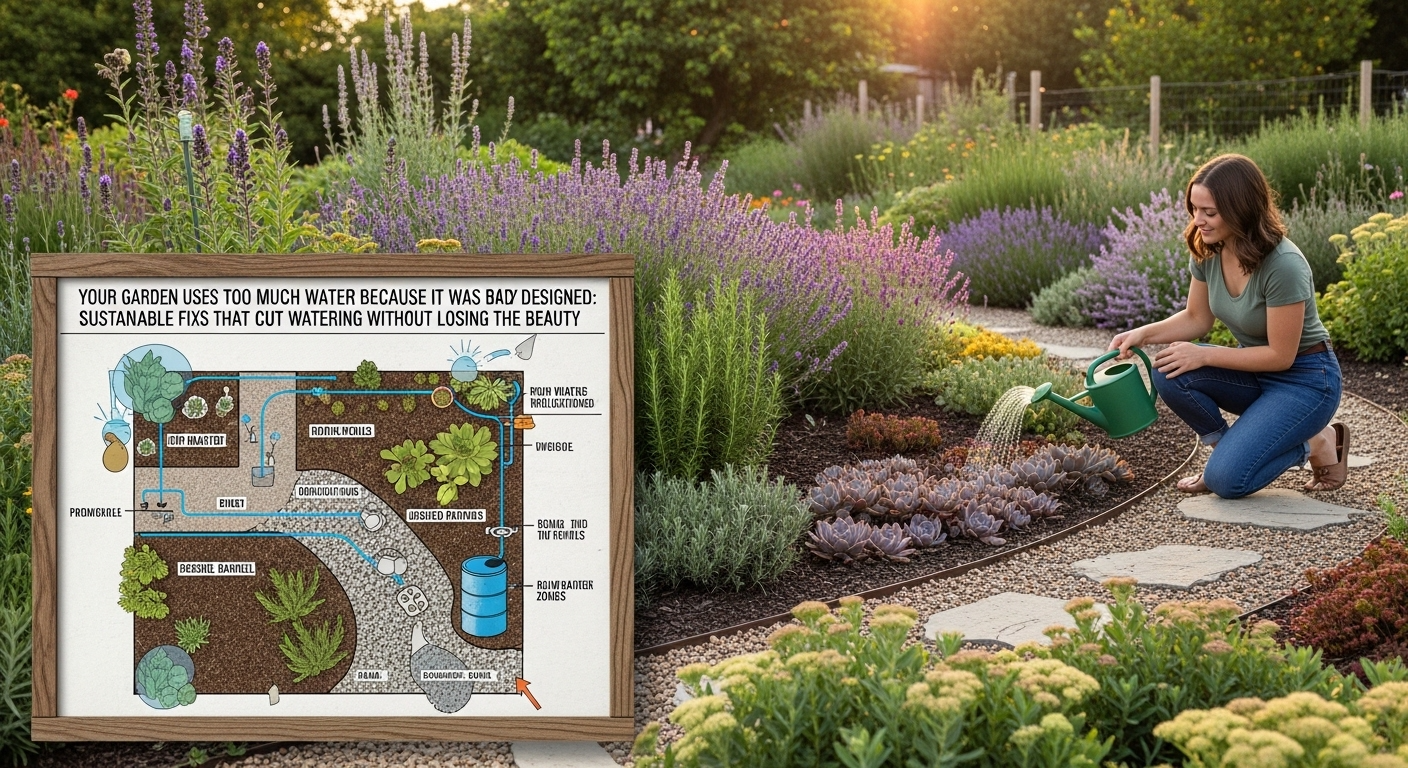
The solution is to design in what landscapers call hydrozones — areas grouped by water needs rather than by appearance alone. A high-water zone near the house can hold edibles, containers, and special showpieces you want to see every day. A moderate zone in the middle of the garden suits adaptable shrubs and perennials. An outer low-water zone handles tough natives, Mediterranean plants, and deep-rooted grasses that manage well on rainfall alone once established.
Nature also doesn’t plant in rows. Try designing beds in layers instead — a small tree or large shrub overhead providing shade and wind protection, flowering shrubs and tall perennials in the middle filling space and sheltering the soil, and low-growing ground-covering plants at the base keeping bare soil out of sight. These layered plantings create cooler, moister conditions where every drop of water stretches further.
Fix the Irrigation
Even a well-designed garden needs some supplemental watering, especially in its first few years. But irrigation works best as a precise tool, not a blunt one.
If you have an overhead sprinkler system, there’s a good chance it’s spraying water onto paths, fences, and furniture while evaporating in the heat before it even reaches the soil. Drip irrigation delivers water slowly and directly to the root zone of shrubs and trees. Soaker hoses snaked through dense plantings and covered with mulch do the same job in garden beds. Each zone can then be set to match the specific plants it serves.
Water deeply and infrequently rather than giving a light daily sprinkle. Shallow watering keeps roots near the surface where heat and wind do the most damage. Deep, less frequent watering encourages roots to explore cooler soil further down, making plants far more resilient between sessions.
And work with the weather rather than ignoring it. Turn off automatic timers after good rainfall. Adjust your watering frequency with the seasons — what a garden needs in midsummer is very different from what it needs in spring or autumn. Water early in the morning when evaporation is lowest.
How to Redesign Without Starting From Scratch
You don’t need to rip everything out. Sustainable landscaping works best as a gentle, ongoing edit rather than a full demolition.
Start by walking your garden and marking what really drinks — the parts that wilt first, demand constant attention, or feel like they’d collapse if you skipped two days in a heatwave. That’s where the design is failing you most. Is there a patch of lawn no one uses? A bed of annuals that needs daily pampering? Containers scattered so widely they’re impossible to water efficiently? Those are your priority areas.
Next, shrink the lawn to the areas you actually use. Replace the rest with mulched beds, permeable paths, or seating areas. Then reorganise your plants so those with similar water needs end up together. Move thirsty plants closer to your main water source. Cluster containers where they can share attention rather than demanding separate trips across the garden.
As you replant and adjust, feed the soil with compost and cover every bare patch with mulch. Then tune your irrigation to reflect the new arrangement — some zones will need dramatically less water, and others can be switched from sprinklers to drip lines.
Over time, what was once a garden held together by habit and hose becomes a place that mostly looks after itself. The lemon tree stops complaining. The water bill softens. And you find you spend less time rescuing plants and more time simply enjoying them.
Frequently Asked Questions
How long does a redesigned low-water garden take to establish? Most water-wise gardens need one to three growing seasons to fully establish. During that time they still need regular watering, especially during heat. After establishment you can gradually reduce frequency as plants develop deeper, more resilient roots.
Do I have to remove all my existing plants? No. Focus first on removing or relocating the thirstiest plants, especially those sitting in full sun far from a water source. Then gradually reorganise beds into hydrozones and add tougher companions alongside what you’re keeping.
Can I still have a lawn? Yes, if you reduce it to the areas you actually use — a play space, a small green frame around a patio, or a grass path between beds. Use drought-tolerant turf varieties where possible and improve the soil so the smaller area you keep is more efficient.
Can a low-water garden still have plenty of flowers? Absolutely. Many plants adapted to dry conditions are extraordinarily floriferous — salvias, yarrow, coneflowers, gaura, and many regional natives among them. Matching plants to your climate and grouping them well gives you colour through the seasons without constant watering.
What is the single most effective first step? Mulch and hydrozoning. Covering exposed soil and grouping plants by water need can immediately cut evaporation and overwatering. Even without changing your irrigation hardware, these two shifts will noticeably reduce your garden’s thirst and improve how your plants look and grow.