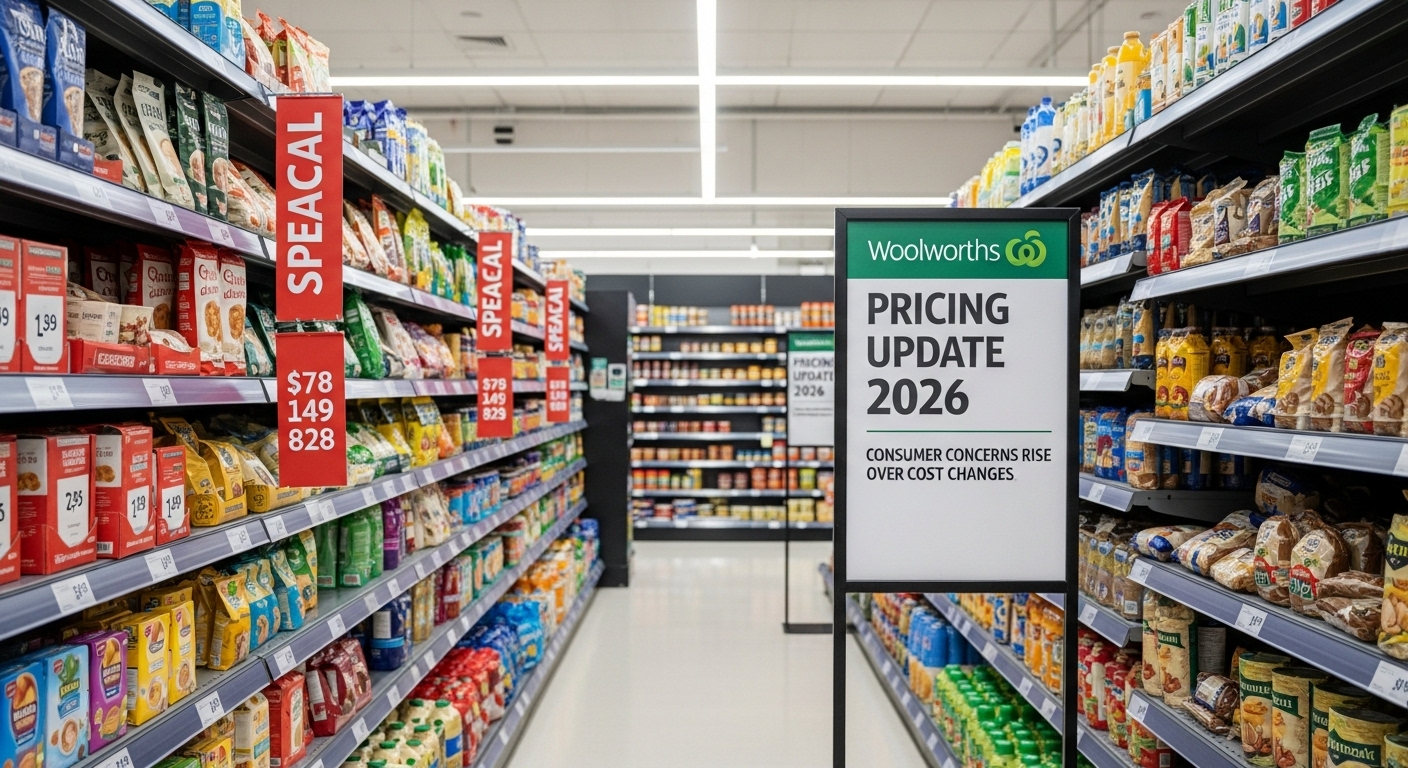
Woolworths Pricing Update 2026 — Consumer Concerns Rise Over Cost Changes
There is a specific kind of frustration that builds at the checkout. It is not the sharp shock of a single unexpected bill. It is the slow accumulation of weekly visits where the trolley looks roughly the same and the total keeps climbing. Where the packet that used to weigh 500 grams now weighs 440. Where the special that once felt like genuine value now requires squinting at the fine print. For many Australian households in 2026, that frustration has found a name and an address: Woolworths.
The supermarket chain is once again at the centre of public criticism over grocery costs, and what is driving the renewed pressure is not one specific controversy. It is the compounding weight of ordinary shopping experiences that no longer feel ordinary because the financial context around them has changed so substantially.
Why Woolworths Is Bearing the Brunt
Woolworths is not the only Australian supermarket facing consumer frustration, and it is not operating in isolation from the global supply dynamics that have pushed food costs higher across every developed economy. But its size makes it visible in a way that smaller retailers are not, and visibility in a cost-of-living crisis attracts scrutiny that might otherwise be diffused across the market.
The specific grievances circulating in consumer groups, community forums, and social media share several consistent themes. Food prices have increased faster than incomes, with Australian Bureau of Statistics data showing that food costs remain significantly elevated above pre-pandemic levels even as inflation has moderated in other categories. The weekly grocery budget buys less than it did two years ago, and the gap between what a trolley used to cost and what it costs now has become a regular feature of household financial conversations.
Shrinkflation has become one of the most emotionally charged elements of the current consumer frustration. The practice of reducing package sizes without proportionally reducing prices is legal when correctly labelled, but consumer advocates argue that it undermines trust in a way that straightforward price increases do not. When a product that appeared to be the same price as last year turns out to contain less, the shopper feels the difference not as a disclosed business decision but as a quiet deception. Snacks, cereals, and pantry staples are the most commonly cited categories, and the changes are frequently small enough to go unnoticed until the packet is already in the kitchen.
Promotional structures that no longer feel generous contribute to the same erosion of trust. Deals that are more targeted, less broadly applicable, and harder to identify as genuine savings leave shoppers feeling that the value proposition they associated with their regular supermarket has quietly shifted.
The Voices Behind the Numbers
Rachel, a parent of two in Brisbane, describes her experience of her regular store with a directness that captures what is happening in households across the country. Her weekly shop looks familiar but produces a total that no longer feels proportionate to what is in the trolley. Her frustration is not primarily with any specific product or pricing decision. It is with the cumulative experience of a shopping ritual that used to feel manageable and no longer does.
Her experience is not unusual. The pattern she describes, more money for the same or less, is the defining grocery experience of the current period for a significant portion of Australian shoppers, and it is landing most visibly on the country’s largest supermarket chain precisely because of its presence in nearly every suburb and town.
Retail analysts observe that the issue is as much about trust as about price. “When people stop trusting the checkout, they start shopping differently — or elsewhere,” noted one analyst. Consumer price consciousness has reached a level where small, repeated increases that might previously have passed without comment now feel intentional and accumulated. The tolerance for ambiguity about value has decreased sharply.
Woolworths’ Position and Response
Woolworths Group has responded to the criticism with consistent messaging that positions the company as managing rather than driving the cost pressures affecting consumers. Company representatives have pointed to increased home-brand and low-cost options, price freezes on specific essential categories, supplier cost pressures that operate independently of retail decisions, and supply chain efficiency investments designed to limit the pass-through of wholesale cost increases.
A company spokesperson described Woolworths as “acutely aware of household pressures” and committed to affordability as an ongoing priority. The substance of this position is not entirely without foundation. Global food supply chains have experienced genuine cost pressures that Australian supermarkets cannot unilaterally absorb, and the company’s home-brand range does provide price points below equivalent branded products in many categories.
But retail analysts argue that the credibility of this messaging has eroded alongside consumer trust. The combination of sustained price increases, shrinkflation, and strong profit results creates a narrative that is difficult to counter with affordability messaging alone, regardless of the operational reality behind it. When consumers feel the gap between a company’s stated priorities and their experienced reality, the messaging amplifies rather than reduces the frustration.
How Consumer Behaviour Is Shifting
The sustained pressure has produced visible and measurable changes in how many Australians shop for groceries. The shifts represent a meaningful structural change in retail behaviour rather than a temporary reaction that will reverse when the cost-of-living environment improves.
Switching between supermarkets has become significantly more common. Shopper loyalty that once produced predictable weekly visits to a preferred store has weakened substantially, with many consumers now treating the weekly grocery run as a comparative exercise rather than a habitual one. Budget retailers and independent grocers are benefiting from this shift.
Branded products are losing ground to home-brand and private-label alternatives at a rate that is accelerating. Consumers who previously chose branded products out of habit or perceived quality are now making active value calculations that frequently favour the lower-cost alternative, particularly in staple categories where the quality difference is minimal.
Unit price comparison, once the domain of highly engaged shoppers, has become mainstream. More consumers are checking price per 100 grams, per unit, or per litre rather than relying on pack size and total price as value indicators, a behaviour change that makes shrinkflation more visible and more frustrating when identified.
What This Means for Australian Supermarkets in 2026
The environment facing major supermarkets in 2026 is structurally different from the one they operated in before the cost-of-living crisis began. Price sensitivity has increased, scrutiny has intensified, and the tolerance for practices that feel unfair has decreased substantially.
Even minor pricing decisions that might previously have generated minimal attention now trigger responses that amplify rapidly through social media and consumer communities. The asymmetry between the size of a pricing change and the scale of the reaction it can produce has shifted, and supermarkets are navigating a public relations environment that is more volatile than it has been in recent memory.
Competition from discount chains and independent retailers is applying margin pressure that did not exist at the same intensity five years ago. The consumer who leaves a major chain does not always return, and the loyalty that major supermarkets built over decades through reward programs, convenience, and range has proven less durable under sustained cost pressure than the companies might have expected.
Frequently Asked Questions
Are grocery prices still rising at Woolworths? Some categories have stabilised while others remain elevated relative to pre-pandemic levels. The overall trajectory has been higher costs for most staple categories, with modest moderation in some areas but no broad return to previous price levels.
Is shrinkflation legal? Yes, when correctly labelled with updated unit weights. However, consumer advocates argue that the practice undermines trust because the changes are easy to miss at the point of purchase, creating a perception of deception even when the disclosure requirements are technically met.
Are home-brand products a reliable way to reduce grocery costs? Often, but not universally. Home-brand products in staple categories typically offer meaningful savings relative to branded equivalents, but quality varies by product and retailer. Comparing unit prices rather than pack prices provides the most reliable basis for value assessment.
Is switching supermarkets worth the effort? Many shoppers who have made the switch report meaningful savings on comparable baskets, particularly for staple categories where the quality difference between retailers is minimal. The time cost of comparing stores needs to be weighed against the financial benefit, which varies significantly by household spending level.
Why does Woolworths attract more criticism than smaller retailers? Scale creates visibility. As one of Australia’s largest supermarket chains with stores in most communities, Woolworths is the most common daily experience of grocery pricing for millions of Australians. The same practices that generate limited attention at a smaller retailer produce significantly more public discussion when they are associated with a company of this size and reach.