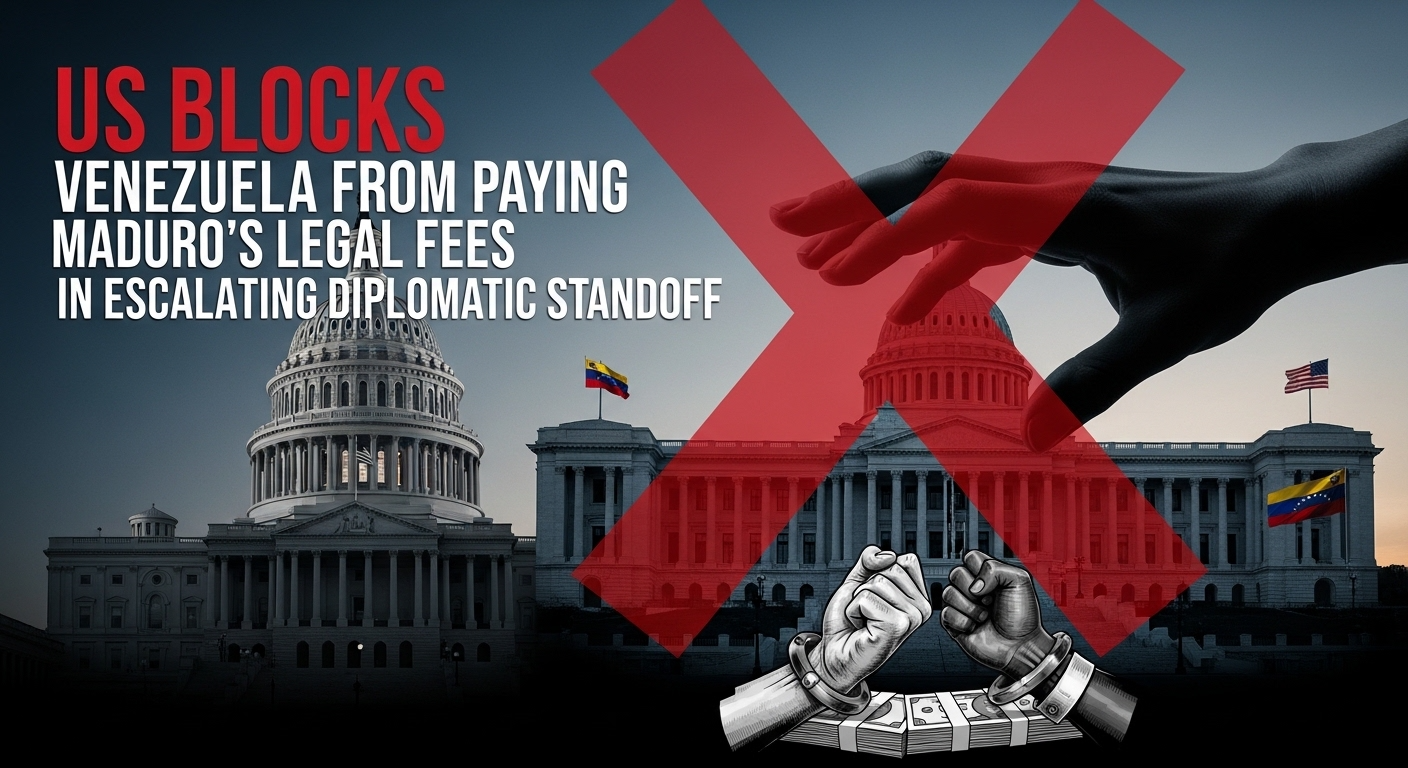
US Blocks Venezuela From Paying Maduro’s Legal Fees in Escalating Diplomatic Standoff
A dispute over unpaid legal fees has added a sharp new dimension to the already tense standoff between the United States and Venezuela. Nicolas Maduro’s lawyer has publicly accused Washington of blocking his client’s ability to pay for legal representation in international proceedings.
It is a development that sounds technical on the surface. But it points to something much larger: the use of financial sanctions as a tool of legal warfare in modern geopolitical conflicts.
What Maduro’s Lawyer Has Claimed
Femi Falana, acting as legal counsel for Venezuelan President Nicolas Maduro, has stated that US sanctions have made it virtually impossible for Venezuela to settle outstanding legal fees owed to lawyers representing the country in international tribunals.
Falana’s accusation is direct: Washington is not just targeting Venezuela’s economy. It is targeting the country’s ability to defend itself legally on the world stage.
The Sanctions Behind the Blockage
The United States has imposed a series of sweeping measures on Venezuela over recent years, targeting government finances, the state oil company PDVSA, and Venezuelan access to global financial systems.
Those sanctions have been broad enough to affect even routine transactions. Paying legal fees to international counsel has reportedly become one of the casualties of that financial isolation.
Key Dates in the Venezuela Crisis
| Date | Event |
|---|---|
| January 2019 | Juan Guaido declares himself interim president, challenging Maduro’s legitimacy |
| January 2019 | The United States and dozens of allies formally recognise Guaido as Venezuela’s president |
| March 2019 | US imposes sanctions on PDVSA, Venezuela’s state oil company |
| August 2019 | Trump administration bans all US business dealings with the Maduro government |
| 2022 onwards | Sanctions regime continues under successive administrations with periodic adjustments |
The timeline shows how the sanctions architecture was built layer by layer, progressively cutting Venezuela off from international financial access.
A Battle Over Legitimacy, Not Just Money
The legal fee dispute cannot be separated from the deeper question at the centre of Venezuela’s crisis: who is the legitimate government. The United States recognises the opposition, while Maduro retains power on the ground with backing from Russia and China.
By preventing Maduro from funding his legal defence in international courts, analysts argue the US is pursuing a strategy of delegitimisation through financial means, not just diplomatic ones.
Key Players in the Dispute
| Person | Role |
|---|---|
| Nicolas Maduro | Current Venezuelan president, whose legitimacy is disputed by the US and its allies |
| Juan Guaido | Opposition leader recognised as interim president by the United States and partner nations |
| Femi Falana | Maduro’s lawyer, who has publicly accused the US of blocking Venezuela’s legal fee payments |
| Donald Trump | Former US president who initiated recognition of Guaido and tightened the sanctions framework |
Each of these figures represents a competing claim on Venezuela’s political and legal identity, and the legal fee dispute puts all of those tensions into sharp relief.
Sanctions as Legal Warfare
International law experts have raised concerns about what this case represents beyond Venezuela itself. When sanctions are broad enough to prevent a country from accessing legal representation, the line between economic pressure and legal warfare becomes blurred.
The worry is that this sets a precedent other nations could exploit, using financial restrictions to deny adversaries the ability to mount any kind of legal challenge in international forums.
The Human Cost That Gets Overlooked
Behind the geopolitical headlines, there is a human dimension that rarely receives attention. The lawyers representing Venezuela in international proceedings have gone unpaid for their professional work, creating real financial hardship for individuals caught between two governments.
For ordinary Venezuelans, the cascading effects of sanctions have been severe. Food, medicine, and basic goods have all been affected by the country’s inability to access global financial markets, and the legal fee dispute is one small symptom of a much larger problem.
Why This Case Matters Beyond Venezuela
Venezuela is not the only country navigating life under US financial sanctions. Nations including Iran, Cuba, North Korea, and Russia all operate under various layers of American economic restrictions that affect their ability to function in international legal and financial systems.
The Maduro legal fee case raises questions about whether sanctions regimes should carry any carve-outs for access to legal representation, a principle that most domestic legal systems treat as fundamental.
Washington’s Strategic Calculation
From Washington’s perspective, the logic is straightforward. Every legal battle Maduro wins in an international tribunal strengthens his claim to legitimacy. Denying him the resources to pursue those battles is part of the broader effort to keep political pressure on his government.
Critics argue this approach carries significant long-term risks to international legal norms. If powerful nations can selectively block legal access through financial sanctions, the integrity of international legal institutions becomes harder to defend.
Frequently Asked Questions
Why is the US blocking Venezuela from paying legal fees? The US sanctions regime has cut Venezuela off from international financial systems so comprehensively that even routine transactions like paying legal counsel have become blocked. Maduro’s lawyer argues this is deliberate, aimed at preventing Venezuela from mounting effective legal defences in international tribunals.
What are the US sanctions on Venezuela actually targeting? The sanctions target a wide range of Venezuelan government activities, including the state oil company PDVSA, senior government officials, and access to US dollar-denominated financial systems. The cumulative effect is near-total financial isolation from Western banking infrastructure.
Who is Juan Guaido and why does he matter here? Guaido is the Venezuelan opposition leader whom the United States recognised as the country’s legitimate interim president in 2019. That recognition is the foundation of the broader dispute, since it frames Maduro’s government as illegitimate and justifies the sanctions architecture designed to undermine it.
Is blocking legal fee payments considered legal under international law? This is contested. Legal scholars have noted that access to legal representation is a broadly recognised principle, and applying sanctions broadly enough to deny that access raises serious questions about compliance with international legal norms, even if it is technically permitted under US domestic law.
What impact have sanctions had on ordinary Venezuelans? The impact has been severe. Widespread shortages of food, medicine, and essential goods have been directly linked to Venezuela’s inability to access international markets and financial systems. The legal fee dispute is a high-profile example of a problem that affects millions of people at a much more basic level.
Could this dispute affect how other countries use sanctions in future? Experts believe it could. If the US approach of using sanctions to deny legal access to adversarial governments is seen to work, it may encourage other powerful nations to adopt similar tactics, potentially degrading the independence and credibility of international legal institutions over time.
How is this situation likely to be resolved? Resolution is tied directly to the broader Venezuela political crisis. Unless there is a fundamental shift in the US-Venezuela relationship or a negotiated sanctions framework, Venezuela’s access to international legal funding is likely to remain constrained for the foreseeable future.
Conclusion
The dispute over Maduro’s legal fees may look like a footnote to a much bigger story. But it captures something important about how geopolitical conflict has evolved in the modern era.
Sanctions are no longer just economic tools. They have become instruments of legal and institutional warfare, capable of preventing governments from exercising rights that most legal systems treat as fundamental. That shift carries implications well beyond Venezuela.
As international institutions and legal scholars watch this case develop, the precedent being set in Caracas may ultimately matter as much in Brussels, Beijing, and Canberra as it does in Washington.
Read more: https://wizemind.com.au/