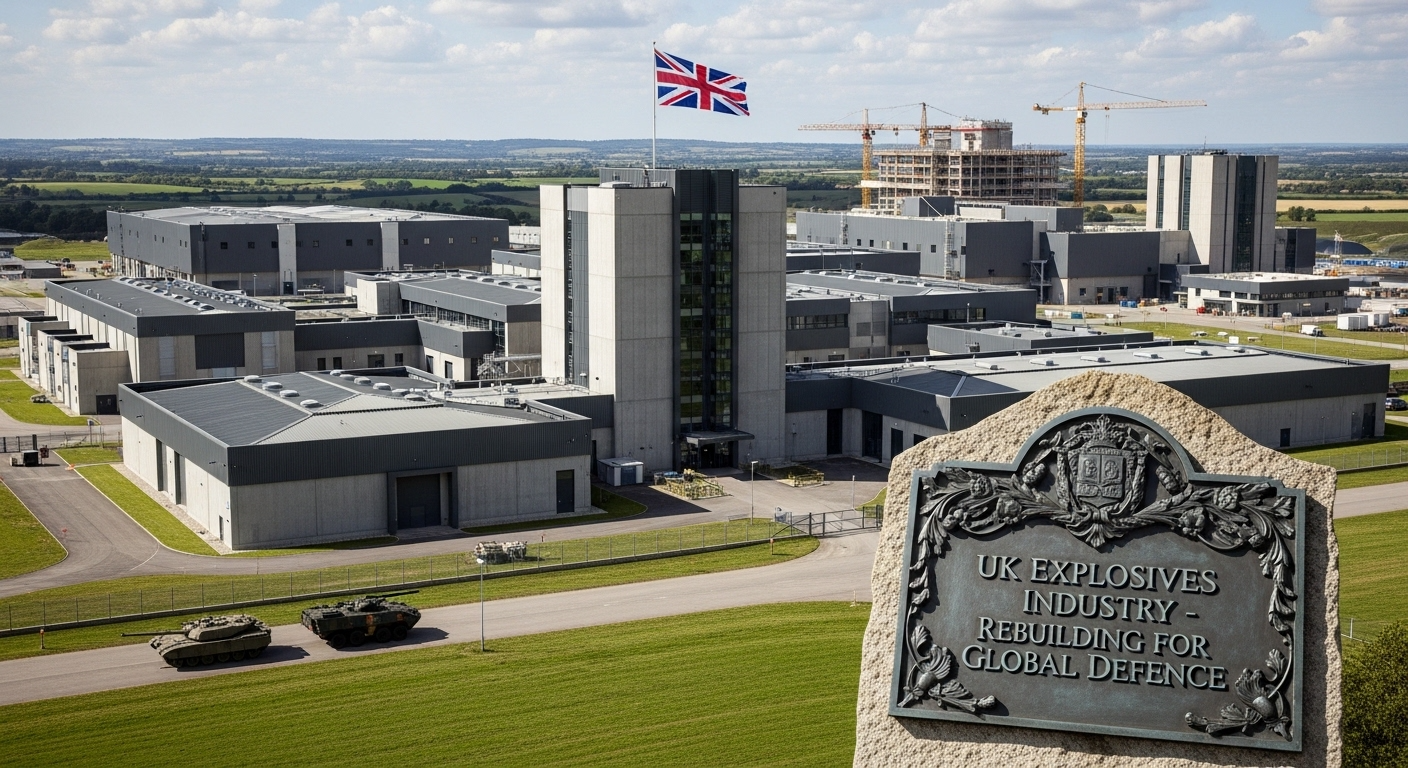
UK Injects £1.7 Billion to Rebuild Its Explosives Industry: What It Means for Global Defence
The United Kingdom has made one of its boldest defence investment decisions in decades. A £1.7 billion commitment to rebuild the country’s explosives production capacity signals a fundamental shift in British security strategy after years of gradual disarmament.
This is not a minor procurement announcement. It represents a deliberate and dramatic reversal of a two-decade trend that saw much of the UK explosives sector dismantled or outsourced to foreign suppliers.
Why Britain Is Rebuilding Its Explosives Capacity
The decision reflects a stark reassessment of global security risks and supply chain vulnerabilities. Years of conflict in Ukraine have exposed how quickly munitions stockpiles can be depleted and how difficult resupply becomes when domestic production capacity no longer exists.
Britain found itself dangerously dependent on foreign suppliers for critical defence materials. The £1.7 billion investment is designed to correct that vulnerability by establishing a dense domestic network of production facilities across the country.
What the £1.7 Billion Will Actually Fund
The investment targets construction of new explosives production facilities strategically positioned across the UK to create a resilient and redundant supply chain. No single facility failure will be able to disrupt the entire network.
Drone production facilities in Plymouth and Swindon are also part of the package, reflecting the growing role of unmanned systems in modern conflict. The investment covers both traditional energetics and the next generation of autonomous weapons technology.
The Scale of What Was Lost
Over the past two decades, Britain systematically reduced its domestic arms manufacturing capacity in the belief that global supply chains and allied partners could meet defence needs. That assumption has been tested severely by recent geopolitical events.
Expertise, infrastructure, and industrial knowledge once lost takes years to rebuild. The £1.7 billion is not just buying facilities. It is buying back the institutional and industrial capability that was allowed to atrophy during a period of relative peace.
UK vs France: Two Very Different Paths
The contrast with France is instructive and telling. While Britain reduced its defence industrial base through the 2000s and 2010s, France maintained consistent investment in its arms manufacturing sector as a deliberate strategic priority.
France treated its defence industry as a national asset to be protected regardless of short-term cost pressures. Britain is now spending significantly more to rebuild what France never allowed to decline in the first place.
Comparison: UK and France Defence Industry Approaches
| Factor | United Kingdom | France |
|---|---|---|
| Recent investment trajectory | Sharp reduction then reversal | Consistent sustained investment |
| Domestic production capacity | Significantly reduced, now rebuilding | Maintained at strategic level |
| New commitment | £1.7 billion announced | Ongoing steady allocation |
| Drone integration | New facilities in Plymouth and Swindon | Already embedded in defence structure |
| Strategic philosophy | Rebuilding after disarmament | Never fully disarmed |
The table highlights a fundamental philosophical difference between two of Europe’s major military powers and the very different costs associated with each approach over time.
The Drone Component Changes the Strategic Picture
New drone production facilities represent more than a manufacturing decision. They signal that Britain is integrating unmanned systems into its core defence infrastructure rather than treating them as supplementary technology.
The Plymouth and Swindon facilities will produce unmanned aerial systems designed for both reconnaissance and strike roles. As conflicts in Ukraine and the Middle East have demonstrated, drone capability has become as strategically important as conventional munitions.
Economic Impact Across British Regions
Thousands of jobs are expected to be created directly and indirectly through the new production network. Defence manufacturing jobs tend to be high-skill, well-paid, and difficult to offshore, making them particularly valuable to regional economies.
Communities hosting the new facilities will see significant economic activity from construction, operation, and supply chain development. For regions that have seen industrial decline over previous decades, defence investment of this scale represents a meaningful economic intervention.
The Risks and Trade-Offs
Expanding the arms industry is not without controversy. Diverting £1.7 billion toward defence production raises legitimate questions about opportunity costs in healthcare, education, and infrastructure investment.
Environmental concerns around explosives manufacturing are also significant. Production facilities of this kind carry risks to local ecosystems and communities that require robust regulatory oversight and transparent public engagement throughout the planning and construction process.
Geopolitical Implications for Britain’s Alliances
Rebuilding domestic explosives capacity strengthens Britain’s position within NATO by reducing its dependence on allied suppliers during high-intensity conflict scenarios. Self-sufficiency in munitions is increasingly valued among alliance members who watched stockpiles drain during the Ukraine conflict.
However, the shift toward a more assertive defence industrial posture may also create friction with nations that have prioritised disarmament and arms control frameworks. Britain will need to manage those diplomatic relationships carefully alongside its rearmament programme.
What Governance Frameworks Are Needed
International law and human rights standards must govern how new drone capabilities are deployed, not just how they are manufactured. The legal framework around autonomous weapons systems remains contested and underdeveloped relative to how quickly the technology is advancing.
Robust parliamentary and independent oversight of both the spending programme and the eventual deployment of new capabilities will be essential to maintaining public trust and legal compliance throughout what is a genuinely unprecedented domestic rearmament effort.
Frequently Asked Questions
Why is the UK investing £1.7 billion in explosives production right now? Years of supply chain vulnerability and lessons from the Ukraine conflict have forced a reassessment of Britain’s dependence on foreign suppliers for critical defence materials. The investment aims to restore domestic production capacity that was systematically reduced over the past two decades.
What exactly will the money be spent on? The investment covers construction of new explosives production facilities across the UK as well as new drone manufacturing sites in Plymouth and Swindon. Both traditional energetics and unmanned systems technology are included in the programme.
How many jobs will the investment create? Thousands of direct and indirect jobs are expected to be created across the regions hosting new facilities. Defence manufacturing roles tend to be high-skill and well-paying, providing meaningful long-term employment rather than temporary construction work alone.
Why did Britain reduce its explosives capacity in the first place? Post-Cold War assumptions about reduced global conflict risk led successive governments to reduce defence industrial investment and rely more heavily on allied suppliers and global procurement. Recent events have demonstrated the strategic error of that approach.
How does Britain’s approach compare to France? France maintained consistent investment in its defence industrial base throughout the period when Britain was reducing its own. Britain is now spending significantly to rebuild what France never allowed to decline, making the French approach look considerably more cost-effective in retrospect.
What are the drone facilities in Plymouth and Swindon designed to produce? The facilities will produce unmanned aerial systems for both reconnaissance and strike roles. The inclusion of drone production alongside explosives reflects how central autonomous systems have become to modern military capability and planning.
What ethical concerns surround the expansion of the explosives industry? Environmental impact, community risk, and the diversion of public funds from civilian needs are the primary ethical concerns raised by critics. Robust regulatory oversight and transparent public engagement are considered essential to managing those concerns responsibly.
Will the investment affect Britain’s relationships with other countries? It could create friction with nations that prioritise arms control and disarmament frameworks while strengthening Britain’s position within NATO. Managing those competing diplomatic considerations will require careful handling alongside the industrial programme.
How will drone deployment be governed under international law? The legal framework around autonomous weapons systems is still developing relative to the speed of technological advancement. Britain will need to develop robust governance frameworks to ensure drone deployment meets international humanitarian law requirements.
Is this investment a permanent shift in British defence strategy? All indications suggest it represents a lasting change in how Britain views domestic defence industrial capacity. The lessons of supply chain dependency learned through recent conflicts are unlikely to be forgotten quickly by those responsible for national security planning.
Conclusion
Britain’s £1.7 billion investment in explosives and drone production is one of the most significant defence industrial decisions the country has made in a generation. It acknowledges directly that the assumption of reliable foreign supply chains was a strategic mistake that cannot be repeated.
The economic benefits, regional jobs, and restored self-sufficiency are genuine advantages. The environmental, ethical, and diplomatic trade-offs are equally real and require careful management rather than dismissal.
As global tensions remain elevated and munitions demand continues, Britain’s decision to rebuild its own production capacity is likely to look increasingly sensible with each passing year. The question now is how quickly and how responsibly the new facilities can be brought online.