Turkey Makes Aviation History — First Drone to Shoot Down a Moving Supersonic Target
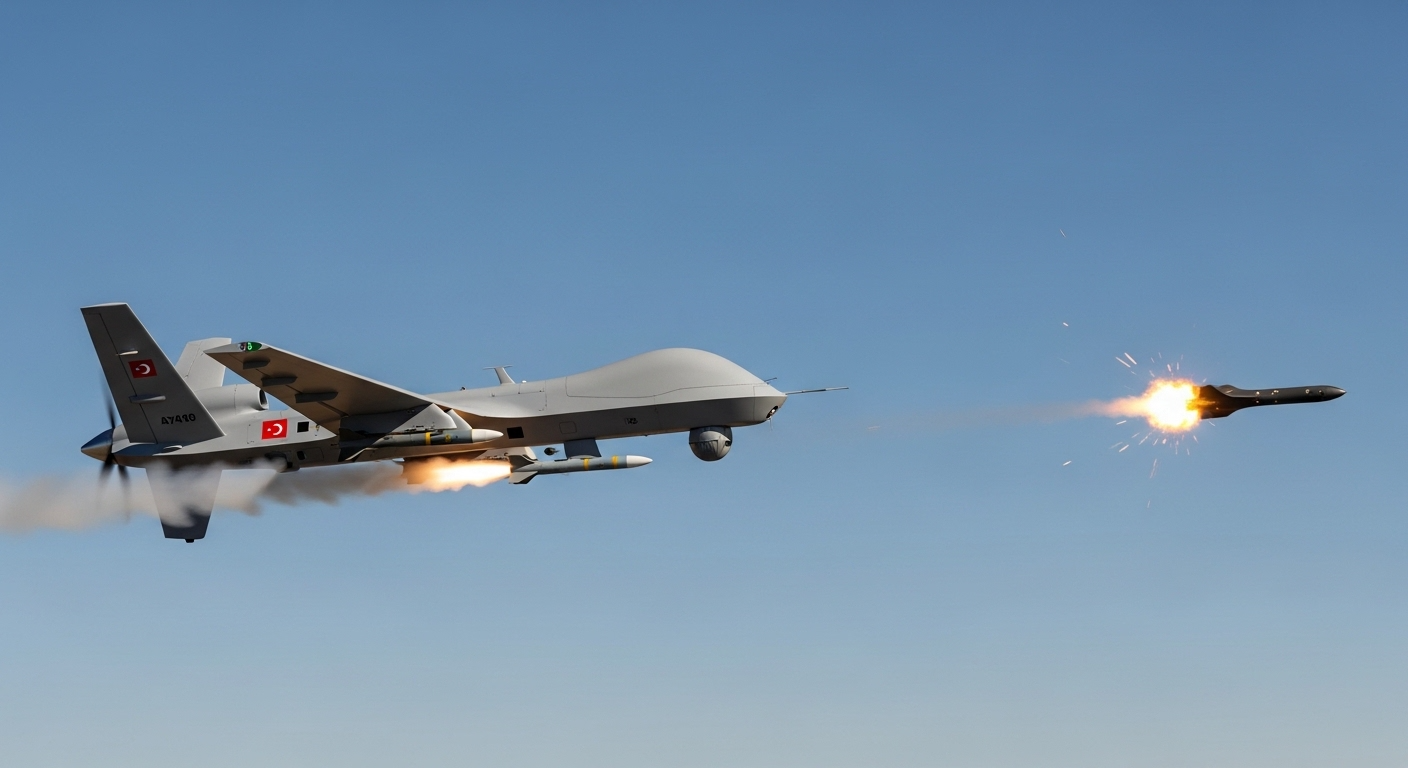
Something shifted in the history of aerial warfare near a stretch of Turkish coastline, and most of the world did not notice it happening. No pilot climbed into a cockpit. No human hand moved a joystick. Near the city of Sinop on the Black Sea coast, an unmanned aircraft detected a supersonic target moving at speeds that would challenge the fastest fighter jets ever built, calculated an interception, and destroyed it. From detection to missile launch, every decision was made by a machine.
Turkey’s Bayraktar Kizilelma drone has become the first combat drone in history to autonomously shoot down a moving supersonic target. The implications of that sentence extend far beyond one test, one coastline, and one country.
What Actually Happened at Sinop
The test was deliberately chosen for its difficulty. A supersonic target drone does not forgive hesitation or imprecision. It moves faster than most human reaction times can meaningfully process, and hitting it requires predicting where it will be rather than responding to where it is. The window between detection and the last possible moment to fire is measured in fractions of seconds.
The Bayraktar Kizilelma handled all of it without human input. Its onboard AI system tracked the target in real time, calculated the optimal interception point, adjusted the missile’s trajectory continuously as both aircraft moved, and determined the precise moment to fire. The missile connected. The target was destroyed. The entire engagement, from first detection to confirmed hit, unfolded autonomously.
Turkey’s military has been developing next-generation unmanned aerial vehicles at Sinop for years, and the Bayraktar Kizilelma represents the leading edge of that program. But this test was not simply a demonstration of hardware capability. It was a demonstration that AI can now perform one of the most demanding tasks in aerial combat without a human in the decision chain at any point.
The Aircraft Behind the Achievement
The Bayraktar Kizilelma is not the small, propeller-driven surveillance drone that most people picture when they hear the word drone. It weighs over six tonnes, operates at jet speeds, and is designed to perform missions that were previously exclusive to manned fighter aircraft. Air superiority, interception, and precision ground strikes are all within its designed capability envelope.
Developed by Turkish defence company Baykar, the same organisation behind the Bayraktar TB2 drones that gained global attention during conflicts in Ukraine and elsewhere, the Kizilelma represents a generational leap beyond its predecessors. Where the TB2 operated at low speeds and required human operators for targeting decisions, the Kizilelma operates autonomously at speeds and altitudes that place it in direct competition with conventional fighter jets.
Its sensor architecture is one of the reasons the autonomous engagement was possible. The AESA radar, an Active Electronically Scanned Array system, can track multiple targets simultaneously even in environments cluttered with interference, and it does so with a precision that older radar systems cannot match. This is combined with sensor fusion technology that integrates radar data with infrared and optical inputs, giving the aircraft a layered, continuously updated picture of its surroundings. The drone does not rely on any single sensor. It synthesises all of them simultaneously, producing situational awareness that is in some respects more complete than what a human pilot inside a cockpit can achieve.
The AI System That Made the Decision
At the centre of everything that happened near Sinop is an artificial intelligence system that performed a task human pilots train for years to execute, and did it in the time it takes to exhale.
Engaging a supersonic target is not a matter of pointing a weapon and firing. The target is not where you see it. It is where the physics of its current trajectory will place it by the time your missile reaches that point in space. The calculation requires knowing the target’s current speed and heading, projecting its likely movements, accounting for the missile’s own flight characteristics, and identifying a launch window that gives the weapon enough time and angle to intercept successfully.
Human pilots with thousands of flight hours develop the instincts to perform this calculation under pressure. The Kizilelma’s AI system performs it computationally, at a speed that removes the concept of pressure entirely. There is no hesitation, no adrenaline, no narrowing of attention under stress. The calculation happens, the launch window is identified, and the missile fires.
This is not merely faster than a human pilot. It is a fundamentally different kind of decision-making process, one that does not degrade under the conditions that make aerial combat so psychologically and physically demanding for humans.
What This Changes About Air Combat
The implications of a fully autonomous combat drone successfully engaging a supersonic target reach into virtually every aspect of how militaries think about aerial warfare.
| Factor | Manned Fighter Aircraft | Autonomous Combat Drone |
|---|---|---|
| Pilot training requirement | Years of intensive training | Not required |
| Risk to human life | High in combat scenarios | Eliminated for the drone operator |
| Reaction speed | Limited by human physiology | Determined by processing speed |
| Operational endurance | Limited by pilot fatigue | Limited by fuel and systems only |
| Unit cost | Extremely high | Significantly lower |
| Scalability | Constrained by pilot supply | Potentially unlimited |
| Ethical oversight | Inherent in human decision-making | Requires deliberate design |
Manned fighter jets are extraordinarily expensive to build, operate, and maintain. Training a combat pilot to a level of proficiency suitable for air-to-air engagements takes years and costs millions. Losing a pilot is a human tragedy and a strategic setback simultaneously. Autonomous combat drones eliminate the human risk entirely and reduce the cost and training barriers substantially.
The more consequential shift, however, is in how conflicts might be waged. A military with a large fleet of autonomous combat drones can sustain aerial operations at a pace and scale that a pilot-dependent air force cannot match. Drones do not experience fatigue, do not require rest cycles, and can be risked in situations where sending a human pilot would be unacceptable. The calculus of aerial engagement changes fundamentally when one side is making decisions in milliseconds and the other is measured by the physical and psychological limits of human performance.
The Global Response
Turkey’s achievement has not gone unnoticed in defence ministries around the world. The United States, Russia, China, and the major European military powers all have autonomous weapons development programs, and Turkey’s successful test provides both a benchmark and an accelerant for those efforts.
For smaller nations, the strategic implications are arguably more significant. Advanced autonomous combat capability has historically required the industrial and financial resources of major powers. If platforms like the Kizilelma demonstrate that effective autonomous air combat capability can be achieved at substantially lower cost than traditional manned aircraft programs, the distribution of air power globally could shift in ways that reshape regional security balances.
NATO is watching closely. The alliance’s air defence architecture has been built around manned aircraft operating within defined command and control structures. Integrating autonomous combat systems into that architecture raises questions about interoperability, rules of engagement, and the conditions under which autonomous weapons are authorised to engage that have not yet been fully resolved at the alliance level.
The Ethical Dimension That Cannot Be Avoided
The same capabilities that make the Kizilelma’s achievement so significant from a military perspective make it genuinely troubling from an ethical one, and treating those concerns as secondary to the technical accomplishment would be a mistake.
When a human pilot decides to fire a weapon, that decision carries with it everything that makes the person human. Experience, judgment, the weight of consequence, and the knowledge that the action cannot be undone. When an AI system makes the same decision, none of that is present. The system executes against its programming. Whether its programming adequately captures the complexity of the situations it will encounter in real conflict is a question that no test over a controlled range can fully answer.
International organisations and governments are already engaged in contested debates about how autonomous weapons should be regulated. Some argue for meaningful human control requirements, where a human must be in the decision loop for any lethal engagement. Others contend that the speed of modern combat makes such requirements operationally unworkable. The gap between those positions has not narrowed, and Turkey’s test has made the conversation more urgent rather than easier.
The question is not whether autonomous weapons will become a feature of future conflict. Turkey’s test near Sinop makes clear they already are. The question is what rules, if any, will govern how they are used.
Conclusion
Turkey’s successful autonomous engagement of a supersonic target near Sinop is a genuine historical milestone in military aviation. It is the clearest demonstration yet that artificial intelligence has crossed a threshold in aerial combat capability, moving from supporting human decision-making to replacing it entirely in one of the most demanding engagement scenarios that exists.
The Bayraktar Kizilelma will not be the last autonomous combat platform to demonstrate this capability. Other nations will follow, some quickly. The technology will spread, improve, and find its way into operational use in conflicts that are not controlled tests over friendly coastlines. The military advantages are real and significant. The ethical questions are equally real and considerably less resolved. Both deserve the seriousness the moment demands.
For more science, technology, and global affairs coverage, visit wizemind.com.au