This Chinese Aircraft Is Not “Just Any Plane” — For 10 Years It Has Been the Backbone of Beijing’s Antarctic Logistics
The wind hits you first. Hard and horizontal, like a shove from an invisible hand. Snow stings any exposed skin. The world is white and blinding. And then, out of that frozen nowhere, a dark shape appears low in the sky, engines growling against the roar of the Antarctic plateau. Chinese researchers at Kunlun Station lift their heads. They know that sound. For a decade, it has meant one thing: their lifeline is arriving.
The Workhorse That Was Never Meant for the End of the World
On paper, the Xueying-601 does not sound like a legend. It is not a cutting-edge jet or a sleek passenger aircraft. It began life as a Basler BT-67, itself a heavily modernized version of the Douglas DC-3, an airframe design that first flew in the 1930s when world maps still had pale patches labeled “Unknown.”
Yet this turboprop-powered classic has become something extraordinary in the most unforgiving place on Earth. For ten years it has been the quiet backbone of China’s Antarctic logistics — a tough, slow, and stubbornly reliable aircraft threading its way between ice runways, snowfields, and remote outposts where temperatures can drop below minus 70 degrees Celsius.
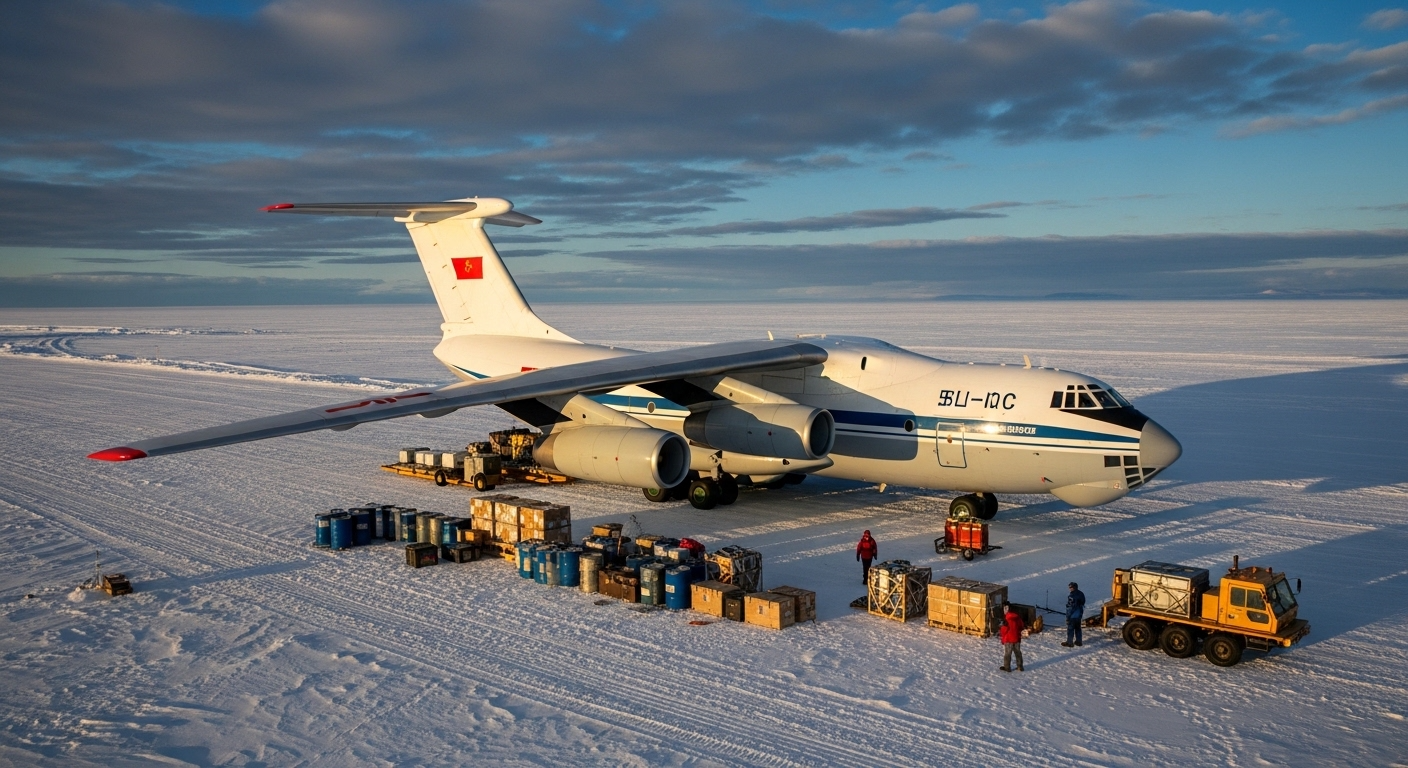
Stand beside it on the ice and what you notice first is not sleekness but purpose. The fuselage is thick-bodied. The nose is blunt. The wings are straight and workmanlike. The reinforced skis, scuffed from countless landings, look like snowshoes on the landing gear. Bright Chinese characters and the red flag stand out sharply against the white surroundings, as if the aircraft itself were a moving declaration: we are here, and we belong in this blank space.
Its official name, Xueying-601, translates to “Snow Eagle.” The name carries a hint of drama that the aircraft itself never flaunts. The Snow Eagle is built for hauling fuel, food, scientific instruments, and people across a continent larger than Europe. In Antarctica, glamour does not keep engines from freezing. What matters is whether the aircraft will start, fly, land, and do it all again tomorrow.
The Quiet Making of a Polar Strategy
To understand why this one aircraft matters so much, you have to look at a map of Antarctica. Each research station is a bet placed on a future in which polar data is power: climate models, sea-level predictions, mineral surveys, and scientific prestige.
China’s presence on the ice has grown steadily since its first Antarctic expedition in the 1980s. Today it operates several permanent stations including Zhongshan on the coast, Taishan in the interior, and Kunlun near Dome A, one of the coldest, highest, and most remote places scientists have ever tried to work.
Kunlun sits over 4,000 meters above sea level on the East Antarctic plateau. Reaching it is a logistical nightmare. For years, Chinese teams relied on long overland convoys, tractors and sleds crawling more than 1,200 kilometers across dangerous ice. It could take weeks to reach the station, and every kilometer carried serious risk.
That is where the Snow Eagle changed everything. By entering service in the mid-2010s, it gave Beijing something far more valuable than a faster ride: flexibility. An aircraft capable of short takeoffs and landings on snow and ice made Kunlun and other inland stations feel less like isolated experiments and more like real, connected outposts.
In the geopolitical competition of the polar regions, logistics capacity is strategy in disguise. If you can reach your stations more easily, more often, and more safely, you can keep more scientists there, for longer, doing more ambitious work.
Not Just Any Plane: Built for the Edge of Survival
Look at the Snow Eagle up close and its adaptations for polar extremes become obvious. This is where the “not just any plane” part becomes clear.
Ski-wheel landing gear allows the aircraft to operate from compacted snow runways deep inland as well as blue-ice runways and prepared strips near the coast. One aircraft, multiple surfaces.
Turboprop engines replaced the old piston motors of the original DC-3. Turboprops are more reliable and powerful in cold, thin air, which is essential when taking off at altitude from a rough snowfield with a heavy load.
Improved insulation and heating systems inside the fuselage protect instruments, fuel, electronics, and human bodies from brutal temperature swings that would destroy lesser aircraft.
Extended fuel tanks give the Snow Eagle the range needed for deep inland flights from coastal hubs like Zhongshan to remote interior points.
Upgraded navigation and avionics help the crew fly over featureless whiteout terrain where the horizon can disappear completely and every instrument must work together perfectly.
Inside the cabin, the aircraft feels more like a mobile workshop than a passenger space. Cargo netting lines the walls. Fold-down seats are bolted along the sides. Your breath mists in the cold. The hum of the engines is not just background noise. In Antarctica, that vibration is reassurance that the chain of supply, science, and return is still intact.
A Decade of Building an Invisible Highway in the Sky
Over ten years, the Snow Eagle has quietly traced an invisible highway across East Antarctica. Each mission writes its path in flight logs rather than asphalt, but the pattern is unmistakable: a network of connections radiating from the coast toward the remote interior.
On a typical summer day, the aircraft departs from Zhongshan heavy with cargo, clawing into the pale sky. Hours later it appears, almost ghostlike, above a remote station where the only sign of human presence is a few brightly colored buildings pressed into the white.
Supplies are offloaded. Fuel drums rolled down ramps. Scientists in bulky red suits shuffle forward, faces already frost-nipped, to greet crew members they have seen only a few times a year. There is rarely time to linger. Fuel and daylight are precious. But for those few minutes, the isolation shrinks.
Flights like these have enabled astronomy observations at Dome A, ice-core drilling projects examining ancient climate records, and geophysical surveys that peer beneath the ice sheet. The Snow Eagle has also been fitted with airborne radar and remote sensing equipment, mapping hidden mountains and subglacial lakes deep under the ice.
Every hour it spends in the air is multiplied many times over in scientific value. Access is the rate-limiting factor in Antarctic science. Without a reliable way to move people and equipment inland, even the most brilliant research plan stays trapped on a desk in Beijing.
How It Compares to Other Polar Aircraft
China’s Snow Eagle operates in the same world as other famous polar workhorses, including the American LC-130 Hercules, and smaller Twin Otter and Basler fleets used by Australia, Italy, and Norway.
| Feature | Xueying-601 (BT-67) | LC-130 Hercules |
|---|---|---|
| Role | Medium-load flexible inland logistics | Heavy cargo and bulk resupply |
| Landing Surface | Snow, ice, short prepared runways | Snow (ski), longer ice runways |
| Typical Payload | Passengers, field equipment, smaller loads | Large cargo pallets, vehicles, fuel |
| Key Strength | Agility, short-field performance, efficiency | Sheer capacity and range |
| Typical Operator | Civilian polar programs including China | US military and NSF support |
China does not yet operate a large fleet of heavy ski-equipped cargo planes. Instead, the Snow Eagle fills a carefully chosen niche: economical enough to run repeatedly, capable of reaching tight inland landing areas, and flexible enough to shift from cargo hauling one day to airborne survey operations the next.
In polar aviation, the scoreboard is not drawn in sleek lines or speed records. It is measured in seasons completed safely, stations kept supplied, and people brought home alive.
The Human Stories Behind Every Flight
The Snow Eagle’s real impact lives in human memory — the way the sound of its engines, growing louder from miles away, can shift the mood of an entire camp.
Picture a team at Kunlun Station after weeks of isolation. They have been working long shifts under the relentless Antarctic summer sun, endless brightness blending days into each other. Food stocks are adequate but monotonous. A few small comforts were requested without much hope: fresh fruit, better coffee, spare parts for an entertainment drive.
Then word comes over the radio. The Snow Eagle has departed Zhongshan and is inbound. Suddenly everything changes. Snowmobiles are checked. The landing area is groomed one more time. Cameras are charged because even after years of flights, the sight of a plane materializing from the horizon over this frozen plateau still feels miraculous.
When the aircraft finally appears, a speck that grows into wings and tail and roaring engines, work stops. People step outside and pull on their goggles. For a moment, this tiny outpost on the ice feels stitched more tightly to the rest of the world. New colleagues arrive. Old ones leave. Mail from home. Someone receives a package from their parents, a familiar brand of instant noodles. Tiny details, but in their totality they matter more than they ever would in a city.
The flight crew has its own rituals. Checklists run twice. Fuel calculations obsessively revisited. In Antarctica, complacency kills. Flying here is a blend of technical discipline and an intuitive feel for weather and snow, skills sharpened with each passing season. For ten years now, many Chinese polar aviators have measured their careers in the seasons flown aboard this one aircraft.
The Geopolitics Flying Quietly in the Background
The Snow Eagle’s steady hum is not purely a scientific soundtrack. In the background, the Antarctic Treaty System tries to hold together a fragile consensus that the continent should remain demilitarized and science-focused. But as ice melts and interest in polar routes and resources grows, the great powers are paying far more attention.
For China, expanding Antarctic operations signals both scientific ambition and long-term geopolitical presence. The Snow Eagle is not a military aircraft, but its existence sends a clear message: China can support complex operations in the harshest environment on Earth, and it intends to remain a permanent stakeholder in polar affairs.
A nation that once watched others dominate the map is now writing its own lines across the last blank continent, not through conquest, but by flying the same frozen routes summer after summer until its presence feels inevitable.
What Comes After the Snow Eagle?
After a decade of service, a natural question hangs in the air: what comes next? China has been steadily growing its polar capabilities on land and sea, commissioning advanced icebreakers, expanding stations, and training more personnel.
Future plans may include additional aircraft with greater payload, specialized search and rescue platforms, or even unmanned aerial systems that complement manned flights with data gathering and reconnaissance. Yet even as new tools appear, there is every reason to believe the Snow Eagle will keep flying.
That is the paradox of polar aviation: new technology is often layered onto old, proven platforms. The DC-3 lineage is living proof. An aircraft family old enough to have seen the Second World War is still carrying the 21st-century ambitions of a fast-rising power out beyond the edge of the usual world.
If you ever find yourself standing on the windy apron of an Antarctic station as the Snow Eagle taxis past, you might notice how the pilots’ windows are frosted at the edges, how the wing flaps shudder in the gusts, how the sound enters your chest as much as your ears. It is not the sound of a prototype or a futuristic machine. It is the sound of work being done, again and again, in a place that resists human presence at every turn.
Ten years ago this aircraft was just another modified turboprop in an aviation catalog. Today, for the scientists, engineers, mechanics, and weather-beaten crew who depend on it, the Snow Eagle is something else entirely: a thread of continuity in a land of extremes, a dependable answer to the question — will help reach us?
It is not just any plane because, in the world’s coldest continent, just any plane would have turned back long ago.
Frequently Asked Questions
Why is the Snow Eagle so important to China’s Antarctic program?
Because it gives China flexible and reliable access to inland stations like Kunlun and Taishan. Over ten years it has enabled faster resupply, safer personnel transfers, and more ambitious scientific campaigns deep in the Antarctic interior, replacing slow and dangerous overland convoys.
What type of aircraft is the Snow Eagle exactly?
Snow Eagle, or Xueying-601, is a Basler BT-67, a modernized turboprop conversion of the classic Douglas DC-3. It features new engines, upgraded avionics, structural reinforcements, and ski-wheel landing gear designed for polar operations on snow and ice.
Can the Snow Eagle land anywhere in Antarctica?
It is highly versatile but not unlimited. It can operate from prepared snow runways, blue-ice strips, and compacted surfaces near coastal stations. Field teams groom simple landing areas inland, and the aircraft’s short takeoff and landing performance makes these operations feasible.
How does it compare to the LC-130 Hercules?
The LC-130 carries much heavier loads over longer distances but requires more infrastructure and longer runways. The Snow Eagle is smaller, more fuel-efficient, and better suited to frequent runs to modest inland landing sites. In practice they fill complementary roles in the broader ecosystem of polar aviation.
Has the Snow Eagle been used for science or only logistics?
Both. Besides moving cargo and personnel it has been equipped with radar and remote sensing instruments for mapping ice thickness, subglacial features, and regional topography. Many of China’s inland scientific campaigns have depended directly on its ability to reach and support remote field locations.
Is the Snow Eagle expected to be replaced soon?
There is no widely publicized plan to retire it immediately. Given its proven reliability and the DC-3 family’s extraordinary global service record, it is more likely that new aircraft will be added alongside the Snow Eagle rather than replacing it outright in the near term.