The Worm Moon 2026: March’s Full Moon Meets a Total Lunar Eclipse at the Start of Spring
Step outside on a cool March evening in 2026 and the sky has something planned. The air still carries a bite, but something in it has shifted. There is a softness at the edge of the cold, a faint smell of thawing soil, the distant drip of snowmelt from a gutter. And overhead, rising in the east, the full moon climbs into view, round and bright, preparing to do something it does only rarely. Over the next few hours it will not just light up the night. It will turn red.
This is the Worm Moon of 2026, March’s full moon, arriving at the start of meteorological spring and draped in the quiet drama of a total lunar eclipse.
Why March’s Full Moon Is Called the Worm Moon
Every full moon in the traditional North American calendar carries a name that reflects what the natural world is doing at that time of year. March’s moon earned its name from one of the most unassuming signs of seasonal change: worms.
As March arrives, the frost line begins to pull back. Soil that was locked solid for months starts to loosen and darken. You can push your fingers into it again and feel that cool, damp weight. Birds sense the change before most of us do. Robins tilt their heads toward the ground, listening for movement beneath the surface before plunging down to pull out a wriggling meal. The worms are back. Spring is coming.
Other traditions gave this same moon different names. The Crow Moon, for the noise of crows returning as winter thins. The Sap Moon, for the first sweet drips of maple sap finding their way into waiting buckets. The Crust Moon, for the freeze and thaw cycle that leaves a brittle rind of ice over the softening snow each morning.
But Worm Moon has a particular earthy honesty to it. It reminds you that spring does not arrive only through blossoms and birdsong. It comes first through soil, through unseen tunneling, through the small invertebrates that turn dead matter back into living ground. It is the kind of name that makes you think of mud under your nails and the smell of rain on the way.
What Actually Happens During a Total Lunar Eclipse
As the Worm Moon rises and climbs higher, something begins to change. A subtle curve appears along one edge of the bright white disk. It is not a cloud. It is Earth’s shadow, and it is moving with a slow, deliberate certainty across the surface of the moon.
This is how a total lunar eclipse works. The Earth moves directly between the sun and the moon, blocking sunlight from reaching the lunar surface. But the moon does not go dark. Some sunlight finds its way around the edges of our planet, bending through the thin shell of our atmosphere. By the time that light reaches the moon, much of the blue has scattered away, the same process that makes daytime skies appear blue. What remains is the warmer end of the spectrum: rust, copper, deep amber red.
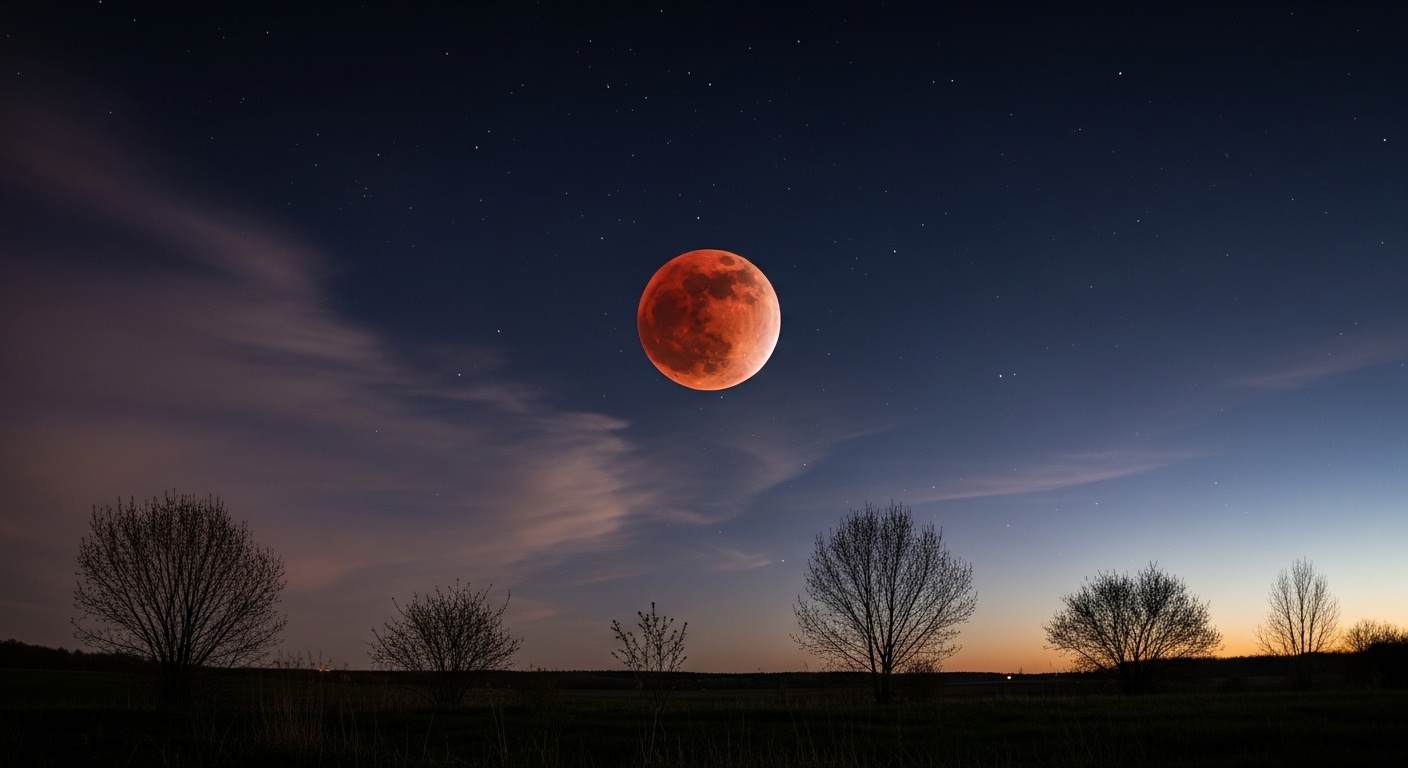
Seen from Earth, the full moon transforms. The brilliant white disk dims and reddens, glowing like an ember at the bottom of the sky. Shadows on the ground soften and almost disappear. Stars that were washed out by moonlight begin to reappear, slowly reclaiming the sky. The night feels different. Quieter. Older somehow.
Each lunar eclipse produces its own shade of red depending on what is in Earth’s atmosphere at the time. Dust, volcanic ash, humidity, and large weather systems all influence the final color. Some eclipses produce a deep garnet that is barely visible against the stars. Others glow a warm brick orange. You will not know exactly what tone the 2026 Worm Moon will take until you are standing outside watching it happen.
How the Eclipse Unfolds
A lunar eclipse is not a single moment. It is a slow progression, and watching the whole thing from beginning to end is far more rewarding than catching just the middle.
The first stage is the penumbral phase, where the moon drifts into the outer edge of Earth’s shadow. The change is so subtle most people miss it, just a slight dimming that is easy to dismiss as clouds.
Then the umbral phase begins. Earth’s central, darker shadow starts to cut across the lunar surface. A curved, inky bite appears along one edge of the moon and slowly spreads. Over the course of roughly an hour, that shadow crosses the entire disk.
Totality is when the moon is fully inside Earth’s shadow and burning with its deep red glow. This phase can last up to an hour, giving you real time to sit with what you are seeing. The color shifts subtly as the eclipse deepens and then begins to ease. When the moon finally starts sliding back out of the shadow, the process reverses. A bright edge returns. The red fades. The familiar full moon reasserts itself as if nothing happened.
No special equipment is needed to watch this safely. Unlike a solar eclipse, a lunar eclipse carries no risk to your eyes and can be watched directly with no protection. A pair of binoculars rewards you with the extra detail of craters and plains still visible through the red glow. A blanket and something warm to drink are the only other things worth bringing.
The Meaning of a March Eclipse at the Start of Spring
The meteorological calendar splits the year into four tidy seasons of three months each. Spring runs from March through May, summer from June through August, autumn from September through November, and winter from December through February. This system helps scientists compare climate data cleanly from one year to the next.
But the seasons do not actually work like a light switch. Early March can still feel like the heart of winter in many places, grey and icy and uncompromising. In others, it is already a riot of swelling buds and the first patches of green pushing through soil. The Worm Moon appears in this uncertain middle territory, when winter is losing its grip but has not yet let go entirely.
There is something quietly fitting about a lunar eclipse at this exact moment. The moon darkening and turning red just as the earth begins to soften and wake feels less like coincidence and more like punctuation. A pause between seasons. A breath between acts.
People who mark the year by the rhythms of nature rather than dates on a calendar tend to remember events like this long after they forget the official start of spring. Years from now, March 2026 may be remembered simply as the night the full moon turned red over the thawing ground.
How to Make the Most of This Night
Watching an eclipse can easily become a quick checkbox. See the thing, take a photo, go back inside. But this one is worth more time than that.
Start by noticing the temperature on your skin when you step out. Early March surprises people. Some nights carry a deep still cold that settles into the bones. Others feel almost forgiving, like the air has made a quiet decision. Listen to what is happening around you while the moon changes. Dripping meltwater. An owl in nearby trees. Dogs reacting to the unfamiliar dimness of a sky that was bright a moment ago. Geese moving overhead under a red lantern.
Smell the air. Thawing snow has its own faint mineral quality. Damp earth has a richness that is entirely its own. Even in cities, cold wet concrete carries a distinctive scent on nights like this. All of it becomes part of the memory.
If you have children with you, ask them what color they think the moon will turn. Ask what animals might be noticing the change along with you. If you are alone, let your sense of scale stretch for a while. The earth is currently casting its shadow across another world. That is not a small thing to sit with.
And when you do pull out your phone to take a photo, remember to spend at least as much time just looking. A photo captures the color. It does not capture the way the night felt slightly displaced from ordinary time, or the odd quiet of a sky where the moon has temporarily stepped back and let the stars take over.
What the Worm Moon Quietly Teaches
We tend to celebrate arrivals. The first truly warm day. The first flower. The first morning you leave the house without a coat. But nature spends most of its time in transition, moving through the almosts and not-yets.
The worms that gave this moon its name do not burst onto the scene overnight. They move gradually through the soil, following warmth, invisible unless you are specifically looking for them. Meteorological spring is not a curtain that goes up on March first. It is a long negotiation between cold and warmth, between ice and mud. The eclipse itself is not a single moment but an unfolding, from bright to dimmed to red to restored.
Standing outside under the Worm Moon, you are sharing a view with countless generations who stood in the same position, at the same time of year, watching the sky, listening for birds, smelling the ground, naming what they saw. They did not have global forecasts or satellite data, but they knew this feeling in their bones. The softening soil. The returning worms. The hungry robins. The sense that the worst of winter had passed.
In 2026, the experience is still fundamentally the same. You tilt your head back, feel cool air on your face, and watch Earth’s shadow move slowly across its oldest nighttime companion. The eclipse ends, the moon brightens, and you come back inside carrying something small and quiet that is hard to name but easy to feel.
FAQ
What is the Worm Moon? It is the traditional name for the full moon in March, tied to the thawing of the ground and the reappearance of worms in the soil as winter loosens its hold.
Why is the 2026 Worm Moon especially notable? It coincides with a total lunar eclipse, meaning the full moon will pass completely through Earth’s central shadow and take on a deep reddish color for a period during the night.
Is it safe to watch a lunar eclipse without eye protection? Yes, completely. Lunar eclipses carry no risk to your eyes and can be viewed directly with no filters or protective glasses needed.
What color will the moon turn? During totality it typically glows red, copper, or orange. The exact shade depends on what is currently in Earth’s atmosphere, including dust, humidity, and volcanic particles.
Do I need to travel somewhere special to see it? Clear skies and an unobstructed view of the moon are all you need. A dark location away from city lights will show you more stars during totality, but the eclipse is visible from any open area, including backyards and balconies.
How long does totality last? Totality can last up to roughly an hour in many lunar eclipses, giving you plenty of time to watch, settle in, and really notice what the night feels like while it is happening.
How does this connect to the start of meteorological spring? Meteorological spring begins on March 1. The Worm Moon falls early in March, making it one of the first full moons of the new season and a vivid natural marker of the shift from winter toward warmer months.