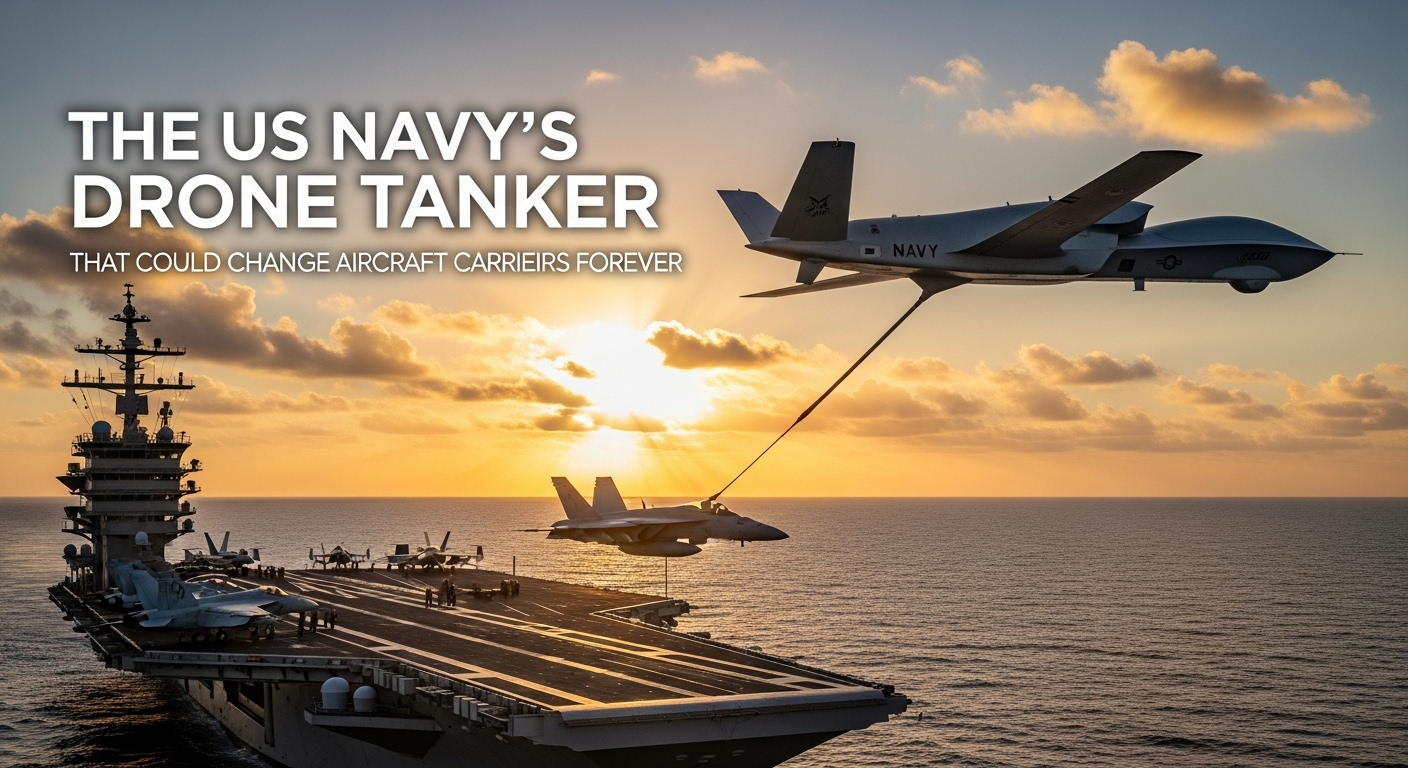
The US Navy’s Drone Tanker That Could Change Aircraft Carriers Forever
The MQ-25 Stingray just cleared one of the most underrated tests in naval aviation. This unmanned tanker drone successfully completed taxi trials on a live carrier flight deck, and the implications are far bigger than they might first appear.
For a programme that has been years in the making, this milestone signals that carrier-based drone operations are no longer a distant concept. They are happening right now.
What Is the MQ-25 Stingray?
The MQ-25 Stingray is the US Navy’s first operational carrier-based unmanned aircraft, built specifically to serve as an aerial refueling tanker. Its job is to fly from the deck of an aircraft carrier, rendezvous with fighter jets mid-air, and extend their range significantly.
The drone was developed by Boeing and is designed to slot into existing carrier air wing operations without disrupting the flow of manned aircraft launches and recoveries. It looks unlike anything else on a flight deck, a sleek, tailless design inspired by the shape of a manta ray.
Why Taxi Testing Matters More Than It Sounds
To those outside the military aviation world, taxi testing sounds routine. In reality, operating any aircraft on a carrier flight deck is one of the most complex and high-risk environments in all of aviation.
The deck is crowded, constantly moving, and operates under strict safety protocols. Successfully taxiing the MQ-25 autonomously on the USS Dwight D. Eisenhower proved the drone can navigate that environment without human hands at the controls.
The Milestone That Opens the Door
The MQ-25 completed its first carrier deck taxi tests on the USS Dwight D. Eisenhower, marking a pivotal step in its journey toward full operational deployment. Captain Chad Reed, program manager for the Navy’s Unmanned Carrier Aviation program, described it as a key demonstration of the system’s maturity.
With taxi operations confirmed, the programme now shifts focus toward aerial refueling trials and expanding the drone’s operational range. Each test brings the Stingray closer to becoming a permanent fixture on US carrier decks.
How the Stingray Extends Carrier Power
Carrier-based fighter jets like the F/A-18 Super Hornet have a finite combat radius. Once that range is consumed, they must return to the carrier or rely on tanker support from other manned aircraft, which are themselves a limited resource.
The Stingray changes that equation. By taking over the aerial refueling role autonomously, it frees up manned aircraft for strike and combat missions while allowing fighters to push farther from the carrier than ever before.
Key Specifications and Development Milestones
| Specification | Detail |
|---|---|
| Aircraft Type | Unmanned aerial tanker |
| Developer | Boeing |
| Primary Role | Aerial refueling for carrier-based jets |
| Design | Tailless, low-observable profile |
| Launch Platform | Aircraft carrier flight deck |
| Carrier Tested | USS Dwight D. Eisenhower |
| Propulsion | Turbofan jet engine |
| Target IOC | Mid-2020s |
Comparing Old and New Refueling Approaches
The shift from manned to unmanned tanking is not just a technology upgrade. It is a fundamental change in how carrier air power is organised and deployed.
| Feature | Manned Tanker (F/A-18 in Tanker Role) | MQ-25 Stingray |
|---|---|---|
| Crew Required | Yes, trained pilot | None |
| Combat Role Lost | Yes, removes fighter from strike missions | No impact on manned aircraft |
| Endurance | Limited by pilot fatigue | Extended autonomous operation |
| Range Extension for Jets | Moderate | Significant improvement |
| Cost Per Mission | High, uses combat asset | Lower, dedicated tanker platform |
| Carrier Deck Space | Shared with strike aircraft | Dedicated unmanned platform |
The numbers make the case clearly. Replacing a manned fighter in the tanker role with a dedicated autonomous drone is both more efficient and more strategically sound.
A Strategic Shift in Carrier Air Power
The US Navy’s carrier strike groups are the most powerful mobile military assets on the planet. But their reach has always been constrained by the operational radius of their aircraft.
The MQ-25 directly addresses that constraint. With the Stingray operating as a dedicated tanker, carrier jets can extend their missions by hundreds of nautical miles, which in contested Pacific environments is an enormous operational advantage.
The Broader Context: Unmanned Aviation at Sea
The Stingray is part of a wider shift across the US military toward integrating unmanned systems into frontline operations. The Navy has been particularly active in this space, recognising that autonomous platforms can take on dangerous or repetitive missions while preserving human pilots for high-stakes combat roles.
The success of the MQ-25 programme also signals to rival nations that American carrier capability is not standing still. It is evolving at pace, incorporating autonomous systems that expand what a carrier strike group can do without adding to its crew count.
What Comes Next for the Programme
Following the taxi tests, the MQ-25 is scheduled to progress through a series of flight trials and aerial refueling demonstrations. The Navy intends to achieve initial operational capability and eventually field the first MQ-25 squadron for deployment.
Future versions of the aircraft may also take on intelligence, surveillance, and reconnaissance roles, further expanding its value beyond simple tanking. The platform’s design already lends itself to lower radar visibility, which opens doors for more sensitive mission profiles.
Frequently Asked Questions
What does the MQ-25 Stingray actually do? The MQ-25 Stingray is an unmanned aerial tanker designed to refuel carrier-based jets in flight. It takes off and lands on aircraft carriers autonomously and is built specifically to extend the combat range of the carrier air wing.
Why is taxi testing considered a major milestone? Operating on a carrier flight deck is one of aviation’s most demanding environments. Successfully completing autonomous taxi tests confirms the drone can safely navigate the deck without human intervention, which is a prerequisite for all further carrier integration work.
Which aircraft will the MQ-25 refuel? The primary aircraft expected to benefit include the F/A-18 Super Hornet, the EA-18G Growler, and the F-35C. These are the core combat aircraft in the current carrier air wing, and extending their range has direct strategic value.
How does the Stingray compare to existing tanker solutions? Currently, some F/A-18s are assigned a dedicated tanker role, which takes a combat-capable aircraft out of the strike mission. The MQ-25 replaces this arrangement with a purpose-built unmanned platform, freeing every manned jet for its primary role.
Is the MQ-25 stealthy? The Stingray features a low-observable design with a tailless, blended profile that reduces its radar signature compared to conventional aircraft. While it is not a dedicated stealth platform, its design reflects the Navy’s interest in reduced-signature unmanned systems.
When will the MQ-25 enter full service? The programme is progressing through testing phases with the goal of achieving initial operational capability in the mid-2020s. A full MQ-25 squadron deployment is planned to follow once all operational trials are completed.
Could the MQ-25 take on roles beyond refueling? Yes. The Navy has indicated that future variants or configurations could take on ISR and electronic warfare support roles. The platform’s range and endurance make it well suited for persistent surveillance missions in addition to tanking.
Conclusion
The MQ-25 Stingray is not just a drone. It is a structural change in how American carrier aviation will operate for the next several decades. By removing the tanker burden from manned combat aircraft, it multiplies the striking power of every carrier strike group it joins.
The taxi tests on the USS Dwight D. Eisenhower may look modest on paper. In reality, they mark the moment unmanned carrier aviation moved from the drawing board to the flight deck. What follows will reshape naval power projection across the Indo-Pacific and beyond.
Read more: https://wizemind.com.au