The tree topper is dead: decorators now place this object instead for a more elegant Christmas tree
The first time I realized the tree topper was dead, it was sitting in my hands — dented, leaning sideways, and covered in dust from the attic. A gold plastic star that had topped my family’s Christmas tree for fifteen years, its points now dull and warped from too many hot fairy lights. I turned it over, felt how light and hollow it was, and thought: this does not belong up there anymore.
Downstairs, the tree was waiting. Bare at the top, its highest branch reaching toward the ceiling like an open question. For the first time, that branch was not calling for a star or an angel. It was simply there — quiet, green, and full of possibility.
I did not know it then, but I was not alone. All over the world, decorators, stylists, and everyday homeowners were quietly retiring their tree toppers and doing something different — something softer, more intentional, and more grown-up. The traditional tree topper was dying. And in its place, something new was taking root.
The Quiet Revolution at the Top of the Tree
For decades, we have forced oversized stars, angels, and light-up contraptions onto the crowns of our Christmas trees — often bending the top branch just to make the thing stay put. The result looked festive from a distance, but up close it often felt chaotic. The topper pulled the eye upward and away from everything else, demanding attention like a glittery exclamation mark at the end of a sentence.
Interior decorators started noticing it first. Photoshoots for glossy winter issues began to shift. At the top of the tree, instead of stiff angels with plastic curls or tinsel-laden stars, there appeared something more minimal and unexpectedly graceful: a simple bow.
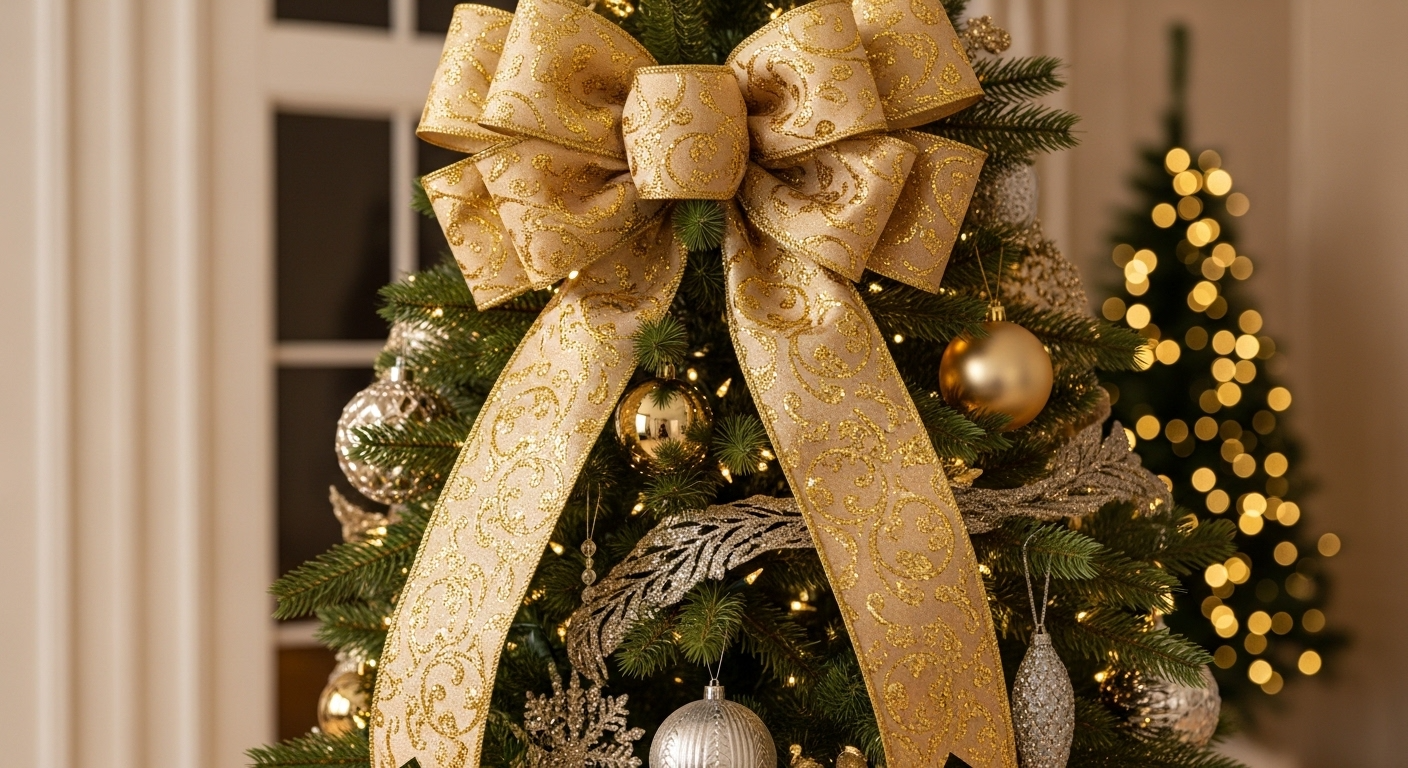
That is the object now quietly replacing the traditional tree topper. Not a heavy, light-up object. Not a figurine. A bow — often oversized, sometimes cascading, occasionally made of velvet, silk, or linen, but always, almost stubbornly, soft.
You might have already seen it: a wide ribbon, tied with an intentional looseness, its tails falling down through the branches, becoming part of the tree rather than sitting on it. No intense glare, no glowing bulbs — just texture, flow, and a sense of calm.
The Rise of the Ribbon: Why Bows Make Trees Look Instantly Elegant
The shift from rigid toppers to fabric bows is more than just a trend — it is an evolution in how we think about festive spaces. Modern Christmas decor leans toward calm, layered, and cozy rather than loud and over-saturated. A bow aligns beautifully with that aesthetic.
Where a star or angel often feels like a separate object stuck on at the end, a bow belongs to the tree. It drapes. It moves subtly when someone brushes past. It invites touch and invites the eye to travel downward rather than abruptly stop. Even the way a bow catches light is gentler. Velvet drinks in the glow of fairy lights. Silk gleams in narrow highlights. Linen looks matte and quiet, like freshly fallen snow.
The magic lies in the way a bow connects the top of the tree to everything beneath it. Those long tails that fall through the branches can be woven in and out of the foliage, tracing a visual thread from crown to trunk. Instead of being a singular statement at the highest point, the topper becomes the beginning of a story that winds all the way down.
In living rooms where people have toned down bright multicolor schemes to softer palettes — warm whites, rich greens, deep reds, and gold accents — the classic plastic topper can feel out of place. A bow, by contrast, is adaptable. It can be lush crimson velvet in a traditional home, pale champagne silk in a minimalist loft, or rough jute ribbon in a cabin where the tree still smells like the forest outside.
Choosing the Right Bow: Texture, Scale, and Color
Walking into a craft store in late November can be overwhelming — spools of ribbon stacked like little towers, all promising to transform your tree. But the art of replacing your topper with a bow is less about more, and more about intention.
| Bow Style | Best For | Look and Feel |
|---|---|---|
| Wide Velvet Bow | Classic, cozy, traditional homes | Luxurious, warm, softly dramatic |
| Silk or Satin Ribbon | Modern, minimal interiors | Elegant, fluid, light-catching |
| Linen or Cotton Ribbon | Scandi, rustic, nature-inspired spaces | Understated, textured, organic |
| Jute or Burlap Bow | Farmhouse, cabin, country decor | Earthy, casual, homey |
| Sheer Organza Bow | Light, airy, romantic trees | Ethereal, glowy, soft-focus |
Scale matters more than most people realize. A tiny bow on a grand, full tree will vanish. An enormous bow on a compact, slim tree will feel costume-like. As a general guide, the width of your ribbon should sit somewhere between 2.5 and 4 inches for standard home trees. For very tall trees — eight feet and above — you can go wider, but always keep a sense of proportion.
Color is where personality comes in. Many decorators now choose a single ribbon color and let it dictate the rest of the tree’s palette. A moss-green bow can echo through glass baubles, stockings, and even the wrapping paper under the tree. A soft blush bow might be repeated in dried flowers and copper ornaments. The result is a quiet, intentional harmony — less visual noise, more visual rest.
How to Place a Bow So It Feels Effortless, Not Fussy
There is a small ritual to tying the perfect bow at the top of a tree. Stand back first. Take in the tree the way a guest would when they enter the room. Notice where your eye naturally lands. Then imagine a ribbon flowing from that point — upward, then down, drawing your gaze along the shape of the tree.
When you climb the step stool, do not think of yourself as forcing an object onto the tree. Think of yourself as finishing a sentence it has already started. Find the straightest, strongest top branch. Gently secure the bow to the branch using floral wire or a thin ribbon in a matching color. Leave enough slack so the bow sits comfortably, not rigidly upright.
The tails are where the magic happens. Instead of letting them dangle straight down, give them a path. Twist them lightly around branches. Tuck sections deeper inside the foliage, then pull them back out again a foot lower, so they seem to weave in and out. On a lit tree, this creates little vignettes of ribbon and light that feel almost cinematic when you sit next to it at night.
Some decorators go further, using multiple ribbons layered together — a wider velvet base with a narrower metallic accent on top. This quietly mimics the depth of a designer tree without screaming for attention. The rule of thumb: if you can see the technique more than you feel the mood, it is probably too much.
Memory vs. Minimalism: Saying Goodbye to the Old Topper
Of course, the star or angel at the top of the tree has not just been an object — it has been a placeholder for memory. Many of us grew up watching a parent or grandparent climb the final rung of the step ladder, place that topper with care, and step down to a chorus of “It’s perfect!” Even when it wasn’t.
To move away from that can feel almost like a betrayal. But traditions are not museums. They are more like rivers — they move, they bend, they quietly rearrange the stones beneath the surface. Letting go of the classic topper does not mean erasing those memories. It means making room for new ones.
Some people now place their old topper lower on the tree, nested in the branches like a keepsake instead of a crown. Others display it on a shelf nearby, framed by garlands or candles — a relic honored, but not forced to perform.
And then there is the act of tying the bow itself. Unlike rigid toppers that demand one person with both hands free, a bow can be a shared creation. One person holds the ribbon, another tightens the knot, a child stands back and declares whether the tails are equal. The process becomes more collaborative, more inclusive. The topper no longer belongs to whoever is tallest — it belongs to everyone.
How the Bow Changes the Mood of the Whole Room
It is astonishing how much the choice at the very top of the tree affects the atmosphere of the entire space. A blinking star can make the tree the loudest guest at the party, even when no one else is talking. A bow, on the other hand, lets the tree participate in the room’s mood, not dominate it.
Imagine a quiet December evening. The room is dim, lit mostly by the tree and perhaps a single lamp in the corner. With a softer topper, the tree looks settled, almost meditative. The ribbon’s curves echo in the folds of the curtains, the throw on the sofa, the spine of an open book. You are not dealing with a light show — you are sharing space with something living, seasonal, and strangely calming.
For those who lean into natural decor — dried oranges, wooden beads, handmade ornaments — the bow becomes the final brushstroke, tying together branches and textures rather than floating in a separate, glittery universe. For minimalists who favor fewer ornaments, a single exquisite ribbon at the top can carry more emotional weight than any store-bought angel ever did.
Even daytime looks different. With no bulky topper breaking the line, the silhouette of the tree against a bright window is cleaner and more sculptural. The shape reads as part of the architecture of the room, not an afterthought.
From Trend to New Tradition
Will the bow endure? Trends are fickle, and Christmas decor is especially prone to cycles. But the bow taps into something more fundamental than a passing style: the desire to make our homes feel like extensions of ourselves, even in the most decorated season of the year.
It is not that stars and angels are inherently wrong. It is that many of us have outgrown the idea that festive must mean overloaded. We crave beauty that breathes. We want our living rooms at Christmas to feel not like showroom windows, but like places where we can actually exhale.
The bow offers a way to honor that desire. It is simple enough to be reimagined year after year — different fabrics, different colors, different ways of draping. It is also humble enough to let the rest of the tree shine. Ornaments passed down through generations, a wonky paper snowflake made in kindergarten, a single pinecone from a walk last November — these details no longer have to compete with a flashing star. They can exist quietly, held together by a single ribbon that whispers rather than shouts.
Maybe that is why, the year I finally retired our plastic star, no one in my family complained. When they walked into the room and saw the tree — a deep green spruce dressed in soft white lights and a single wide, caramel-colored velvet bow at the top — they paused. They did not say it was perfect. They said it felt calm. Warm. Grown-up, in the best possible way.
The tree topper, as we knew it, may be dead. But in its place, something gentler has arrived. Not a symbol perched above us, glowing down from on high, but a ribbon woven into the branches, reminding us that beauty does not always live at the top. Sometimes, it trails downward, wrapping itself around everything we love, quietly tying the season together.
Frequently Asked Questions
Is the traditional tree topper really out of style?
Not completely. Stars and angels still appear on many trees, especially where sentimentality is strong. However, in contemporary decor — especially in professionally styled spaces — bows and softer toppers are now far more common because they integrate better with modern interiors.
What type of ribbon works best as a tree-top bow?
Wired ribbon is ideal. The hidden wire along the edges lets you shape loops and tails so they hold their form. Velvet, linen, satin, and sheer organza are all popular, depending on whether you prefer a cozy, natural, sleek, or airy look.
How long should the bow tails be?
For most trees, tails that reach about halfway to two-thirds down the tree look balanced and elegant. You can trim them shorter for a subtler effect or let them cascade almost to the bottom for a more dramatic, designer-style look.
Can I keep my old topper and still use a bow?
Yes. Many people move their traditional topper lower into the branches as a sentimental ornament and crown the tree with a bow instead. This way, the memory is preserved without dominating the visual style of the tree.
What if my tree is very small?
On smaller trees, choose narrower ribbon and a more compact bow. You still get the elegant effect, but without overwhelming the tree’s proportions. A simple single-loop bow with shorter tails can look especially refined on tabletop or mini trees.