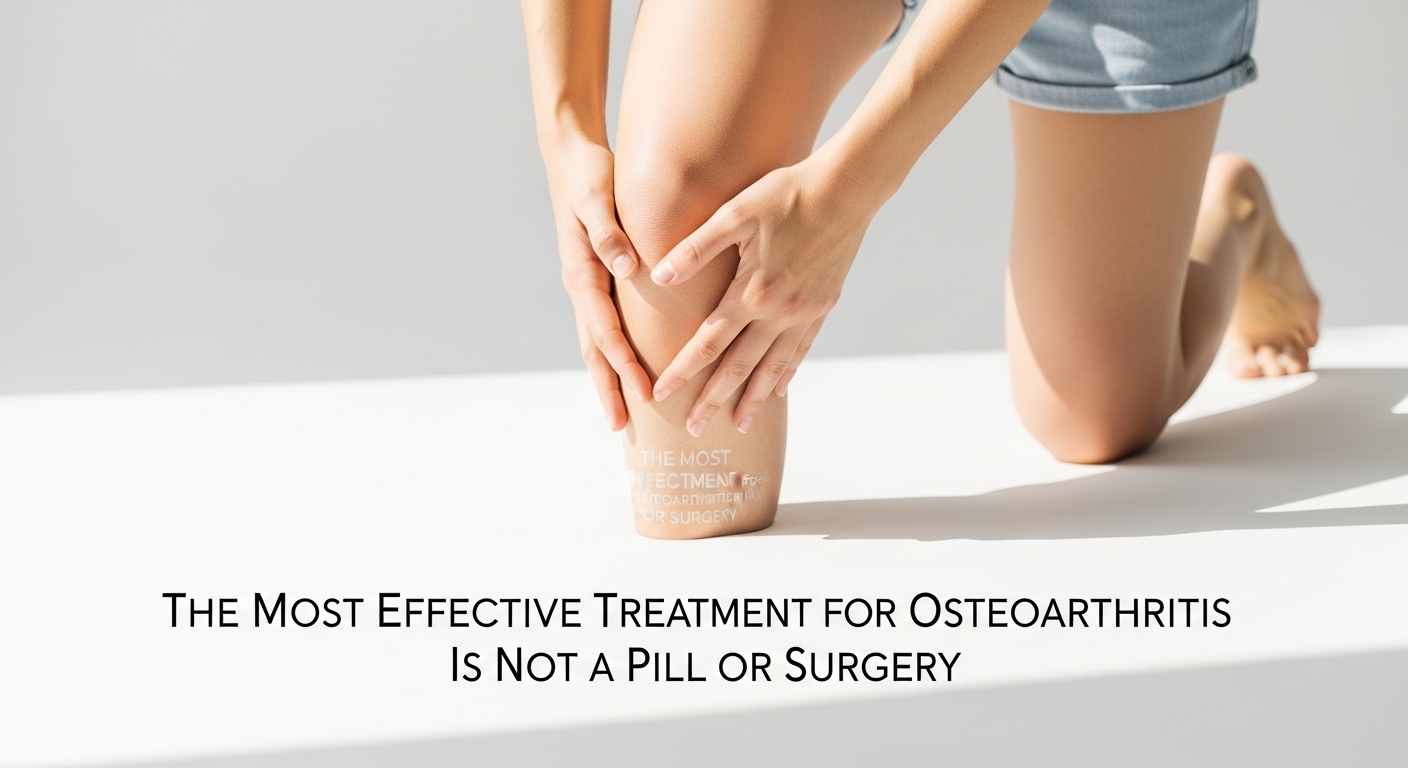
The Most Effective Treatment for Osteoarthritis Is Not a Pill or Surgery
The first thing you notice is the sound. A low, rough grinding inside your own knee when you push yourself up from a chair. Not loud enough for anyone else to hear, but you feel it, like sand caught in a hinge that used to move smoothly. Maybe it is your hip when you climb the stairs, or your fingers when you twist open a jar. It starts subtly, an ache after a long day, a stiffness that is there before you are properly awake in the morning. But slowly, almost shyly, it begins to shape the decisions you make. You take the lift instead of the stairs. You say no to the walk. You hold your joints with the kind of careful attention usually reserved for something already broken.
Someone gives it a name: osteoarthritis. You nod in that way people nod when they recognise a word without fully understanding what it means for their life. Then comes the explanation. The cartilage in your joints is thinning. The cushioning is wearing down. Your bones are beginning to communicate with each other more directly than they were designed to. And you ask the question everyone asks.
So what do I take for it?
Because we live in a world that loves the promise of a pill. One tablet to quiet the noise. One injection to fix the problem. One surgery to replace the faulty component and return things to how they were. But osteoarthritis does not respond to that kind of thinking. It is not a single problem with a single solution. It is a slow shift in the landscape of your body, gradual and patient and shaped over years.
And here is the part that surprises most people. The most effective treatment we currently know of for osteoarthritis is not found in a bottle or a needle or an operating room. It is found in movement. In the strength of your own muscles. In the simple and deeply underestimated act of choosing to keep using your body rather than protecting it into stillness.
The Quiet Truth Your Joints Have Been Trying to Tell You
When most people imagine a joint affected by osteoarthritis, they picture bone grinding against bone and hear it described as inevitable deterioration. That image, repeated constantly in consultations and online searches, can feel like a verdict. If things are wearing out, surely moving less would slow the damage?
That logic is understandable. It is also, for most people, exactly backwards.
When pain leads to stillness, several things begin happening beneath the surface in ways that make the problem worse rather than better. Muscles around the affected joint weaken from disuse, particularly those in the hips, thighs, and core that are responsible for absorbing impact and guiding movement. Balance and coordination gradually decline, making falls more likely. Stiffness increases, which makes pain worse and movement harder. And the nervous system, responding to a body that seems to be signalling threat, becomes increasingly sensitive to pain signals over time.
The joint that hurts becomes the joint you trust less. The less you trust it, the less you use it. The less you use it, the weaker and stiffer and more painful it becomes. Pain transforms from a physical issue into a lifestyle, one cautious and reluctant decision at a time.
The research on this is consistent and has been replicated across enormous numbers of people over many years. Structured exercise, particularly strength training combined with low-impact movement, is the single most effective non-surgical treatment available for osteoarthritis. It performs better than medications for pain management and daily function over the long term. It does not accelerate joint damage. In the right form and at the right intensity, it protects the joint by rebuilding the muscular support around it and improving the way you move.
The Day Movement Becomes Medicine
Picture a small, bright room with rubber mats and the quiet sound of effort. A physical therapist hands you a simple resistance band, lighter than you expected, and asks you to sit in a chair and slowly straighten your leg against the resistance. It feels almost laughably small. You have walked kilometres on this knee. You have climbed hills with it. And here you are working with an elastic band on what feels like the most modest movement imaginable.
But weeks pass, and something begins to change. That small exercise becomes easier. The muscle in your thigh, which had thinned quietly over years of cautious underuse, starts to remember its role. Walking to the car is no longer something you pace yourself for. Climbing the front steps is still work, but it is not a negotiation any more.
This is what happens when movement is used as medicine. The treatment is not a single dramatic intervention. It is a patient recalibration of how your body functions, a gradual restoration of the muscular support that your joints depend on to move without carrying every load alone.
What this kind of care looks like in practice:
- Strength training two to three times per week focused on the legs, hips, and core
- Gentle, consistent low-impact cardio such as walking, cycling, or swimming for twenty to thirty minutes most days
- Stretching and mobility work to maintain the full range available to each joint
- Balance exercises to rebuild confidence and reduce the risk of falls
None of this requires a gym membership or an athlete’s level of fitness. It requires consistency and a willingness to start where you actually are rather than where you used to be.
Pills, Injections, and Surgery: Helpful Allies, Not the Foundation
Nothing here suggests that medications or surgical options are without value. They can be genuinely important parts of managing osteoarthritis in specific circumstances. But they are supporting characters in this story, not the main one, and treating them as the foundation tends to lead to disappointment.
Pain medications, particularly anti-inflammatory drugs, can make it possible to get through the day. Sometimes they reduce pain enough to make movement feel approachable again, which is genuinely useful. But they do not rebuild muscle, restore coordination, or improve the mechanics of how a joint moves. Their effects last only as long as you take them.
Corticosteroid or hyaluronic acid injections can offer more targeted and sometimes longer-lasting pain relief in specific joints. They have a legitimate role, particularly when a joint is too inflamed and painful to begin any kind of movement-based rehabilitation without some relief first. But research is clear that they address symptoms rather than underlying function and that their benefits diminish over repeated applications.
Joint replacement surgery, when it is appropriate, can be genuinely life-changing. For people whose pain and limitation have become severe enough that daily life has effectively contracted around their joints, the right surgical intervention can restore a quality of life that seemed permanently out of reach. But the people who do best after joint replacement are almost always those who were stronger and more mobile going into the surgery and who committed to rebuilding that strength and mobility in recovery. Without movement, even a technically excellent artificial joint does not deliver its full potential.
Moving Wisely When Movement Hurts
The most difficult aspect of using exercise as a primary treatment for osteoarthritis is that pain has trained most people to interpret it as a signal to stop. With osteoarthritis, that interpretation is frequently misleading. Pain in a joint affected by this condition often reflects the heightened sensitivity of a nervous system that has been on alert for a long time, not necessarily damage occurring in real time.
This does not mean the pain is imaginary. It means the system interpreting and broadcasting it has become more protective than the actual situation requires. Learning to distinguish between discomfort that indicates productive effort and pain that signals a need to adjust is one of the most valuable things anyone managing osteoarthritis can develop.
Some practical guidance for moving with a joint that hurts:
- Mild to moderate discomfort during exercise that settles within twenty-four hours is generally within an acceptable and safe range
- Pain that is severe, sharp, catching, or that worsens significantly and lingers for more than a day suggests the intensity or type of movement needs adjusting rather than stopping entirely
- If a particular exercise is too painful, change the approach before abandoning it. Smaller range of motion, lighter resistance, shorter duration, or a different movement pattern can all reduce the demand while preserving the benefit
- Focus on the pattern across weeks rather than individual days. Your body is allowed to have difficult days. What matters is whether strength, distance, and recovery are gradually improving over time
- A physical therapist or sports medicine practitioner can provide significant help in designing a program specific to your joints, your history, and your starting point
A Simple Week That Supports Your Joints Without Taking Over Your Life
You do not need specialist equipment or a complicated schedule to begin giving your joints the kind of support that genuinely changes the course of osteoarthritis. What you need is a basic plan and the willingness to return to it consistently.
A reasonable week for someone starting out might look something like this:
Twice a week, twenty to thirty minutes of strength work focused on the legs, hips, and core. Simple exercises that work without a gym include slow chair squats where you lower yourself to the seat and rise again, bridges where you lie on your back and lift your hips off the floor, step-ups onto a low stable surface while holding something for support, and leg extensions using a light resistance band while seated in a chair.
Most days, twenty to thirty minutes of low-impact movement. Walking at a pace comfortable enough to hold a conversation, riding a stationary bicycle, or moving through water in a pool all provide the kind of cardiovascular activity that benefits joint health without placing excessive load on damaged cartilage.
Several times throughout the week, five to ten minutes of gentle stretching and mobility. Slow controlled knee bends while holding a counter, hip circles in a standing position, and calf stretches after walking keep joints moving through their available range and reduce the morning stiffness that makes the first hour of each day so discouraging.
Additional things that support this work:
- Managing body weight where possible, as even modest reductions in excess weight meaningfully reduce the load on hips and knees with every step taken
- Choosing footwear that provides adequate cushioning and support, as what happens at the foot affects alignment throughout the entire lower limb
- Prioritising sleep and stress management, as pain sensitivity increases substantially when the body and nervous system are under sustained pressure
None of these changes are individually dramatic. Together, accumulated over weeks and months, they produce outcomes that are.
What Effective Treatment Actually Looks Like Over Time
We tend to judge treatments by how quickly they stop pain. Immediate relief feels like success. Gradual improvement feels unreliable, even suspicious. But osteoarthritis is a long story, written across years of accumulated decisions, postures, habits, and physical history. Any approach that promises to resolve it overnight is offering you only a fraction of what you actually need.
Ask different questions and a different picture emerges. Can you move more easily than you could three months ago? Are you doing things you had stopped doing? Is your daily life expanding rather than contracting? When you measure by these standards, consistent exercise-based treatment looks less like a modest and inconvenient suggestion and more like the most powerful tool available.
Medications can quiet pain for a day. Injections can quiet it for a season. Surgery, when it is the right decision, can give you a joint that carries you reliably for another decade or two. All of these have genuine value and none should be dismissed. But none of them can be the foundation of a life that continues to move freely and with confidence.
The foundation is you on an ordinary Wednesday afternoon choosing a short walk over sitting still. You on a Saturday morning doing slow steady squats by the kitchen counter with your hands resting on the bench for balance. You breathing a little harder, muscles warming, joints loosening, a body remembering what it was built to do.
The most effective treatment for osteoarthritis is not mysterious or expensive or difficult to access. It does not require a specialist’s waiting list or a complicated prescription. It is unglamorous and patient and quietly profound.
Move, and keep moving. Strengthen, and keep strengthening. Let your body know, through consistent and gentle action, that you are still here and still willing to meet the world on your own two feet.
Read More: For more health guidance, wellness advice, and expert-informed articles written for Australian readers, visit wizemind.com.au