The International Space Station Is Retiring. Here’s What Comes Next.
After more than two decades in orbit, the ISS is approaching the end of its life. The transition to what follows is one of the most consequential decisions NASA has ever faced.
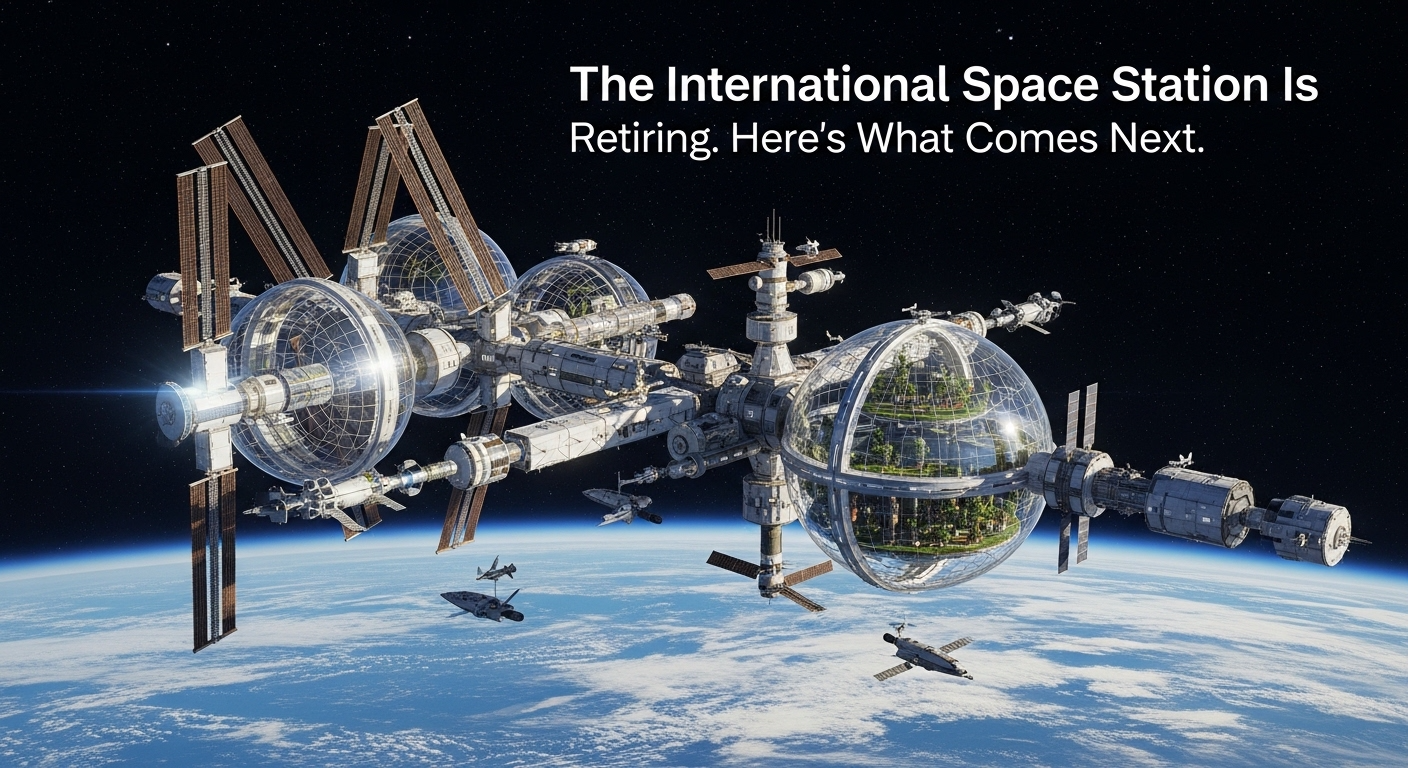
When the first module of the International Space Station was launched in 1998, the idea of a permanently crewed laboratory orbiting 400 kilometres above Earth felt like science fiction made real. Over the following two decades, the station became the longest continuously inhabited outpost in human history — a platform for thousands of scientific experiments, a symbol of what international cooperation can achieve, and a proving ground for everything humanity has learned about living and working in space. Now, after years of extensions and repairs, the ISS is running out of time. Its planned retirement is set for 2030, and the question of what replaces it is no longer theoretical.
Why the ISS Is Being Retired
The ISS was not designed to last forever. Its original operational lifespan was 15 years — meaning it was already living on borrowed time before NASA and its partners began extending operations through regular maintenance, module upgrades, and structural assessments. Those extensions have been remarkable feats of engineering, but the station’s age is now showing in ways that are increasingly difficult to manage.
Cracks have appeared in older Russian modules. Air leaks, while manageable so far, have become a recurring issue. The cooling systems, solar arrays, and life support equipment — all of which have been repaired and replaced over the years — are approaching the limits of their serviceable lives. Keeping the ISS operational beyond 2030 would require levels of investment and maintenance that NASA and its international partners have concluded are no longer justifiable, particularly when those resources could be directed toward what comes next.
The decision to retire the station is not a failure. It is the natural endpoint of an extraordinary machine that outlasted its own design by more than a decade.
What the ISS Has Actually Achieved
Before looking forward, it is worth understanding what humanity stands to lose — and what it has already gained. The ISS has hosted over 270 people from 20 countries. It has been the site of more than 3,000 scientific investigations across fields ranging from biology and physics to Earth observation and materials science. Experiments conducted in its unique microgravity environment have contributed to advances in cancer research, vaccine development, water purification technology, and our understanding of how the human body ages.
It has also served a less visible but equally important function: teaching us how to keep humans alive in space for extended periods. Everything NASA learns about managing bone density loss, muscle atrophy, psychological stress, and radiation exposure in orbit feeds directly into the planning for future missions to the Moon and eventually Mars. The ISS has been, in many ways, a 25-year rehearsal for deeper space exploration.
Key Milestones in the ISS Timeline
| Year | Event |
|---|---|
| 1998 | First module launched — Zarya, the Russian control module |
| 2000 | First permanent crew arrives — continuous human habitation begins |
| 2011 | Station assembly completed after more than 40 construction flights |
| 2024 | Original extended retirement date under earlier planning |
| 2030 | Current confirmed retirement date |
| Late 2020s | Target window for commercial successor stations to become operational |
NASA’s Bet on the Private Sector
The most significant shift in NASA’s approach to the post-ISS era is the decision to hand the future of low Earth orbit to commercial companies rather than build and operate a government successor. This is a deliberate strategic choice, not a cost-cutting retreat. NASA’s reasoning is that the private sector can operate stations in low Earth orbit more efficiently and at lower cost to the taxpayer, freeing government resources for the more complex and expensive work of deep space exploration — the Moon, Mars, and beyond.
Several companies are now in various stages of developing commercial space stations with NASA support through its Commercial Low Earth Orbit Destinations programme.
The Main Contenders to Replace the ISS
| Station | Developer(s) | Key Details |
|---|---|---|
| Axiom Station | Axiom Space | Modules initially to attach to the ISS before operating independently; most advanced in development |
| Orbital Reef | Blue Origin & Sierra Space | Mixed-use commercial station targeting research, manufacturing, and tourism |
| Starlab | Voyager Space & Airbus | Single-launch station design; broad research focus with university partnerships |
| Haven-1 | Vast Space | Smaller initial station with plans for expansion; first launch targeted for 2025 |
Each of these proposals takes a different architectural approach, but all share the same basic model: commercially owned and operated stations that NASA and other customers — including international space agencies, research institutions, and private companies — pay to use. Rather than owning the hardware, NASA becomes a tenant and a customer, much as it currently pays for crew transport through SpaceX’s Crew Dragon.
The Risks Nobody Is Fully Resolving Yet
The transition plan is logical on paper, but it carries real risks that the space community is actively debating. The most pressing is the gap problem. If commercial stations are not operational before the ISS retires in 2030, there will be a period during which the United States — and potentially its international partners — has no platform for humans in low Earth orbit. NASA’s stated goal is to avoid any such gap entirely, but the development timelines for commercial stations have already slipped from initial projections, and spaceflight schedules almost always take longer than planned.
There is also the question of whether commercial operators can deliver the reliability and safety standards that crewed operations require. The ISS was built with government oversight, redundant systems, and decades of accumulated operational knowledge. A new commercial station will be starting from a different baseline, and proving that standard of safety takes time and — inevitably — incident data that no one wants to generate.
Finally, there is the geopolitical dimension. The ISS was a product of the post-Cold War era — a partnership between the United States, Russia, Europe, Japan, and Canada that persisted through considerable political turbulence. The future commercial stations are primarily American ventures. How international participation in low Earth orbit is structured going forward, particularly with Russia’s involvement in the ISS now deeply complicated by geopolitical tensions, remains an open and consequential question.
What This Means for Space Science
The scientific community has its own concerns, which centre on continuity. Many long-running experiments aboard the ISS are producing data whose value increases with time. Breaking the chain of observations — even temporarily — can reduce the scientific value of decades of accumulated results. Researchers are pressing for detailed transition plans that specify how ongoing experiments will be migrated, paused, or concluded before the ISS is deorbited.
The deorbit itself is an engineering challenge of considerable scale. The ISS is the largest object ever assembled in space — roughly the size of a football field, weighing approximately 420 tonnes. Bringing it down safely requires a controlled reentry that directs debris toward a remote ocean zone. NASA is planning for this process, but it will be one of the most complex deorbit operations ever attempted.
Frequently Asked Questions
When exactly will the ISS be retired? The current confirmed retirement date is 2030. NASA plans to deorbit the station in a controlled manner, directing it toward a remote area of the South Pacific Ocean.
Will there be a gap in human spaceflight after the ISS retires? NASA’s explicit goal is to avoid any gap by ensuring commercial successor stations are operational before 2030. Whether that timeline is achieved depends on the development progress of companies like Axiom Space, Blue Origin, and Voyager Space.
Why is NASA using commercial companies instead of building a new government station? NASA’s strategy is to free government funding from low Earth orbit operations so it can concentrate on deep space missions — the Artemis lunar programme and eventual crewed Mars missions. Commercial operators are expected to run low Earth orbit stations more cost-effectively, with NASA as a paying customer rather than an operator.
What will happen to the experiments currently running on the ISS? NASA and its research partners are developing transition plans for ongoing experiments. Some will be concluded before retirement, others may be relocated to commercial stations, and some data streams may be interrupted. The scientific community has raised concerns about continuity, and detailed planning is ongoing.
Will other countries still have access to space stations after the ISS retires? Commercial stations plan to offer access to international partners and customers. However, the structure of international participation will be different from the ISS model, where partner agencies co-own and co-operate the station. The extent to which smaller nations retain meaningful access remains an open question.
What is the Axiom Station and how far along is it? Axiom Space is the most advanced of the commercial competitors. Its plan involves launching modules that initially attach to the ISS, allowing the station to be built out and operational before the ISS retires. It then separates and operates independently. NASA has contracted with Axiom for multiple private astronaut missions, and the company has been progressing toward its first module launch.
Could the ISS retirement date be extended again? It is technically possible, as it has been extended before. However, NASA has indicated that the structural and maintenance challenges make further extensions beyond 2030 inadvisable, and that the funding is better directed toward transition and successor programmes. A significant failure or safety concern could accelerate the retirement date rather than extend it.