Space Debris Armour: The Next-Generation Tiles That Could Soon Become Indispensable for Every Satellite
The space above our planet is no longer the quiet, empty expanse it once appeared to be. It has become a crowded and increasingly dangerous environment, filled with debris travelling at speeds that can destroy a satellite in an instant.
A company called Atomic-6 believes it has built the solution, and the technology is closer to real-world deployment than most people realise.
The Problem That Keeps Getting Worse
There are currently hundreds of millions of pieces of debris orbiting Earth, ranging from defunct satellites and rocket stages down to fragments no larger than a fleck of paint. At orbital velocities, even the smallest piece carries enough kinetic energy to cause catastrophic damage.
The number of objects in orbit is growing faster than it is being managed, and the collision risk is increasing every year as more satellites are launched into an already congested environment.
What Hypervelocity Impact Actually Means
The term used by engineers is hypervelocity impact, and it refers to collisions where relative speeds between objects can reach tens of thousands of kilometres per hour. At those speeds, the physics become extreme.
A piece of debris the size of a marble hits with the force of a hand grenade. A larger fragment can split a satellite apart entirely, generating thousands of new pieces of debris in the process.
Why Kessler Syndrome Is the Real Nightmare
The Kessler syndrome is a concept first proposed by NASA scientist Donald Kessler in the 1970s. It describes a cascading chain reaction where one collision generates debris that causes further collisions, which generate more debris, until certain orbital zones become completely unusable.
“As the Kessler syndrome becomes an increasingly pressing concern, solutions like the Space Armor tiles are crucial for maintaining a sustainable and secure presence in low-Earth orbit,” says John Williamson, Aerospace Engineering Professor.
Introducing Atomic-6 and the Space Armor Tiles
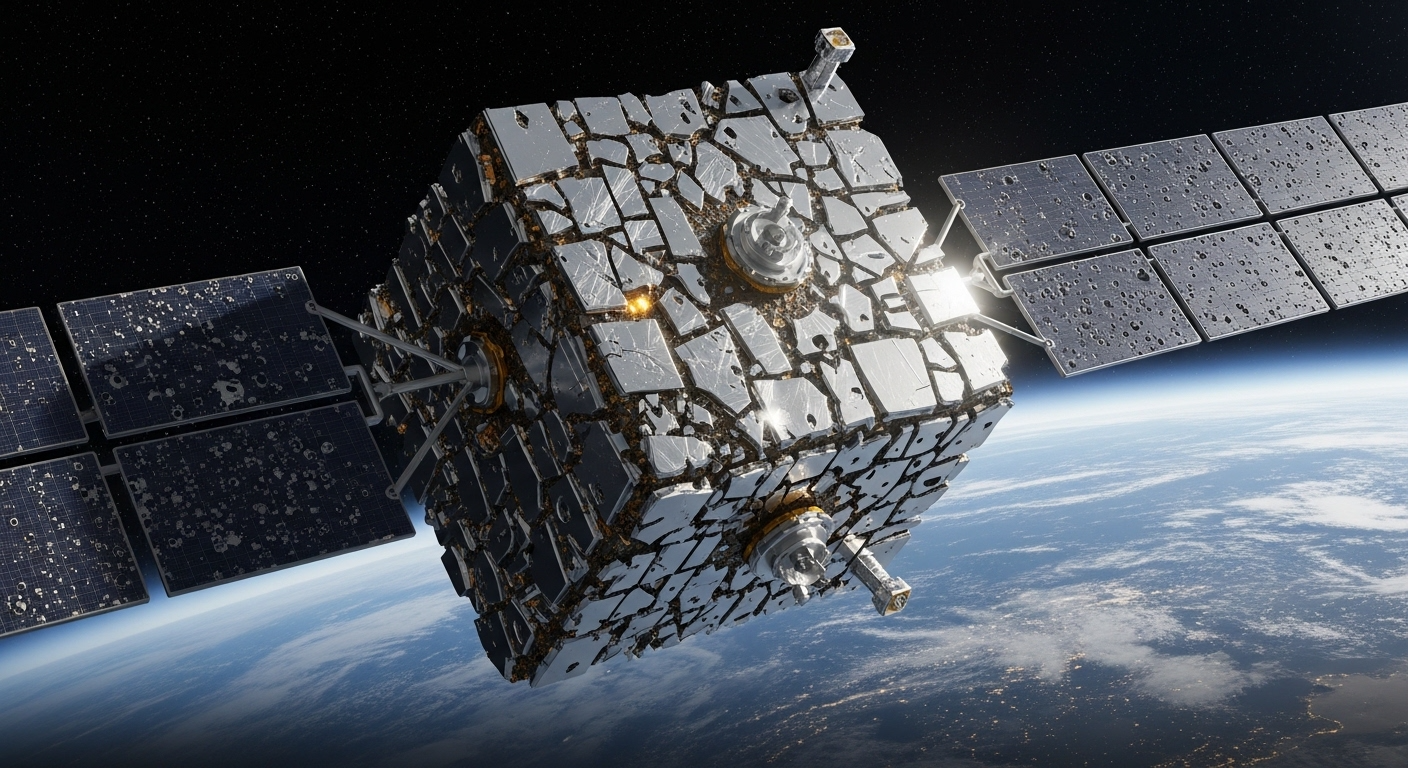
Atomic-6 is a space technology company that has developed what it calls Space Armor tiles, a modular and customisable protective system designed to be built directly into the structure of satellites rather than added onto them afterward.
The distinction between built-in and bolted-on is more significant than it might sound, and it is central to why this approach could work where others have fallen short.
Built-In Rather Than Bolted On
Traditional protective measures for satellites tend to be afterthoughts added to existing designs. They add weight, affect performance, and can fail or degrade independently of the main spacecraft structure.
Atomic-6’s approach integrates the protective tiles directly into the satellite’s architecture from the design stage. The armour becomes part of the structure rather than a layer sitting on top of it, which means it doesn’t compromise performance or add avoidable mass.
What the Tiles Are Actually Made Of
The Space Armor tiles use advanced materials specifically engineered to withstand the extreme conditions of space, including temperature fluctuations, radiation exposure, and the sudden violent energy of a hypervelocity impact.
The engineering goal is to absorb and dissipate kinetic energy from high-speed collisions rather than simply resist them. A material that can spread and redirect that energy protects the satellite in ways that rigid shielding alone cannot.
Expert Reaction to the Technology
“The Space Armor tiles represent a game-changing innovation in the field of satellite protection. By integrating the protective measures directly into the satellite’s design, Atomic-6 has found a way to enhance resilience without compromising performance.” — Dr. Sarah Emerson, Space Policy Analyst
“The military applications of the Space Armor technology are significant. By enhancing the resilience of satellite-enabled communication and surveillance systems, this innovation could provide a strategic advantage in an increasingly competitive and contested space domain.” — General Olivia Diaz, Retired Military Strategist
The First Real Test: Starburst-1
Atomic-6 has partnered with satellite operators to integrate the Space Armor tiles into an actual mission. The Starburst-1 satellite has been equipped with the tiles and is serving as a live testbed for how the technology performs in real orbital conditions.
The data gathered from this mission will shape the future development of the tiles and inform how widely and quickly they can be adopted across the industry.
Key Features and Benefits at a Glance
| Feature | Benefit |
|---|---|
| Advanced impact-resistant materials | Withstands hypervelocity collisions from debris |
| Modular and customisable design | Adapts to different satellite architectures |
| Built into satellite structure | No performance compromise or added bulk |
| Lightweight and compact | Minimal effect on payload and operations |
| Tested on Starburst-1 mission | Real-world validation in orbital conditions |
| Scalable across mission types | Applicable from small satellites to large platforms |
Applications Beyond Satellites
Atomic-6’s vision for the technology extends well beyond protecting individual spacecraft. The company is exploring how the same principles can be adapted for astronaut space suits, adding another layer of protection for crew members during extravehicular activity.
Ground-based infrastructure is also under consideration. Control centres and communication hubs that support space operations could benefit from adapted versions of the same protective technology, creating a more comprehensive system of defence against the debris problem.
Military and Strategic Implications
Satellite-based communication, surveillance, and intelligence systems are now central to modern defence capability. Losing a key satellite to debris could disrupt military operations at a critical moment.
The Space Armor tiles offer a way to harden these assets against an unpredictable but constant threat, which has not gone unnoticed by defence planners and policymakers who are increasingly focused on the security of space-based infrastructure.
What Happens if This Becomes Standard
If Space Armor tiles become a default component of satellite design, the implications for the industry are significant. Mission planners could operate with greater confidence, knowing that their assets have meaningful protection against the most common and unpredictable threat in orbit.
More ambitious missions become viable. Longer operational lifetimes become realistic. And the contribution to reducing the escalation of space debris could have collective benefits for every operator working in low-Earth orbit.
Conclusion: Armour That Space Has Been Waiting For
The space debris problem has been building for decades and solutions have lagged behind the growth of the threat. Atomic-6’s Space Armor tiles represent a practical, engineering-driven response that addresses the problem at the point of vulnerability rather than trying to clean up debris after the fact.
Whether the Starburst-1 mission confirms what the technology promises, the direction of travel is clear. Satellites without meaningful debris protection are becoming a liability, and built-in armour may soon be as standard as the solar panels that power them.
Read more: https://wizemind.com.au/
Frequently Asked Questions
What is space debris and why is it dangerous? Space debris refers to defunct satellites, spent rocket stages, and fragments from collisions or explosions in orbit. At orbital velocities, even small fragments carry enough kinetic energy to cause catastrophic damage to operational satellites.
What are the Space Armor tiles developed by Atomic-6? They are a modular, customisable protective system made from advanced materials and designed to be integrated directly into the structure of satellites. They are engineered to absorb and dissipate the energy of hypervelocity impacts from debris.
What makes this different from existing satellite shielding? Most existing protection is bolted onto satellites as an afterthought. The Space Armor tiles are built into the satellite’s architecture from the design stage, meaning they don’t add unnecessary weight or compromise the spacecraft’s performance.
What is the Kessler syndrome? It is a theoretical cascade scenario where one collision in orbit generates debris that causes further collisions, creating a self-perpetuating chain reaction that could eventually make certain orbital zones unusable. It was first proposed by NASA scientist Donald Kessler in the 1970s.
What is the Starburst-1 mission? It is a satellite mission being used as a live testbed for the Space Armor tiles. Data from the mission will validate the technology’s performance in real orbital conditions and guide its future development and adoption across the industry.
Can this technology be used for things other than satellites? Yes. Atomic-6 is exploring applications for astronaut space suits during extravehicular activity and for ground-based space infrastructure including control centres and communication hubs.
What are the military implications of this technology? Satellite-based systems are critical to modern defence operations. Protecting them from debris ensures continuity of communication, surveillance, and intelligence capabilities, which represents a significant strategic advantage in an increasingly contested space environment.
Key Points
- Space debris has made low-Earth orbit one of the most hazardous environments for operational satellites
- Hypervelocity impacts occur at speeds of tens of thousands of kilometres per hour making even small fragments lethal
- The Kessler syndrome describes a cascading collision chain that could eventually make certain orbits completely unusable
- Atomic-6 has developed Space Armor tiles specifically engineered to absorb and dissipate hypervelocity impact energy
- The tiles are built into the satellite structure rather than bolted on afterward preserving performance and minimising added weight
- Advanced materials engineering allows the tiles to withstand both the physical extremes of space and sudden violent impacts
- The Starburst-1 satellite is serving as a live testbed for the technology in real orbital conditions
- Real-world mission data will determine how quickly and widely the tiles are adopted across the industry
- Applications are being explored for astronaut space suits and ground-based space infrastructure beyond just satellites
- Military and defence planners are paying close attention given the strategic importance of satellite-based systems
- If adopted as standard the technology could enable more ambitious missions and longer satellite operational lifetimes
- Built-in debris protection may become as standard a feature as solar panels within the next generation of satellite design
- The technology addresses the debris problem at the point of vulnerability rather than attempting cleanup after the fact
- Widespread adoption could collectively reduce the escalation of debris density in the most congested orbital zones
- Atomic-6’s approach represents one of the most practical engineering responses to a problem that has been growing for decades