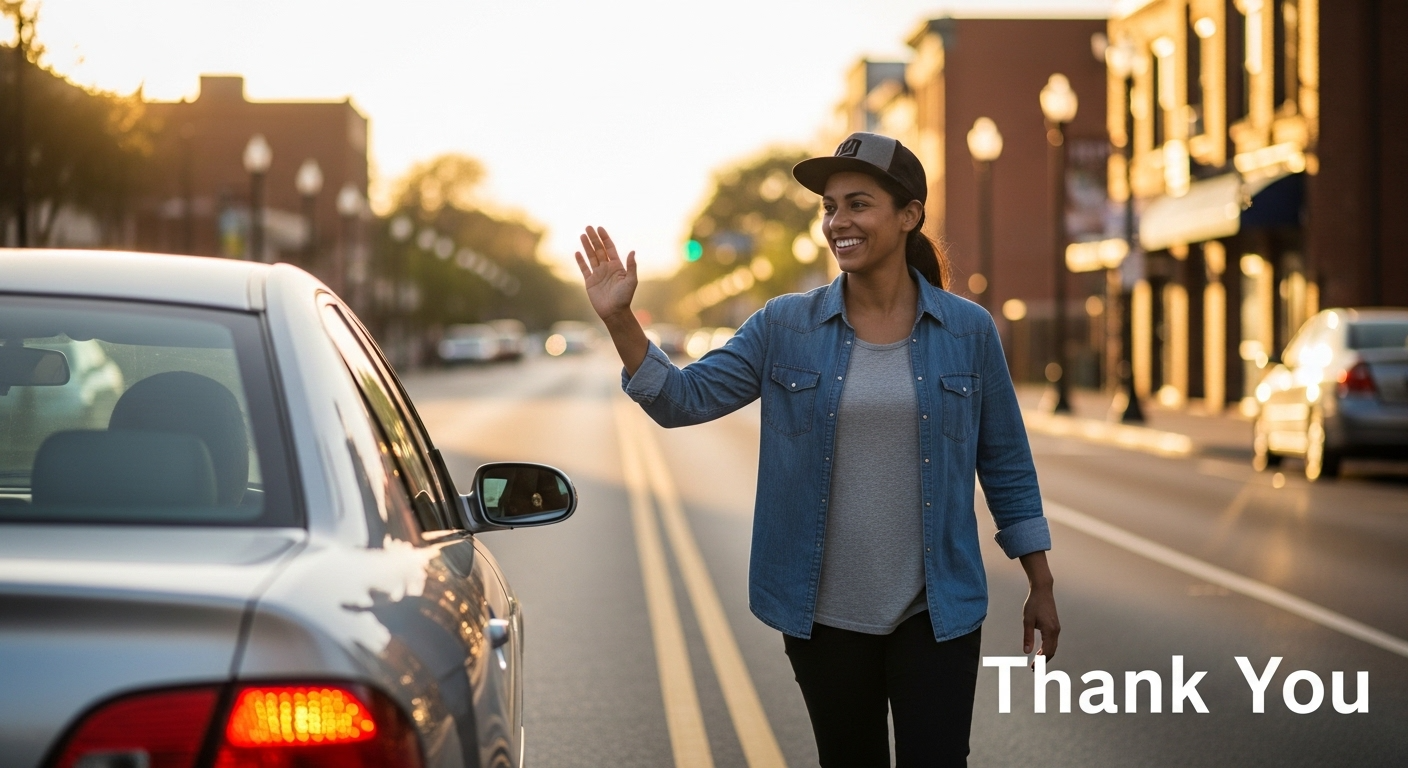
Psychologists Say Waving Thank You at Cars While Crossing the Street Reveals Specific Personality Traits
The light changes, the signal blinks to life, and you step off the curb. A car slows. You walk in front of it, feel the engine idling a few feet away, and almost without thinking, your hand lifts in a small wave. A tiny moment, barely noticeable. Yet psychologists say that little gesture might reveal more about who you are than almost anything else you do in a day.
Two Types of People at Every Crosswalk
Watch any busy intersection long enough and a pattern emerges. Some pedestrians cross without a glance at the car that stopped, eyes already fixed on where they are going. Others tilt their head, raise a palm, offer a quick smile as they pass. Sometimes the wave is barely there, just a flick of the wrist. Sometimes it is almost theatrical, as if the person is both grateful and faintly apologetic for stepping into someone else’s path.
Psychologists have become increasingly interested in micro-interactions like these. Unlike planned displays of politeness, a crosswalk wave happens in the space of a heartbeat. There is no time to think, no opportunity to compose a better version of yourself. That is precisely what makes it so revealing. It is an unguarded flash of personality, caught in the glow of a car’s headlights.
What researchers keep finding is that people who instinctively wave their thanks at drivers tend to cluster around specific traits: higher agreeableness, stronger empathy, a more cooperative mindset, and an internalized sense of social responsibility. A small gesture turns out to be a symptom of a much larger way of moving through the world.
What the Wave Actually Communicates
When your hand lifts at a crosswalk, you are doing something more than being polite. You are showing how your mind weighs relationships, even with strangers you will never see again.
In that fraction of a second, several things are happening beneath the surface. Your brain is registering the driver not just as a vehicle in your path but as another person making a small cooperative choice. You are acknowledging that kindness, even when it is expected or legally required, still deserves a response. You are treating the street not as a strip of concrete with competing rights but as a shared space where people briefly coordinate their movements together.
This tendency aligns closely with agreeableness, one of the core dimensions in the Big Five personality model that psychologists use to map human character. Agreeable people are more considerate by default, more drawn toward cooperation than competition, and more sensitive to the emotional texture of everyday interactions. Waving at a driver feels natural to them in the same way that holding a door or saying excuse me feels natural, not because they are performing virtue but because they genuinely experience social spaces as collaborative rather than contested.
Empathy plays a closely related role. You cannot see the driver’s life from the crosswalk, but something in you registers that their time has value too. Maybe they are running late. Maybe they are tired. The wave rises as a kind of acknowledgment that you have stepped, briefly and temporarily, into their trajectory, and you appreciate that they slowed for you.
A Micro-Ritual That Stitches Communities Together
Urban life is full of near-collisions managed entirely through invisible social agreements. Pedestrians, cyclists, and cars thread past each other constantly, often with inches to spare. Most of the time we move through this choreography half-distracted, eyes on our phones, minds elsewhere. Against that backdrop, the crosswalk wave stands out as something deliberate. It says, I saw what you did there. I see you.
Psychologists describe these kinds of repeated small behaviors as social micro-rituals: tiny voluntary actions that hold communities together even between strangers who will never speak. A nod on a running trail. A murmured after you at a doorway. A hand reaching to hold elevator doors for someone a few steps behind. None of these are required. That is exactly what gives them meaning. They are signals, however brief, that we are paying attention to the people around us.
Research into prosocial behavior has found that these small actions carry outsized effects on both mood and identity. When you wave at a driver and they nod back, you have turned what could have been a pure transaction into something closer to a connection. It lasts less than a second, but your brain registers it as a completed social loop and releases a small amount of dopamine in response.
People who engage in one kind of prosocial micro-ritual tend to engage in others as well. Someone who habitually waves at cars is statistically more likely to hold doors for strangers, thank service workers even when rushed, make space for others on crowded public transport, and offer directions to someone who looks lost before being asked. These behaviors share a common root: a worldview that assumes your actions affect other people’s experience of the day, and that this matters.
The Personality Traits Most Commonly Linked to the Wave
While every person is shaped by their own history and context, observational research has identified some consistent patterns. People who regularly wave at drivers tend to score higher on agreeableness, which shows up as instinctively acknowledging someone else’s effort and feeling that saying thank you, even nonverbally, is simply the right thing to do. They tend to score higher on empathy, imagining the driver’s perspective and responding to it. They often show higher conscientiousness, treating politeness as part of how responsible people behave in shared public spaces. They lean toward what researchers call a prosocial orientation, a general drive to keep social interactions smooth and cooperative. And they tend toward lower hostility and lower cynicism, meaning they are less likely to see drivers as adversaries and more inclined to treat them as partners in a shared flow of movement.
That tiny wave, in other words, is something like a fingerprint of your deeper tendencies.
Not Waving Does Not Make You a Bad Person
Not waving is not automatically a sign of selfishness or rudeness. The brain is more complex than that, and crosswalks are far busier inside our heads than they appear from the outside.
Some people cross with their attention turned deeply inward, occupied by anxiety, unfinished thoughts, or the mental rehearsal of conversations they are about to have or already regret. Their lack of gesture comes from cognitive overload, not entitlement. By the time they have registered that the car stopped, they are already somewhere else entirely.
Others grew up in cultures or families where the gesture simply was not part of the script. They were taught, explicitly or not, that crossing when you have the right of way is a neutral act. Saying thank you for something that is already your legal due can even feel like unnecessary deference in some contexts, a politeness that edges toward self-erasure rather than genuine appreciation.
There are also people who are naturally more independent and self-contained in how they move through the world. Not selfish, but internally oriented. Where a highly agreeable person feels a small glow from a polite exchange, a more self-contained person may feel genuinely nothing at all. The stillness of their hand is not aggression. It is simply neutrality.
Psychologists emphasize this nuance because it is easy to construct quick moral judgments from the sidewalk. The truth is that most human behavior in public is driven by attention, habit, culture, and current mood, none of which say much about a person’s fundamental decency.
Why It Feels Wrong Not to Wave
For many people, failing to wave creates a small but real discomfort. If you recognize that feeling, you know the experience of moving too quickly past the moment and carrying a faint itch of social guilt for the next half a block. That discomfort comes from your brain’s craving for completion.
Social psychologists describe reciprocity as one of the most fundamental rules of human relations. When someone does something for you, even something as small as slowing their car, your mind automatically scans for how to rebalance that exchange. The wave is your quick, efficient way to close the loop. Without it, the interaction feels unfinished. The same mechanism is at work when someone holds a door and you say thank you on autopilot. It is not just manners. It is your mind tidying up its social ledger.
Research shows that even symbolic reciprocation, a nod, a moment of eye contact, can increase people’s sense of connection and reduce feelings of anonymity in public spaces. In dense cities where it is easy to feel invisible and interchangeable, these glancing acknowledgments remind both parties that they are occupying a shared human story, not just a parallel commute happening to unfold in the same location.
What Your Crosswalk Habits Say About Your Wider Life
If you are someone who almost always waves, you might notice a broader pattern. You are probably also the one who says sorry when someone walks into you rather than the other way around. You likely go slightly out of your way to catch a stranger’s eye on the street, not because you are particularly extroverted but because making the world feel a little less mechanical matters to you. You are probably more uncomfortable with unacknowledged tension, more invested in harmony, more attuned to the subtle frictions that build up in a room before anyone names them.
People who regularly wave at cars often describe themselves as conflict-averse, preferring smooth interactions to confrontational ones. They tend to be quick to give others the benefit of the doubt, telling themselves the other person is probably having a hard day. They are emotionally attuned to body language and tone, and they care about fairness while still being willing to bend a little to keep the peace.
That set of traits is genuinely valuable. It is also worth noticing that the same qualities that make you considerate and socially generous can leave you vulnerable to burnout when your care goes unreciprocated, or to quiet resentment that builds when you consistently extend courtesy that does not come back.
Can Adjusting a Small Habit Shift Something Bigger
Psychologists have long been interested in a specific question: if behaviors reflect personality, can changing a behavior nudge the personality itself? If someone starts intentionally waving at drivers, does that shift, however slightly, how they relate to strangers over time?
Personality is relatively stable, but many researchers believe in the power of small repeated acts to reinforce and cultivate certain orientations. When you choose to wave, even if it feels mechanical at first, you are quietly rehearsing a way of seeing things. You are practicing the script that says other people’s small efforts are worth noticing. Rehearsed long enough, scripts become beliefs. Beliefs become habits of perception. And habits of perception shape the kind of social world you experience.
Drivers notice this too. Many report a subtle but real lift in mood when a pedestrian acknowledges their courtesy. They feel less like anonymous rule-followers and more like participants in something shared. That small shift can ripple forward, into how patiently they drive at the next crossing, how generously they merge, how much goodwill they carry into the next interaction.
The Street as a Mirror
Next time you step into a crosswalk and a car slows for you, pay attention, not just to the traffic but to yourself. Does your hand lift automatically? Does the moment pass before you think to respond? Do you feel anything at all?
These micro-choices are a kind of quiet x-ray. In a few seconds, without any deliberation, they show how you balance your own rights against others’ efforts, how you respond to being accommodated, and what kind of shared space you are helping to create simply by moving through it.
In the larger picture of the world, a hand wave at a crosswalk is a laughably small thing. But human societies are built from exactly these moments, stacked on top of each other across decades. They determine whether a street feels cold or warm, whether a city feels inhabited by strangers or by neighbors.
The thank you wave exists in the space between law and obligation, between safety and warmth. Nobody will fine you for skipping it. Nobody will thank you publicly for doing it. It is, for most people, completely invisible. And yet, according to psychologists, this invisible thing quietly maps who you are and what kind of world you are helping to build, one crosswalk at a time.
FAQ
Does not waving mean I have a bad personality? Not at all. Personality is complex and many things influence whether someone waves, including attention, mood, cultural background, and habit. Not waving does not mean you are rude or unkind. It may simply mean you were focused elsewhere or were raised with different social norms.
Is there actual research behind this? While few studies examine the crosswalk wave specifically, a substantial body of research looks at comparable micro-rituals and small acts of public politeness. These behaviors consistently correlate with agreeableness, empathy, and prosocial orientation across multiple studies.
Can adopting the habit actually make me more considerate over time? Repeated small acts can reinforce certain mindsets. Waving, saying thank you, making eye contact, and similar behaviors can deepen a sense of shared responsibility and gratitude over time. It will not completely reshape your personality, but it can strengthen certain positive tendencies that are already there.
Do drivers actually notice or care? Many do. Drivers frequently report feeling more appreciated and more patient when pedestrians acknowledge their courtesy. The wave turns an anonymous pause into a brief moment of human recognition, which can influence how kindly they behave at the next crossing.
Is there ever a reason not to wave? Yes. Safety comes first. In a complex or fast-moving crossing, keeping your attention on traffic is more important than gesturing. In some situations, people may also feel unsafe making eye contact or drawing attention to themselves. The value of the wave always sits below the priority of staying alert and protected.