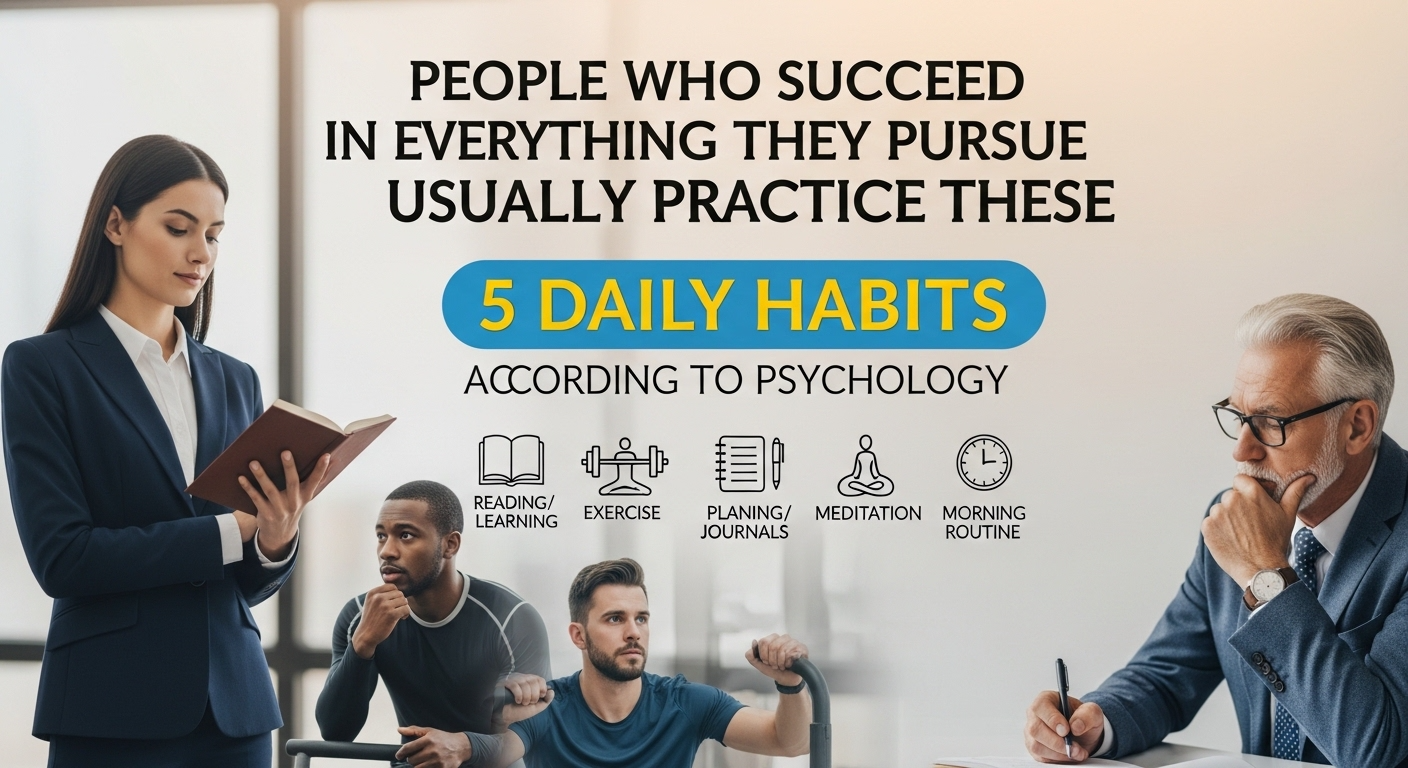
People Who Succeed in Everything They Pursue Usually Practice These 5 Daily Habits, According to Psychology
What separates the person who masters one skill from the person who excels across multiple domains? It’s rarely raw talent or luck. Watch high achievers closely enough and you’ll notice they operate by an entirely different set of rules than most people around them.
These aren’t the polished morning routines you’ve read about a thousand times. They’re unglamorous, sometimes uncomfortable practices that rewire how the brain approaches challenge, failure, and growth. Psychology research reveals five specific daily habits that distinguish people who actually accomplish their ambitions from those who merely talk about them.
They Deliberately Reject Comfort Early in the Day
High achievers don’t wait for motivation to strike. They manufacture discomfort before their willpower depletes. This might mean a cold shower, an intense workout, or tackling the most difficult task before checking email or social media.
Psychologist Roy Baumeister’s research on ego depletion shows that willpower functions like a muscle — it weakens as we make decisions throughout the day. High achievers understand this and protect their peak mental state for what matters most, not for what feels easy.
The pattern is consistent: choose friction first. By 9am, they’ve already done something that required pushing past resistance. This sets the neural pathway for the entire day. Every subsequent challenge feels smaller by comparison.
Behavioural psychology researcher Dr. James Chen puts it plainly: “Willpower is a finite resource. People who understand this protect their peak hours like they protect their money. They spend them on what counts, not on what’s comfortable.”
They Practice Strategic Incompetence Daily
This sounds counterintuitive: successful people intentionally spend time being bad at things. Not their area of expertise — something entirely new or deliberately humbling.
A CEO might take a beginner’s pottery class. A surgeon might struggle through a language app. The common thread isn’t the activity — it’s the deliberate exposure to failure in a low-stakes environment.
This practice serves two psychological functions. First, it normalises failure and strips away the shame that paralyses most people. Second, it keeps the growth mindset active. When you regularly experience struggle and progress in small ways, you train your brain to see challenges as solvable rather than threatening.
When you regularly practice being a beginner at something, the feeling of not knowing stops being terrifying. You learn to sit with incompetence without it becoming a statement about your identity. That shift carries directly into the areas where your ambitions actually live.
They Seek Rejection as Data, Not Judgment
Most people avoid rejection. Achievers court it deliberately. A sales professional might make five cold calls specifically hoping to hear no. A writer submits work knowing rejection is probable. An entrepreneur pitches knowing the odds aren’t in their favour.
The shift is subtle but profound. They reframe rejection from personal failure to useful information. Neuroscientist Tara Marshall’s research shows that people who actively seek feedback and criticism develop stronger neural pathways for learning and adaptation.
By seeking rejection regularly, they inoculate themselves against its sting. The fear loses power through repeated exposure. More importantly, they gather real data about what works and what doesn’t — intelligence that people who hide from rejection never obtain.
Dr. Miranda Walsh, whose work focuses on neuroscience and decision-making, describes it this way: “People who achieve at the highest levels treat rejection like a scientist treats a failed experiment — as data, not as a verdict on their worth. The emotional detachment is learned through practice.”
They Document Outcomes Without Self-Judgment
High achievers maintain records of their attempts, results, and contributing variables. Not as judgment, but as observation. Did they sleep well? Eat properly? Exercise? What happened with the outcome? The documentation is clinical, not emotional.
This practice creates accountability without shame. It reveals patterns invisible in memory alone. It provides evidence of progress that motivation-driven people can’t access on difficult days when everything feels stalled.
The act of writing forces clarity. Vague intentions like “I’ll be more disciplined” become measurable when you’re tracking actual sleep hours and specific task completion. Psychologist BJ Fogg’s research on behaviour change shows that tracking increases consistency by 40 percent or more.
What matters is tracking both the inputs you control — preparation time, sleep, approach — and the outputs that result. Over weeks and months, patterns emerge that are invisible in the moment but obvious in the record.
They Protect Time With Nothing to Do
Paradoxically, high achievers are fiercely protective of time with nothing to do. Not meditation necessarily — but genuine absence of stimulus and task. Walks without podcasts. Drives without music. Waiting time unoccupied by screens.
Neuroscientist Marcus Raichle discovered the brain’s default mode network, which activates during rest and is crucial for creative thinking, problem-solving, and memory consolidation. People who never allow this network to activate are working with a diminished cognitive toolkit, regardless of how hard they try during active hours.
Achievers recognise that breakthroughs rarely happen during intense focus. They emerge during recovery. The shower insight, the walk solution, the idea that arrives in that quiet moment between tasks — these require the wandering mind, not the concentrated one.
Dr. Adrian Klopp, a neuroscience researcher, argues: “We’ve medicalised boredom when we should be celebrating it. The brain needs periods of low activation to synthesise learning and generate novel solutions. When people eliminate boredom entirely, they’re cutting themselves off from a fundamental cognitive resource.”
How These Habits Work Together
These five habits don’t operate independently. They reinforce each other in ways that produce disproportionate results.
Seeking rejection builds resilience that makes physical discomfort feel manageable. Strategic incompetence normalises failure in ways that reduce emotional avoidance when documenting outcomes. Protected rest time allows the brain to process both setbacks and victories more effectively. Discomfort practice early in the day generates the willpower reserves that make the other four habits more sustainable.
The achiever’s day looks chaotic from outside — discomfort, deliberate failure, sought rejection, uncomfortable documentation, and protected emptiness. But the internal experience is one of growing mastery, because each element trains the brain to interpret challenge as opportunity rather than threat.
Frequently Asked Questions
How long before I see results from these habits? Internal changes — confidence, resilience, better problem-solving — typically emerge within six to eight weeks. External results usually require three to six months of consistent practice. The key is measuring habit adherence, not outcomes, during the early period. Did you do the practice? That’s the only question that matters at first.
Do I need all five habits, or can I pick and choose? Start with one. Beginning with all five simultaneously almost guarantees failure. Add them sequentially every two to three weeks. The research shows that the combination is more powerful than any single habit, but arriving there gradually is far more sustainable.
What if I miss a day? One missed day doesn’t matter. Missing three in a row suggests the habit isn’t properly integrated yet. Return to it without guilt or self-commentary. Research shows that occasional misses don’t derail progress — only giving up does.
Can I substitute different activities for the specific examples? The activity matters less than the principle. If cold showers feel impossible, intense exercise provides similar stress exposure. If pottery class seems impractical, language learning or cooking serve the same function. Match the principle to your actual life.
What’s the biggest mistake people make when implementing these habits? Quitting too early while expecting immediate external results. The practices feel awkward for weeks — that’s normal and expected. They feel awkward because they’re rewiring your nervous system. Persisting through the awkwardness is precisely when the real change happens.
How do I track these habits without becoming obsessive about it? Use a simple binary system: did it or didn’t. A checkmark on a calendar is sufficient. Avoid lengthy journaling at first because it becomes a barrier in itself. Keep tracking so simple that it requires almost no willpower.
What if my work environment makes some of these practices difficult? Adapt at the margins. Discomfort practice can happen before work. Incompetence practice works during lunch or evenings. Rejection seeking can occur outside professional contexts. Protection of boredom can happen during commutes if you resist filling them with podcasts. None of these requires a complete life overhaul.