No Other Nation Has Tried What China Is Attempting With Its New Nuclear Plant Built to Mass-Produce Industrial Heat
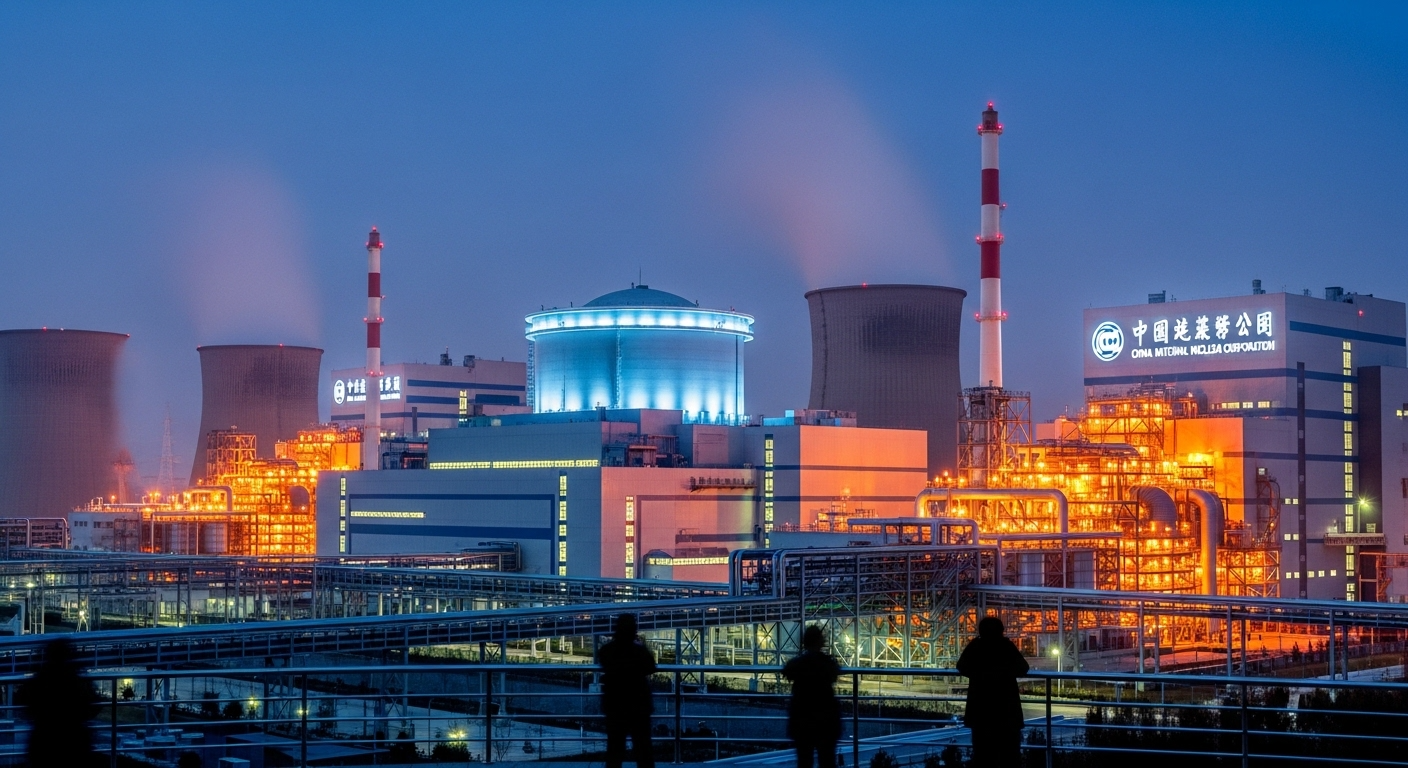
The air over the Gobi Desert looks almost empty at first glance — just light, distance, and a slow shimmer of heat. But if you stand still long enough, you can feel the hum of something larger building at the horizon. Trucks crawl along new roads, cranes pivot against a sky the colour of bleached bone, and in the centre of it all rises a set of strange rounded structures that look less like a classic power plant and more like the skeleton of a new idea taking shape.
This is where China is trying something no other nation has seriously attempted: a nuclear plant designed not simply to make electricity, but to mass-produce industrial heat. Invisible, searing, world-shaping heat.
The Heat Behind Everything We Touch
We almost never think about industrial heat. It doesn’t flick a light switch or charge your phone. It doesn’t glow in your living room. But it is there, quietly behind almost everything you touch.
The rebar inside a high-rise? Born in a blast furnace above 1,500°C. The cement in a city’s foundations? Fired in kilns that look like metallic volcanoes, burning limestone and fossil fuels day and night. Fertilisers, plastics, glass, synthetic fibres, fuels, even the hydrogen people hope will someday clean up shipping and aviation — all of them drink heat in volumes that make household energy use look like a candle beside a bonfire.
Today, nearly three-quarters of industrial heat worldwide comes from burning fossil fuels. For countries that built their growth on coal, like China, that dependency runs deep. So when Chinese engineers stand under the desert sun and talk about sending nuclear heat instead of coal into the arteries of industry, it isn’t a minor tweak. It is a gamble on rewriting an entire layer of the energy system — one most of us never see.
Reimagining What a Nuclear Plant Is For
If you close your eyes and picture a nuclear plant, you probably see the same thing most people do: tall cooling towers exhaling white plumes, a fenced perimeter, a stern sense of danger and precision. Electricity hums out into the grid. It’s a familiar story — but it’s also an old one.
China’s new high-temperature gas-cooled reactor project is quietly rewriting that script. Instead of focusing only on electrons, it is designed to generate very high-temperature heat that can be piped, stored, or integrated into heavy industrial processes — steel, cement, chemicals, hydrogen production — sectors that normally burn staggering amounts of coal, oil, and gas.
This is what makes the plant remarkable: it isn’t just another source of clean electricity. It is, by design, a direct challenger to fossil fuels at the heart of industrial civilisation — the huge furnaces, kilns, and reactors that stay out of sight but define how we build and fuel modern life.
A Different Kind of Reactor, Built for Fire
Inside China’s new reactors, instead of the water used in most conventional designs, helium gas carries the heat — an inert, clear fluid that doesn’t corrode metal or boil into steam. The fuel isn’t the familiar solid rods but tiny black pebble-sized spheres, each grain wrapped in hard ceramic shells so tough that engineers sometimes call them miniature containment vessels.
Where traditional reactors heat water to around 300°C, these helium-cooled designs can reach temperatures in the 700 to 900°C range, with future generations aiming even higher. That extra heat is the entire point. It lets the reactor do things beyond spinning turbines. It can directly drive chemical reactions, crack water to make hydrogen, distil and refine, bake and melt, feed entire industrial parks with a steady non-fossil source of process heat.
Think of it as a heat engine with branches: some output goes to generators for electricity, some to insulated pipelines feeding factory complexes, some to thermal storage tanks for later use. It is less like a single power plant and more like a campus built around a sun-hot heart.
Why No One Else Has Really Tried This
The idea of using nuclear reactors for process heat is not new. Engineers have discussed it for decades. In the 1970s, experimental high-temperature reactors were tested in the United States and Germany. Many were successful on technical grounds. And yet they withered.
The obstacles were not just physics. They were politics, economics, and timing. Oil shocks came and went. Public distrust of nuclear energy hardened after major accidents. Fossil fuels stayed cheap, abundant, and politically entrenched. Industrial companies, already comfortable with their coal and gas furnaces, had little reason to gamble on unfamiliar nuclear pipelines.
To build an entire plant around the idea that nuclear heat could anchor national industry requires a rare combination: long-term planning, huge state capital, tolerance for experimentation, and a political system willing to push through local resistance. In other words, it requires a country willing to act like a single, focused investor with decades-long patience.
China, for better or worse, fits that role more than almost anyone else on Earth right now.
The Gobi as a Test Bed for the Future
Walk the dust-blown perimeter of the site and you can sense the scale of the ambition. The desert doubles as a canvas. Transmission lines march away toward cities. Nearby, industrial zones are already pencilled in on planning maps — steel, chemicals, materials, possibly hydrogen.
Engineers talk about the project not as a single plant but as a template. The dream is to build dozens, maybe hundreds, of similar units across the country close to energy-hungry industrial clusters. Each would be smaller than the classic behemoth nuclear stations of the past, but far more flexible in what it can serve.
Instead of one massive reactor meant to power a region, picture a family of modular reactors each feeding heat and electricity directly into local factories. Steam lines instead of coal conveyors. Helium-heated exchangers instead of gas burners. The smokestacks still stand, but what comes out of them thins and fades.
Safety, Fear, and the Strange Calm of Pebble Fuel
Nuclear power lives in a strange emotional space. It is both one of the safest energy technologies per unit of energy produced and one of the most feared. Any conversation about a new reactor design dragged those fears along like a long shadow.
The Chinese engineers know this. Part of the reason they chose the high-temperature, helium-cooled, pebble-fuel design is its passive safety features. TRISO fuel pebbles are engineered to hold onto radioactive materials even under extreme heat. The reactor core is shaped and moderated so that if cooling fails, the reaction simply slows as temperatures rise rather than racing out of control.
In theory — and in past experimental tests in other countries — these reactors can survive situations that would be catastrophic for traditional designs. Shut the valves, walk away, and the physics gradually turn the fire down.
If you want to win public acceptance for piping nuclear-generated heat into factories near where people live and work, it helps to be able to say: the fuel itself is built to resist the worst.
From Coal Smoke to Invisible Heat
In Chinese industrial cities, the smell of coal has long been an invisible signature — soot on windows, haze in winter, a faint tang in the back of the throat. Over the last decade, large parts of that visible pollution have been pushed back with aggressive clean-air policies. The air in many places really is better.
But the heat demand remains. Factories do not run on blue skies. They run on steam and flame.
If the new nuclear heat plants work as intended, the transformation will be oddly quiet. There will be no dramatic ribbon-cutting that signals the end of coal. Instead, one plant after another might tap into a thermal pipeline instead of installing a new boiler. A chemical complex might rearrange its guts to accept high-temperature helium-heated exchangers. A steel mill might pilot a new process using hydrogen produced from nuclear heat instead of coking coal.
The city air will not suddenly sparkle, but something deeper will have changed: the story of how things get hot, and what has to burn to make them so.
Why This Matters Far Beyond China
It would be a mistake to see this project as a purely domestic experiment. The world is watching — governments, energy companies, climate scientists, sceptics, and dreamers alike — because the stakes extend far beyond the Chinese desert.
Steel, cement, ammonia, and petrochemicals are some of the hardest sectors to decarbonise. They are responsible for a huge slice of global greenhouse gas emissions, yet they have relatively few mature, scalable alternatives to fossil fuels. Wind turbines and solar panels are spectacular at generating electricity. But high-temperature, always-on industrial heat is harder. Batteries are ill-suited to store vast volumes of concentrated heat economically. Hydrogen made from renewable power can help, but it remains expensive and infrastructure-heavy.
In that context, a network of nuclear heat plants begins to look less like a niche idea and more like a possible backbone for industrial decarbonisation.
There is also a strategic dimension. If nuclear heat for industry becomes real, who controls the designs, the fuel supply, the manufacturing capacity? Will nations become dependent on Chinese reactors and expertise in the same way many became dependent on imported gas and oil? This reality is already creating a subtle race. Countries from Europe to North America to South Korea and Japan are taking a fresh look at high-temperature reactors — not just for climate reasons but to avoid falling behind.
A Story Still Being Written in Sand and Steel
Back at the desert site, the story is still young. Concrete is poured. Reactor vessels are lowered into place. Control systems are wired and tested. There is a smell of dust and hot metal, of insulation and new paint.
Talk to a young engineer there and you might catch the mix of pride and nervousness in their voice. They have grown up in a China where speed is normal — high-speed rail, instant digital payments, sprawling cities that grow overnight. Now they are helping build something that moves at a very different pace: nuclear years, regulatory years, international scrutiny years.
They know the stakes. If the project falters, critics will say the world was right to doubt nuclear innovation. If it works — quietly heating factories without drama, on time and close to budget — it may prove a concept that ripples outward for decades.
We tend to think of climate solutions in bright, visible images: fields of solar panels, elegant wind turbines, sleek electric cars. But the deeper work of transformation often happens in places like this: at the edge of a desert, beside a cluster of nondescript buildings, in the rustle of safety manuals and the glow of screens.
No other nation has yet tried, in such a concentrated and purposeful way, to use nuclear power not just to make electricity but to become a mass-producer of industrial heat. Whether China’s experiment becomes a model to emulate or a cautionary tale to study will depend on engineering details, public trust, economics, and sheer luck.
But beneath all the charts and policy debates lies a simpler truth: the world is, at last, wrestling with the heat that built it. In the shimmer over a desert reactor, we are glimpsing an answer — not complete, not uncontested, but real — to the question of how we might keep the furnaces of civilisation burning without cooking the planet that holds them.
Frequently Asked Questions
Why is China’s new nuclear plant considered unique? Because it is explicitly designed to mass-produce industrial-grade heat, not just electricity. Its high-temperature reactor can deliver heat suitable for heavy industry, potentially replacing coal and gas in sectors like steel, cement, chemicals, and hydrogen production.
What type of reactor is being used? China is using a high-temperature gas-cooled reactor. It uses helium as a coolant and TRISO pebble fuel, which allows it to reach much higher temperatures than conventional water-cooled reactors, making it ideal for industrial process heat.
How does this help reduce carbon emissions? Industrial heat is one of the largest sources of global CO₂ emissions because it relies heavily on burning fossil fuels. By supplying clean nuclear-generated heat directly to factories, these plants can significantly cut emissions in sectors that are otherwise very hard to decarbonise.
Is this reactor design safer than older nuclear plants? It is designed with strong passive safety features. The TRISO fuel pebbles can withstand very high temperatures without releasing most radioactive materials, and the reactor’s physics make runaway reactions less likely. While no technology is risk-free, this design is generally considered to have important safety advantages over older generations.
Could other countries adopt this approach? Yes, in principle. Many nations are studying high-temperature reactors and nuclear process heat, but China is currently moving the fastest at full industrial scale. If its projects prove reliable and economical, other countries may either licence the technology or develop their own versions.
Will this replace renewable energy sources like wind and solar? Not necessarily. Nuclear industrial heat addresses a different problem than most renewables — very high-temperature, around-the-clock process heat for heavy industry. A future low-carbon system may blend renewables for electricity with nuclear and other technologies for industrial heat, storage, and backup power.