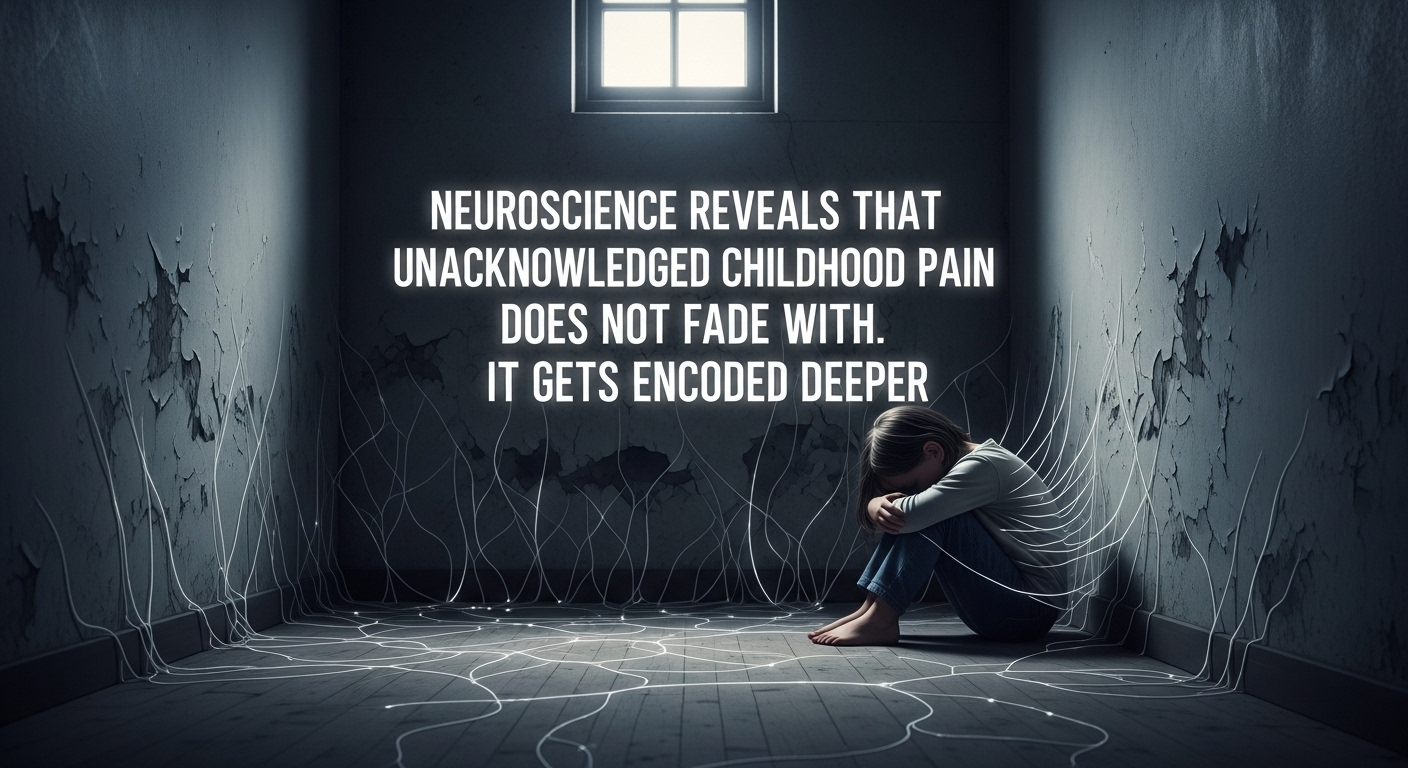
Neuroscience Reveals That Unacknowledged Childhood Pain Does Not Fade With Time. It Gets Encoded Deeper.
Loving parents can cause lasting wounds. That sentence will bother some people, and that reaction is understandable. We have built an entire cultural framework around the idea that good intentions protect children from harm, that warmth and presence are enough to shield a developing brain from pain. But after more than a decade of sitting across from adults who cannot explain why Sunday dinners with their perfectly kind mother leave them clenched and irritable for days afterward, something uncomfortable becomes impossible to avoid. Love and injury are not mutually exclusive. They coexist more often than most people want to admit.
The conventional wisdom goes something like this. If your parents loved you, fed you, showed up to your school events, and never raised a hand against you, whatever discomfort you carry from childhood is yours to sort out. Gratitude should override grievance. You had it good. Move on. But that framework collapses the moment you meet a 38-year-old woman who adores her father and also cannot stop flinching when he raises his voice to call the dog. Something else is operating beneath the story she tells herself about her happy childhood. Something encoded.
What the Neuroscience Actually Says
The research on this is clearer than most people realise. Childhood experiences, particularly emotional ones, do not simply get filed away in a mental cabinet to be retrieved or ignored at will. They become embedded in the architecture of the brain itself. Early life experiences create lasting changes in brain structure and function, essentially becoming biologically encoded in ways that persist long after the original events have passed. The pain does not fade with time. It consolidates.
It is important to be precise about what kind of pain is meant here, because this is not primarily about abuse. It is about the smaller, chronic absences. The moments a child needed emotional attunement and received practical solutions instead. The times a four-year-old’s tears were met with you’re fine rather than tell me what happened. The thousands of micro-moments where a feeling was implicitly dismissed, not out of cruelty, but out of a parent’s own discomfort with emotion or their own unexamined patterns.
These are the injuries that confuse adults most, because they do not come with a clear narrative. There is no villain. There is no dramatic scene to point to. There is just a persistent, low-grade emotional static that shows up in relationships, in body tension, in a sudden flare of irritation that seems wildly disproportionate to whatever triggered it.
Why the Body Remembers What the Mind Forgets
The distinction between implicit and explicit memory is central to understanding this phenomenon. Explicit memory is autobiographical. You remember the event, the date, the details. Implicit memory is different. It stores emotional and sensory information without a conscious narrative attached. You do not remember the event. You remember the feeling. Or more accurately, your nervous system does.
A child whose sadness was routinely ignored may have no conscious memory of any specific incident. But their implicit memory has catalogued the emotional texture of those moments. The tightening in the chest. The learned impulse to swallow tears. The vague sense that needing comfort makes you a burden. By adulthood, this pattern operates automatically.
This is why a forty-year-old can describe their parents as great and their childhood as happy, and in the same conversation describe a pattern of shutting down emotionally the moment anyone gets close to them. They cannot connect the two experiences. Their explicit memory says everything was fine. Their implicit memory tells an entirely different story, one running beneath conscious awareness.
The adults who genuinely enjoy time with their parents are not the ones whose childhoods were perfect. They are the ones whose feelings were taken seriously.
The Encoding Gets Deeper, Not Lighter
Here is what is worth understanding clearly. Unprocessed emotional pain from childhood does not weaken over the decades. In many cases it strengthens. Research on memory encoding shows that our perception of painful childhood experiences evolves over time, shifting with new experiences and cognitive development. The memory does not sit still. It gets reinterpreted, layered, and sometimes amplified by adult experiences that echo the original wound.
Consider this pattern. A child who learned that expressing anger made her mother withdraw does not carry that lesson into adulthood unchanged. She carries it into her first relationship, where her partner’s silence during conflict feels catastrophic. She carries it into her workplace, where she over-apologises after every disagreement. Each new experience that resonates with the original pattern reinforces the neural pathway. The groove gets deeper.
Recent work in trauma psychology confirms that adult relationships actively shape how we remember and process childhood experiences. A painful dynamic with a current partner can actually intensify the emotional charge of a childhood memory that seemed manageable for years. The past and present are not separate compartments. They feed each other in both directions.
This is why some adults reach their mid-thirties or forties and suddenly feel a surge of anger toward a parent they have always described as loving. Nothing changed in the relationship. What changed is that the adult accumulated enough life experience to recognise what was missing, even if they still cannot fully articulate it.
The Anger That Has No Name
The anger is the part that brings people to therapy, and it is also the part that generates the most shame. People will describe it almost apologetically. I know this is ridiculous, but I get so angry when my mother calls. They qualify it, minimise it, stack disclaimers on top of it. Because the cultural script says you should not be angry at someone who loved you.
But the anger makes sense once you understand what it is actually about. It is rarely about the parent as they are now. It is about the child who needed something that was not provided, and the adult who is only now beginning to recognise the cost of that absence. The anger is grief wearing a disguise. It has nowhere else to go.
Small things emerge when you slow down and examine the emotional texture of an otherwise stable childhood. A father who changed the subject when emotions got intense. A mother who praised achievement but never asked how her daughter actually felt. These are not traumas in the clinical sense. They are absences. And absences are harder to grieve because there is nothing concrete to point at, no clear event to name.
This connects to what psychologist Jonice Webb describes as Childhood Emotional Neglect. The experience of having your emotional needs consistently overlooked by otherwise caring parents. It is not what happened to you. It is what did not happen. And that absence leaves a mark the conscious mind struggles to locate precisely because there is no specific memory attached to it.
The Paradox of the Good Enough Childhood
One of the more painful realisations that can emerge from this kind of self-examination is that your parents can have been genuinely good people who genuinely loved you and still have left you with wounds that shape your adult life. These two things are not contradictory. They are simply the reality of being raised by humans who had their own unprocessed pain, their own blind spots, their own implicit memories running quietly in the background of their parenting decisions.
That reckoning does not require loving your family less. It requires understanding yourself more honestly.
The adults who make the most meaningful progress are not the ones who build a case against their parents. They are the ones willing to hold complexity. Your parents loved you and they missed things. You had a good childhood and you carry pain from it. You are grateful and you are angry. All of these can be simultaneously true, and accepting that they can coexist is often the most difficult and most necessary step.
What Acknowledgment Actually Requires
Acknowledgment does not mean parents must sit down and catalogue every emotional misstep they ever made. It means something simpler and harder. Creating space for the adult child’s experience to be real, even when it does not match the parent’s memory of events.
When a parent says I did my best, they are usually telling the truth. But that statement, offered in response to a child’s pain, functions as a door closing. It prioritises the parent’s intention over the child’s experience. Acknowledgment sounds more like: I hear that something hurt you. Tell me more.
Research by psychologist James Pennebaker on expressive writing suggests that putting unnamed emotional experiences into words has measurable effects on both psychological and physical health. The act of articulating what happened, of giving language to the previously wordless, begins to shift implicit memory into explicit territory where it can be examined and worked with. This is why adults who cannot explain their anger often feel relief simply from having someone validate that the anger makes sense. The feeling existed in a kind of internal exile. Bringing it into language brings it into relationship, where processing and change become possible.
Moving Through, Not Past
None of this is about blame. Blame is a dead end. The adults doing this work do not want to build a case against their mothers and fathers. They want to understand why they feel what they feel. They want to stop being blindsided by emotional reactions that seem to arrive from nowhere. They want to love their parents without that love being laced with an ache they cannot name.
The path forward involves willingness to hold complexity over extended time. It involves recognising that the brain encoded those early lessons deep, deeper than logic, deeper than gratitude, deeper than the story told about a happy family. But encoding is not destiny. What gets wired can be rewired. What gets stored in silence can be brought into language.
The first step is the one most people resist longest. Admitting that the anger is real. That it belongs to you. That its existence does not cancel out the love, and the love does not cancel out the anger. Both are true. Both have always been true.
Sitting with that discomfort, rather than explaining it away, is where the real work begins. And the real work, difficult as it is, produces something that the original coping strategies never could. Understanding that is genuinely yours.
Read More: For more psychology, mental health, and wellbeing content written for Australian readers, visit wizemind.com.au