My Wife Does Not Make My Pulse Race Anymore — She Makes My Nervous System Calm Down, and It Took Me Forty Years to Understand the Difference
The love that saved my marriage was the opposite of everything I had been taught love was supposed to feel like.
Most people believe that real love keeps its electricity. That a relationship worth staying in never fully loses its charge. The whole culture reinforces this idea in ways so pervasive they become invisible — songs about racing hearts, films where couples in their sixties still look at each other the way you look at something you might lose. The unspoken message in all of it is clear: if your pulse has stopped racing, something has gone wrong. Something has died. You have settled for less than you deserved.
I believed this for a long time. Through the first decade of my marriage, through the second, and well into the third. And believing it nearly cost me everything.
When the Spark Fades and Nobody Tells You What Comes Next
My wife and I met in a community college pottery class in the early 1980s. I was terrible at pottery. I still am. But when my bowl collapsed for the third time and she laughed, something happened in my chest that I can only describe as an electrical malfunction. My hands shook. My mouth went dry. I could not think of a single intelligent thing to say, so I said something stupid, and she laughed again.
That was the beginning.
For years afterwards, I measured the health of our relationship by whether I still felt that jolt when she walked into a room. And when the jolt faded, as it does, as it must, I panicked quietly. I did not tell her. I did not tell anyone. I just carried a low-grade worry that we were running out of something essential — that the thing holding us together was slowly losing pressure, and that there was nothing I could do but watch it happen.
We went to marriage counselling in our forties. What I have not written about before is the specific moment in that counsellor’s office when I finally said out loud what I had been carrying privately for years: I do not feel the spark anymore.
The counsellor — a woman in her sixties with reading glasses on a chain — looked at me with something between patience and pity and said one word: Good.
I wanted to argue. I wanted to explain that good was entirely the wrong response, that losing the spark was losing something vital, that she had misunderstood what I was describing. But she held up her hand.
What you are describing, she said, is your nervous system growing up.
The Biology of New Love That Nobody Explains Honestly
It took me another fifteen years, a significant health scare at fifty-eight, and a lot of quiet early morning walks before what she said fully landed.
Here is what I have come to understand about that racing pulse at the pottery class all those years ago. That electrical malfunction in my chest was my sympathetic nervous system activating. Fight or flight. Adrenaline. Cortisol. My body was responding to my wife the way it responds to novelty and potential threat, because research on neural pathways suggests these experiences can activate remarkably similar systems. The reason new love feels like a drug is because it is one. Your body is flooded with chemicals designed to make you hyper-alert, slightly irrational, and intensely focused on the source of the stimulation.
This is useful. It gets you across the room. It makes you say stupid things to women in pottery classes. But it is not sustainable, and it is not — I now believe — the deepest or most important thing love can do to a body.
What happened over the following decades, so slowly I could not see it, was that my wife’s presence began activating a completely different system. The parasympathetic nervous system. The one that slows your heart rate rather than accelerating it. The one that tells your body it is safe — that you can rest, that you can put down whatever you have been carrying, that the scanning can stop.
My wife no longer makes my pulse race. She makes my blood pressure drop. She makes my breathing slow. When she sits beside me on a Wednesday evening, something in my chest unlocks that I did not even know was locked until the moment it releases.
And this, I have come to believe, is the more profound thing. The more radical thing. The thing nobody writes songs about because it does not photograph well.
What Co-Regulation Actually Means in a Long Marriage
Attachment researchers have identified a process they call co-regulation — the idea that two people who have been together long enough begin to regulate each other’s nervous systems. Your partner’s calm becomes your calm. Their breathing influences yours. Over time, long-term couples synchronise in ways that are measurable and physiological and entirely invisible to both people experiencing it.
This is what a forty-year marriage builds. Not the adrenaline of novelty, but the deep biological infrastructure of safety. Two nervous systems that have learned, through thousands of ordinary moments, how to settle each other down.
The difficulty is that a calm nervous system does not announce itself. A racing heart is impossible to ignore. Calm just feels like nothing — like the absence of something. And when you have spent your life measuring love by its intensity, its absence feels like loss rather than arrival.
I remember the first time I recognised it consciously. My wife survived breast cancer in her late forties. During her treatment I sat in hospital waiting rooms for hours at a time, and my body was wrecked — clenched jaw, shallow breathing, shoulders up around my ears. Then she would come out of the treatment room, pale and exhausted, and reach for my hand, and something in me would release. Not excitement. Not a spark. Just a profound unclenching. Shoulders dropping. Jaw softening. The ability to breathe again.
My body was telling me something my mind had not caught up with: this woman is my safety. She is the place where my nervous system goes to rest.
The Confusion Between Calm and Settling
The cultural vocabulary we have for love is almost entirely drawn from the early stages of it. The racing pulse. The obsessive thinking. The electric awareness of the other person in any room. These experiences are real and they are powerful, and they are also produced by a neurochemical state that the body cannot and should not sustain indefinitely.
When those chemicals normalise, as they do for everyone in every long relationship, the silence they leave behind feels like loss. Like something has gone wrong. Like the love that was there has quietly departed, leaving only habit and history and the accumulated furniture of a shared life.
This confusion — between the fading of adrenaline and the fading of love — is responsible for enormous unnecessary suffering in long relationships. People leave marriages that are working because they no longer feel the thing that was only ever supposed to be the beginning. They mistake the arrival of safety for the departure of love.
What nobody tells you early enough, because it does not fit the story culture wants to tell about romantic love, is that the destination is not more of what you felt at the start. The destination is something else entirely. Quieter. Less cinematic. More profound.
What Nearly Losing It Taught Me About What It Was
We nearly divorced in our early fifties. What I remember from that period was not primarily sadness or anger, though both were present. What I remember most is the constant low-level activation of living in that uncertainty. Walking into my own house and feeling my body tighten because I did not know what kind of reception I would get. That is what the breakdown of co-regulation feels like in a body. Your own home becomes a place where your nervous system cannot rest. You are always slightly on guard. Always slightly vigilant. Never fully able to put your shoulders down.
We fought our way back. Through counselling, through hard and necessary conversations, through the grinding daily work of rebuilding trust. What came back was not the spark. What came back was the quiet. And having experienced its absence, I understood for the first time what the quiet actually was.
It was not the absence of love. It was love in its most functional and most durable form.
The Wednesday Morning Test
My wife and I have sat at the same café table every Wednesday morning for years. We do not always have much to say. Sometimes she reads something on her phone while I watch the street outside, and we exist in a shared quiet that would look, from outside, like two people who have simply run out of things to talk about.
From inside, it feels like the safest place on earth.
I think about my parents when I think about this. My father worked double shifts. My mother managed a household budget that had no right to work. They were not romantic people in any visible sense. I never saw them dance. I rarely saw them kiss. But every evening when both of them settled into their chairs, the whole house changed. Five children, chaos throughout the day, but when both of them were there and settled, something shifted in the air. The house became safe.
I did not have a word for that then. I do now. Two nervous systems that had learned, through decades of ordinary life, how to signal safety to each other. Not through grand gestures or sustained romance. Through presence, reliability, and the quiet consistency of simply being there.
What Long Love Actually Feels Like in the Body
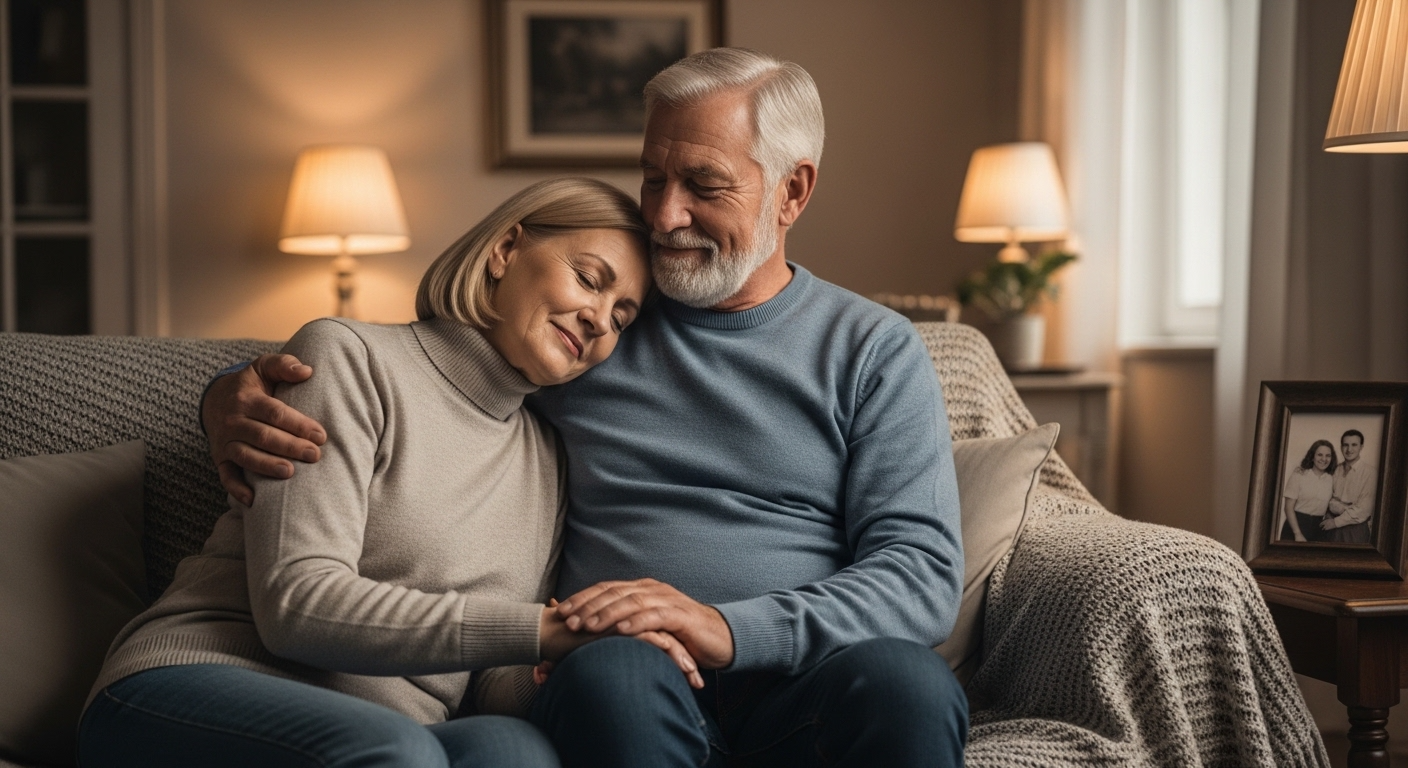
My wife is in her sixties now. She has grey in her hair and reading glasses she is always misplacing. She falls asleep on the couch most evenings before nine. When she does, her breathing changes — becomes slow and deep — and I notice that mine changes too. My chest loosens. My thoughts slow. The low hum of background anxiety that I carry, which I think most people carry but rarely name, goes quiet.
She does this without trying. Without knowing. She does it by being there.
If you are in a long relationship and you carry the quiet worry that the absence of racing hearts means something has gone wrong, I want to suggest a different test. Not what you feel when your partner does something exciting or unexpected. What you feel when they simply sit down beside you.
Does your breathing change? Do your shoulders drop, even slightly? Does something in your chest release in a way you would not notice if you were not paying attention?
That is not the absence of love. That is love doing precisely what it was built to do — not in the dramatic early phase where it floods you with adrenaline and makes you irrational, but in the deep phase where it does something far more useful and far more rare: it makes you safe.
I wasted years mourning the spark. Years measuring our relationship against a standard that was only ever designed for beginnings. Years confusing calm with indifference, safety with settling, the parasympathetic nervous system with the absence of everything that mattered.
The distinction between a racing pulse and a calm nervous system, between adrenaline and safety, between the spark and the quiet — it took me forty years of marriage to understand it fully. I am glad I stayed around long enough to learn it. And I am glad, every Wednesday morning at that café table, that she did too.
At a Glance
| Early Love | Long Love |
|---|---|
| Sympathetic nervous system activated | Parasympathetic nervous system activated |
| Racing pulse, adrenaline, cortisol | Slowing heart rate, dropping blood pressure |
| Body responds as if to novelty or threat | Body responds as if to safety |
| Exciting and unsustainable | Quiet and deeply sustaining |
| Photographs well, generates good stories | Invisible from outside, profound from inside |
Frequently Asked Questions
Is it normal for the early excitement in a relationship to fade? Completely normal and biologically inevitable. The neurochemical state that produces early romantic excitement — high dopamine, adrenaline, and cortisol — cannot be sustained indefinitely. Its fading is not a sign that love is ending. It is a sign that the relationship is maturing into something different and, in important ways, more durable.
What is co-regulation in a long-term relationship? Co-regulation is the process by which two people in a long relationship begin to physiologically regulate each other’s nervous systems. Over time, a partner’s presence, breathing patterns, and emotional state can calm or activate your own nervous system in measurable ways. It is one of the deepest and most invisible things a long relationship builds.
How do you tell the difference between the calm of genuine long love and the numbness of a relationship that has actually ended? The clearest test is what your body does in your partner’s presence. Genuine long-term love tends to produce a release of tension — shoulders dropping, breathing slowing, a subtle unclenching — even without any particular excitement. Numbness or the end of love tends to produce flatness or, more tellingly, a subtle ongoing vigilance or tightening rather than release.
Is it possible to rebuild co-regulation after it has broken down? Yes, but it requires the consistent rebuilding of safety through behaviour over time — through reliable follow-through, honest communication, and the gradual accumulation of experiences in which the relationship functions as a safe place rather than a threat environment. It is slow and it is unglamorous and it is entirely possible.
Why does culture focus so much on the early excitement of love rather than the mature version? Because early excitement is visible, dramatic, and tells a good story. The calm of long love is quiet and looks, from outside, like nothing particularly remarkable. It does not photograph well. But the people who have experienced both generally report that the quiet version is the more profound one.
What should someone do if they are confusing the fading of early excitement with falling out of love? Pay attention to the body rather than the narrative. The question is not whether your partner still makes your heart race. The question is what your nervous system does in their presence — whether their being there produces a release or a tightening. That distinction is a more reliable guide to the actual state of the relationship than any amount of intellectual analysis.