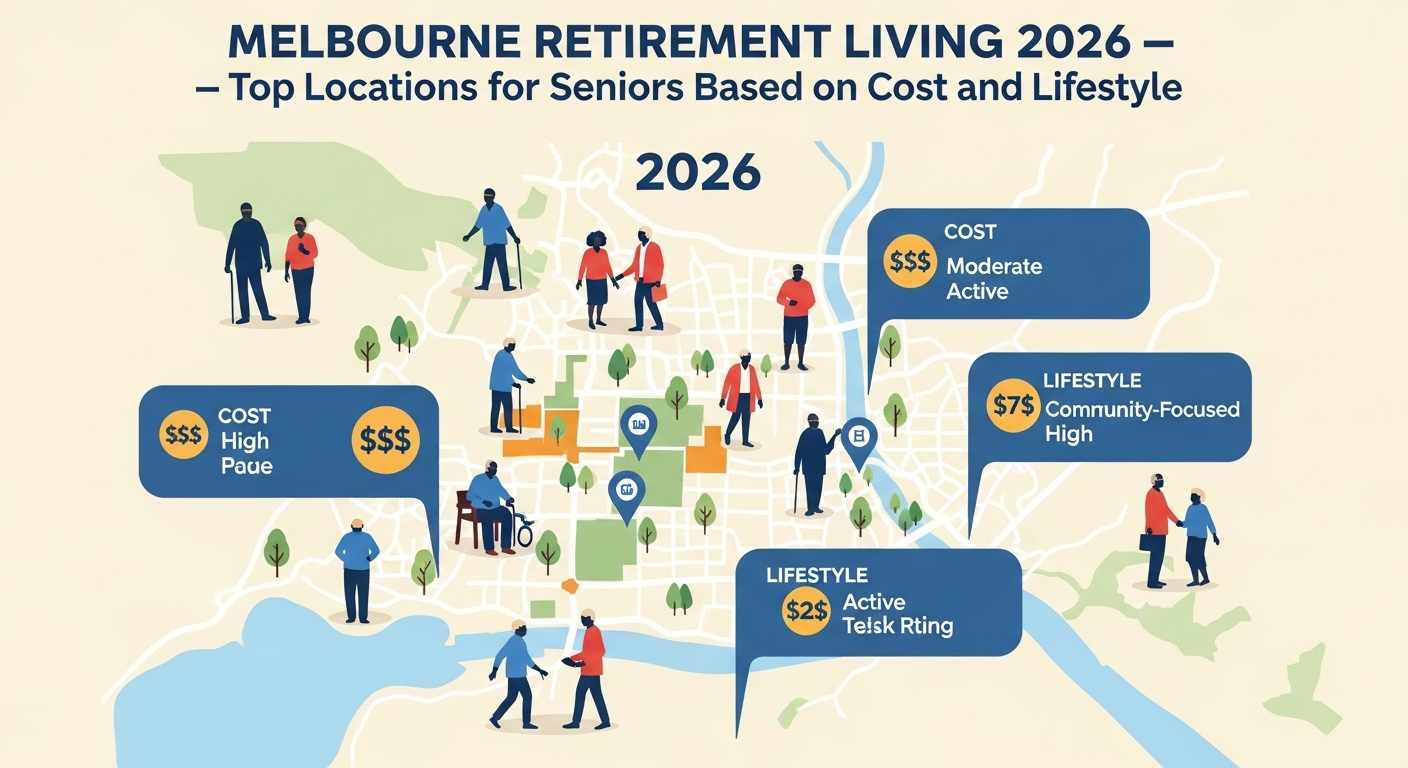
Melbourne Retirement Living 2026 — Top Locations for Seniors Based on Cost and Lifestyle
Retirement in 2026 looks different from what previous generations expected. It is less about slowing down and more about living well, maintaining the connections, independence, and daily rhythms that make life meaningful. For the growing number of Australians choosing Melbourne as the city in which they will spend their retirement years, the quality of the decision about where specifically to live within that city carries consequences that compound over time.
The right suburb can mean the difference between a retirement that feels free and one that gradually closes in. Proximity to healthcare, the ability to walk safely to essential services, access to public transport for the years when driving becomes less practical, and a genuine sense of community are not secondary considerations. They are the factors that determine whether a retirement location works for five years or for thirty.
Here are eight Melbourne suburbs that stand out in 2026 for the specific combination of qualities that make retirement not just manageable but genuinely good.
How to Read These Recommendations
Before the suburb-by-suburb overview, the framework for what makes a location retirement-appropriate is worth stating clearly. Experts consistently identify the same priorities when advising retirees on location decisions, and they are worth keeping in mind when assessing any suburb against your own circumstances.
Proximity to hospitals, GPs, and specialist medical facilities matters more as the retirement period lengthens. Flat terrain and safe walking paths determine whether a suburb remains physically accessible as mobility changes. Public transport access becomes the determining factor for maintaining independence when driving is no longer practical or preferred. Availability of downsized, low-maintenance housing prevents the burden of a large property from consuming the retirement years. And genuine community engagement opportunities prevent the social isolation that research consistently identifies as one of the most significant risks to wellbeing in later life.
| Suburb | Lifestyle | Walkability | Healthcare Access | Relative Cost |
|---|---|---|---|---|
| Brighton | Coastal, calm | High | Excellent | High |
| Camberwell | Traditional, quiet | High | Excellent | High |
| Williamstown | Village, waterfront | High | Very good | Medium |
| Doncaster | Modern, convenient | Medium | Very good | Medium |
| St Kilda | Coastal, social | Very high | Excellent | Medium |
| Mornington | Scenic, relaxed | Medium | Growing | Medium |
| South Yarra | Urban, vibrant | Very high | Excellent | High |
| Essendon | Balanced, green | Medium | Very good | Medium |
1. Brighton — Coastal Living With Genuine Practicality
Brighton’s reputation as one of Melbourne’s most desirable suburbs extends well into the retirement context, and the reasons go beyond the obvious appeal of coastal living. The suburb has been evolving its housing stock in ways that directly benefit downsizers, with large family homes giving way to contemporary apartments and retirement communities positioned near Church Street’s concentration of cafés, supermarkets, banks, and medical facilities.
The terrain is level, which matters considerably for daily walking well into later life. Direct and frequent train services connect Brighton to the CBD without requiring car use for access to the wider city. Specialist medical care is excellent, and the combination of coastal lifestyle with genuine urban infrastructure makes Brighton one of the few suburbs that does not require compromise between the two.
The cost is genuinely high, which is the primary reason this suburb does not suit all retirement budgets. For those who can afford it, the long-term stability of both rental and resale values adds a financial dimension to what is already a strong lifestyle case.
2. Camberwell — Quiet Stability and Deep Community Roots
Camberwell appeals most directly to retirees who are not seeking lifestyle transformation but rather the continuation of a familiar, well-connected way of living in a suburb that rewards long-term residence. Many of the retirees choosing Camberwell are people who have lived there for decades and are choosing to stay rather than seeking somewhere new.
Camberwell Junction functions as a genuinely walkable centre where pharmacies, groceries, cafés, and transport connections exist within comfortable walking distance of each other. The train and tram coverage removes car dependency entirely for most daily activities, which is one of the suburb’s most significant practical assets for retirees thinking about the next decade rather than just the current one.
The community connections that develop over years of living in one place have a protective effect against the isolation that can develop in retirement, and Camberwell’s character as a suburb where people stay long enough to know their neighbours is one of its less measurable but genuinely important qualities.
3. Williamstown — Village Character With Waterfront Access
Williamstown occupies a distinctive position in Melbourne’s retirement geography. It offers the foreshore access and walking culture of a coastal suburb with the lower density and quieter atmosphere that retirees who are stepping back from urban intensity often find more appealing than the busier beach suburbs closer to the city.
The foreshore itself is level and accessible, which matters practically for daily walking as a sustainable activity well into later life. Ferguson Street provides local shops, cafés, and medical facilities without requiring residents to leave the suburb for everyday needs. The social networks and local identity that characterise Williamstown’s community are genuine, and the suburb’s relative isolation from inner Melbourne creates a village-like environment that many retirees actively prefer to more connected but busier alternatives.
4. Doncaster — Modern Convenience Oriented Around One Hub
Doncaster has emerged as a strong choice for retirees prioritising practical convenience and modern apartment living at a price point below the coastal and inner suburbs. Westfield Doncaster functions as the suburb’s central infrastructure, concentrating supermarkets, pharmacies, medical facilities, and social spaces in a single accessible location that reduces the need to travel for most daily requirements.
The housing stock in Doncaster increasingly includes apartment buildings with lift access designed with older residents in mind. The age-appropriate design of new developments in this suburb is one of the specific reasons it has attracted growing attention from retirees who are thinking practically about accessibility as well as lifestyle. The relative affordability compared to bayside and inner-city alternatives makes it a realistic option for a wider range of retirement budgets.
5. St Kilda — Urban Energy and Social Connection
St Kilda has undergone a subtle transformation in its retirement positioning over recent years. What was once considered primarily a young-resident suburb has developed genuine appeal for retirees who value social engagement, walkability, and coastal proximity without sacrificing urban convenience.
The suburb’s walkability rating is among Melbourne’s highest, which means retirees can navigate their daily lives entirely on foot for most purposes. The café culture and community gathering spaces that characterise St Kilda reduce the social isolation risk that is one of the most serious threats to retirement wellbeing. Medical facilities in the inner south and nearby Prahran are easily accessible, and public transport coverage is excellent for the times when walking is not the preferred option.
The medium relative cost compared to Brighton and Camberwell makes St Kilda accessible to a broader range of retirement budgets while still delivering the urban amenity of an inner suburb.
6. Mornington — Space and Peace at a Distance
Mornington represents a fundamentally different retirement proposition from the Melbourne suburbs listed above. It requires accepting greater distance from the city and higher car dependency in exchange for space, quiet, and a scenic coastal environment that many retirees actively seek after decades of urban life.
The lifestyle appeal is real and well-documented among retirees who have made the move after selling city homes. The community character of Mornington creates the social connections that retirees relocating from elsewhere need to rebuild, and the improvement in healthcare access over recent years has addressed what was previously one of the suburb’s significant drawbacks for retirees with ongoing medical needs.
For couples and active retirees in good health, the lifestyle trade-off is compelling. For those with significant or growing healthcare requirements, the distance from major medical facilities is a factor worth weighing carefully against the lifestyle appeal before committing to the move.
7. South Yarra — Urban Independence for Downsizers
South Yarra suits a specific retirement profile with considerable precision. It is the right choice for retirees who want to remain in the city, who have the budget for premium apartment living, and who are downsizing from larger properties while retaining access to the dining, shopping, cultural, and healthcare infrastructure of inner Melbourne.
Toorak Road and Chapel Street provide the concentration of accessible services that makes car-free living genuinely practical. Proximity to major hospitals is one of South Yarra’s most significant assets for retirees managing ongoing healthcare requirements, and the train and tram coverage removes the car dependency that most outer suburbs require. The suburb is busier than most others on this list, which is precisely the quality that its retirement residents value rather than tolerate.
8. Essendon — Balance and Greenery at Accessible Cost
Essendon has been attracting growing attention from retirees who are priced out of the inner and bayside suburbs but are not willing to sacrifice quality of life for affordability. It provides the parks, river trails, and retail infrastructure that support an active retirement lifestyle without the premium pricing of the suburbs to its south and east.
The public transport connections through Essendon are reliable, including both trains and trams that connect to the wider city without requiring car ownership. The suburban character provides the leafy, lower-density environment that many retirees find more conducive to daily walking and neighbourhood connection than denser inner suburbs offer. For retirees whose priority is maximising quality of life within a more moderate budget, Essendon consistently delivers.
Frequently Asked Questions
Is Melbourne still a strong choice for retirement in 2026? Yes. The combination of healthcare quality, public transport coverage, cultural activity, and diverse neighbourhood character makes Melbourne one of Australia’s most practical and liveable retirement cities across a wide range of budgets and lifestyle preferences.
Can retirees live without a car in Melbourne? In suburbs like St Kilda, South Yarra, Camberwell, and Brighton, yes. These suburbs have public transport coverage and walkability that make car-free living genuinely practical for daily life. In Mornington and parts of Doncaster, some car access remains useful.
Which suburbs offer the best value for retirement budgets? Essendon, Doncaster, and parts of Mornington offer the strongest combination of quality and relative affordability. Williamstown and St Kilda sit in a middle range, with Brighton, Camberwell, and South Yarra at the premium end.
What is the most common mistake retirees make when choosing a suburb? Choosing based on current preferences without adequately considering future mobility and healthcare needs. A suburb that works well at 65 needs to continue working at 75 and 85, which means walkability, healthcare proximity, and public transport matter more than they might initially appear.