Japan Unveils Truck-Mounted Laser Cannon at DSEI Japan 2025: The Weapon That Could Make Drone Swarms Obsolete
Japan has just answered one of modern warfare’s most pressing questions. At DSEI Japan 2025, the country unveiled a truck-mounted laser cannon designed to make mass drone attacks economically and tactically unviable against prepared defenders.
The weapon was developed by Japan’s Acquisition, Technology and Logistics Agency and represents a fundamental shift in how nations can defend against the growing threat of cheap, expendable drone swarms.
The Problem This Weapon Solves
The core challenge of modern drone warfare is brutally economic. A commercial quadcopter costs around $500 to build. Shooting it down with a traditional missile costs $100,000 or more. An adversary can flood a defence system with cheap drones knowing the defender will bankrupt themselves trying to stop them.
Japan’s laser cannon changes that calculation entirely. Each laser intercept costs approximately $10 in electricity. The economics suddenly favour the defender rather than the attacker.
The Cost Comparison That Changes Everything
| Threat Type | Cost to Build | Traditional Intercept Cost | Laser Intercept Cost |
|---|---|---|---|
| Commercial quadcopter | $500 | $100,000 | $10 |
| DIY kamikaze drone | $2,000 | $150,000 | $10 |
| Loitering munition | $10,000 | $200,000 | $10 |
The table makes the strategic logic of laser defence immediately clear. When the intercept cost drops to $10 regardless of target type, the entire economic advantage of drone swarm warfare disappears.
What the Weapon Actually Looks Like
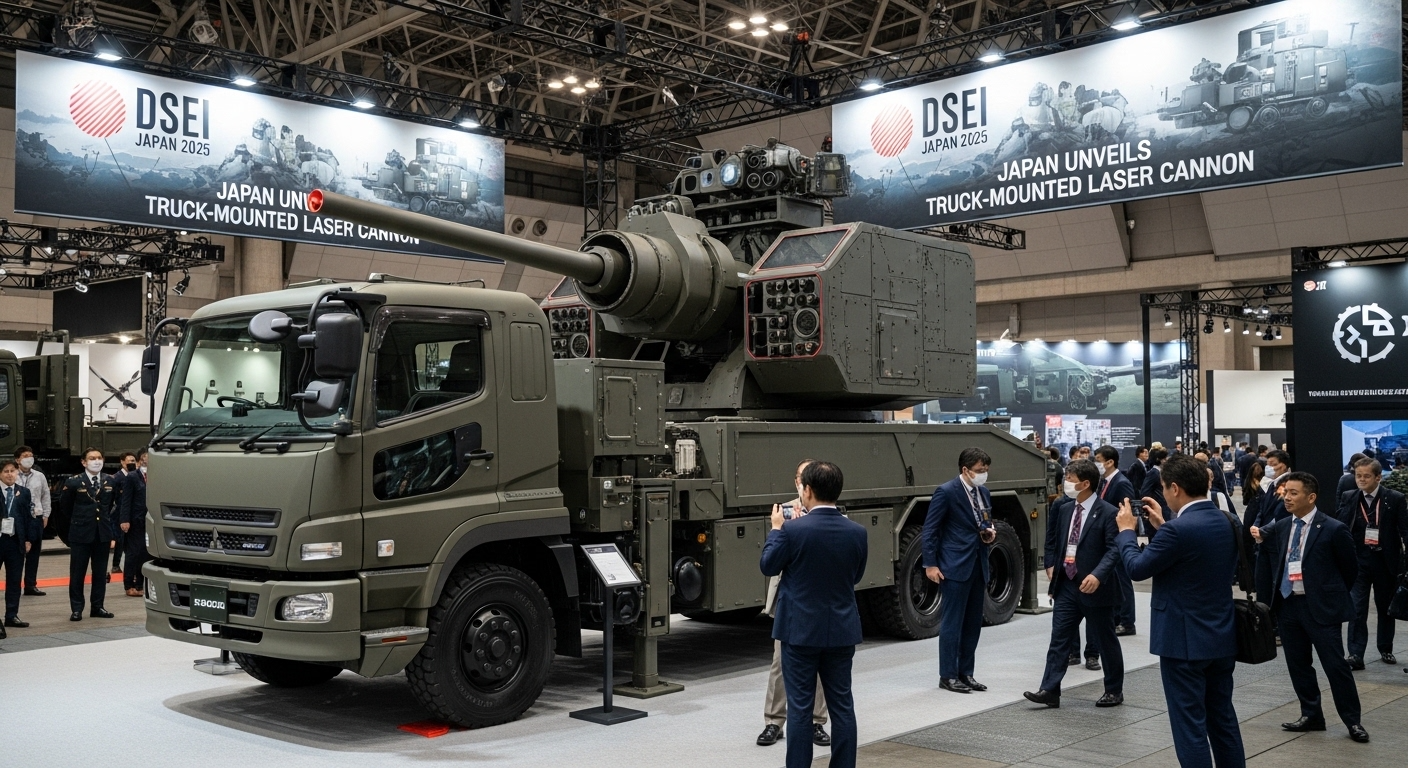
The system is mounted on an armoured 8 by 8 truck with a compact turret on top. There are no large gun barrels, no missile tubes, and nothing that immediately signals its devastating capability. The appearance is deliberately understated.
Inside that turret sits a 10-kilowatt laser system capable of burning through drone components within seconds of acquiring a target. The weapon was developed specifically to counter what military planners call LSS threats, meaning Low, Slow, and Small targets that traditional radar and missile systems struggle to engage cost-effectively.
How the System Works in Operation
The laser directs a concentrated beam of infrared energy at an incoming target, burning through critical components including cameras, flight controls, and explosive payloads until the drone simply falls from the sky. There is no explosion and no debris raining onto the area below.
Critically, the weapon operates in complete silence and is invisible to the human eye. One moment a drone is on course toward its target. The next, it is tumbling out of the sky with no warning, no muzzle flash, and no audible signature. That silence is itself a powerful deterrent.
The Targets It Is Designed to Defeat
The Japan laser cannon is specifically engineered to handle the drone threat categories that are most difficult for conventional systems. These include quadcopter drones used for reconnaissance and artillery spotting, improvised explosive drones built from commercial components, modified civilian platforms carrying surveillance equipment, and loitering munitions that circle overhead waiting for an opportunity to strike.
Swarm attacks using coordinated groups of cheap drones are the most serious threat the system addresses. By making each intercept cost-effective regardless of how many drones are sent, the weapon removes the primary advantage of swarm tactics entirely.
Read More: https://wizemind.com.au/
The Mobility Advantage
Traditional air defence installations are fixed, which means they can be mapped, identified, and avoided by adversaries planning an attack. The Japan laser cannon drives on standard roads like any other military vehicle, able to appear wherever protection is needed at any given moment.
That mobility fundamentally changes the defensive calculus for potential attackers. Planning a drone strike becomes significantly more complex when the laser defence system could be positioned anywhere along the route without warning.
What This Means for Japan’s Regional Rivals
The timing of this unveiling carries a deliberate strategic message. Tensions across the Asia-Pacific region have been rising, and drone technology is spreading to more actors faster than traditional countermeasures can adapt.
By publicly demonstrating this capability at DSEI Japan 2025, Japan is sending a clear signal to regional rivals that mass drone attack strategies are no longer a reliable option against Japanese defensive positions. Strategic analyst Rebecca Torres notes that knowing an adversary has this capability changes the entire risk calculation before an attack is ever launched.
Applications Beyond Military Defence
The implications of this technology extend well beyond battlefield use. Critical civilian infrastructure including power plants, airports, and government buildings all face growing threats from small drones that are difficult to detect and expensive to counter with conventional means.
A silent, precise weapon that neutralises threats without collateral damage or debris appeals directly to civilian security agencies managing these risks. The same technology that protects military positions can protect the infrastructure that modern societies depend on daily.
Global Context: Who Else Is Developing This
Japan is not alone in pursuing laser-based air defence. The United States, Israel, and Turkey are all testing their own versions of directed energy weapons for similar defensive purposes. The technology is moving from experimental to operational across multiple defence programmes simultaneously.
Japan’s public unveiling at a major international defence exhibition accelerates that global development timeline by demonstrating that truck-mounted laser defence is no longer theoretical. It is built, deployable, and ready for evaluation by allied and partner nations.
Frequently Asked Questions
How powerful is Japan’s new laser cannon? The system generates 10 kilowatts of laser energy, which is sufficient to burn through drone components within seconds of acquiring and locking onto a target. Power output can be adjusted depending on the threat being engaged.
Can the laser cannon work effectively in bad weather? Weather conditions including heavy rain, fog, and dust can reduce laser effectiveness. The system includes sensors designed to optimise performance across various environmental conditions, but severe weather remains a limitation for current directed energy systems generally.
How many drones can the system engage at the same time? The current system engages targets sequentially, one at a time. However, multiple laser cannon units can be coordinated across a wider area to handle swarm attacks by dividing targeting responsibilities between systems.
Is this weapon expensive to operate on a sustained basis? Each intercept costs approximately $10 in electricity, making it dramatically more affordable than traditional missile interceptors on a per-engagement basis. The main operational costs are maintenance, crew training, and power supply rather than consumable ammunition.
Will other countries develop similar weapons? Several nations including the United States, Israel, and Turkey are already testing their own laser-based air defence systems. Japan’s unveiling accelerates the global timeline by demonstrating the technology is operational rather than experimental.
Can civilians or adversaries see the laser beam during operation? No. The laser operates in the infrared spectrum, which is completely invisible to the human eye. The weapon fires with no visible beam, no flash, and no sound, making its operation undetectable without specialised sensors.
What types of drones is the system specifically designed to counter? The system targets Low, Slow, and Small threats including reconnaissance quadcopters, improvised explosive drones, commercial platforms modified for military use, loitering munitions, and coordinated swarm attacks using large numbers of cheap drones simultaneously.
How does laser defence change the strategy of drone swarm attacks? It removes the economic advantage entirely. Drone swarm tactics rely on the attacker spending far less than the defender on each exchange. When the defence cost drops to $10 per intercept, sending 100 drones costs the attacker far more than it costs the defender to stop them.
Is the system currently deployed or still in testing? The system was unveiled publicly at DSEI Japan 2025, indicating it has reached a stage of development suitable for international demonstration. Whether it is in active operational deployment with Japanese defence forces has not been formally confirmed.
Could this technology be used to protect civilian infrastructure? Yes, and that application is considered highly significant. Airports, power plants, government buildings, and public venues all face growing drone threats. A silent, precise, and low-collateral-damage system is well suited to those environments.
Key Points to Remember
- Japan’s laser cannon fires at a cost of approximately $10 per intercept compared to $100,000 or more for traditional missile defence, fundamentally reversing the economics of drone warfare.
- The system is mounted on a mobile 8 by 8 truck, allowing it to reposition rapidly and preventing adversaries from mapping fixed defensive positions.
- It operates in complete silence with an invisible infrared beam, offering no warning to targeted drones and significant psychological deterrence to adversaries planning attacks.
- The weapon is specifically designed for Low, Slow, and Small targets that conventional radar and missile systems struggle to engage cost-effectively.
- Multiple units can be coordinated to cover wider areas and handle simultaneous swarm attacks by dividing targeting responsibilities between systems.
- The United States, Israel, and Turkey are all developing comparable systems, confirming this is a global shift in air defence philosophy rather than an isolated development.
- Applications extend beyond military use to critical civilian infrastructure protection, where the no-debris, no-explosion characteristic of laser intercepts is especially valuable.
- The public unveiling at DSEI Japan 2025 sends a deliberate strategic message to regional rivals that mass drone attack strategies face a credible and cost-effective counter.
Conclusion
Japan’s truck-mounted laser cannon is not a futuristic concept but an operational reality demonstrated publicly at one of the world’s most significant defence exhibitions. It addresses the single most disruptive tactical development in modern warfare and does so in a way that is economically sustainable for defenders.
The era of overwhelming air defences with cheap drone swarms may be ending before it truly began, and Japan has just made that argument with hardware rather than theory.
For the broader defence world, the question is no longer whether laser air defence works. The question is how quickly every nation that faces a drone threat can field it.