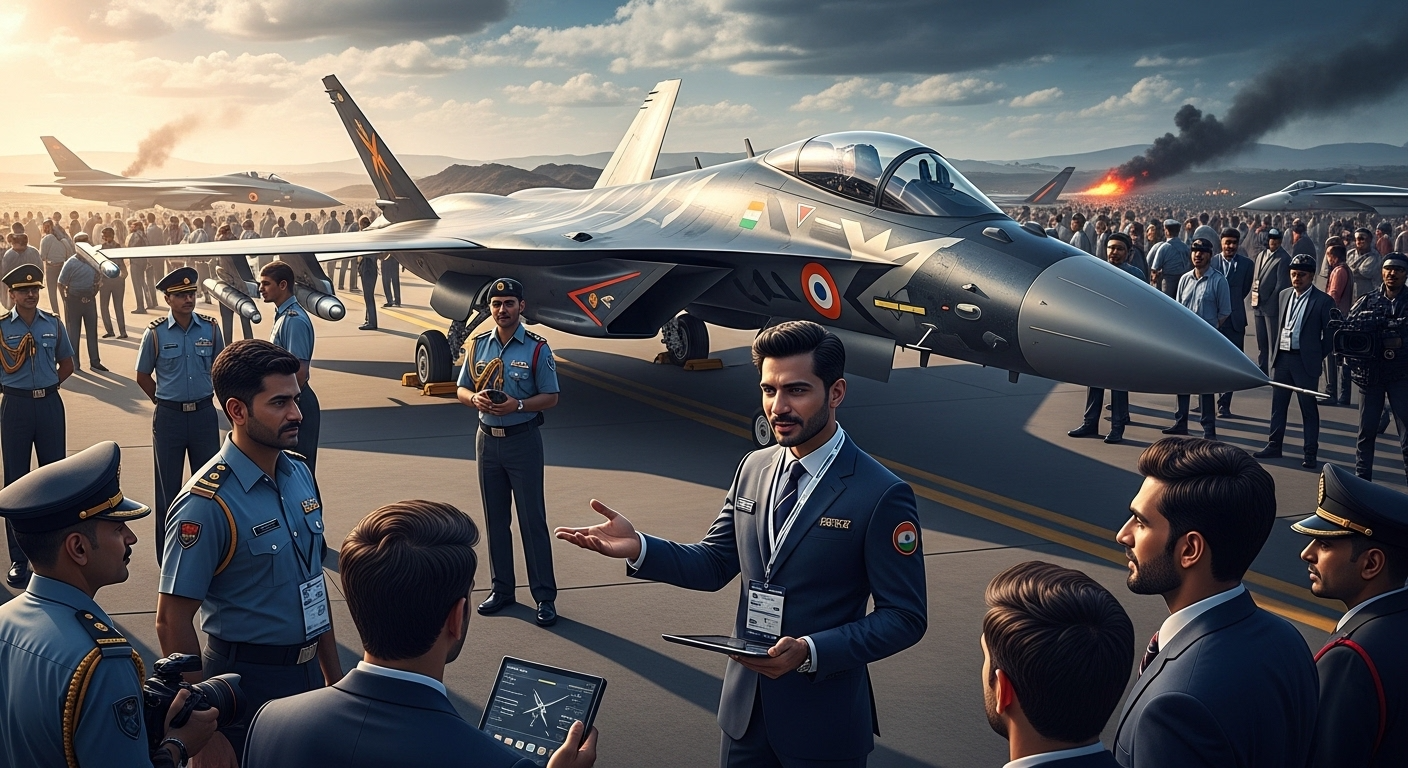
India’s Biggest Rival Turns a Border Clash Into a Fighter Jet Sales Tour
The dust from the recent clash between India and its biggest rival had barely settled when the invitations started going out. Not for peace talks. For an air show.
What looked like a defense expo on paper was really something else entirely: a flying sales pitch aimed at more than a dozen cash-strapped militaries looking for modern air power without the modern price tag.
The star of the show was a compact, low-cost fighter jet that its makers want the world to believe is the smart choice for nations who want to matter in the sky but cannot afford the luxury brands.
The Setting Was No Accident
Hosting an air show right after a high-profile military clash is not a coincidence. It is a strategy. The rival state knew that combat footage, even selectively edited, carries weight that no brochure ever can. So it packaged the clash as proof of concept and sent invitations to 13 countries that were already on the fence about upgrading their aging fleets.
The message was simple: our jets flew in a real fight, and they came home.
Defense ministers, air force chiefs, and procurement officers walked the tarmac under a blazing sun, watching the jet perform loops and high-speed passes. Some took notes. Others just watched. All of them were doing math in their heads.
What Makes This Jet Attractive
The honest answer is price. When a top-tier Western fighter costs well over a hundred million dollars per aircraft, and a country also needs hospitals, roads, and schools, the budget conversation gets very uncomfortable very fast.
This jet offers a way out of that conversation. Its makers promise a lower purchase price, cheaper operating costs, simpler maintenance, and in some cases the option to assemble units locally. For a government trying to show strength at home and in the region, that combination is genuinely tempting.
The sales pitch is not just about hardware either. In private meetings on the sidelines of the show, representatives spoke of strategic partnerships, joint training programs, and long-term cooperation. The jet is the opening line. The relationship is the real product.
The 13 Countries Being Courted
They come from different regions and different situations, but they share a common problem: aging fleets that spend more time in hangars than in the air, and budgets that cannot stretch to cover Western alternatives.
Some want to replace Soviet-era aircraft that have outlived their usefulness. Others are watching neighbors upgrade and feel the pressure to keep up. A few are making a more calculated move, using this purchase to deepen ties with a rising power that can offer not just weapons but political backing and economic investment.
At the show, each delegation had its own roped-off area near the runway for private demonstrations. The jet would roar past, and the commentator would rattle off specs: payload, range, radar capability, cost per flight hour. The numbers were designed to land like a closing argument.
How the Recent Clash Became a Marketing Tool
Inside one exhibition hall, looping videos played footage from the conflict. Radar screens lighting up, missiles being fired, cockpit views framed to look decisive and clean. Visitors stood in small groups watching, arms crossed, running their own silent assessments.
The rival state leaned hard into the idea that this jet had been tested in real conditions and performed. Independent analysts still debate exactly what happened during the clash and what the footage actually proves. But in that hall, the narrative was controlled and the conclusion was pre-loaded: combat-proven, battle-ready, available now.
For countries evaluating aircraft that have never left the runway in anger, that framing carries real emotional weight, even if the fine print deserves more scrutiny.
India Is Watching Closely
Even though India’s flag was not flying at the show, its presence was felt in every question asked and every comparison made. When foreign officials asked about performance against peer adversaries, everyone in the room understood exactly which adversary was being referenced.
India has been building its own story in parallel. Its homegrown fighter program, once a slow-moving domestic experiment, has grown into a symbol of technological ambition and industrial self-reliance. Every sale its rival makes is a quiet challenge to that story and to India’s influence across the regions being targeted.
This is not just a competition over aircraft. It is a competition over whose version of the future sounds more convincing to nations trying to figure out which side of history to stand on.
The Hidden Costs of “Low-Cost”
Every experienced procurement officer knows that the sticker price is just the first page of a very long story. Engines need overhauls. Radars need upgrades. Pilots need years of training. Spare parts need supply chains that run smoothly even when politics get complicated.
Countries that have bought foreign military hardware in the past have sometimes discovered that the real costs arrive later, when a supplier delays parts, ties conditions to deliveries, or applies quiet pressure when foreign policy diverges from expectations. A cheap jet that creates a long-term dependency on an unpredictable partner is not necessarily a bargain.
Some of the 13 countries being courted already know this from experience. Others are weighing it carefully. A few may decide that the risk is worth taking because the alternative, flying nothing, is worse.
What This Moment Tells Us About the World
What happened at that airfield is a small but sharp illustration of how global power works today. A country takes a tense military confrontation and converts it into a commercial opportunity within weeks. It targets nations that feel left behind by expensive Western alliances and offers them something they can actually afford, wrapped in the credibility of recent combat.
It works because the underlying need is real. Many countries genuinely cannot afford the aircraft they want. Many genuinely do need to modernize. And many are genuinely looking for partners who do not come with the political conditions that major Western suppliers often attach.
The rival state has found a message that fits that gap. Whether the jet lives up to it over a 30-year service life is a different question entirely. But at an air show, under a hot sun, with a jet screaming overhead and a polished brochure in hand, the future always looks cleaner than it turns out to be.
The Contracts That Could Change the Region
When the show ends and the delegations fly home, the real negotiations begin. Letters of intent, technical evaluations, financing discussions, political consultations. Some of the 13 countries will move forward. Others will stall. A few will use the interest as leverage to extract better terms from their current suppliers.
But even the conversations themselves shift something. Every country that seriously considers this jet is also signaling something to India, to the West, and to its own population about where it sees its future pointing.
The jet will fly again tomorrow, and the day after. The clash that gave it credibility will remain a piece of dangerous history. The contracts being discussed around it may quietly reshape which countries control which skies, and who they answer to when it matters most.
FAQ
Why is this fighter jet being called low-cost? It is marketed as significantly cheaper to buy and operate than top-tier Western fighters. The appeal is modern military capability at a price that does not break national budgets.
How did the clash help sell the jet? The rival state used footage from the conflict to claim the jet is combat-proven, which gives potential buyers more confidence than a platform that has only ever been tested in exercises.
Why these 13 countries specifically? They share common traits: aging fleets, limited budgets, and a desire to modernize without becoming fully dependent on expensive Western suppliers or politically complicated Russian ones.
What risks come with buying this jet? Long-term dependency on the supplier for spare parts, upgrades, and training. If the relationship sours, the aircraft can become grounded. Lifecycle costs can also exceed the attractive upfront price.
How does India factor into this? India is the unspoken reference point throughout the entire sales pitch. Its rival is using their shared conflict as a selling point while trying to expand influence among countries India considers strategically important.