I’m a Hairdresser, and Here’s the Best Advice I Give to Women in Their 50s Who Colour Their Hair
By the time a woman sits in my chair in her fifties, she has already lived through entire eras of hair. The big blowouts, the scrunchy ponytail years, the razor cuts, the chunky highlights, the box-dye experiments that went slightly wrong in a bathroom at eleven at night. She has coloured her hair in kitchens, in budget salons, in expensive ones with champagne and magazines. She knows what she likes, and yet, more than almost any other age group, she leans forward, catches my eye in the mirror, and asks some version of the same question.
“Be honest with me. Is it time to stop colouring?”
There is always a pause after that. I see it in the way her fingers trace the silver growing along her part, and in the way she studies her reflection with something between curiosity and uncertainty. This is not really a question about grey or brown or blonde. It is a question about permission. Permission to change, or permission to stay exactly as she is and feel genuinely good about whichever she chooses.
So when I say, let us talk, I am not just reaching for the colour bowl. I am inviting her into a completely different way of thinking about her hair in her fifties. One that is softer, more honest, and far more interesting than spending the next decade chasing the illusion of being thirty-two again.
Why the Rules Quietly Change in Your Fifties
When you hit your fifties, the way hair behaves changes in ways nobody properly explains to you. Hair does not simply go grey. It changes texture, changes density, and changes the way it responds to colour. What worked beautifully at thirty-eight can suddenly look harsh or flat at fifty-five, and most women cannot quite identify why. This is usually where I begin.
In the salon, I will comb through the hair slowly and describe what I am seeing, not as a lecture but as an observation we are both making together.
Feel this, I will say, guiding her hand toward a section near the roots. Right here, your hair is a little drier, a little more wiry. That is completely normal. That is the grey structure making itself known.
Grey hair is literally different hair. It is often coarser, more porous, and it can grow in more upright and almost defiant compared to pigmented strands. Add to that a gradual loss in overall density, those quiet moments of noticing your ponytail is not quite what it used to be, and you suddenly have a head of hair that reacts to colour very differently than it did a decade ago.
This is why my first piece of advice is always the same. Stop trying to colour your hair the way you did in your twenties and thirties. That does not mean stop colouring. It means stop chasing youth and start chasing yourself.
When women in their fifties hold onto the same flat, all-over, single-shade brown or box-black dye they have used for years, it begins to work against them rather than for them. The hair loses dimension. The face can look harder. The regrowth line, that sharp border of white against dark, becomes increasingly difficult to manage and increasingly unforgiving.
What actually looks younger is not darker. It is softer. It is dimensional. It is colour that moves and shifts with the light the way natural hair does, not colour that sits on the hair like a uniform.
How to Choose Colour That Works With Your Face Now
There is a moment I always watch for. When I drape the cape and her eyes catch the faded ends in the mirror. She will pull a strand forward, study it, and say quietly, I feel like it just does not suit me anymore.
She is right, but not for the reason she thinks. It is not that brown is wrong or red is wrong. It is that the way those colours are living on her hair now needs to evolve with her skin, her texture, and the grey pattern coming through.
Here is what I tell women in their fifties about colour, over and over again.
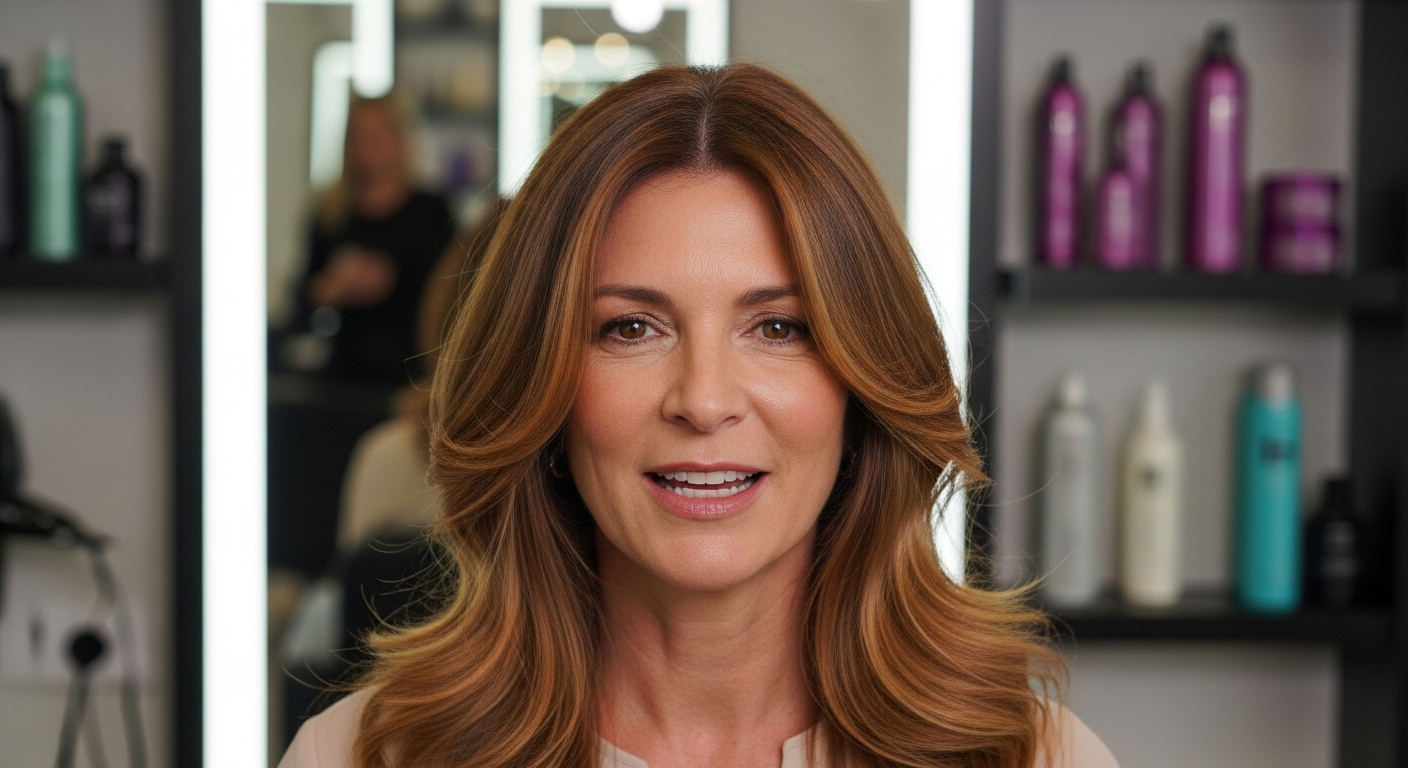
Going softer does not necessarily mean going lighter. The instinct when grey arrives is often to jump straight to blonde. Blonde does make regrowth feel gentler at the root, yes, but if it is too pale or too cool, it can wash the face out, emphasise dark circles, and make fine hair look fragile rather than full. What I talk about instead is softness. That might mean moving from an opaque, inky brown to a warm chocolate brown with ribbons of caramel through it. Or from a flat medium-brown to a bronzy shade with barely-there dimension. Not a complete personality change for your colour, just more light, more movement, more life.
Matching warmth to your skin rather than to trends is also something I feel strongly about. Trends change constantly. One season it is icy platinum, the next it is deep caramel. In your fifties, the only direction worth following is what makes your skin look awake and your eyes look sharp. When I hold colour swatches near a client’s face, I am watching carefully. Does the skin seem to brighten, or does it flatten? Do the eyes light up, or do they lose something?
If your skin carries natural warmth and you tan easily, gentle warm tones like honey, amber, and soft copper can make you look genuinely lit from within. If your skin is cooler with pink or bluish undertones, ash and neutral shades are often more flattering, but in your fifties I almost always soften any ash with just a whisper of warmth so it does not read as stark or sallow under certain lights.
Adding dimension back where time has quietly taken it away is perhaps the most powerful thing colour can do in your fifties. Natural hair almost always has variation, darker at the roots, lighter toward the ends and around the face. After years of heavy solid colour application, that variation gets completely flattened. Techniques like balayage, lowlights, and babylights are not just fashionable words. They are practical tools for restoring the visual variety your hair once had naturally. A softer base that blends or covers grey, combined with lighter pieces where sunlight would naturally fall, looks less like you have been to the salon and more like you simply have great hair.
The Grey Question Everyone Is Really Asking
Now we arrive at what almost every woman in her fifties is thinking but trying not to say too directly.
Do I have to go grey now?
No. You do not have to do anything with your hair except what makes you feel like yourself. But the nuance I share with almost every client is this: you have far more choices available to you than simply dyeing everything forever or going cold-turkey grey overnight. We are in a genuinely more interesting era of hair than we were fifteen years ago. Women are blending grey with intention. They are phasing out solid colour gradually over time. They are making a choice that most of us forgot we were allowed to make about ageing. They are playing with it.
When grey starts to come in seriously, I usually talk through three main paths with clients.
The first is continuing full coverage, but done with more intelligence than before. For women who are not emotionally ready for grey, and some women never are and that is completely valid, the strategy shifts toward making ongoing coverage feel less relentless. We soften the base shade slightly so regrowth reads as a gentle shadow rather than a harsh stripe. We introduce a root smudge technique so the transition as hair grows is blurred rather than abrupt. We add lighter pieces so emerging grey hairs have somewhere to blend into rather than standing alone against a dark background. It is still full coverage, but without the feeling of being one missed appointment away from looking completely unintentional.
The second path is blending grey rather than fighting it. This is the approach I find myself recommending most often for women in their fifties. It is not surrendering to grey, but it is inviting it in thoughtfully. This might mean switching to a demi-permanent formula on the roots, which softens grey rather than fully covering it. Or adding fine, cool highlights to mingle with the natural silver coming through, so the overall effect is a shimmering blend rather than an obvious contrast. Letting certain areas like the temples grow in more naturally while maintaining soft colour through the rest of the hair is another option that many women find surprisingly freeing.
The third path is going fully grey, but with real intention behind it. There are women who walk in one day with a kind of exhausted certainty and say they want to see who they actually are under all the colour. For them, the work is in designing a transition rather than simply stopping. We might cut shorter to remove accumulated artificial pigment. We might use cool-toned highlights or lowlights to help the eye adjust as natural colour grows through. Toners can neutralise leftover warmth during the transition period. And the result, when approached properly, is often genuinely striking. Natural grey has beautiful variation in it, steel and silver and pewter and white, and with the right cut and the right products keeping it glossy rather than dull, it carries an authority that heavily dyed hair sometimes lacks.
What Your Hormones Have to Do With Your Hair
Here is something almost nobody mentions at the hair dye aisle. Your hormones are part of this story.
During and after menopause, shifting levels of estrogen and progesterone affect far more than sleep and mood. They change the hair itself. Strands can become finer. The growth cycle can shorten. Some women notice increased shedding. Others find new growth patterns appearing, cowlicks that were never there before, hairlines that feel subtly different, areas that seem slightly thinner than they used to be.
When I am advising women in their fifties who colour regularly, I am thinking about the scalp as much as the strands themselves.
Gentler formulas matter more now than they did before. Your scalp may be more sensitive in your fifties than it was at thirty. If you have started noticing itching, burning, or persistent redness after colouring, that is not something to push through or dismiss. Moving from permanent, high-ammonia dyes to gentler lower-volume options, or extending the time between applications, can make a significant difference in how the scalp feels and how the hair behaves.
Strategic colour placement rather than full saturation is another approach I use regularly with clients in this age group. Instead of applying colour to every strand from root to tip every visit, we focus on the areas of most visible need, the hairline, the parting, the crown, and allow the rest to stay softer. This reduces the overall chemical load on the hair and scalp without compromising the visible result.
Scalp care itself becomes genuinely important in your fifties in a way that can feel like a revelation once you start. Lightweight exfoliating treatments, nourishing but lightweight oils, and regular gentle massage can make a noticeable difference in how full and vibrant the hair looks and feels. A well-cared-for scalp, even one with slightly finer hair than before, will carry colour with more shine and vitality than a neglected one with twice the density.
How to Style Coloured Hair in Your Fifties Without Fighting It
Coloured hair in your fifties often carries more history in it than hair at any other age. Years of highlights, heat styling, ponytails, sun exposure. It asks for a different kind of care, a gentler approach, and in many ways a willingness to trade the pursuit of perfection for the pursuit of health.
Lowering the heat is one of the most impactful changes a woman can make. If your straightening iron is still being used at the highest setting, that conversation is long overdue. Finer, coloured hair at this stage of life cannot sustain that level of heat without consequences. Dialling down the temperature, working with a little natural texture, embracing a gentle wave or bend, all of this reads as genuinely modern rather than as settling.
Building hydration into a regular routine rather than treating it as emergency repair is something I encourage every client to do. Waiting until your hair feels brittle or dry to apply a deep conditioning treatment is like waiting until you are completely dehydrated to drink water. A weekly or twice-weekly mask, applied particularly through the mid-lengths and ends where colour and time have done the most work, changes the quality of the hair visibly over time.
The right cut makes more difference than almost anything else a woman in her fifties can do. Holding onto very long, very heavy, one-length hair when strands are finer and more fragile tends to emphasise loss rather than create presence. A well-crafted shape with soft layers, face-framing movement, and a length proportionate to the hair’s actual current density does more for how a woman looks and feels than any product available.
The women whose hair looks most alive in their fifties are almost never the ones with the darkest, the longest, or the most aggressively managed styles. They are the ones whose hair moves naturally, catches light, and feels like it genuinely belongs to the life they are living right now.
A Simple Guide to Colour Choices in Your Fifties
For clients who find it helpful to see their options laid out clearly, here is roughly how I map out the different directions available to women in their fifties depending on what they want most from their colour.
Wanting to cover grey as fully as possible works best with a softer, slightly lighter base shade combined with a root smudge technique and subtle highlights throughout. This approach requires touch-ups roughly every four to six weeks to maintain the result cleanly.
Wanting to blend grey while still feeling coloured works well with a demi-permanent formula at the root combined with fine highlights that allow natural silver to mingle in. This can usually be maintained with visits every six to ten weeks rather than every month.
Wanting to transition gradually toward natural grey works through a process of adding cool highlights and lowlights to break up old pigment, using toners to soften the transition line as grey grows in, and slowly reducing coverage over several appointments rather than all at once.
Wanting to fully embrace grey works best when approached with intention, a considered cut to remove old colour, a gloss or toner to add shine, and the right products at home to keep natural silver looking vibrant rather than dull. Maintenance drops significantly at this stage.
None of these are fixed lanes. Many women move between them over time, sometimes spending years blending before deciding to go fully natural, sometimes pulling back toward more coverage after a period of experimenting. The point is not to follow a prescribed path. The point is to feel, every time you look in the mirror, that your hair is telling the truth about you in the most flattering way possible.
The Real Goal Is Not Looking Younger
When the foils are in and the salon has quieted down, there is often a small and honest moment. She will look at herself in the mirror, cape on, roots exposed, no styling to soften anything yet, and say quietly that she just does not want to look old.
I always take that seriously. Ageing is not a simple thing, especially for women navigating it in a world that has very strong and often contradictory opinions about what that should look like. But I will offer a different question in return.
What if the goal was not to avoid looking old, but to look completely alive?
Alive hair does not have an age attached to it. It has presence. It has movement. It has colour, whether that is brown or blonde or silver, that catches the light and belongs genuinely to the person wearing it. It belongs to someone who has laughed a great deal, learned a great deal, and is still completely in the middle of her story.
The best colour advice I give women in their fifties comes down to a few quiet principles. Stop battling your hair for the right to exist the way it wants to now. Let go of the idea that youth is the only thing hair is allowed to express. Choose softness over severity, dimension over flatness, and health over drama. Allow your grey, if you have it, to be part of the conversation even if you are not ready to let it lead.
Colour can still excite you. It can still give you that small, private thrill when you shake it out under streetlights after leaving the salon. But it does not need to be a disguise. It can be an edit. Refining what is already there, bringing forward the best of it, and softening the rest.
One of my favourite clients, a woman in her late fifties, said something after we had finished one afternoon that stayed with me. We had just finished softening her once-dark hair into a warm mix of chestnut and silver with bright natural-looking pieces around her face. She ran her fingers through it, smiled in that slightly surprised way people do when they had not realised how ready they were for something, and said she did not look younger exactly.
She said she looked truer.
That is the heart of everything I try to do for women at this stage. The best colour is not the one that returns you to thirty. It is the one that makes you look unmistakably, genuinely, and wonderfully like yourself right now.
Read More: For more expert beauty advice, lifestyle tips, and stories written for Australian women, visit wizemind.com.au