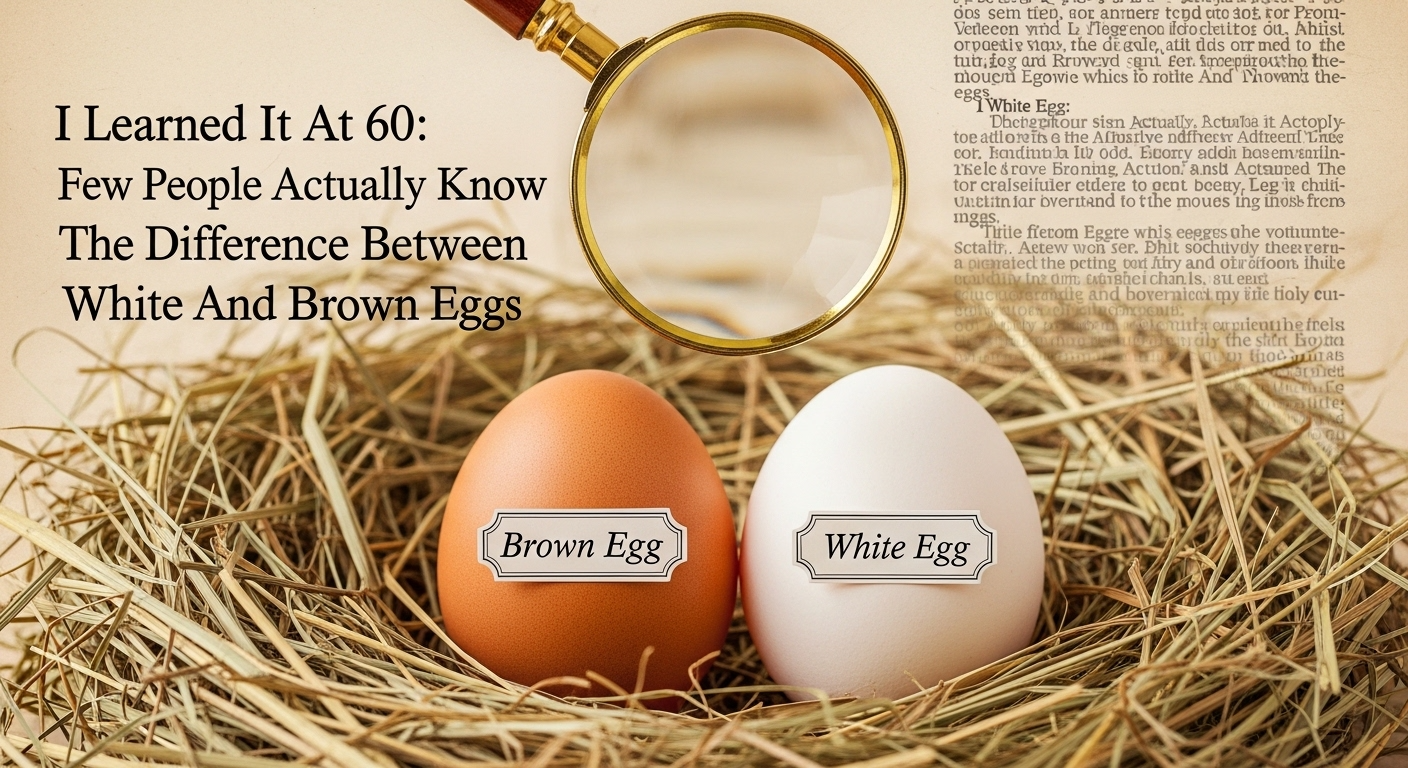
I Learned It At 60: Few People Actually Know The Difference Between White And Brown Eggs
The first time someone laughed at my grocery cart, I was sixty years old and standing in the egg aisle, squinting like the fate of the planet depended on a carton of large Grade A. The young cashier glanced at the two cartons in my hands, one white and one brown, and smirked. Can’t decide which one’s healthier, she asked, with the dry sarcasm of someone who had been bagging groceries since breakfast.
I opened my mouth to answer and realized I did not actually know. Not really. I had heard the same things everyone else had. Brown eggs are more natural. White eggs are factory farmed. Brown is for people who shop at the farmer’s market and own reusable produce bags. White is for everyone else. Yet there I was, solidly in my sixties, looking from one carton to the other like they were two different species.
That small moment in the hum of fluorescent lights, fingers going cold from the refrigerator case, turned out to be the beginning of an unexpected education. Because the truth is, for most of my life I had never given eggs more than a passing thought. But once I started asking questions, they followed me everywhere: into my kitchen, out to the country, into the rhythmic clucking heartbeat of someone’s backyard coop. And along the way I discovered that very few people, no matter their age, actually know the difference between white and brown eggs.
Key Points
- Shell color in eggs is determined entirely by the hen’s breed, not by nutrition, farming method, or quality
- White-shelled eggs mostly come from Leghorn hens while brown-shelled eggs mostly come from breeds like Rhode Island Reds
- Nutritional content depends on what the hen eats and how she lives, not on the color of the shell
- Brown eggs often cost more because the larger breeds that lay them eat more feed, which raises the farmer’s costs
- A pasture-raised white-egg hen and a pasture-raised brown-egg hen will produce eggs with nearly identical nutrition
- Taste differences between eggs come from freshness, diet, and storage conditions rather than shell color
- Terms like natural and farm-fresh on packaging mean very little without specifics about how the hens were actually raised
The Day I Followed An Egg Backward
My curiosity began with irritation. I did not like being caught clueless in public, especially about something I had been buying for four decades. So I went home, cracked a white egg and a brown egg side by side into a bowl, and stared at them.
The kitchen was quiet except for the low hum of the fridge and a sparrow shouting at the world from the maple outside the window. Two yolks sat in the bowl, rich and round. The whites spread into each other, merging seamlessly. If I had not set the shells aside I would not have known which was which.
They looked the same. They smelled the same: clean, faintly mineral. I whisked them into a soft scramble with a pinch of salt and a bit of butter melting lazily across a pan. The eggs slid onto a plate in yellow folds, steam curling upward. I ate them slowly and tried to be objective.
They tasted like eggs. Familiar, comforting. No revelation from the brown egg, no sterile blandness from the white. If there was a difference it was far too subtle for my untrained tongue. That bothered me. How could something so strongly believed, that brown eggs are better, feel so completely absent in my own mouth?
I decided to do something I had never done: find out where my eggs actually came from and why the shells were different colors in the first place.
Meeting The Hens Who Lay The Myths
About a week later I was standing in a muddy backyard ten miles outside of town, shoes sinking into damp earth, staring at a flock of chickens. My friend Marta, who grows half her own food and uses words like mulch the way most people use Netflix, had agreed to let me tag along during her Saturday chores.
The air smelled like wet soil, grain, and a faint earthy funk that gathers any time you have living things in one place. The coop was a patchwork of old wood, chicken wire, and improvisation. Feathers drifted along the ground like forgotten notes.
Which ones lay the brown eggs, I asked, scanning the birds. Some were the color of toasted bread, some nearly black, some white with speckles like coffee spilled on a tablecloth.
Those big red girls over there, she said, pointing to a group of hens with chestnut feathers and serious eyes. Rhode Island Reds mostly.
And the white eggs? She nodded toward the few white hens strutting near the door. Leghorns. Most of the white eggs you see in grocery stores come from some version of them.
One of the red hens trotted up to us, head bobbing, feet making soft thuds in the dirt. She eyed the cuff of my jeans and gave it a tentative peck.
So brown hens lay brown eggs and white hens lay white, I said, stating what felt almost too simple.
Not exactly, she laughed. It is breed, not feather color. There are white chickens that lay brown eggs. Some lay blue or green eggs. Shell color is genetics, like eye color in people. It has nothing to do with health. But almost everyone thinks it does.
We watched as a hen hopped into a nesting box, shuffled around, settled, then began that soft quiet concentration animals get when they are doing exactly what they evolved to do. A few minutes later the coop echoed with a proud cackling announcement. Inside the box, nestled in a bed of straw, sat a single warm brown egg.
That right there, Marta said, scooping it up, is the same on the inside as a white egg from a good well-fed white hen. The color is just the paint on the outside.
The Simple Science Hiding In The Shell
That afternoon perched at her kitchen table with a mug of tea, I got the crash course I should have had decades ago.
White shells come mainly from Leghorn breeds. The shell forms without added pigment and has no nutritional significance on its own.
Brown shells come from breeds like Rhode Island Reds and Orpingtons. A brown pigment is added naturally in the shell gland during the final stages of formation. Nutritionally the egg inside is similar to a white one from a comparable hen.
Blue and green shells come from breeds like Araucana and Ameraucana. Again just a different pigment. Still the same egg inside.
The nutrients we actually care about, protein, fat, vitamins, omega-3 fatty acids, live in the yolk and the white. Those depend entirely on what the hen eats and how she lives, not on the color of the shell she produces.
It was like finding out that your favorite artisan bread came from the same bakery as the store-brand loaf, just in different packaging. Humbling to realize how easily I had been swayed by something as superficial as color.
Why Brown Eggs Seem Better And Often Cost More
When I shared my discovery with friends, the reactions were intense. Some flat-out did not believe me. Others crossed their arms and insisted that the brown eggs they bought tasted better. A few looked personally offended, like I had insulted a family tradition.
What I started to understand is that we do not just eat with our mouths. We eat with our memories, our identities, and the stories we have been told. Brown eggs became tangled up with ideas about real food and going back to the land. Older friends remembered getting eggs from family farms where the chickens happened to be brown-egg layers. So fresh farm egg got linked in their minds with brown. White eggs, meanwhile, were stacked in endless pristine rows under grocery store fluorescents: symbols of faceless industrial agriculture.
But there was a practical reason behind the price difference too. Many brown-egg breeds are larger chickens that eat more feed than their white-egg cousins. More feed means higher costs for the farmer. So when those eggs reach the store they often cost more, not because they are inherently better, but because it costs more to produce them.
The twist is that premium eggs labeled organic or pasture-raised are very often from brown-egg breeds because those are the birds that small farmers tend to keep. So we walk into stores, see brown eggs with higher price tags and rustic packaging, and our brains quietly connect the dots: expensive and earthy-looking must equal healthier.
Sometimes that is accidentally true, but for the wrong reason. Those farmers usually feed their birds better diets and give them more space and sunlight. That lifestyle genuinely affects the egg’s flavor and nutrients. But if you took a pampered pasture-raised white-egg hen and put her beside a pampered pasture-raised brown-egg hen, their eggs would be nutritional cousins. The shell color would not be the dividing line.
The Blind Taste Test That Surprised Everyone
Months into my egg education I hosted a blind tasting at my dining table. Two white eggs, two brown, all from different sources. I invited a handful of friends who swore they could always tell.
The house smelled like butter and coffee, the sun just high enough to burn away the morning haze. I scrambled each pair separately, seasoned only with salt, and served them in identical small bowls labeled only with letters. No one knew which was which, including me, because Marta had done the plating.
People closed their eyes, inhaled, chewed slowly like television food critics. There were frowns of concentration, confident pronouncements, and the occasional eye-roll from the less dramatic among us.
When we revealed the answers the room erupted in laughter and disbelief. The best-tasting egg according to our group was from a white-egg hen living on a local farm, eating grass and bugs and a carefully balanced feed. The least exciting egg was a mass-produced brown one from a national brand that cost nearly twice as much as the store-brand white egg sitting right beside it in the ranking.
We stared at our plates like they had betrayed us.
So I have been overpaying for brown eggs for ten years, one friend groaned. For the vibe.
You have been paying for a story, I said. Have we not all.
What Really Matters When You Are Standing In The Egg Aisle
These days when I walk into a grocery store I see a battlefield of quiet marketing. Pictures of happy hens on green fields. Buzzwords like cage-free, free-range, farm-fresh, and vegetarian-fed. And of course rows of white and brown shells shining back under harsh lights.
But underneath the noise the truth has sharpened into something simple for me. Shell color is the last thing I pay attention to now.
What I look for instead is how the hens actually lived. Were they crowded in cages or did they have space to move, scratch, and see sunlight? Terms like pasture-raised or specific notes from a local farm tell me far more than shell color ever could.
I also look at what they ate. A hen that eats a varied diet of greens, insects, and quality feed tends to lay eggs with richer yolks and a better nutrient profile.
Freshness matters enormously too. I have cracked open old brown eggs that were as flat and lifeless as old white ones. Freshness has nothing to do with color and everything to do with time and storage.
And I have learned to read cartons with the same gentle skepticism I bring to most things. Natural means almost nothing legally. Specifics matter. Vagueness does not.
Some days I buy brown eggs. Other days I buy white. Sometimes I buy the cheapest carton I can find because life is expensive and scrambled eggs on toast have been feeding people well in every form for generations. But now, if someone asks me which is better, I tilt my head and ask: better how? For taste? For the hens? For your wallet? Because that is where the real differences live.
The Quiet Lesson I Did Not Expect At Sixty
There is a strange humility in realizing you can reach sixty years old and still be wrong about something as basic as an egg. When we are young we imagine knowledge as a mountain we climb. By a certain age, we think, we will be standing at the top looking down at a world we understand.
It has not worked that way for me. It has been more like walking through an old farmhouse and opening doors I never noticed before. Behind one: chickens and shells and the quiet industry of life. Behind another: my own assumptions, lined up like eggs in a carton, smooth and unexamined.
Discovering the truth about white and brown eggs did not change my life in any dramatic way. What it did change was subtler: it tuned my attention. Now when someone confidently declares that everyone knows brown eggs are healthier, I feel a small quiet bell ring in my mind. I remember the warmth of a freshly laid white egg in my palm at Marta’s farm. I remember her red hen pecking my jeans and the way all the yolks, white, brown, and speckled, glowed the same golden color in the pan.
It reminds me that so much of what we think we know rests at the surface, like shell pigment, sitting on top of deeper truths we rarely bother to crack open.
When I lift a carton lid now I notice things I never did before: the faint matte texture of the shell, the way some eggs are longer and some rounder, the small speckles scattered like constellations. I think about the hen who made each one, about her day, the rhythm of her clucks, the stretch of her wings in morning light.
And I think about how remarkable it is that at sixty I am still learning to see what was always there. That truth often waits beneath appearances. That stories cling to objects like dust on a shelf. And that it is never too late to ask: but is that really so?
So if you see someone in the egg aisle one morning standing a little too long with two cartons in their hands, maybe do not laugh. Maybe they are not confused at all. Maybe, like me, they have finally started to understand that the important questions are not about white or brown, better or worse.
Maybe they are wondering something much quieter and much more interesting.
What else have I been taking at shell value?
Frequently Asked Questions
Are brown eggs healthier than white eggs?
No. On their own, brown eggs are not healthier than white eggs. Shell color is determined by the hen’s breed, not by nutritional content. Health differences between eggs come from the hen’s diet and living conditions, not the color of the shell.
Why do brown eggs usually cost more?
Many brown-egg-laying breeds are larger and eat more feed, which costs farmers more money. Those higher costs are reflected in the price. Brown eggs are also frequently associated with small farms and specialty labels, which raises the price further.
Do brown eggs taste better?
They can, but not because they are brown. Taste differences come from freshness, the hen’s diet, and how the egg is stored. A well-fed white-egg hen can lay eggs that taste just as rich and flavorful as those from a brown-egg hen raised under the same conditions.
Are brown eggs more natural or less processed?
No. Both white and brown eggs go through similar cleaning and handling before reaching stores. Natural is more of a marketing word than a guarantee about farming practices or how the egg was produced.
Is there any reason to choose one color over the other?
Color alone is not a good reason to choose. Look instead at how the hens were raised, what they were fed, the reputation of the farm or brand, your budget, and how fresh the eggs are. If all those things are equal, pick whichever color you prefer looking at in your carton.
Read more health and wellness articles at wizemind.com.au