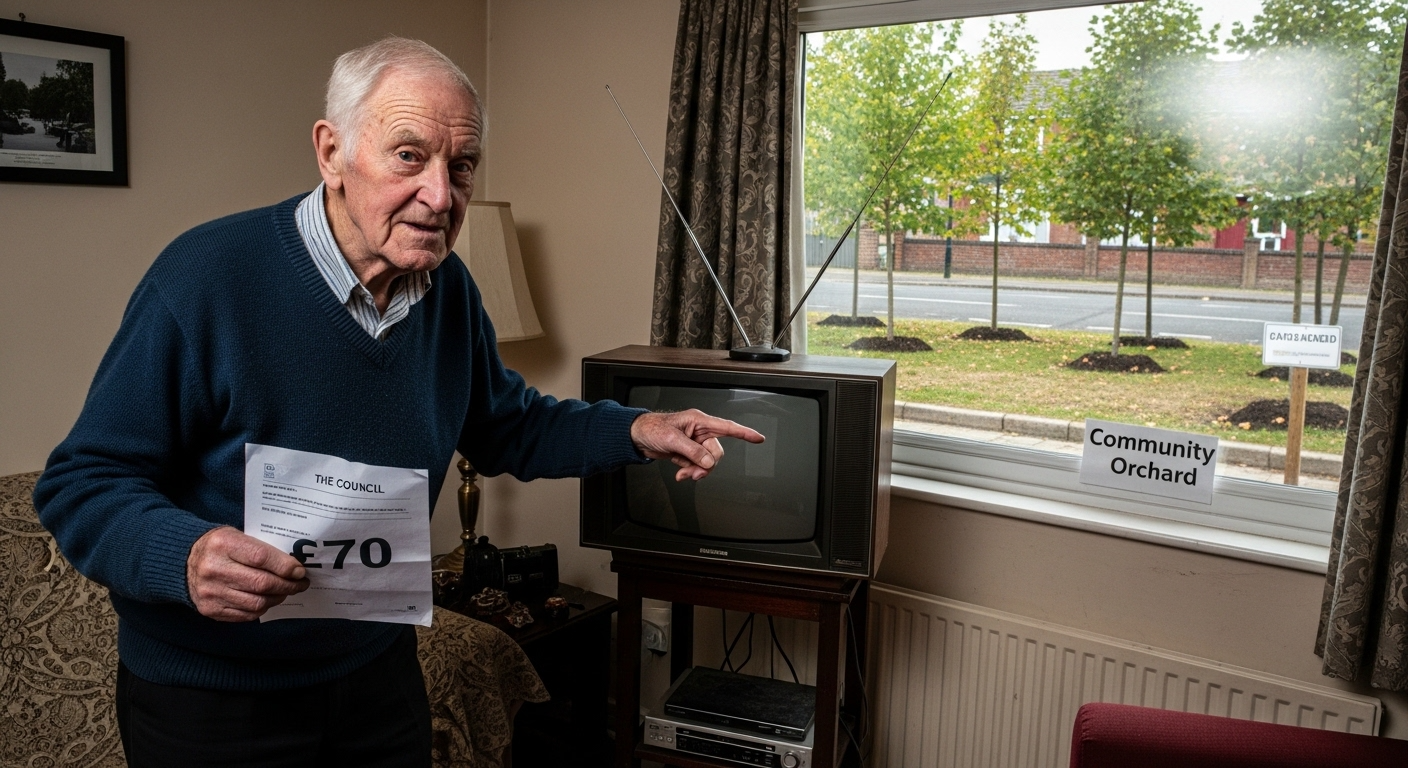
He Planted Trees for the Community. Now the Council Wants £70 and He Says They Can Take His Telly.
Jan Goodey spent Valentine’s Day planting apple trees with ten volunteers near a woodland in Brighton. By the end of the morning, he had helped lay the groundwork for a community orchard that local children would one day pick fruit from. He had also earned himself a parking fine.
The £35 penalty for stopping his van on double yellow lines while unloading mulch, compost, fencing, stakes, and trees has since doubled to £70 after his appeal was rejected. Goodey, a 60-year-old gardener working with the Brighton Permaculture Trust, has a straightforward response to that outcome. He is not paying it. Not now, not after the appeal, not under any circumstances. “They can take my telly,” he said. “I’m not paying it.”
What Actually Happened That Morning
Goodey was volunteering with the Brighton Permaculture Trust, a Sussex-based charity focused on sustainable living and community environmental projects. The tree planting event near Hodshrove Woods was designed to create a new apple orchard for the local area, partly funded by the council itself. Goodey was there in a working capacity, having earned around £120 for the day.
To unload the materials needed for the project, he parked his van near the playground on Goodwood Way. The spot was on double yellow lines. He says he parked with his wing mirrors folded in, left no obstruction, and was careful to stay clear of the ambulance turning circle at the bottom of the road. He was actively unloading at the time, which under UK traffic law can qualify as an exemption to the double yellow line restriction.
The parking attendant did not see it that way. The fine was issued.
The Council’s Position
Brighton and Hove City Council has not budged. Councillor Trevor Muten, the cabinet member for transport and city infrastructure, acknowledged Goodey’s work with the Permaculture Trust but was clear that the fine was correctly issued and would stand.
The council’s argument centres on the location. With a playground nearby, Muten said, parking enforcement in that area carries particular importance. The rules around double yellow lines exist to keep access clear for pedestrians, emergency vehicles, and anyone who might need to move through the area quickly. Good intentions, the council maintains, do not create an exemption.
Muten pointed Goodey toward the Traffic Penalty Tribunal, an independent adjudicator where he can present his case to an impartial body if he wants to continue challenging the fine through official channels.
A Pattern Worth Noting
This is not the first time Goodey has found himself in a dispute with local authorities over a fine. In 2022, he was issued a £400 penalty for leaving a bag of donated items outside a charity shop on Lewes Road. He appealed that one too, and the council eventually revoked it, accepting that it had been issued in error.
That outcome perhaps explains some of Goodey’s confidence in digging in this time. He has been through the process before, pushed back, and won. Whether the same result follows here is less certain, given that the council appears more settled in its position.
The Tension This Case Puts on the Table
What makes Goodey’s situation resonate beyond the £70 is the broader question it raises. Community volunteers, charity workers, and environmental groups regularly operate in public spaces with vehicles, equipment, and the kind of logistical reality that does not always align neatly with parking regulations. A bag of mulch and a bundle of chestnut stakes cannot be carried from a compliant parking bay three streets away.
Should there be a mechanism, even an informal one, that allows organisers of council-supported community events to arrange temporary loading permissions in advance? The council partially funded the very project Goodey was penalised for supporting. That detail sits awkwardly at the centre of this story.
Some people reading about this case will land firmly on the side of the rules. Double yellow lines mean what they mean, regardless of why you stopped. Others will feel that a system flexible enough to revoke a £400 fine for a bag of charity donations should find room to reconsider a £35 fine issued during a tree planting morning.
Goodey himself is not framing it as a legal argument so much as a matter of principle. He gave up his weekend, earned a modest wage, and helped create something that local children will grow up around. The fine, in his view, is not just financially disproportionate. It is simply wrong.
The telly, for now, stays put.