He Films His Stalker: Kayaker Narrowly Escapes Great White Shark Off California Coast
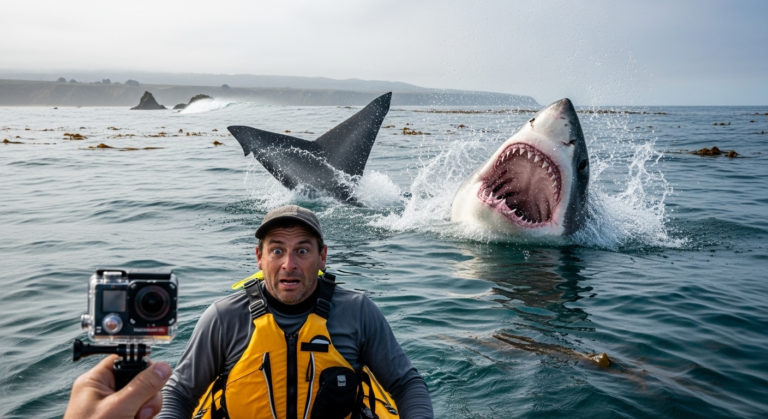
The Pacific looked peaceful that morning. Flat water, soft light, a single red kayak moving quietly through the swell just off the California coast. Then the man paddling it reached for his phone, hit record, and pointed the camera at what he first thought was a shadow passing beneath his hull.
It was not a shadow.
A Morning That Started Like Any Other
He had launched before sunrise, the way he always did. No drama, just the familiar scrape of plastic over wet sand, the smell of salt air, and the meditative quiet of open water. A GoPro sat on his chest mount, as it did on every trip, usually capturing nothing more exciting than rolling swells and distant boats.
He was not looking for trouble. He was not expecting any.
But somewhere beyond the breakers, the water changed. Not dramatically, not with any Hollywood warning sign. Just a subtle shift, a dark patch moving against the swell rather than with it. His hand went to his phone. Old habit. He lifted it, aimed the lens, and the camera focused on something that stopped him cold.
A dorsal fin cut the surface. Tall, triangular, and moving with complete confidence.
The Great White Shark Was Right There
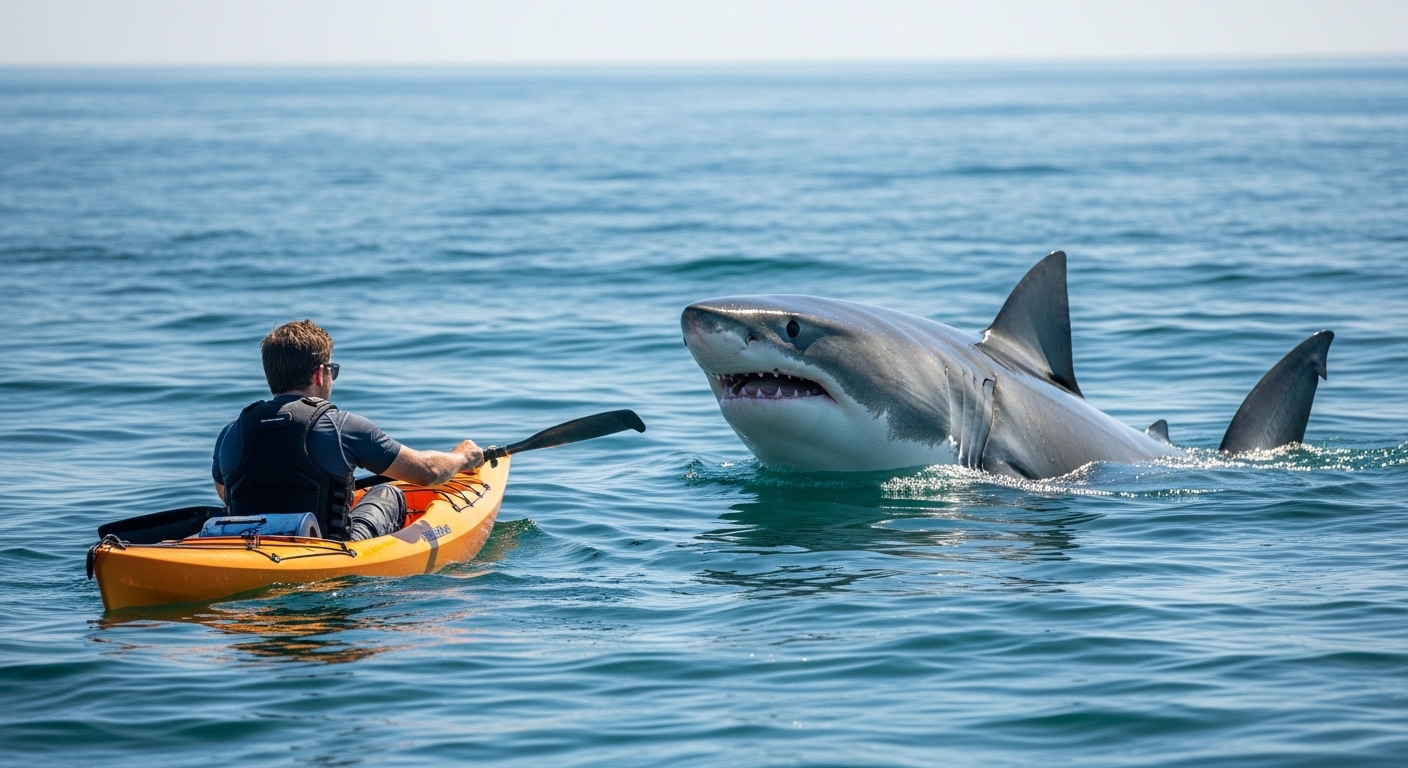
It was not a dolphin. He knew that the moment he saw the rigid, upright fin and the thick grey body trailing behind it. The shark was long, roughly the same length as his kayak, maybe longer. It moved like something that had never once questioned its place at the top of the food chain.
Every nerve in his body fired at once.
Key details from the encounter:
- The shark circled the kayak in wide, slow passes rather than charging directly
- It surfaced close enough for him to see the pale underside as it rolled slightly
- One eye, dark and expressionless, angled upward toward him
- The behavior matched what marine experts call investigative or exploratory circling
- He remained in the water with the shark for approximately six to seven minutes
He did not bolt. He stayed as still as he could and kept the camera rolling.
Why He Kept Filming Instead of Paddling
People watching the video later asked the same question repeatedly. Why film? Why not just go?
The honest answer is that sudden movement attracts attention, and his instincts told him that thrashing toward shore was a worse option than staying calm. Holding the phone also gave his hands something to do other than shake. Narrating gave shape to the fear building inside him. If something went wrong, at least there would be footage. At least it would be real.
He whispered to the shark at one point, the way you might talk to an unfamiliar dog you are not sure about. He told it he was just plastic and nothing interesting. He laughed once, a short and involuntary laugh that the microphone caught cleanly.
It was not bravery. It was the only thing he could keep doing.
The Shark That Followed Him Toward Shore
The encounter did not end quickly. The shark disappeared beneath the murk, which was worse than seeing it, then reappeared on the opposite side. It fell back, surfaced again, and paced him as he made slow, careful strokes toward land.
He could see faint scars along its flank as it drifted close, evidence of a long life in a rough ocean. The tail moved with the kind of casual power that made his paddle feel like a toy.
At some point, the water changed color beneath him, shifting from deep green to the lighter, sandy hue of the shallows. The coastline grew larger. The pier came back into focus. And then, without ceremony, the shark simply peeled away and sank out of sight.
He kept filming for another full minute before he finally lowered the phone.
Great Whites Off California: What the Science Says
Along much of the California coastline, great white sharks are not occasional visitors. They are residents, particularly in areas near seal colonies and cold water upwelling zones. Marine biologists have documented a steady presence of juvenile and subadult whites in nearshore waters, drawn by rich feeding grounds and favorable temperatures.
What makes encounters like this one more visible today is not a sudden surge in aggression. It is the cameras. Drones, GoPros, and waterproof phones now document what has always been happening just beneath the surface.
Important context around shark encounters:
- Great white attacks on humans remain statistically rare compared to time spent in the water
- Most close encounters involve investigative behavior, not predatory intent
- Kayakers and paddleboarders are more vulnerable than swimmers in traditional attack scenarios due to silhouette shape
- Paddling steadily toward shore and avoiding splashing are the most commonly recommended responses
- Never paddle alone in known shark activity zones without a communication device and safety gear
When the Video Hit the Internet
He shared the footage and it spread quickly. Not because it was the most dramatic thing ever filmed in the ocean, but because of how unfiltered it was. No music, no editing, no slow motion replay. Just a shaking frame, ragged breathing, and that fin moving through the water with absolute calm.
Marine enthusiasts broke down the tail movement, the spacing between dorsal and caudal fin, the slow deliberate circling. They built a picture of a large, unhurried animal doing what large unhurried animals do when something unfamiliar enters their space.
Others shared their own stories. Phantom bumps from below. Seals exploding past kayaks in a panic. The unsettling feeling of being watched in open water without being able to see what is watching.
He Still Goes Back
It took time. The first few trips after the encounter were jittery, every clump of kelp a suspected fin, every dark patch a held breath. But the ocean eventually reclaimed its quieter edges. Dawn became what it had always been, meditative and wide and full of birds.
He is different now, though. More alert, more aware that the water is not his space. He has simply been allowed to borrow it.
His video does not show a shark attacking. It shows a shark looking. That is a distinction worth holding onto, both for those who fear the ocean and for those who love it.
What To Do If You Encounter a Shark While Kayaking
Knowing how to respond in the moment can make a real difference. Here is what safety experts recommend:
- Stay as calm as possible and avoid sudden splashing movements
- Keep arms and legs inside the vessel at all times
- Make slow, steady paddle strokes toward shore rather than sprinting
- Do not attempt to touch, hit, or provoke the shark in any way
- Maintain visual contact where possible so you are not caught off guard
- Carry a waterproof communication device on every solo trip
- Check local wildlife reports before launching in known shark activity areas
The Ocean Has Always Been Their Space
It would be easy to frame this story as a brush with death and nothing more. But the great white shark that followed his kayak that morning was not a monster. It was an animal doing what animals do in the water they have always called home.
Encounters like this are becoming more visible because of the cameras we carry, not because sharks are suddenly more dangerous. The ocean has not changed. We have simply started recording what was always there.
He still paddles at dawn. He still carries his phone in a waterproof sleeve. And somewhere out beyond the breakers, life in the deep continues exactly as it always has, whether we are watching or not.
Read More: For more true stories, wildlife encounters, and outdoor safety guides written for Australians, visit wizemind.com.au