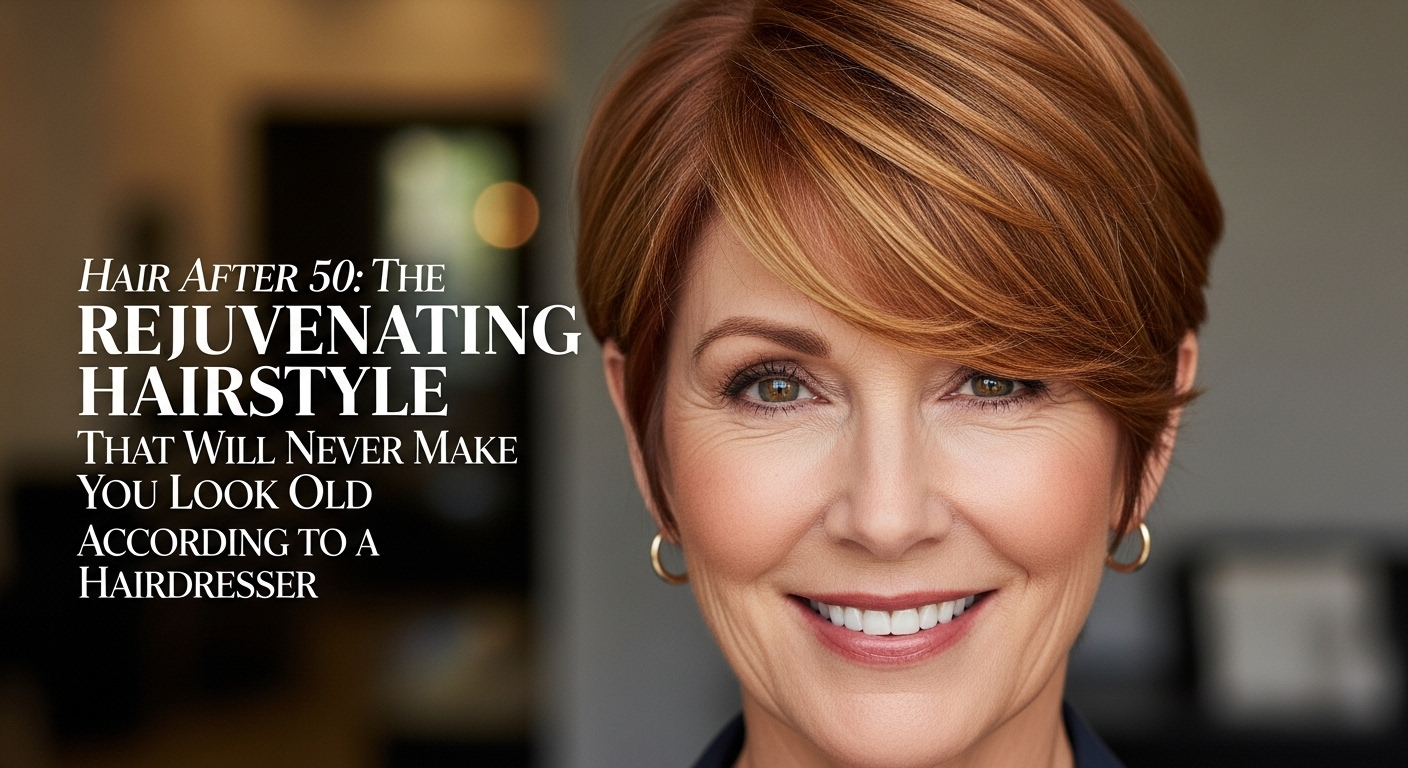
Hair After 50: Here’s the Rejuvenating Hairstyle That Will Never Make You Look Old, According to a Hairdresser
The first thing you notice is the sound. The soft snip of scissors, like a tiny metronome keeping time with the quiet music playing somewhere in the background. Outside, the afternoon light is unforgiving, bouncing harshly off shop windows up and down the street, but in here it is warm and flattering. You are sitting in the chair with the black cape wrapped around you like armour, staring at your reflection. Fifty-something. A little tired. A little wiser. Considerably more aware of how a mirror can be both friend and critic depending entirely on the angle.
You do not want to look younger, the hairdresser says, comb moving gently through your hair. You want to look alive.
There is a difference. And this, she explains, is precisely where the magic of the right hairstyle begins.
The Hairdresser’s Secret: It Is Not About Age, It Is About Movement
People come in clutching photographs of celebrities half their age, the hairdresser, Mara, tells me as she adjusts her position and leans toward the mirror. But hair after 50 has its own story. You cannot copy and paste from your thirties. What you can do is choose a cut that makes you look present, here in this moment, rather than frozen in a decade you have already lived through.
She speaks the way good stylists always do, with the particular quality of someone who has seen an enormous amount of real life unfold in their chair. She has been cutting hair for nearly three decades, watching clients grow into themselves through marriages, divorces, illnesses, promotions, and retirements. She remembers the first time someone sat down and whispered that they thought they looked old now and wondered whether anything could be done about it.
That was the moment I realised, she says, what people really want. A style that does not age them further, that does not signal they have given up. They want softness and movement and light. They want hair that makes them feel like themselves, just updated.
According to Mara, the hairstyle that consistently avoids making women look old is surprisingly unassuming. A softly layered mid-length cut sitting somewhere between the collarbone and just above the shoulders, with gentle face-framing pieces worked in around the cheekbones and jaw. Not a harsh blunt bob. Not long heavy curtains of hair. Not a stiff sprayed helmet. A cut that breathes.
I call it the Ageless Mid-Length, she says with a slight laugh. Because on women in their twenties, thirties, forties, fifties, sixties, and beyond, it always looks current. Never try-hard. Never dated.
Why the Ageless Mid-Length Works So Well After 50
If you have ever caught your profile in a shop window and wondered when your hair started pulling your face downward rather than lifting it, you are in very large company. Hair over 50 often changes in multiple ways simultaneously. It can become finer, drier, more fragile, and paradoxically more stubborn and resistant to styling all at once. It may stop holding a curl the way it once did, lose its natural wave, or sit noticeably flatter at the crown than it used to.
This is where mid-length magic comes in, Mara says, tilting your chin slightly and studying your jawline in the mirror. Too long, and gravity pulls everything southward. Too short, and every line and angle of your face is suddenly on full display without the softening effect of surrounding hair. A length that hovers between the collarbone and the shoulders frames the face, lifts the features, and creates a softening effect that neither extreme can reliably produce.
She demonstrates by gathering the hair to different lengths, a live illustration of how the face changes with each shift.
The layers she builds into this cut are soft and unobtrusive. Nothing chunky or obviously layered. Just enough to create a natural flow that gives the hair a sense of life and direction. The face-framing pieces fall near the cheekbones and graze the jaw, functioning like gentle parentheses around the face that draw the eye upward toward the eyes and the smile rather than downward toward anything else.
This cut also has a practical advantage that becomes more valuable as life gets busier. It can be worn sleek or wavy, tucked behind the ears for a weeknight dinner or tousled for a casual weekend. It does not require an exhausting blow-dry routine every single morning. It accepts and even welcomes a small amount of bend and imperfection.
Perfection ages us, she says. Softness does not.
The Length That Flatters Almost Everyone
Ask a range of experienced hairdressers what the safest and most consistently flattering length is after 50, and a significant number of them will arrive at the same answer. Mid-length. The reasons are practical and predictable once you understand what the length is actually doing.
It lifts the eyes and the overall face by removing the downward pull of hair that extends past the chest, making the whole face look more open and awake without the exposure that a very short cut can create. It balances the neck and the jaw by landing at the precise point where neck lines and jaw definition can be simultaneously softened and subtly highlighted rather than emphasised or hidden. It works particularly well with finer hair because strands of moderate length carry more natural volume than long hair that collapses under its own weight. And it grows out gracefully without an obvious and uncomfortable in-between phase that makes the person wearing it wish they had not changed anything.
A great mid-length cut does not trap you, Mara says. It gives you options. It lets you say yes to last-minute plans without standing in front of the bathroom mirror for forty minutes wondering what to do with your hair.
Soft Layers, Not Choppy Ones: The Subtle Art of Movement
There is layering, and then there is layering that respects the reality that you have a full life to attend to and cannot spend the first hour of every morning working on your hair.
After 50 I rarely cut aggressive or choppy layers, Mara explains. They can make hair look thinner and stringier and more high-maintenance than anyone wants. Instead I cut what I think of as invisible layers. Gentle, flowing ones that do not announce themselves as layered but still create movement and air through the hair.
She runs a wide-tooth comb through damp hair and lifts small sections, snipping tiny amounts that fall like feathers. The result is more texture and more air between the strands, but without any jagged or disconnected pieces. The hair should feel light when you move your head, she says. Like it wants to follow you rather than resist you.
These soft layers produce what she describes as the sway effect. That subtle swing when you turn your head, when you laugh, when you walk across a room with purpose. It is the precise opposite of stiff hair that appears frozen in place. Frozen hair, it turns out, makes the face wearing it look frozen too.
Movement reads as vitality, she says. If your hair looks alive, you look alive.
The Power of Face-Framing Pieces
If mid-length is the canvas, the face-framing layers are the detail work that pulls the whole composition together into something genuinely flattering.
These are the pieces that quietly do the heavy lifting, Mara explains. A soft curtain near the cheekbones, a subtle sweep near the jawline, and suddenly your best features are highlighted while the things you might feel self-conscious about fade quietly into the background.
Face-framing layers can soften deeper lines around the mouth by drawing the eye away from that area and upward. They bring attention toward the eyes, which is almost always where you want it. They create the visual impression of lift at the cheekbones and can either soften a strong jaw or bring structure to a softer one depending on how they are cut and positioned.
There is a small alchemy at work in this. The hair moves, the features catch the light, and the reflection begins to look less like someone trying to reverse time and more like someone who is genuinely, comfortably at home in their current chapter.
Colour, Shine, and Texture: The Finishing Touches That Matter More Than Ever
Even the best cut can read as tired if the hair itself looks dull, flat, or over-processed. After 50, the conversation about hair is not limited to length and layers. It extends to texture and light.
Shine is youth, in hair terms, Mara says. But shine does not mean jet-black box dye or one flat uniform blonde. It means dimension. It means allowing light to bounce rather than be absorbed.
She frequently suggests soft warm highlights or lowlights, even through grey hair, to introduce depth and movement that a single solid colour simply cannot provide. If your hair is transitioning to silver or white naturally, celebrate it but refine it, she says. A toner to address unwanted yellow tones, a gloss treatment to add shine, and a strategic highlight or lowlight placed thoughtfully can make the difference between hair that looks intentional and elegant and hair that looks like an ongoing battle with the calendar.
Texture care is equally important. Mature hair is often drier, particularly if years of colour and heat styling have accumulated their effects. Hydration becomes the quiet backbone of everything else you do.
Think of your hair like linen rather than synthetic fabric, she says. It requires more care and more gentleness, but the result when you treat it well is genuinely beautiful.
In practice this means fewer harsh clarifying shampoos, more conditioners and weekly masks, and styling products that encourage movement without creating stiffness. Light creams, serums, or mousses that work with the hair’s natural inclination rather than fighting it.
A practical guide to the most common goals and what actually helps:
For hair that looks tired and flat, a mid-length cut with soft face-framing layers does more than any product to lift the overall impression. For finer or thinning hair, gentle invisible layers combined with a light root-lifting product and avoiding lengths that are too long will create volume that holds through the day. For grey hair that needs to look intentional rather than accidental, a gloss or toning treatment combined with a small amount of dimensional colour transforms the effect entirely. For reducing daily styling time, a cut that air-dries well combined with a simple routine of leave-in conditioner and a light cream is often all that is needed.
What to Ask Your Hairdresser So You Leave with the Right Result
For many people, the hardest part is not knowing what they want but communicating it clearly once they are sitting in the chair. The cape goes on and somehow all the ideas that seemed so clear in the car park vanish, replaced by a vague nod and a smile and forty minutes later a cut that belongs to someone else’s life.
Mara suggests arriving with specific phrases ready rather than relying on a photograph alone to do the communicating.
Telling your stylist you would like a mid-length cut sitting between your collarbone and shoulders gives them a clear target to work toward. Asking for soft blended layers for movement, specifically not choppy layers, communicates the quality of the layering you want rather than just the fact of it. Requesting gentle face-framing pieces that flatter your cheekbones and jawline tells them where to focus the detail work. Mentioning that you want the cut to be easy to style in ten to fifteen minutes or to air-dry well sets a practical expectation that shapes the entire approach. And saying you want to look modern but not like you are attempting to look twenty again gives them the clearest possible brief about the tone and direction of the work.
Then invite the conversation rather than issuing a one-way instruction. Ask where they think the most flattering length is for your specific face shape and neck. Ask how they can create movement without sacrificing fullness. Ask what they would suggest for colour or shine to make the hair look more alive. A good hairdresser will respond to these questions with genuine enthusiasm. It is their opportunity to collaborate rather than simply execute.
What I love about the mid-length layered face-framing style, Mara says, is that it starts as a template but becomes entirely yours through the customisation. A little longer here, slightly shorter there, a side part, a soft fringe if you want one. Your version is the only one that matters.
The Feel of It: How the Right Cut Changes More Than Your Reflection
The cape comes off. Fine hairs cling briefly to your neck and cheeks like scattered punctuation at the end of a long sentence. You stand, brush them away, and catch your reflection again. This time something has shifted.
The new length skims your collarbone and falls in a soft forgiving line. When you tilt your head your hair follows with a subtle sway, not dramatic, just quietly alive. The layers around your face frame your eyes and catch the light. Your jaw looks more defined. The lines around your mouth seem softer, less important somehow, less insistent on being noticed.
Run your hands through it, Mara says. It should feel easy.
You do. There is a pleasant lightness to it, like setting down something you had been carrying for longer than you realised. The cut does not feel like a costume. It feels like a slightly more awake version of yourself, the version that was there all along and simply needed a different frame.
The best hairstyle after 50, she says, is not about pretending you are not the age you are. It is about editing. Removing what weighs you down. Sharpening what lights you up.
Later, stepping out into the afternoon light, your reflection catches in a shop window. This time you do not look away from it. The hair moves when the breeze nudges it. The mid-length swing, the soft layers, the face-framing pieces all work together to deliver one quiet and completely accurate message.
You are still here. You are still changing. And none of it has to look old.
Read More: For more hair, beauty, and lifestyle stories written for Australian women, visit wizemind.com.au