Goodbye to Induction Hobs — The New Kitchen Technology Preparing to Take Their Place in 2026
The kitchen has always been the room where a home reveals its character most clearly. It is where the real life of a household happens, where meals are made under pressure on a Tuesday evening and where Sunday mornings unfold slowly over coffee and something on the stove. For the past two decades, the induction hob has been the centrepiece of that space in modern homes. Precise, fast, energy-efficient, and genuinely superior to everything that came before it. But something new is arriving, and the kitchen landscape is about to shift again.
Intelligent cooktops are the technology that manufacturers, designers, and materials scientists have been quietly developing while induction held the spotlight. They are not simply a better induction hob. They represent a different conception of what a cooking surface is, what it does, and how it relates to the kitchen around it.
What an Intelligent Cooktop Actually Is
The distinction between an induction hob and an intelligent cooktop is worth understanding clearly, because the difference is more fundamental than an incremental performance improvement. Induction hobs heat through electromagnetic coils positioned beneath a glass surface at fixed locations. You place your pan on a burner zone. The zone heats. Everything else stays cold.
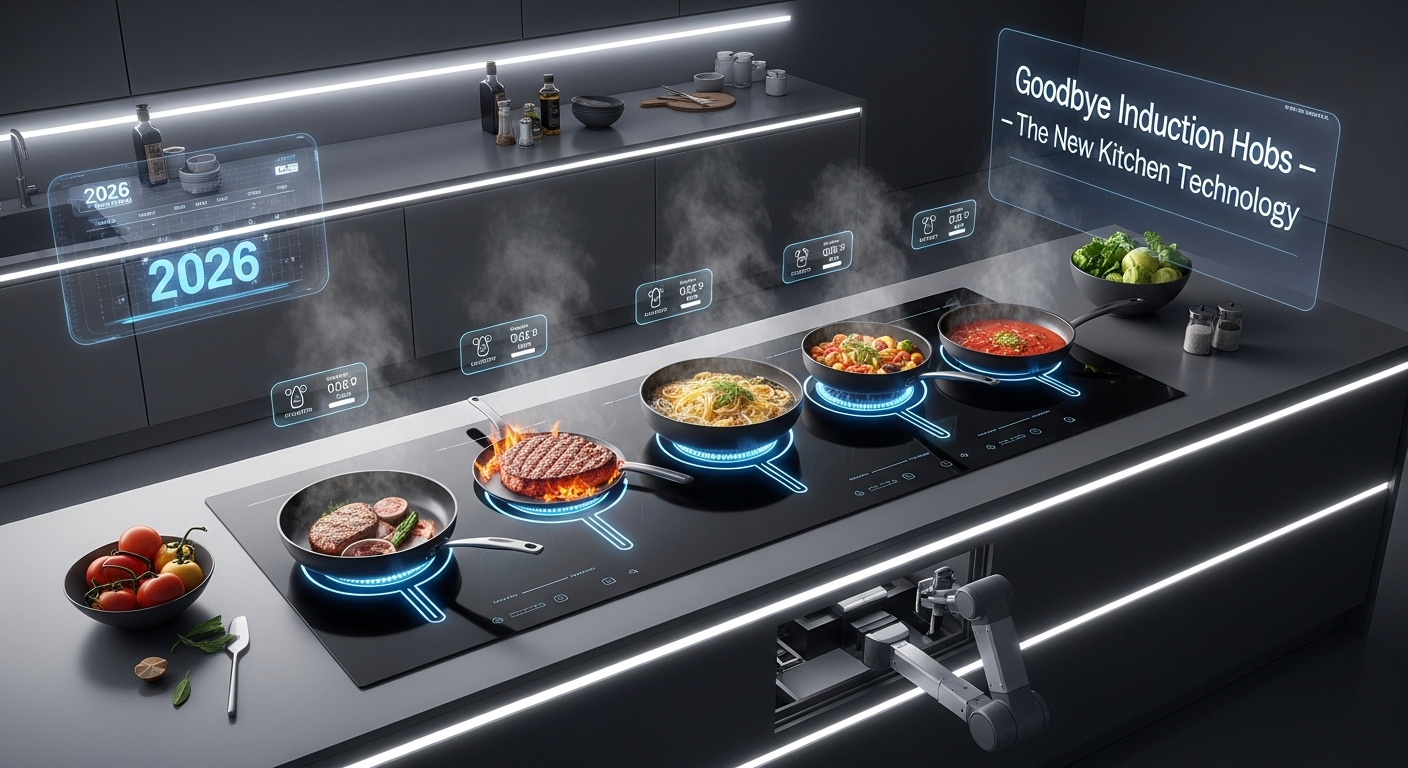
An intelligent cooktop abandons the fixed zone entirely. The entire surface is active, and the appliance uses sensors to detect where cookware is placed, what size it is, and how it is positioned, then generates heat precisely where and in the quantity needed. You place a small saucepan in one corner and a large stockpot in the centre, and the surface responds to both simultaneously without any manual zone selection.
The sensors go further than location detection. Advanced systems monitor temperature within the cookware, track cooking time, and in some implementations can detect the contents of the pan to a degree that allows real-time guidance and adjustment recommendations. The surface is not just a heat source. It is an active participant in the cooking process.
Why Induction Is Being Superseded
Induction was celebrated when it arrived because it genuinely was better than what preceded it. Faster than gas in energy transfer, safer because the surface itself does not heat, more responsive than ceramic or halogen, and considerably more energy-efficient than every previous domestic cooking technology. The adoption curve has been steep and justified.
But induction has limitations that become apparent precisely because the technology performs well enough that users begin to notice the constraints rather than just appreciating the improvements. Fixed zones mean fixed spatial logic. A large wok cannot sit comfortably between two standard zones. A small milk pan in the centre of a large zone uses more energy than it needs. The physical layout of the hob determines what you can cook and how, rather than the other way around.
The intelligent cooktop dissolves those constraints. The surface responds to the cookware rather than requiring the cookware to respond to the surface. This is the conceptual shift that kitchen designers describe as genuinely transformative rather than incremental.
Energy efficiency improves alongside flexibility. When heat is generated only where a vessel is sitting and only in the precise area that vessel occupies, the energy wasted heating zones that extend beyond the cookware base disappears. For households that cook seriously and frequently, the cumulative efficiency gain is meaningful.
How Kitchen Design Changes Around the Technology
The arrival of intelligent cooktops is not just a swap of one appliance for another. It requires a rethinking of how kitchens are designed and how surfaces relate to cooking activity. The seamless integrated surface that the technology enables changes the visual and functional logic of the kitchen substantially.
Where a traditional kitchen demarcates the hob as a distinct zone, the intelligent cooktop can blend into a continuous surface that extends across the available counter space. The visual boundary between cooking area and preparation area softens or disappears entirely. This is partly aesthetic and partly practical, because a surface that is not divided into fixed functional zones can be used differently across different contexts.
The infrastructure implications are real and require planning rather than assumption. Power supply requirements for intelligent cooktops differ from standard induction installations. Ventilation needs to be assessed against the different heat distribution patterns. The placement of sinks, storage, and cabinetry needs to be considered in relation to a cooking surface that may extend differently than the hob it replaces.
Designers working with this technology describe it not as a complication but as an opportunity. The constraints of the fixed hob zone have shaped kitchen layouts for decades, and removing that constraint opens design possibilities that have not previously been available. The kitchen of the future that the technology enables is not just better at cooking. It is differently organised around cooking in ways that reflect how people actually use their kitchens rather than how the limitations of previous technology required them to.
What Experts Are Saying
Kitchen design specialist Jane Doe frames the shift in terms that go beyond the technology itself. “The shift towards intelligent cooktops is a game-changer for the kitchen industry,” she observes. “These advanced appliances not only offer greater precision and efficiency but also have the potential to fundamentally change the way we design and interact with our kitchens.”
Technology analyst John Smith places the development within the broader context of smart home evolution. “Consumers are increasingly demanding appliances that offer greater intelligence, flexibility, and connectivity,” he notes. “These cooktops represent a significant step forward in the evolution of kitchen technology, and we’re only just scratching the surface of their potential.”
Sustainability expert Sarah Lee adds the environmental dimension that manufacturers are increasingly treating as central rather than peripheral. “By embracing this new technology, we can create more efficient, sustainable, and intuitive kitchen spaces” that better meet the needs of modern homeowners who are thinking about their energy consumption as seriously as their cooking performance.
What the Transition Looks Like in Practice
The replacement of induction hobs will not be sudden. The intelligent cooktop is a more expensive appliance at this stage of its development, requires infrastructure consideration that a like-for-like swap does not, and demands a learning curve from users who have built their cooking habits around the fixed-zone logic of induction.
The pattern of adoption will likely follow the same curve that induction itself followed when it arrived. Early adopters in new builds and premium renovations, followed by gradual mainstream adoption as prices decrease and installers become more familiar with the requirements. The point at which intelligent cooktops become the default rather than the premium choice will depend on manufacturing scale and cost reduction that typically follows technology maturation.
For homeowners currently planning a kitchen renovation or new build, the question worth asking is not whether intelligent cooktops will become standard, but whether the timeline of your project aligns with wanting to be early in that transition or waiting for the technology to mature further. Both are legitimate choices with different risk and cost profiles.
Key Points
- Intelligent cooktops represent a conceptual departure from induction rather than an incremental improvement. Where induction heats fixed zones that the cook must work around, intelligent cooktops use sensors to detect cookware location and size, generating heat precisely where and in what quantity each vessel requires. The cooking surface responds to the cook rather than constraining them.
- The energy efficiency advantage over induction is genuine and measurable. By generating heat only in the precise area occupied by cookware rather than across a fixed zone that may extend beyond the vessel, intelligent cooktops eliminate a category of energy waste that induction, despite its efficiency advantages over previous technologies, still produces.
- Kitchen design changes fundamentally around this technology rather than simply substituting one appliance for another. The seamless integrated surface dissolves the visual and functional boundary between cooking and preparation areas, enabling kitchen layouts that reflect how people actually use their kitchens rather than the constraints that fixed-zone cooking technology imposed.
- The transition will be gradual rather than sudden, following the adoption curve that induction itself followed from premium innovation to mainstream standard. Infrastructure requirements including power supply, ventilation assessment, and installation expertise mean that the shift involves more planning than a direct appliance swap, which naturally extends the adoption timeline.
- For homeowners planning renovations or new builds, the intelligent cooktop is worth serious consideration even at this relatively early stage of mainstream availability. The technology is proven in premium installations, the direction of development is clear, and planning a kitchen around its capabilities now avoids the retrofitting costs that will arise for those who install induction today and want to upgrade within a decade.