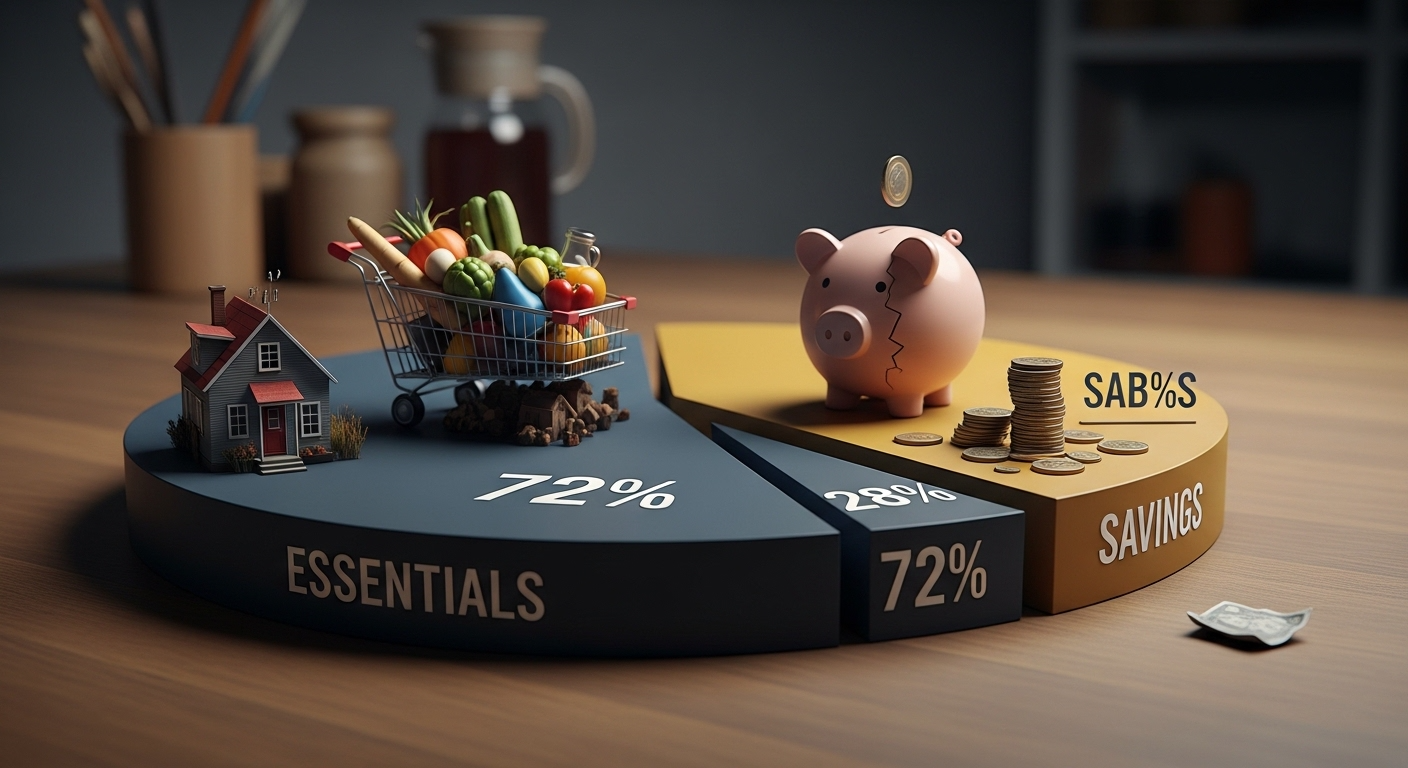
Goodbye Savings Habit as Essentials Consume 72% of Household Income
For years, the financial advice given to Australians was consistent and straightforward: pay yourself first, build a buffer, set money aside before you spend on anything else. That advice assumed something that is no longer true for a growing number of households. It assumed there would be money left over after the essentials were paid for.
In 2026, that assumption has broken down. Across Australia, households are reporting that essential living costs now consume up to 72 percent of total household income, leaving so little remaining that consistent saving has become genuinely impossible for millions of families. This is not a story about poor financial discipline or bad spending habits. It is a story about numbers that simply no longer add up.
How Essentials Came to Dominate the Household Budget
The shift did not happen overnight. It has been building steadily over several years as multiple categories of essential spending increased simultaneously, each one individually manageable but collectively overwhelming.
Housing costs, including rent, mortgage repayments, council rates, and strata fees, now account for 30 to 35 percent of income for a typical Australian household. For renters in major cities the proportion is often higher, with some households in Sydney and Melbourne spending 40 percent or more of gross income on rent alone.
Food and groceries have risen sharply and now represent 15 to 18 percent of household income for most families. The grocery bill that once felt like a background expense has become one of the most actively managed items in many household budgets, with people making specific decisions about what to cut or substitute each week.
Energy, water, and utility costs take another 7 to 9 percent. The removal of power bill relief programs in 2026 and the underlying structural increases in energy pricing have pushed this category significantly higher than it was even two years ago.
Transport and fuel costs account for 6 to 8 percent, and insurance across home, car, contents, and health has risen sharply in recent years, adding another 5 to 7 percent to the essential spending total.
Add these categories together and essential costs alone are consuming between 63 and 77 percent of income for a typical Australian household. What remains after these non-negotiable expenses is genuinely small, and for many households it is not enough to save anything meaningful after other necessary spending is covered.
Why the Savings Habit Is Breaking Down
Financial counsellors and economists are consistent in their assessment: Australians have not stopped saving because they lack discipline or ambition. They have stopped saving because the financial arithmetic no longer supports it.
Income growth across most of the workforce has not kept pace with the increase in essential costs over the past three years. A household whose income has grown by 5 percent over that period has fallen significantly behind if their essential costs have risen by 15 to 20 percent in the same timeframe, which is the experience many families are describing.
The particular challenge of 2026 is that multiple essential categories increased at the same time. In previous periods of financial pressure, a spike in one area such as fuel prices was often offset by stability in others. The current environment has delivered simultaneous increases in housing, food, energy, and insurance, creating a compression effect on budgets that is harder to absorb than any single category increase would be.
Government support payments, for households that receive them, are providing some relief but that relief is being consumed immediately by bills rather than providing room for saving. The support is helping households stay afloat but it is not creating the breathing space needed to rebuild savings habits.
For many households, the savings that existed before the current cost of living period are also being actively drawn down to cover monthly shortfalls. What was once an emergency fund has become an operational budget, and the financial security those savings represented is gradually disappearing.
Who Is Struggling the Most
The inability to save is being felt across a much wider range of households than the conversation about financial stress typically acknowledges. It is not limited to low-income earners or people experiencing unemployment.
Renters in major cities are among the most severely affected. Frequent rent increases over recent years have pushed housing costs to a level where even households with solid incomes have minimal room left for saving after rent and other essentials are covered.
Single-income households face the challenge of covering costs designed for a dual-income economy on one salary. The gap between single and couple household purchasing power has widened as costs have risen.
Families managing childcare and education costs are experiencing a double pressure, with these significant expenses sitting on top of all other essential costs and leaving even less room for savings.
Older Australians on fixed incomes, including those receiving the Age Pension or drawing down super at a fixed rate, face a particularly difficult situation because their income is largely predetermined while their costs continue to rise. They cannot respond to higher costs by working more hours or seeking a higher-paying role.
Perhaps the most striking development in 2026 is how many households that previously felt financially secure are now reporting an inability to save. Middle-income families, dual-income professional households, and people who would never have described themselves as struggling financially are now finishing each month with nothing left to put aside.
Real Experiences From Households
A retail worker in Adelaide described the change in her financial situation with simple clarity. Her savings have not grown in over a year. Every extra dollar that comes in goes directly to bills before she has any opportunity to think about setting it aside.
An electrician from Melbourne described a more troubling shift. He is no longer saving money each month. He is spending savings each month. The account he built over years as an emergency fund is now part of his regular monthly budget, covering the gap between his income and what everything costs.
These are not unusual stories in 2026. They are being repeated by households across every state and territory, across different income levels and different family structures. The common thread is not a lack of effort or planning. It is a cost structure that has outpaced income growth and left households with genuine arithmetic problems rather than behavioral ones.
What This Means for the Broader Economy
Economists are watching the decline in household savings rates with genuine concern because the consequences extend well beyond individual family finances.
Household savings provide the financial buffer that allows people to absorb unexpected costs without immediately turning to credit. When that buffer disappears, a single unexpected expense such as a medical bill, a car repair, or a home maintenance issue becomes a financial crisis rather than a manageable inconvenience.
As more households exhaust their savings, dependence on credit cards and buy-now-pay-later products increases. This creates ongoing interest costs that further reduce the income available for essentials, creating a cycle that is difficult to break once it begins.
Financial stress, even without an income loss, rises when households have no savings buffer. The psychological and health impacts of constant financial anxiety are well documented and create additional costs in terms of healthcare utilization and reduced workplace productivity.
When a large proportion of the population is simultaneously unable to save and increasingly reliant on credit, the overall resilience of the economy to any external shock, such as a job loss spike or another round of cost increases, is significantly weakened.
How Households Are Adapting
Australians are not passively accepting this situation. They are making rational adjustments to manage their finances within the constraints they are facing, even when those adjustments feel like retreats from previous financial goals.
Many households have stopped automatic savings transfers because there is genuinely nothing to transfer at the end of the month. This is not a failure of commitment. It is an acknowledgment that setting up an automatic transfer to a savings account that immediately bounces back due to insufficient funds achieves nothing.
Offset accounts are being used differently, as a daily transaction management tool rather than a long-term wealth-building vehicle. Keeping the offset account as high as possible to reduce mortgage interest is one of the few savings-adjacent strategies that remains viable for homeowners in the current environment.
Emergency savings, where they still exist, are being fiercely protected even as other financial goals are abandoned. Many households have made a deliberate decision to stop trying to grow savings and focus purely on maintaining a small emergency buffer against complete financial vulnerability.
Financial counsellors describe these adjustments as practical survival responses rather than failures of financial management. People are doing what makes sense given the conditions they are actually living in, not the conditions financial advice was written for a decade ago.
What to Do If Saving Feels Impossible Right Now
If you are in the situation where saving feels genuinely out of reach in 2026, the most useful thing you can do is stop measuring yourself against goals that were set in a different economic environment and start working with the reality of your current situation.
Update your budget based on what things actually cost now, not what they cost twelve or twenty-four months ago. Many people are operating from mental budget frameworks that underestimate their current costs and create a false sense that money should be going further than it is.
Check for every concession and rebate you are entitled to. As covered elsewhere in this series, significant amounts of available support go unclaimed each year. Energy rebates, council concessions, healthcare savings, and transport discounts are all worth investigating if you have not done so recently.
Avoid expanding your use of credit to maintain a lifestyle that your income no longer supports at current cost levels. Credit provides temporary relief but creates ongoing costs that make the underlying problem worse over time.
Protect even a very small emergency buffer if at all possible. Even $500 to $1,000 set aside and genuinely not touched except for true emergencies provides meaningful financial protection against the costs that consistently push people from manageable stress into genuine crisis.
Be honest with yourself about the current situation without attaching blame or guilt. The inability to save in 2026 is an economic condition affecting millions of Australian households. Treating it as a personal failure makes it harder to think clearly about practical responses.
Frequently Asked Questions
Is it normal to not be saving anything in 2026?
For a significant proportion of Australian households it is unfortunately the current reality. Research and household surveys consistently show that essential costs have grown faster than incomes for most working Australians over the past three years, reducing or eliminating the financial room that saving requires.
Should I stop my automatic savings transfer if I cannot afford it?
If maintaining an automatic savings transfer means you are regularly falling short on essential bills or going into overdraft, stopping it temporarily is a sensible response. An automatic transfer that creates a shortfall elsewhere is not actually helping you save. Resuming it when your financial position improves is always an option.
What is the most important financial priority if I cannot save right now?
Protecting a small emergency buffer and avoiding high-interest debt are the two priorities most financial counsellors recommend for households that cannot currently build savings. Maintaining even a minimal buffer prevents small unexpected costs from becoming larger financial crises.
Where can I get free help if I am struggling with household finances?
The National Debt Helpline on 1800 007 007 provides free financial counselling for Australians experiencing financial difficulty. Services Australia can also advise on any government support payments or concessions you may be eligible for that could help reduce your essential cost burden.