Goodbye Clogged Drains: The Simple Home Hack to Unclog Your Sink and Washbasin in Just Minutes
Clogged drains are one of those household problems that manage to be both deeply unglamorous and genuinely disruptive. A sink that drains slowly, or not at all, turns an ordinary morning routine into a standing puddle of frustration. The default responses tend toward either reaching for a bottle of harsh chemical cleaner or calling a plumber, both of which cost more than the problem deserves. What many Australian households already have sitting in their pantry, however, is everything needed to clear most everyday clogs in a matter of minutes without any chemicals, specialist tools, or professional help.
The Pantry Combination That Actually Works
The two ingredients at the centre of this approach are baking soda and white vinegar, which you likely already have within arm’s reach of the kitchen sink where the problem is most likely occurring.
The science behind why this works is straightforward. Baking soda is a mild alkali, and white vinegar is a dilute acid. When they meet, they react rapidly and produce carbon dioxide gas, which is what creates the familiar fizzing and foaming action. That physical agitation, combined with the chemical activity of the reaction, works to loosen and dislodge the accumulated soap scum, grease, hair, and organic debris that causes most household drain blockages.
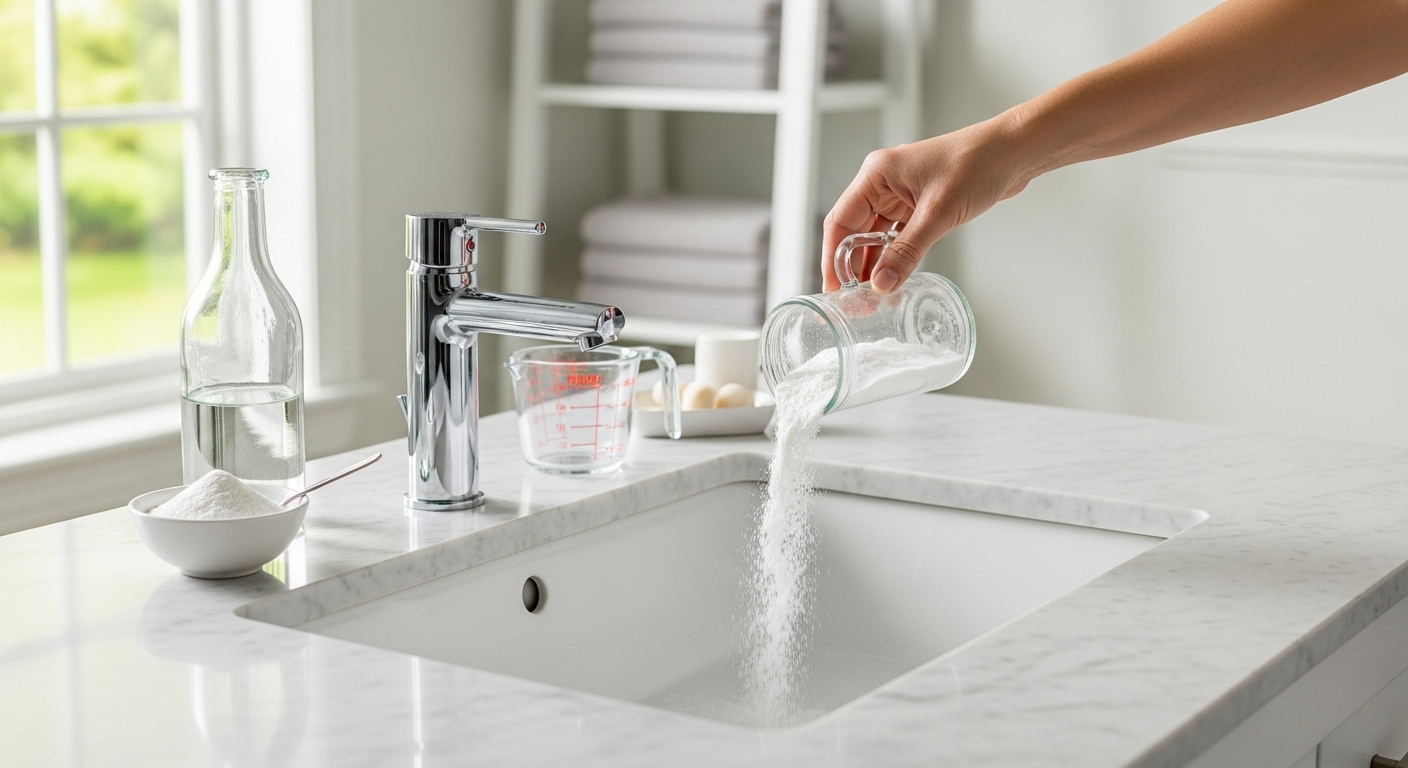
The method is equally simple. Pour approximately half a cup of baking soda directly down the drain, pushing it as far down as possible. Follow immediately with half a cup of white vinegar. You will hear and see the fizzing reaction begin almost immediately. Cover the drain opening if you can, with a plug or even a folded cloth, to direct the pressure of the reaction downward into the pipe rather than up and out. Allow the mixture to work for five to ten minutes, then flush the drain thoroughly with a full kettle of boiling water. The heat helps to dissolve any remaining grease and carry the loosened material through the pipe.
For a moderately blocked drain, a single application is often sufficient. For a drain that has been slow for some time and has accumulated significant buildup, repeating the process twice in sequence before the final boiling water flush tends to produce better results.
When You Need Something Stronger
The baking soda and vinegar method handles the majority of common household drain blockages effectively, but there are situations where the clog is more resistant and requires a different approach.
Enzyme-based drain cleaners are the next step up and are worth keeping in your cleaning supplies. Unlike chemical drain cleaners that work through aggressive and potentially pipe-damaging reactions, enzyme products contain naturally occurring microorganisms that digest the organic matter causing the blockage. They are particularly effective on the kind of slow, gradual buildup from hair, soap residue, and food particles that accumulates in bathroom and kitchen drains over months. The trade-off is time. Enzyme cleaners typically need several hours, or overnight, to produce their full effect. They are best used as a treatment for persistent slow drainage rather than for an acute blockage that needs immediate resolution.
When neither chemical nor biological approaches are shifting the problem, mechanical methods are the answer. A plunger is the first tool to reach for. Place it firmly over the drain opening to create a seal, push down slowly and firmly several times, then pull up sharply to create suction. The combination of pressure pushing down and suction pulling up can dislodge blockages that have resisted other approaches. For kitchen sinks with a double basin, cover the second drain opening before plunging to ensure the pressure is directed into the pipe rather than escaping through the other opening.
A drain snake, also called a plumber’s auger, is the tool for serious blockages that resist both chemical and plunger treatment. These are available from hardware stores for a modest cost and are designed to travel down the pipe and physically break up or retrieve whatever is causing the obstruction. Using one takes a little practice but is well within the capability of anyone comfortable with basic DIY tasks.
Preventing Blockages Before They Start
Understanding what causes most drain blockages makes prevention straightforward. In bathroom drains, hair is the primary culprit. It combines with soap scum to form dense, sticky accumulations that gradually reduce flow until the drain stops completely. A simple mesh drain strainer placed over the shower or bath drain and emptied regularly after each use eliminates most of this problem without any additional effort.
In kitchen sinks, cooking grease and oils are the main cause of blockages. They flow down the drain as liquid when hot but solidify on the inner walls of pipes as they cool, gradually narrowing the passage until flow stops. Wiping oily pans and dishes with a paper towel before washing, and disposing of cooking fats in the bin rather than the sink, prevents this buildup from developing. Running hot water through the sink for thirty seconds after washing up helps carry any residual grease further down the pipe before it can solidify.
Using the baking soda and vinegar method as a monthly maintenance flush, even when the drain appears to be flowing normally, keeps pipes clear before partial blockages have a chance to develop. Pour a generous amount of baking soda down, follow with vinegar, wait ten minutes, and flush with boiling water. This takes less than fifteen minutes and prevents the more stubborn blockages that require significantly more time and effort to resolve.
Why Chemical Cleaners Are Worth Avoiding
Commercial chemical drain cleaners are effective at dissolving blockages, but they work through highly caustic reactions that are not selective about what they break down. Over time, regular use of these products can degrade the inner surfaces of older pipes, particularly those made from PVC or rubber-sealed connections. They are also genuinely dangerous to handle, capable of causing serious burns on contact with skin or eyes, and their fumes are harmful in enclosed spaces. When they flush through into the water system, they introduce compounds that affect aquatic ecosystems and local water quality.
The baking soda and vinegar method and enzyme-based alternatives produce none of these side effects. They are safe to handle without protective equipment, safe to flush into the water system, and safe for the internal surfaces of your plumbing. For an outcome that is equivalent or better in most common situations, the case for the chemical-free approach is clear.
When DIY approaches have been tried and the blockage persists, or when a drain is backing up repeatedly despite regular maintenance, that is the point at which calling a licensed plumber is the right decision. Persistent blockages can indicate a problem further down the pipe than household tools can reach, or a structural issue with the plumbing itself. Addressing those situations early, before a slow drain becomes a backed-up pipe and a backed-up pipe becomes water damage, is considerably less expensive than the alternative.
For most everyday drain problems, however, your kitchen pantry already contains the solution.
Read More: For more home maintenance tips, practical household hacks, and lifestyle advice written for Australian readers, visit wizemind.com.au