Goodbye Air Fryer: This So-Called Miracle Kitchen Gadget With Nine Cooking Methods Is a Useless Luxury That Will Divide Home Cooks and Enrage Frugal Families
The first thing you notice isn’t the hum. It’s the glow. That eerie spaceship-blue light on the kitchen counter, casting long shadows over the cutting board and the wilting basil you swore you’d use. The air fryer door clicks shut like a tiny vault. Inside, your dinner spins and crisps and hisses — a promised miracle in a plastic box, a healthy revolution that somehow still smells like frozen potato wedges and marketing campaigns.
You stand there, arms folded, listening to the whirr and wondering when exactly cooking turned into waiting next to an appliance that behaves like a tiny jet engine.
The Strange Seduction of Countertop Miracles
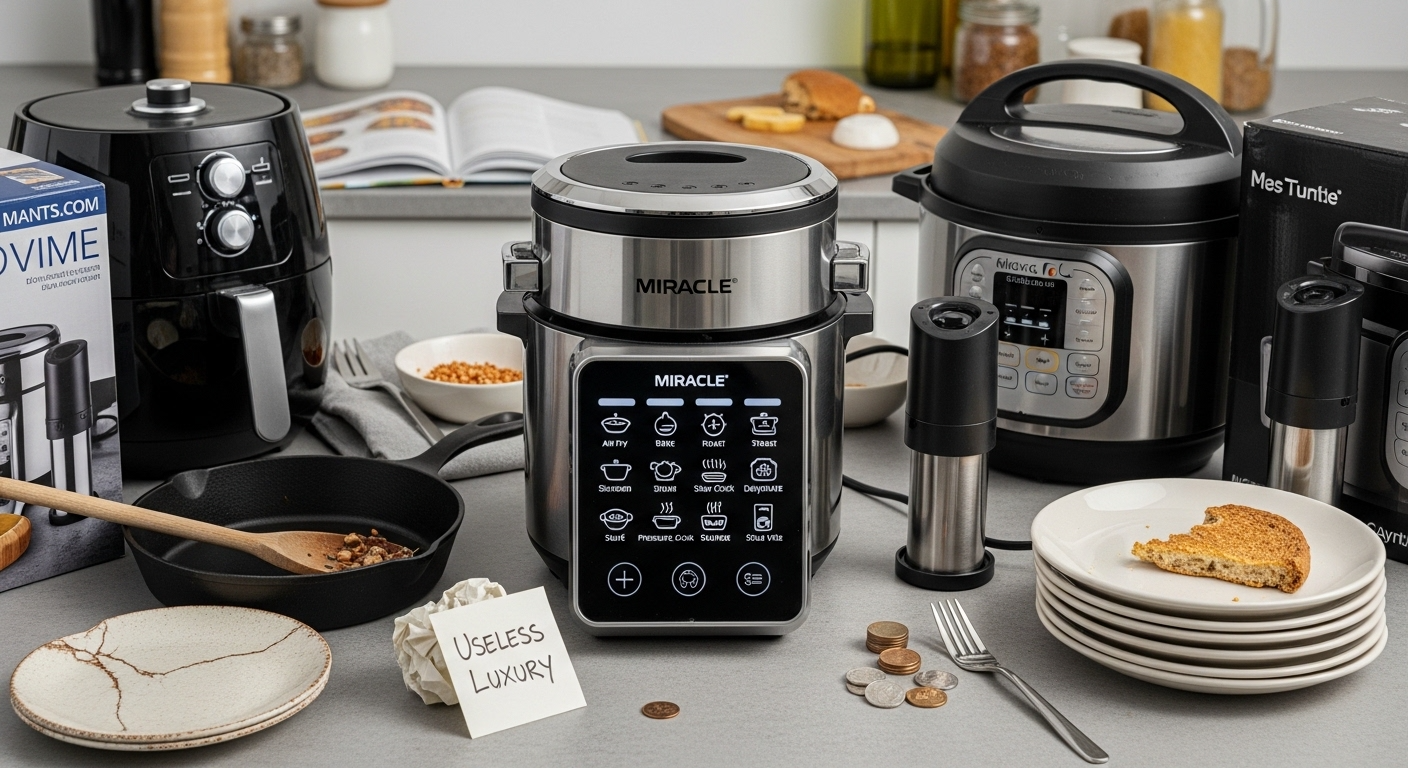
It always starts gently. A video, maybe. A friend’s post of perfectly browned chicken wings with a caption full of exclamation marks. A coworker swearing this little machine saved their weekday dinners, made them healthier, saved them money, saved them time. A miracle, they say, like a blender with a halo. Nine cooking methods in one: air fry, bake, roast, grill, dehydrate, reheat, broil, toast, even proof your bread dough if you’re feeling ambitious.
It sounds like sorcery for the overworked and undercaffeinated. You imagine yourself tossing vegetables in a bowl, sliding a basket into the glowing chamber, and emerging minutes later with a meal that looks like it was styled for a cookbook. No more oil-slicked pans, no more watching the oven timer with mild dread. Just rapid hot air and salvation.
So you buy it. Or maybe it’s gifted to you, wrapped in shiny paper and expectation. You lug the box onto the counter, shuffle aside the coffee maker and the toaster, banish a stack of cookbooks to a lesser shelf, and set the new god in place. It’s bigger than you imagined — a cross between a squat robot and a tiny moon lander. It hums with possibility.
And then, in the soft light of an ordinary weeknight, that possibility meets broccoli. Or truthfully, frozen fries.
The Nine-Method Machine That Still Only Makes One Kind of Dinner
The promise of nine cooking methods sounds outrageously efficient. Why keep a toaster, an oven, and a dehydrator when you can have this? But spend a few weeks with it and a quieter story begins to surface.
Press the buttons. Listen to the fan. Feel the counter tremble ever so slightly. The air fryer does fry — sort of. It does roast — sort of. It reheats pizza in a way that makes you nod and think: not bad. It can bake, though your muffins emerge with the suspicious pallor of something cooked on Mars — a little dry, a little strange, the texture not quite right.
The nine cooking methods all start to blur into one essential trick: it blasts food with hot air, fast. That’s it. That’s the core magic. Whether you call it roasting, baking, or grilling, the machine is doing the same thing with a slightly different temperature and timer. It’s like a Swiss Army knife where every blade is just another kind of spoon.
You begin to see the limitations when you try to feed more than one person. The basket, deceptively deep, doesn’t hold much once you remember that crowded food doesn’t crisp — it steams. So you cook in batches. Fries in two rounds. Chicken thighs in three. That 20-minute miracle meal stretches into 50, and someone is always eating lukewarm while the last batch finishes. The nine-method wonder suddenly looks a lot like a very fast, very small oven that’s inexplicably enormous on your countertop.
The Luxury of Space and the Price of a Plug
There’s a quiet stubborn arrogance to appliances that assume endless counter space. They arrive boxy and confident, demanding territory in homes already juggling blenders, coffee machines, knife blocks, dish racks, and the clutter of real life.
For those in small apartments, shared housing, or older homes where outlets are few and temperamental, the decision isn’t just about features. It’s about what has to leave to make room. A rice cooker that never fails you. A trusty cast-iron skillet that has outlived three apartments and a relationship. A kettle that has boiled for every late-night conversation and every early bleary-eyed morning. What do you push aside to clear a landing pad for this plastic promise of better dinners?
The cost isn’t only spatial. It hums on your electricity bill too. While air fryer marketing loves to compare it to a full-size oven and declare it more efficient, that argument sidesteps a more piercing question: did you really need another appliance to do what your stove and oven already accomplish fairly well? Especially when money is tight, spending a significant sum on an air fryer feels less like savvy modern living and more like giving in to the quiet pressure of everyone else has one.
When Frugality Meets FOMO
In a frugal home — where leftovers are carefully boxed, bread heels become breadcrumbs, and a whole chicken is stretched into three meals and a broth — the air fryer is a problem disguised as a solution. It promises to save oil, save time, save health. But it doesn’t sauté onions better than a pan. It doesn’t simmer stew. It doesn’t boil pasta. It’s a specialist masquerading as a generalist, and specialists are a luxury you feel more than you admit.
How many bags of beans and rice could that money have bought? What happens when the heating element dies or the basket’s non-stick coating peels — will it be repaired, or quietly replaced with yet another model and another excuse to spend?
Modern frugality isn’t just about pennies. It’s about resistance to being told that one more gadget is what stands between you and a better life. For many families, especially those who’ve watched trends come and go and seen bread machines and electric woks gather dust, the air fryer feels less like liberation and more like an echo of every time someone said “you need this” when, really, you didn’t.
The Quiet Power of What We Already Own
Walk through a kitchen that has seen years of real meals and you’ll recognise the actual heroes. The pot with the slightly warped bottom that still makes excellent soup. The skillet seasoned to a dark shine, its surface now nearly non-stick through time and care rather than coating. The Dutch oven that moves from stovetop to oven to table, its heavy lid clicking into place with a sound as comforting as a heartbeat.
These tools ask something of you: presence. Stirring. Adjusting heat. Listening to the sizzle. They aren’t set-it-and-forget-it devices — they’re invitations to stand in the fragrant, steamy middle of your own life and cook. Not just reheat. Not just time-manage. Cook.
The air fryer, by contrast, is all about distance. You toss, you season, you press a preset, and you walk away. It is cooking reduced to intervals and alarms, a transaction between you and a plastic shell. When that becomes the default, something subtle but significant is lost.
You stop learning how food behaves under heat. You stop noticing how a drizzle of oil on vegetables in the oven can coax out a sweetness that a fan-blast never quite achieves. You stop tasting as you go, relying instead on pre-programmed times and temperatures written by someone who has never met your stove, your tastebuds, or your oven that always runs slightly hot.
The Myth of the Health Halo
The air fryer emerged in a culture deeply anxious about food. We are tired, time-starved, and bombarded with warnings about oil, sugar, carbs, and processed everything. Into this worry walks an appliance that seems to promise: keep your indulgences, we’ll fix them for you. Wings without guilt, fries without shame, nuggets without the greasy aftertaste of compromise.
But lower oil does not automatically mean a meal is nourishing. Breaded, frozen, highly processed foods don’t become wholesome simply because they were cooked with a fan and a clever marketing campaign. And vegetables, when they do make it into the basket, often arrive as an afterthought tossed alongside the main event rather than something celebrated in their own right.
The myth of air fryer health is not that it can’t be part of a healthier pattern — it can — but that the gadget itself does the heavy lifting. True health in the kitchen still comes from planning, from learning, from chopping onions at a table you had to clear off first. It comes from knowing exactly what went into your meal because you put it there with your own slightly tired, slightly proud hands.
The Emotional Cost of the Useless Luxury
Call any beloved gadget useless and you’ll start a fight. Call it a useless luxury and you’ll reveal a fault line that runs straight through modern domestic life.
On one side stand those who swear the air fryer changed everything. On the other are people who see yet another symbol of lifestyle inflation — of being told that a simple pan, a working oven, and a little know-how are suddenly no longer enough.
For some, an air fryer is a tool of survival amid long workdays and commutes, a way to put something hot on the table without collapsing. For others, the suggestion that you need one to keep up lands like an accusation: if your kitchen doesn’t look like a showroom of trending gadgets, are you failing?
In families where money is watched carefully, the air fryer becomes a symbol of tension. One person sees a smart investment in time and health. Another sees an indulgence that could have been a cushion for an unexpected bill. Its whirring fan becomes the soundtrack of a quiet argument about what is worth paying for and what should be resisted, even when everyone swears it’s the next big thing.
Goodbye, Glowing Gadget
There comes a day, often quietly, when the air fryer door closes for the last time. You may not know it in that moment. Maybe you just forget to plug it in again. Maybe you try roasting vegetables on a sheet pan and remember how the edges go caramel-brown in a way the air fryer never quite nails. Maybe you realise that washing one pan is easier than wrestling a basket from a too-hot shell and scrubbing crumbs from a mesh labyrinth.
It migrates first to the side of the counter. Then to a high shelf. Then, more honestly, to the boot of a car on the way to a second-hand shop, or into the arms of a friend still in the honeymoon phase with the idea of it.
Letting it go isn’t about rejecting convenience or technology. It’s about acknowledging that your kitchen is not a showroom — it’s a working landscape, and everything that lives there must earn its keep. For many, the air fryer fails that test. It’s not broken exactly. It’s simply not necessary. Not when a pot can simmer, a pan can sear, an oven can roast for a crowd, and all of them ask only for a little attention and occasionally a good scrub.
What feeds us — really feeds us — is rarely flashy. It’s the habit of stirring a pot while listening to someone talk about their day. It’s the repetition of chopping garlic until your hands smell like an Italian kitchen. It’s learning to use the tools you already own so well they feel like extensions of your own fingertips.
Goodbye, air fryer. Thanks for the fries. The rest, it turns out, we can handle on our own.
Frequently Asked Questions
Is an air fryer ever worth buying? It can be, if you genuinely use it often for specific tasks like crisping frozen foods, reheating leftovers, or cooking for one or two people. But if you already have a reliable oven and stovetop and cook for a larger household, its benefits may not justify the cost or the counter space.
Does an air fryer really make food healthier? It can reduce added oil compared with deep-frying, but it doesn’t automatically make processed foods healthy. True improvements in diet come more from what you cook — whole ingredients, vegetables, balanced meals — than from which appliance you use to cook them.
Is an air fryer cheaper to run than an oven? For small portions it may use less energy because it heats up quickly in a compact space. For large meals or batch cooking a full oven is often more practical and can be equally or more efficient overall.
What are good alternatives to an air fryer? A hot oven with a convection setting, a sturdy sheet pan, and a wire rack can mimic most air fryer results. A cast-iron skillet, a Dutch oven, and a decent saucepan together cover far more cooking methods than an air fryer ever will.
How do I decide whether to keep or ditch mine? Track how often you use it for a month. If it’s central to your routine and genuinely saves you stress, it’s earning its space. If it mostly gathers dust while your pans and oven do the real work, consider selling or donating it and reclaiming your counter — and your confidence in simpler tools.