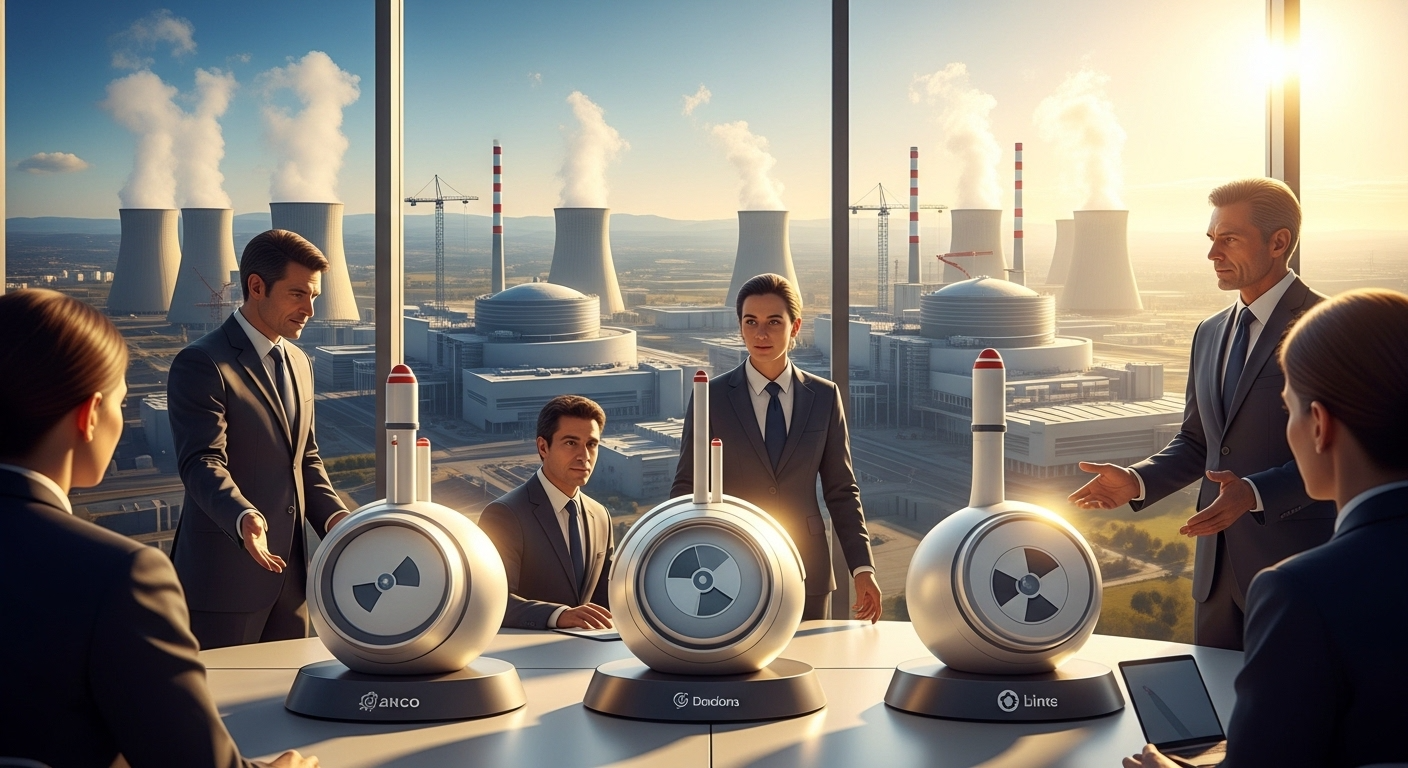
French Nuclear Power Enters a True Golden Age as a Third Company Submits a Reactor to the Safety Authority
Something significant is happening in French energy that deserves more attention than it is currently receiving. For years, nuclear power in France occupied an uncomfortable position, technically dominant but politically uncertain, with ageing reactors, cost overruns at new build sites, and a post-Fukushima anxiety that cast doubt over the technology’s future even in the country that had built its entire electricity system around it.
That atmosphere is changing rapidly. A third major company has now submitted a new reactor design to France’s nuclear safety authority, joining two others who made similar submissions in recent months. Three separate companies are now actively seeking regulatory approval for new reactor designs in France simultaneously, a level of competitive activity in French nuclear development that has not been seen in decades.
Industry observers are beginning to use a phrase that would have seemed premature just three years ago. They are calling it a golden age.
Who Has Submitted What and Why It Matters
The three companies now engaged in the French reactor approval process each represent a different vision for what nuclear power looks like in the coming decades.
EDF, the state-owned French energy giant that operates France’s existing fleet of 56 reactors, is proposing an evolution of its Evolutionary Power Reactor design, known as the EPR. The EPR is a third-generation pressurized water reactor that has already been deployed in Finland and China, and EDF’s updated submission builds on lessons learned from those construction projects to address previous concerns about build time and cost.
Rolls-Royce, the British engineering company better known for aircraft engines and luxury cars, has been developing a small modular reactor concept that represents a fundamentally different approach to nuclear power generation. Rather than building single enormous reactors that take fifteen years and tens of billions of euros to construct, the Rolls-Royce design is smaller, factory-assembled in standardized modules, and intended to be deployed more quickly and at lower upfront cost. The modular approach is one of the most discussed concepts in global nuclear development and France’s regulatory engagement with it signals genuine interest in diversifying beyond the traditional large reactor model.
Framatome, a leading French nuclear technology company and subsidiary of EDF, is bringing its own advanced reactor design to the table. Framatome has decades of experience in nuclear engineering and component manufacturing, and its submission represents a domestically rooted technological contribution to the renewal of France’s nuclear capacity.
The fact that three distinct approaches, a large evolved reactor, a small modular design, and an advanced domestic technology concept, are all simultaneously entering the French regulatory process reflects a breadth of nuclear ambition that is genuinely new.
The ASN and Why Its Approval Process Is So Critical
The Autorité de Sûreté Nucléaire, France’s independent nuclear safety authority, is the institution that every reactor design must satisfy before a single shovel of ground can be turned. The ASN evaluates reactor designs comprehensively, assessing safety features, emergency response systems, environmental impact, the resilience of systems against both natural and man-made disasters, and the overall technical soundness of the design.
The ASN’s role is not simply bureaucratic. Its approval is the foundation of public confidence in nuclear power, and in France where nuclear energy provides over 70 percent of electricity, that public confidence matters enormously. The ASN gained additional credibility and international standing after applying heightened scrutiny to reactor designs following the Fukushima accident in Japan and the ongoing concerns raised by the situation at the Zaporizhzhia plant in Ukraine.
Both of those events raised the bar for what regulators worldwide expect from new reactor designs. The ASN now requires more comprehensive assessment of safety features in extreme scenarios, more robust emergency response planning, and stronger demonstration of system resilience. Any reactor design submitted to the ASN in 2026 is being evaluated against a significantly higher standard than would have applied a decade ago, which is precisely why approvals from the ASN carry such weight.
The submission of three reactor designs to this rigorous authority signals that EDF, Rolls-Royce, and Framatome each believe their designs can meet this elevated standard. That confidence is itself a statement about how far nuclear technology has progressed.
Why France Is Experiencing This Nuclear Renewal Now
The timing of this nuclear revival is not accidental. It reflects a convergence of pressures and policy shifts that have fundamentally changed the political and economic calculus around nuclear energy in France and across Europe.
The energy crisis triggered by Russia’s invasion of Ukraine was the most immediate catalyst. When European energy security was suddenly and dramatically exposed as vulnerable to geopolitical disruption, the case for every available source of domestically controlled, carbon-free electricity became compelling in a way that no amount of prior advocacy had achieved. France’s existing nuclear fleet, whatever its operational challenges, was suddenly and viscerally understood as a strategic asset rather than a legacy liability.
The climate imperative has reinforced the same conclusion. France has committed to significant carbon reduction targets, and meeting those targets while maintaining a reliable electricity supply requires large amounts of firm, dispatchable, carbon-free power. Wind and solar generation, while growing rapidly, cannot alone provide the consistent baseload electricity that industrial economies require. Nuclear power is the only proven large-scale technology that can provide carbon-free firm power, and that reality has pushed it back toward the center of European energy planning.
President Macron’s explicit commitment to nuclear expansion has provided the political cover and direction that the industry needed. His announcement in 2022 of plans to build six new large reactors and potentially eight more, combined with an extension of the operating lives of existing reactors, sent a clear signal to industry and investors that the French state was committed to nuclear’s future. The submission of three reactor designs to the ASN is partly the industry’s response to that signal.
The Difference Between Large Reactors and Small Modular Reactors
One of the most interesting aspects of the current French nuclear renewal is the simultaneous pursuit of two quite different reactor strategies. Understanding the difference between them helps clarify what France is actually trying to achieve.
Large reactors like the EPR provide enormous amounts of electricity from a single installation. A single EPR generates around 1,650 megawatts of electricity, enough to power a major city. The challenge with large reactors is the scale of the investment required, the complexity of construction, and the long timeline from decision to first power. France’s Flamanville EPR, which has been under construction since 2007 and has experienced significant delays and cost overruns, became a cautionary tale that shaped global perceptions of large nuclear projects. EDF’s updated design submission is in part an effort to demonstrate that the lessons from Flamanville have been genuinely absorbed.
Small modular reactors like the Rolls-Royce design take a different approach. Each unit generates around 470 megawatts, roughly a quarter of a large EPR. The key advantage is that the components are manufactured in a factory setting, which improves quality control and reduces construction time. Multiple units can be deployed at a single site if more capacity is needed. The economics of factory production at scale are expected to make SMRs significantly cheaper per unit of electricity than the first-of-a-kind large reactor projects that have struggled with costs in recent years.
Both approaches have genuine merits and genuine uncertainties. The regulatory process that the ASN is now conducting for all three submissions will help clarify which technologies can be practically and safely deployed in the French context.
What This Means for French Energy Consumers
The long-term implications of a successful French nuclear renaissance for energy consumers are potentially significant, though the timeline between regulatory submission and electricity arriving in homes and businesses is measured in years and decades rather than months.
Electricity price stability is the most direct consumer benefit that nuclear advocates point to. Nuclear power has high upfront capital costs but very low fuel costs and predictable operating expenses over a reactor’s lifetime. A larger fleet of modern reactors would give France greater insulation from the gas price volatility and geopolitical supply shocks that drove European electricity prices to extreme levels in 2022 and 2023.
Industrial competitiveness is another dimension of the consumer benefit. France has historically maintained some of the lowest industrial electricity prices in Europe, largely due to its nuclear fleet. That competitive advantage supports manufacturing employment and industrial activity that benefits the broader economy. Maintaining and expanding the nuclear fleet protects that advantage as France’s existing reactors age.
New employment in nuclear construction, engineering, and operations would be distributed across the regions of France where new reactors are built, providing economic benefits beyond the direct energy system improvements.
The construction of new reactors will not happen overnight. The regulatory review process alone takes years, followed by planning, permitting, and construction phases. The electricity consumers who benefit most from the reactors being submitted today will likely be those consuming power in the 2035 to 2050 timeframe rather than in the immediate near term.
The Broader Significance for European Energy Policy
France’s nuclear renewal is not happening in isolation. It is taking place within a broader European energy policy context that has shifted considerably in recent years.
The European Union’s taxonomy for sustainable finance, which initially excluded nuclear power from its green investment classification, was updated to include nuclear under certain conditions, recognizing that carbon-free firm power generation has a legitimate role in meeting climate targets. This shift has made it easier for institutional investors to fund nuclear projects without running into sustainability restrictions.
Several other European countries are reconsidering nuclear positions they had previously abandoned. Belgium reversed a decision to phase out nuclear power. The Netherlands approved plans for new reactors. Poland is actively pursuing its first nuclear plant. Sweden has reversed its phase-out policy. The political tide across Europe has turned more decisively toward nuclear than at any point since Chernobyl, and France’s renewed activity is both a reflection of and a contribution to that broader shift.
Key Terms in France’s Nuclear Renewal
| Term | Definition |
|---|---|
| Autorité de Sûreté Nucléaire (ASN) | France’s independent nuclear safety authority that reviews and approves all reactor designs |
| Evolutionary Power Reactor (EPR) | EDF’s third-generation large pressurized water reactor design |
| Small Modular Reactor (SMR) | A smaller, factory-assembled reactor design offering faster construction and lower upfront costs |
| Framatome | Leading French nuclear technology company and EDF subsidiary submitting its own advanced design |
| Baseload power | Continuous, reliable electricity generation that operates regardless of weather conditions |
Frequently Asked Questions
What does submitting a reactor design to the ASN actually mean?
It is the formal beginning of the regulatory review process. The ASN will conduct a comprehensive technical, safety, and environmental assessment of the design. This process takes years and may result in requirements for design modifications before approval is granted. Submission does not mean approval, but it is the necessary first step toward building a new reactor in France.
Why are three companies submitting designs at the same time?
The combination of government commitment to nuclear expansion, changed energy security priorities following the Ukraine crisis, and improved investment conditions for nuclear projects has created conditions where multiple companies see a viable commercial opportunity in the French market simultaneously. This level of competition has not been seen in French nuclear development for many years.
Will the new reactors replace France’s ageing existing fleet?
That is the intention. France’s current fleet of 56 reactors was built primarily in the 1970s and 1980s and will require significant investment to extend operating lives or eventual replacement. The new reactor submissions are aimed at providing the next generation of French nuclear capacity as the existing fleet ages.
How does small modular reactor technology differ from traditional nuclear power?
The key differences are scale and construction method. Traditional large reactors are built on-site over many years. Small modular reactors are designed to be manufactured in standardized factory modules and assembled on-site, which is intended to reduce construction time, improve quality control, and lower costs through the economics of factory-scale production.
What are the main risks to this nuclear golden age narrative?
Construction delays and cost overruns have been the most significant practical challenges facing recent large nuclear projects globally. Maintaining public confidence in nuclear safety, particularly in the event of any incident anywhere in the world, remains a continuous requirement. And the regulatory process is genuinely rigorous and may require significant design modifications before approvals are granted. The golden age characterization is an aspiration as much as a current reality.