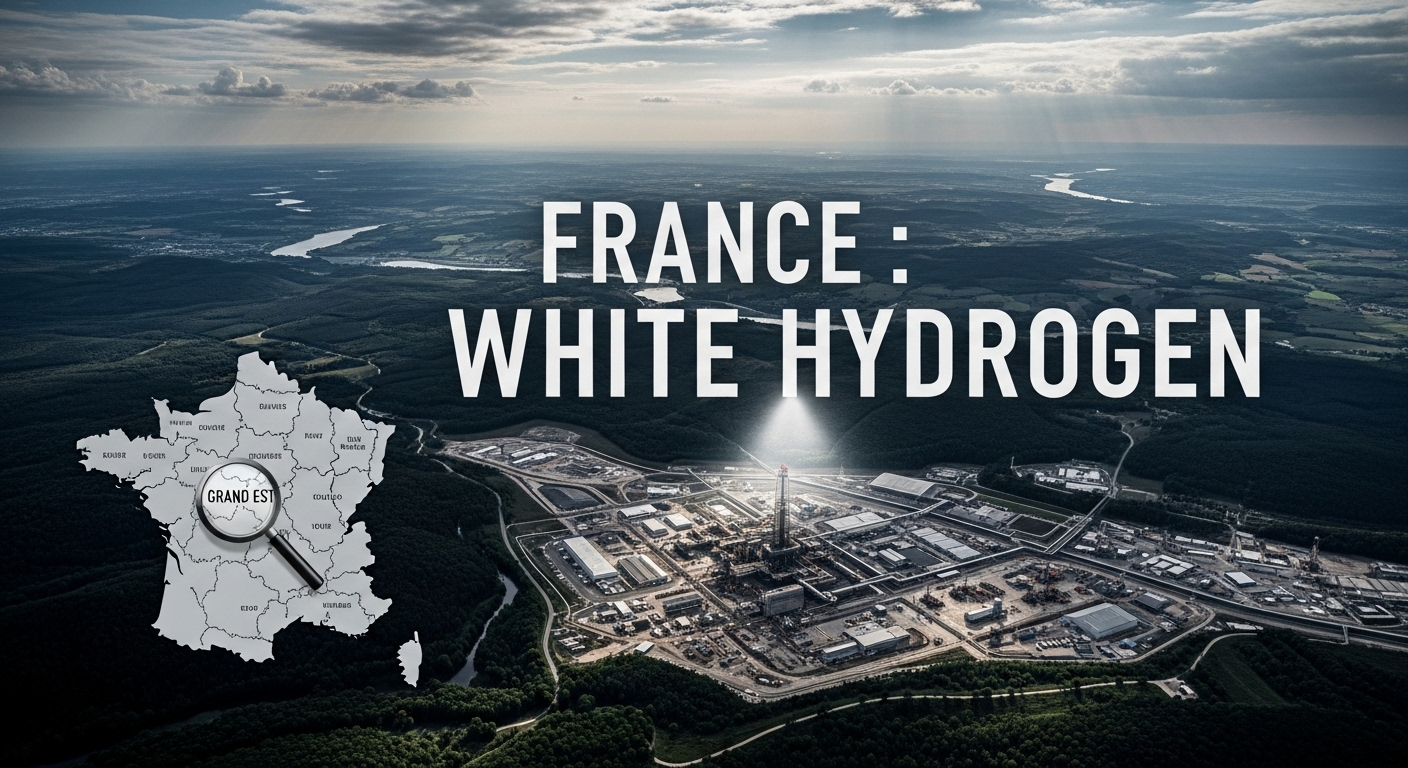
France Is About to Learn Whether It Holds the World’s Largest “White Hydrogen” Reserves in the Grand Est Region
On a soft morning in France’s Grand Est, the air smells faintly of damp soil and budding vines. A thin mist hangs over the rolling fields, blurring the line between rows of winter wheat and the distant fringe of forest. Somewhere under these quiet hectares, geologists believe, an invisible river of gas may be moving through fractured rock — a river of white hydrogen so vast it could rewrite energy maps, and perhaps, in time, the identity of this land itself.
The Day the Earth Breathed Hydrogen
The story begins not with a thunderclap of discovery, but with a whisper: a faint, unfamiliar reading on an instrument in a small town far from Paris. Technicians monitoring an exploratory well in the Lorraine basin noticed traces of hydrogen seeping up from depths no one thought worth a second glance.
“Look at that,” one geologist reportedly muttered, tapping the screen where the concentration curve bent upwards.
This wasn’t the hydrogen produced in industrial plants by splitting water with electricity or reforming natural gas. This was hydrogen made by the Earth itself, bubbling up from deep geological processes that have been going on for millions of years, largely ignored.
They call it white hydrogen or natural hydrogen. It’s colourless of course — the colours are a human code for how hydrogen is produced — but the label white has stuck, a blank-page colour for an energy source we are only starting to understand. Since that first surprise reading, a quiet race has been unfolding beneath the vineyards and forests of Grand Est, involving seismic surveys, long core samples, downhole probes, and big nervous questions.
What Makes White Hydrogen So Different
To people used to hearing about green, blue, or grey hydrogen, this new term can feel like marketing. Yet white hydrogen is something fundamentally different. Those more familiar colours describe industrial products: hydrogen made by humans, usually with a cost, a factory, and a carbon footprint attached. White hydrogen, by contrast, is like a natural spring — formed underground by reactions between water and certain minerals, then trapped in rock structures or slowly released toward the surface.
If early estimates are even half correct, the Grand Est region may sit atop one of the largest accumulations of naturally occurring hydrogen yet identified — possibly the largest known on the planet.
The thought is both thrilling and disconcerting. This quiet corner of France, long shaped by coal mines, steelworks, and then their decline, with villages that still bear the scars of both world wars, might suddenly become a focal point of global energy attention.
Hydrogen burns without producing carbon dioxide. It can power fuel cells, heat homes, or run industrial processes that are difficult to electrify. If you could tap into a large, naturally replenishing source of it underground, the climate implications would be enormous. But so would the social and ecological stakes.
The Grand Est: An Old Landscape With New Secrets
To understand why this discovery matters, you have to stand in the Grand Est long enough to feel its contradictions. On one side, the Rhine valley hums with cross-border traffic and chemical plants. On another, vineyards march along sunlit hillsides producing the sparkling wines for which the region is famous. In between lie stubbornly rural stretches where forest, pasture, and old mining towns coexist in uneasy balance.
This is a place that knows what it means to dig into the earth in search of energy. For generations, coal powered furnaces, warmed homes, and carved out identities here. Then came decline: pits closed, jobs vanished, and towns built around extraction were left to reinvent themselves or fade.
For many older residents, the idea of another boom cycle is not cause for celebration. It’s an echo of a life they thought they had left behind.
Yet white hydrogen is not coal, and its romance is of a different kind. It invites metaphors of springs and invisible rivers of clean energy waiting to be tapped. But move closer and the imagery shifts: maps marked with target zones, trucks rumbling in at dawn, drill rigs rising like steel skeletons against morning fog. The question isn’t simply whether Grand Est holds massive hydrogen reserves. It’s whether France can approach them without repeating the mistakes of the past.
A Subterranean Chemistry Set
What may be lurking below is less a reservoir in the classic oil-and-gas sense and more a complex system in motion. Deep underground, water percolates through fractured rock rich in iron or other reactive minerals. Under intense heat and pressure, chemical reactions tear hydrogen atoms away from oxygen, leaving molecules that can accumulate in pockets, seep along faults, or dissolve into fluids.
Geologists think of it as a vast ongoing experiment the Earth has been running for eons. Some deposits may be closed, like a balloon waiting to be punctured. Others may be open, continually produced and slowly venting to the surface — potentially renewable on human timescales if extraction does not outpace natural generation.
The Grand Est basin is geologically complex, layered with ancient seabeds, tectonic faults, and the ghost of long-vanished mountain ranges. A single well can intersect multiple zones of interest: old coal seams, saline aquifers, and, if the surveyors are lucky, pockets of hydrogen-bearing rock. Each new core sample is a clue. Each gas measurement, a piece of the puzzle.
The Numbers Behind the Mystery
Much of what we currently know about the Grand Est hydrogen is wrapped in uncertainty. Early studies suggest reserves that could rank among the largest known white hydrogen accumulations globally, but ranges are still wide and unconfirmed. Hydrogen traces have been detected from a few hundred metres to several kilometres below the surface. The geological setting involves old sedimentary basins, faults, iron-rich rocks, and areas previously explored for coal, gas, and salt. Some zones may be naturally regenerating through water-rock reactions, but rates and sustainability remain unknown.
These are not the kind of figures that make for easy headlines. Possibly enormous, potentially world-leading, but we’re not sure yet is a hard sell. Yet that is exactly where France stands: on the cusp of knowing.
Over the next few years, a new wave of exploratory drilling, geochemical mapping, and reservoir modelling will help determine whether the Grand Est hydrogen story belongs in textbooks, investment portfolios, or simply in a footnote of geological curiosity.
Promise, Risk, and the Weight of the Past
Talk to local residents in some Grand Est villages and you will hear a familiar mix of scepticism and hope. On a café terrace in a former mining town, someone shrugs and says they’ve heard big promises before. Another points to closed factories: if there’s work for their kids, they’ll listen.
White hydrogen’s climate credentials look strong on paper. If produced responsibly, it could replace fossil fuels in heavy industry, long-distance transport, and the chemical sector. It might support France’s ambitions to lead in low-carbon technologies, reduce dependence on imported gas, and complement its nuclear-heavy electricity mix.
But climate benefit at the global scale does not automatically translate into local well-being. Drilling still requires roads, pads, and seismic lines. There are questions about induced seismicity, groundwater interference, and how to avoid the mistakes of past extraction industries that plowed through communities, leaving polluted sites when the boom faded. Environmental groups are already calling for strict safeguards, open data, and an honest accounting of trade-offs before the first production wells are approved.
France’s Moment of Decision
Inside France’s energy and environment ministries, the mood is a mix of excitement and caution. Officials know the stakes. If the Grand Est reserves are as large as some early papers suggest, France could position itself as a pioneer in a completely new branch of the energy industry. If the estimates prove optimistic, the country still gains valuable scientific insight — but not the transformative resource some are already imagining.
There is also a quieter question hanging over the discussions: what kind of story does France want to tell about its energy future? For decades, the dominant narrative has centred on nuclear power — reactors humming away, providing low-carbon electricity and a sense of technological mastery. White hydrogen, if proven and embraced, would add a new chapter, one in which the Earth itself becomes a partner in decarbonisation.
The period ahead, while scientists confirm the size and quality of the Grand Est reserves, is an opportunity to design rules and expectations in advance. What share of any resource wealth would stay in the region? How would environmental baselines be established and monitored? Could citizen panels have a binding say in whether and how projects proceed? The answers will shape not only what is extracted from the ground, but what is built above it: trust, resentment, or something in between.
A Future Written in Invisible Ink
As dusk falls over the Grand Est, the wind carries the mingled scents of soil, smoke from a wood stove, and the faint perfume of early blossoms. Down in the rock, unseen reactions continue — water meets mineral, bonds break, hydrogen forms. Whether those molecules remain part of an underground drama or rise one day through pipes and valves, powering engines and furnaces, is a choice humans will make in boardrooms and council chambers.
France is about to learn whether it is sitting on one of the world’s largest caches of natural hydrogen. Yet the more interesting question may be what the country chooses to do with that knowledge.
The answer will not arrive in a single headline. It will seep out slowly, in drilling results, policy drafts, public debates, and the quiet recalibration of how people here think about the land beneath their feet. For now, the Grand Est remains what it has quietly been for millennia: a patient archive of geological experiments, watched over by forests, vineyards, and villages. Somewhere below, hydrogen gathers in silence, waiting to learn what story humans will write around it.
Frequently Asked Questions
What is white hydrogen? White hydrogen, also called natural hydrogen, is hydrogen gas that forms naturally underground through geological processes such as reactions between water and certain minerals. Unlike green or blue hydrogen, it is not produced in factories — it accumulates in the Earth’s crust and may be accessible through drilling.
Why is the Grand Est region attracting attention? Exploratory wells in the Grand Est, particularly in the Lorraine basin, have detected significant traces of hydrogen at depth. Early estimates suggest the region could host some of the world’s largest known accumulations of natural hydrogen, though these findings still need confirmation through more detailed exploration.
How could white hydrogen help with climate goals? Hydrogen does not emit carbon dioxide at the point of use. If white hydrogen can be extracted with low environmental impact, it could replace fossil fuels in sectors that are hard to electrify — certain industrial processes, heavy transport, and parts of the chemical industry — supporting efforts to reduce greenhouse gas emissions.
What are the main risks and concerns? Key concerns include potential impacts from drilling and surface infrastructure such as land disturbance, noise, water contamination risks, and possible induced seismicity. There is also uncertainty about whether underground hydrogen systems naturally replenish and at what rate. Social concerns around fair distribution of benefits and genuine community consent weigh heavily too.
When will France know how big the reserves really are? It will likely take several years of focused exploration — additional drilling, seismic surveys, and detailed geochemical studies — before experts can provide robust estimates of size, quality, and recoverability. Definitive figures will emerge gradually as more data becomes available, with policy decisions and pilot projects probably unfolding in parallel.