Even China Doesn’t Move This Fast: US Stuns Defense Industry With Drone Prototype Built in Just 71 Days
The desert air shimmered above the runway, thick with heat and secrecy. A handful of engineers in sun-faded ball caps stood quietly, arms folded, watching a sleek angular shape crouched on the tarmac like a metallic hawk. No big ceremony. No brass bands. Just a low murmur on the radios and the smell of jet fuel.
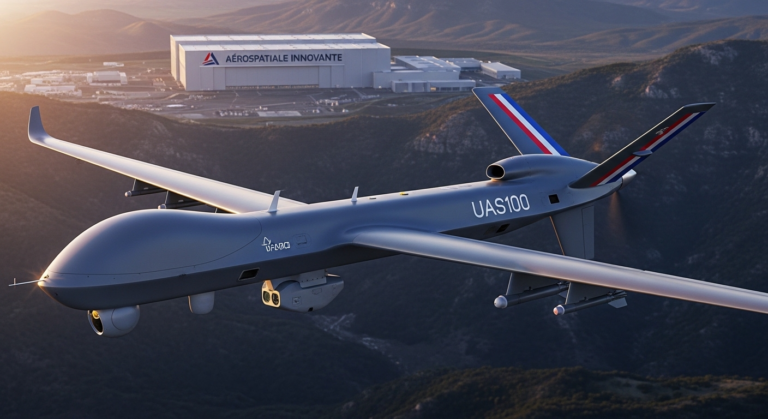
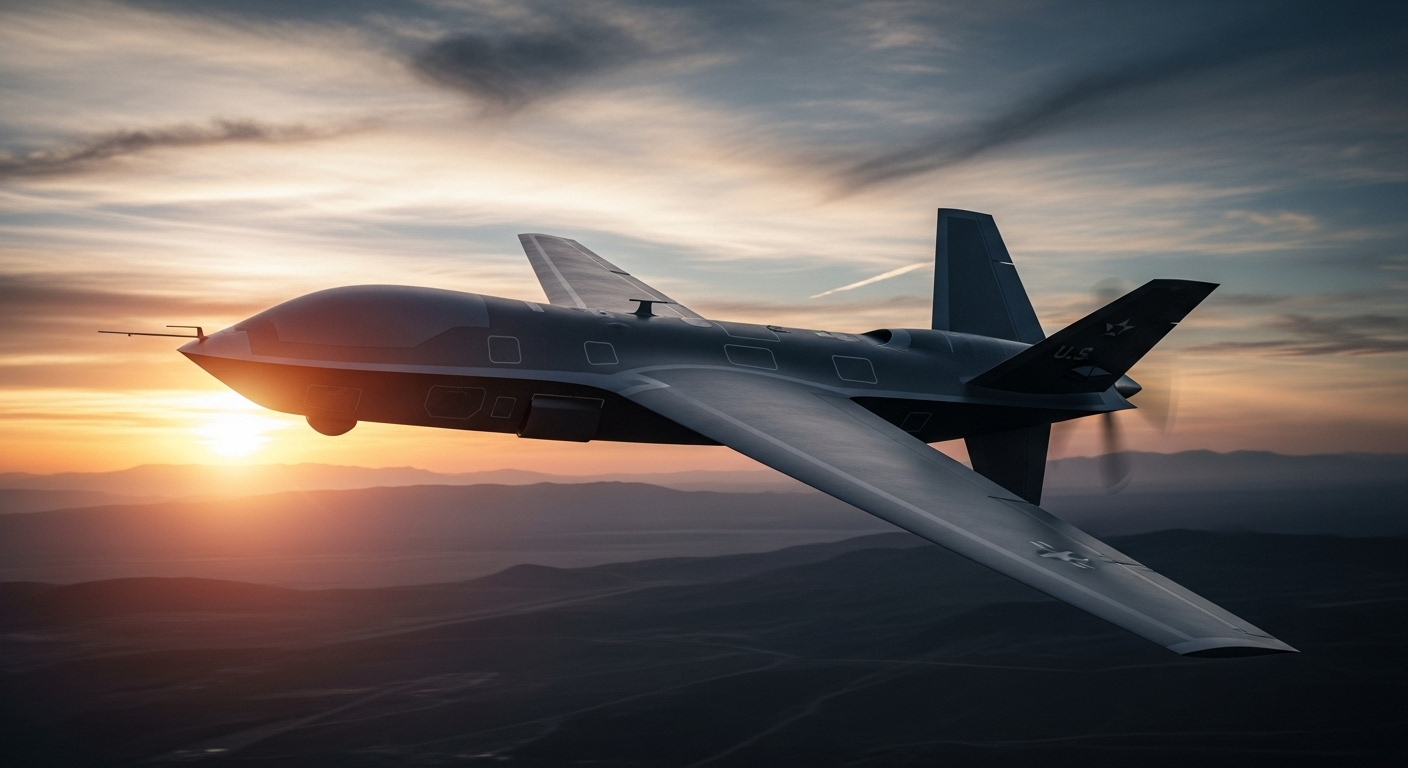
Then, with a rising hiss and a surge that felt almost impatient, the prototype drone leapt forward — alive after just seventy-one days of existence.
Seventy-one. In the world of defense contracts and slow-moving military bureaucracy, that number felt less like a statistic and more like a slap to the face of everything we’ve always done this way.
The Day the Timeline Broke
Someone would later joke that the ground crew’s reaction wasn’t awe so much as confusion. Their body language said it all: this can’t be right, we’re not supposed to move this fast.
In an industry where a new aircraft can take the better part of a decade to trudge from concept to runway, this US drone shattered an unspoken rule carved into conference-room presentations and acquisition manuals. A concept sketched on whiteboards and digital tablets became a physical machine in less time than it takes for some government task forces to agree on their own acronym.
While analysts have spent years warning that China’s military-industrial machine was simply too fast, too focused, too ruthless for the United States to match, here stood a counterargument in carbon fibre and composite skin.
It wasn’t supposed to be possible. Not with the endless reviews and risk-aversion of a system designed to avoid mistakes more than it’s designed to chase breakthroughs. But there it was, rolling past the yellow paint on the taxiway, ready to lift into the hot sky.
The real breakthrough wasn’t just the drone. It was time.
Seventy-One Days, Thousands of Decisions
Imagine walking into a hangar that smells like fresh epoxy and steel, the bright hum of overhead lights and laser cutters filling the background. On one side, engineers huddle around large screens. On the other, technicians in safety glasses move with the swift assurance of people who know that waiting is the biggest enemy they face.
Seventy-one days is a blink in aerospace terms. That time is usually consumed by meetings, documentation, subcontractor delays, testing approvals, and endless redesign cycles. The miracle here wasn’t that the US suddenly discovered new physics. It was that they stripped away layers of friction from the process itself.
Teams didn’t pass the project along hand-to-hand like a relay baton. Instead they worked like a tight-knit expedition on a dangerous climb — engineers, programmers, fabricators, test pilots, and logistics planners all tied to the same rope. When a design issue appeared in the avionics, the change was modelled digitally in real time and sent straight to fabrication. When wing stress numbers looked off, the testing and design teams didn’t schedule a meeting for next week. They pulled their chairs together right then and there.
Beneath it all, a different kind of engine roared quietly: software. Advanced simulations, AI-assisted design tools, and rapidly reconfigurable manufacturing lines meant that hardware wasn’t being invented from nothing. It was being assembled from a living library of previous ideas and proven parts — the same way nature reuses DNA to build wildly different creatures.
The Quiet Competition With China
For years the story has been that China can turn concepts into hardware at almost frightening speed — new warships sliding into the water, missiles paraded down wide boulevards, drones appearing with alien silhouettes on remote airfields. American think-tank reports carry a recurring tone: we’re too slow, too comfortable, too trapped in our own red tape.
So when this US program delivered a flying prototype in just over two months, it struck a nerve. One industry executive put it bluntly over coffee in a conference hallway: “We just proved we can move at Beijing speed — without being Beijing.” There was a rough pride in that line, an insistence that openness and oversight didn’t automatically have to mean paralysis.
But it wasn’t just about bragging rights. The defense world is shifting toward an era where small, smart, and many might matter more than big, exquisite, and few. Swarms of drones, rapidly adapted to new missions, are rewriting what airpower can look like. Whoever can iterate faster — fielding, testing, breaking, fixing — holds a decisive edge.
That’s what makes this seventy-one-day sprint feel less like a one-off stunt and more like a signal flare. If the US can routinely move this fast, the entire cadence of military technology starts to change. China’s speed advantage no longer looks like a distant uncatchable tide. It starts to look like a challenge.
Inside the Hangar: How Fast Feels
Walk through the facility where the drone was born and the atmosphere hits you first. There’s an electric impatience in the air — whiteboards crowded with sketches and numbers, engineers leaning over folding tables, the whir of 3D printers and CNC machines in motion. Fewer suits and more hoodies. Fewer formal updates, more people pointing at live data on screens.
In one corner, a flight control specialist scrolls through lines of code, the soft glow of the monitor reflecting off a coffee cup that might as well be glued to their hand. In another, a composite technician runs a gloved hand along a newly formed wing section, feeling for imperfections the sensors might have missed. The language floating in the air isn’t stiff jargon but a flood of questions and short decisive answers: can we shave weight here, what if we push the envelope on this sensor, run that in the sim before lunch.
The speed doesn’t feel chaotic. It feels like nature in fast-forward time-lapse: clouds building and breaking, rivers cutting new paths, forests regenerating after a burn. Iteration is treated not as a phase but as a constant pulse. Build, test, tweak, repeat — compressing what once took years into weeks.
Where Time Normally Disappears
In traditional defense programs, time vanishes in invisible ways. It disappears in coordination overhead, in the scheduling of reviews, in the safe harbor of let’s table this until the next working group. It pools in the gaps between silos — software waiting on hardware, hardware waiting on approvals, all of it waiting on someone higher up to sign a document.
This drone’s birth story is different precisely because it attacked those gaps. Instead of asking how to make each step better, the team asked how to remove steps entirely. It was a brutal question that carried real risk — fewer checkpoints, less cushion for error.
Yet what emerged wasn’t reckless speed but purposeful momentum. The team used a continuous digital model of the drone from early design through testing, meaning every change updated the entire system instantly. Engineers didn’t receive designs on static documents — they pulled living data straight from the core model.
Even the physical layout of the facility mirrored this philosophy. Design stations sat near fabrication tools, test rigs near analysis teams, as if proximity could shrink time. Because in a very real sense, it did.
What the Numbers Reveal
The contrast between this program and conventional defense timelines is stark. A traditional manned aircraft typically takes five to ten years from concept to prototype. A conventional tactical drone takes two to four years. This drone took seventy-one days.
Those numbers say something almost subversive to people inside the defense world: the way we have always done this is not the way we have to keep doing it. If a small focused team armed with the right digital tools and genuine authority can compress a drone program to seventy-one days, what else can be accelerated? Sensors? Munitions? Entire families of autonomous systems?
A Cultural Shift, Not Just a Technical One
No spreadsheet can capture the harder problem: culture. Bureaucracy is not just paperwork — it’s a deep habit, a comfort in the slow certainty of processes that spread responsibility so thin that no one person feels the risk.
What this project revealed is that speed is as much emotional as it is technical. It demands trust. Trust that engineers can make quick decisions without ten layers of approval. That test pilots can push a new airframe safely. That program managers can accept the sting of small failures in exchange for the prize of rapid learning.
Inside the seventy-one-day sprint, that trust had to be real. There was no time for ritualistic signoffs or office politics. The people drawn to this effort were restless by design — discomforted by the idea that an adversary could out-iterate them into irrelevance.
The Human Cost of Moving Slowly
Somewhere, a pilot flying over contested skies depends on technologies designed for a very different threat landscape. Somewhere, a unit on the ground improvises around gear that arrived years late and already half-obsolete. That is the hidden cost of slow acquisition — it doesn’t just waste money, it risks lives.
Speed, then, isn’t a mere engineering flex. It’s a kind of moral obligation in a world where conflict evolves as quickly as the code that shapes it. The ability to field a prototype in seventy-one days isn’t a trophy. It’s a promise: we will not leave you facing tomorrow’s dangers with yesterday’s tools.
The Message to the Watching World
China is undoubtedly watching. So are other powers, both friendly and otherwise. They’ll study the footage, analyse the drone’s silhouette, and comb through whatever details emerge. But beyond the technical curiosity, they will see something more unsettling: proof that US lethargy is not a fixed law of nature.
Because beneath the matte finish of that drone’s skin is an idea whose implications spread far beyond one airframe. If the US can regularly move from concept to prototype in seventy-one days — or anything close to it — the rhythm of future conflicts changes. Deterrence becomes more dynamic. Dominance, once measured in decade-long lead times, starts to hinge on who can adapt next month.
Even in Beijing’s fast-moving corridors, that possibility cannot be ignored.
Frequently Asked Questions
Why is building a drone in 71 days such a big deal? Because traditional defense projects often take years just to reach a prototype. Compressing that to seventy-one days shows that with the right tools, authority, and culture, the US can sidestep much of its own bureaucracy and move at a pace closer to rapid commercial technology — without completely abandoning safety and oversight.
Does this mean all future US aircraft will be built this fast? No. Complex systems like manned fighters or large transport aircraft still require extensive testing and certification. But this prototype proves that certain categories — especially drones and other unmanned systems — can be developed much more quickly if programs are structured for speed from day one.
How does this compare to China’s development speed? China has earned a reputation for rapidly fielding new platforms. This seventy-one-day build doesn’t mean the US is suddenly faster overall, but it demonstrates that America can match or approach that tempo when it deliberately removes procedural drag and leverages digital design and advanced manufacturing.
Is moving this fast safe? Safety doesn’t disappear but is managed differently. Instead of long front-loaded design phases, the program leaned on rapid iteration and digital testing. The key is accepting more small early failures in order to avoid large late ones — while maintaining rigorous standards and resisting the instinct to slow everything down just in case.
Will this change how wars are fought? Over time, yes. Faster development cycles mean militaries can respond to new threats much more quickly. That points toward more adaptable forces, more autonomous systems, and a battlefield shaped by continuous technological evolution rather than occasional big leaps separated by decades.