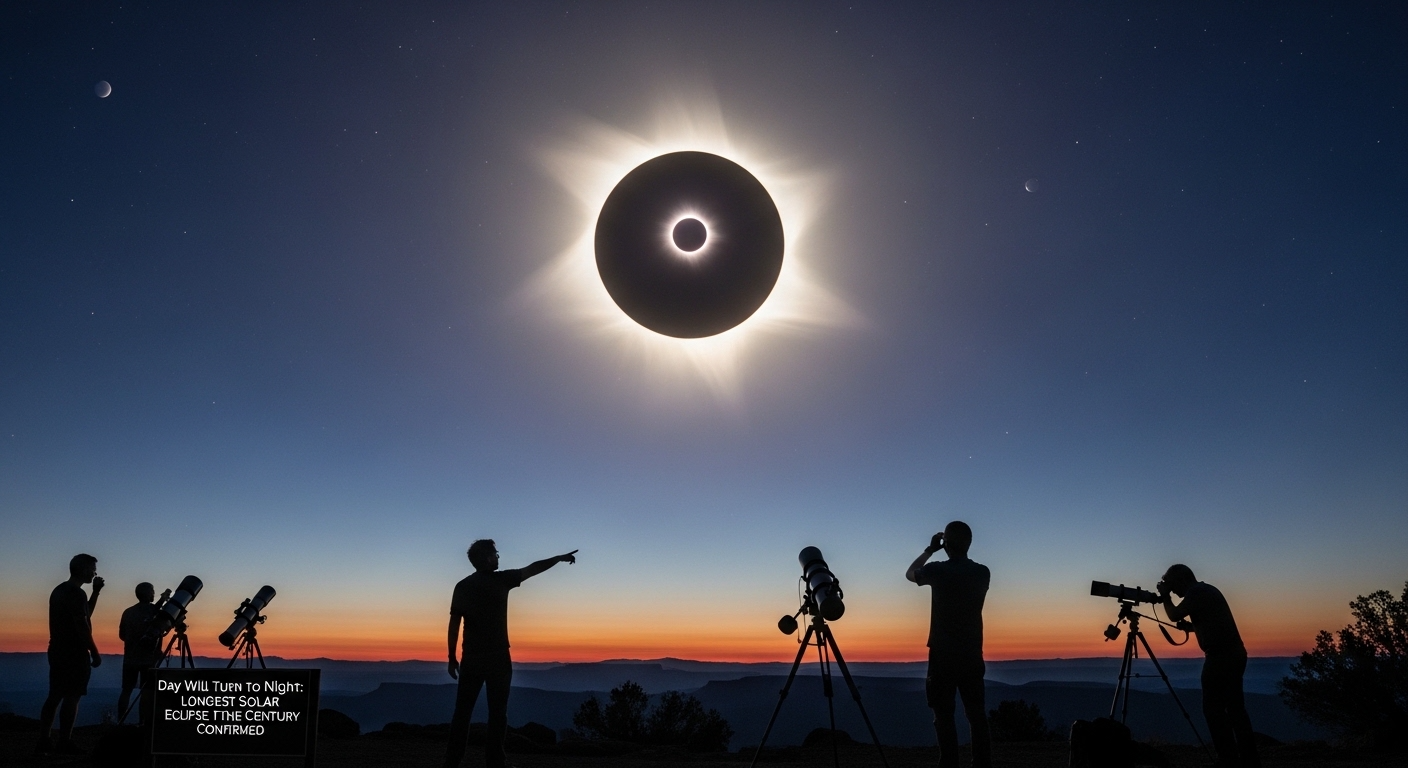
Day Will Turn to Night as Astronomers Confirm the Date of the Longest Solar Eclipse of the Century
The news arrives on an ordinary afternoon, the kind of day that drifts past without leaving much of a mark. A notification appears on a laptop screen. A radio announcer’s voice softens as it leans into a breaking story. A headline blinks across a phone: astronomers have confirmed the date of the longest solar eclipse of the century. In that instant, somewhere between folding laundry and sipping lukewarm coffee, the familiar order of things tilts. A day that will turn to night, fully and dramatically and astonishingly, now has a date on the calendar.
The Day the Sun Steps Aside
Imagine a bright morning that feels routine to the point of invisibility. Car engines rumbling, buses sighing at kerbs, market vendors fanning the air over fruit stalls. And then, almost shyly at first, the light begins to change. Not the quick sweep of a cloud passing overhead, but a slow and mysterious dimming, like someone’s hand turning the dial on the world’s brightness down by degrees.
The confirmed eclipse, astronomers say, will stretch longer than any other this century, sweeping a bold and slender shadow over several regions across the globe. It will not visit all countries or darken every rooftop with its totality, but for those standing beneath the central path, the Sun will vanish behind the Moon for an astonishing interval. Long enough to feel the absence in your bones.
Even for those outside the narrow band of totality, the event will be impossible to ignore entirely. Birds will hesitate mid-song. Shadows will sharpen and then blur strangely, contrast shifting as though the world itself has been run through an editor’s hands. People who had no idea an eclipse was coming will step out of office buildings and laundromats, squinting upward, suddenly aware that the day has become something genuinely strange.
Solar eclipses have always pulled humanity into a shared moment across every culture and era. The sight of the Sun reduced to a thin ring of fire around a jet-black disc has a way of folding time. For a few minutes, screens and arguments and deadlines matter less than the simple question humans have been asking since the beginning of recorded thought. What happens when daylight gives up its throne?
A Century in the Making
The longest solar eclipse of the century did not arrive by accident. Its appointment with Earth was written into the clockwork of the solar system long before the first person watched the sky and tried to give what they saw a name. We simply had to learn how to read the script.
Today’s astronomers can predict eclipses with the precision of transport timetables. They work in seconds and coordinates and narrow paths that snake across oceans and continents on maps that look nothing like the casual visual we tend to carry in our heads of what the sky is doing. This particular eclipse, this rare and drawn-out performance, has been discussed in research papers and observatory corridors for years. Now the date is official. The world has been given notice.
What makes this eclipse extraordinary is fundamentally a matter of geometry. The Moon’s orbit around Earth is not a perfect circle. Sometimes it sits a little closer to us, appearing slightly larger against the sky. Sometimes it sits further away and appears slightly smaller. For a truly long total solar eclipse, three conditions must align simultaneously. The Moon needs to be relatively close to Earth. Earth needs to be at a specific point in its own orbit around the Sun. And the alignment between all three bodies needs to be very nearly perfect. When those pieces slide into position, the Moon’s shadow becomes a tunnel of darkness stretching across the planet’s surface, and the people fortunate enough to stand beneath it are briefly allowed inside.
In observatories and in backyard workshops equipped with serious instruments, preparations are already underway. Telescopes are being calibrated. Camera filters are being tested. Eclipse chasers are studying maps and booking travel with the particular intensity of people who understand that almost is simply not good enough in this particular pursuit. To stand just outside the narrow path of totality is to see an impressive partial eclipse. To stand within it is to watch the Sun disappear entirely, and to feel the world pause around you.
The Science Hidden in the Shadow
Beyond the spectacle, eclipses are among the most productive natural experiments available to solar scientists. When the Moon covers the Sun’s brilliant surface, the blinding glare drops away and reveals the corona, a delicate and ghostly halo of superheated plasma that ordinarily hides in plain sight behind the overwhelming brightness of the disc itself. For the duration of totality, instruments can study the Sun’s outer atmosphere with a clarity that is nearly impossible to achieve at any other time.
During this longest eclipse of the century, research teams plan to track temperature variations within the corona, observe magnetic structures twisting and releasing energy, and search for clues about what drives the solar wind that flows constantly outward through the solar system and past our planet. The data gathered has practical downstream applications. Better models of the Sun’s corona improve space-weather forecasting, the predictions that allow satellite operators and power grid engineers to prepare for incoming solar disturbances before they arrive.
Earth’s own atmosphere responds measurably to the sudden reduction in solar energy. Temperatures drop across the shadow zone. Wind patterns shift. Different atmospheric layers cool at different rates, generating ripples that propagate upward and outward in ways that sensitive instruments can track and measure. An eclipse of this duration gives researchers a longer window than usual to observe and record these effects, which is part of why the scientific community has been anticipating this event with particular enthusiasm.
Where Daylight Will Fail
Maps are already circulating among planning teams, astronomy groups, and tourist boards. They show the path of totality as a dark central band, with zones of partial eclipse spreading outward on either side across continents and ocean stretches. Not every city will receive the same experience. Some will see only a crescent Sun with perhaps half its disc covered. Others, for several extraordinary minutes, will see the Sun disappear entirely.
For anyone making plans, the essential picture breaks down into a few clear categories. Communities sitting directly under the central path will experience totality lasting up to six or seven minutes, with the sky darkening to deep twilight and the corona becoming fully visible to the naked eye during that window. Nearby regions slightly off the central line will see a substantial partial eclipse with noticeable dimming and the Sun reduced to a crescent shape. Areas further from the path will notice more subtle changes in light quality that are most appreciable with eclipse glasses. Regions entirely outside the eclipse zone will see no visible change in the sky, though they will be able to follow events through live broadcasts.
The path of totality operates like a cosmic VIP corridor, narrow and entirely non-negotiable. A town just a short distance outside the central line might see the Sun reduced to a dramatic sliver while a field only a few kilometres further along sits in complete darkness. It is a reminder that on a planetary scale, very small distances produce very different experiences of the same event.
For communities falling beneath the deepest part of the shadow, the eclipse is already reshaping local planning. Schools are designing special programmes around the event. Tourism agencies are drafting campaigns. Farmers and rural communities are factoring it into their seasonal conversations. For a single morning or afternoon, ordinary schedules will defer to what the sky is doing.
Clouds, Weather, and the Gamble of the Sky
There is one element of this event that no amount of astronomical precision can control, and that is the weather. All the correct geometry in the solar system is irrelevant if a persistent layer of cloud sits between an observer and the event they have travelled to see. This is a significant part of what makes eclipse chasing genuinely exciting rather than simply planned. You can do everything right and still be standing under a grey ceiling when the shadow arrives.
Serious eclipse chasers study historical weather patterns for the regions under the path of totality and make informed bets about where the clearest skies are most likely to be on the relevant date. Dry climates with a strong track record of clear mornings become magnets for both scientific expeditions and independent travellers willing to take a calculated risk with their leave days.
Even if cloud does settle over a viewing location on the day, the experience is not completely lost. The eerie dimming of the light, the hush that falls over an area as totality approaches, the behavioural changes in birds and insects and domestic animals, all of these will still occur. The emotional atmosphere of a total eclipse is partly visual and partly something more atmospheric and harder to describe, and clouds cannot prevent all of it.
How It Will Feel When Day Becomes Night
Ask people who have stood under a total solar eclipse to describe it, and their accounts often sound like fragments of dreams reconstructed the following morning. The temperature drop that arrives faster and more noticeably than expected. The strange quality of the remaining light, metallic and thin in a way that ordinary shade never quite replicates. The way colours appear drained from the landscape as though the saturation has been quietly removed. The wind that sometimes picks up as the cooling air begins to move.
During this unusually long eclipse, those sensations will have time to deepen and settle rather than arriving and departing in a rush. The darkness will accumulate slowly rather than switching on abruptly. Street lighting with automated sensors will be fooled into activating at midday. Roosting behaviour will begin in birds that were foraging moments earlier. Insects associated with dusk will begin their evening performances. Domestic animals will grow uncertain and restless in ways that are both interesting to observe and slightly unsettling to witness.
Human reactions to totality have been documented across cultures and centuries and they remain remarkably consistent. People laugh nervously. People fall completely silent. A surprising number cry, often without being entirely sure why. There is something in the experience that reaches past the intellectual understanding of what is happening and touches something older and less articulate. We know precisely what causes an eclipse and can predict its occurrence to the second. And yet when the foundations of ordinary experience shift this visibly, when daylight simply stops being daylight at midday, something in us responds as though reality itself has briefly and inexplicably changed the rules.
Community Under the Shadow
Perhaps what is most worth noting about an event like this is the way it draws people together, if only for a single afternoon. Neighbours who have never spoken will share eclipse glasses along a suburban footpath. Strangers will pass around homemade pinhole projectors and laugh together as tiny crescent shapes appear on pieces of cardboard held over the ground. In parks and on rooftops and in open paddocks, people will gather with the quiet awareness that they are about to witness something they will be describing for the rest of their lives.
Children will remember precisely where they were standing. Teachers will set aside their usual programmes. In some places workplaces will adjust their schedules. In others, workers will find a few minutes on a loading dock or a fire escape, slipping on a pair of cardboard viewing glasses for a quick and furtive upward glance.
And across the world, including in regions that see nothing directly overhead, there will be live streams and photography and the particular energy that comes from knowing that millions of other people are watching the same thing unfold simultaneously. The shadow’s path is narrow. The sense of collective witness is considerably broader.
Watching Safely, Watching Deeply
A solar eclipse demands genuine respect for the Sun’s capacity to cause harm even when mostly covered. The certified eclipse glasses that look almost playfully simple are in reality carefully engineered optical filters designed to block the overwhelming majority of solar radiation at all wavelengths. Without them, a quick and curious glance at the partially eclipsed Sun is enough to cause serious and permanent eye damage.
The rules are simple but non-negotiable. Certified eclipse glasses or approved solar filters for any optical equipment at all times except during complete totality. No sunglasses regardless of how dark they appear. No improvised alternatives. No quick unprotected peeks on the logic that it is only for a moment. Parents and teachers will be drilling this into children in the weeks leading up to the event, and that repetition is appropriate given the stakes.
For anyone without access to eclipse glasses, indirect viewing provides another genuinely satisfying way to follow the event. A small hole punched through a piece of card will project an image of the Sun onto a surface below, and as the eclipse deepens, that circular image becomes a crescent that shrinks progressively toward a thin sliver. Beneath trees with dense canopies, every gap between leaves acts as a natural pinhole projector, covering the ground with shifting crescents as the coverage deepens. It is an extraordinary sight that most people have never encountered and do not expect.
And then, if you are standing in the right place, the moment arrives when you can put the glasses down entirely. Only during totality, only when the Sun is completely hidden. The sky will have moved into a twilight that belongs to no ordinary time of day. Stars will appear. The corona will be visible to the naked eye as pale and delicate plumes extending outward from the black disc of the Moon. Some people will photograph it. Many will simply stand and breathe and try to absorb something that resists being adequately described afterward.
Preparing Your Own Eclipse Story
As the confirmed date approaches, the practical preparations are straightforward. Identify whether your location falls under totality, partial coverage, or outside the eclipse zone entirely. Source certified eclipse glasses from a reputable supplier well in advance, as they tend to sell out quickly once public awareness builds. Monitor weather forecasts for the region and have a contingency plan if cloud coverage looks likely at your preferred viewing site. Find or create an unobstructed viewing position with a clear horizon.
But alongside the practical preparation, there is something worth doing that is quieter and more personal. Think about where you want to be when the light changes. Who you want beside you. What you want to notice and remember. Bring a notebook if writing helps you process experiences. Bring someone whose reactions you find interesting to observe alongside the sky.
Some people will treat the eclipse as a pilgrimage, travelling substantial distances to stand under the shadow at its deepest. Others will walk two blocks from their front door to a nearby oval. Both journeys lead to the same sky. The important thing is to recognise this event for what it is. Not simply an astronomical occurrence, but one of those shared moments in human experience that a generation marks and remembers collectively, the kind that people reference for decades afterward as a common point of orientation.
After the Shadow Moves On
When the Moon’s disc finally completes its transit and the Sun reasserts itself in full, the world will return to its ordinary rhythms with remarkable speed. Birds will resume their interrupted songs. Automated lighting will shut down. Children will be called back inside. The sky will look exactly as it always has.
But something will have shifted in the people who were paying attention. In classrooms, students will carry the memory of the day their science curriculum stepped off the page and arranged itself across the sky above the school oval. Amateur astronomers will spend days reviewing their images, searching for the frame where the corona shows at its most precise. In kitchens and coffee shops, the same fragments of conversation will circulate for weeks. Do you remember how quickly it went cold? Did you hear the birds stop? I had no idea the sky could look like that.
This eclipse will stand as one of the clear markers of this century’s shared experience, a moment etched into millions of personal histories at the same time. Some of the children who watch it will go on to careers in astronomy or physics or atmospheric science. Others will simply carry the imprint of genuine awe through the remainder of their lives, a quiet reminder that the world is considerably larger and stranger than the texture of any ordinary Tuesday suggests.
The next time the Sun sits in a blue sky looking entirely unremarkable, you may find yourself glancing upward with slightly different eyes. Because once you have watched a day become night and then watched it return within the span of a few minutes, it becomes genuinely difficult to treat what is happening above you as mere background.
And that may be this eclipse’s most lasting gift. Not the spectacle of the corona or the six minutes of extraordinary darkness, but the quiet invitation to look up, to feel appropriately small in the best possible sense, and to remember that we live on a moving world in the light of a star that, every few decades or so, simply steps aside.
Read More: For more science, astronomy, and natural world stories written for Australian readers, visit wizemind.com.au