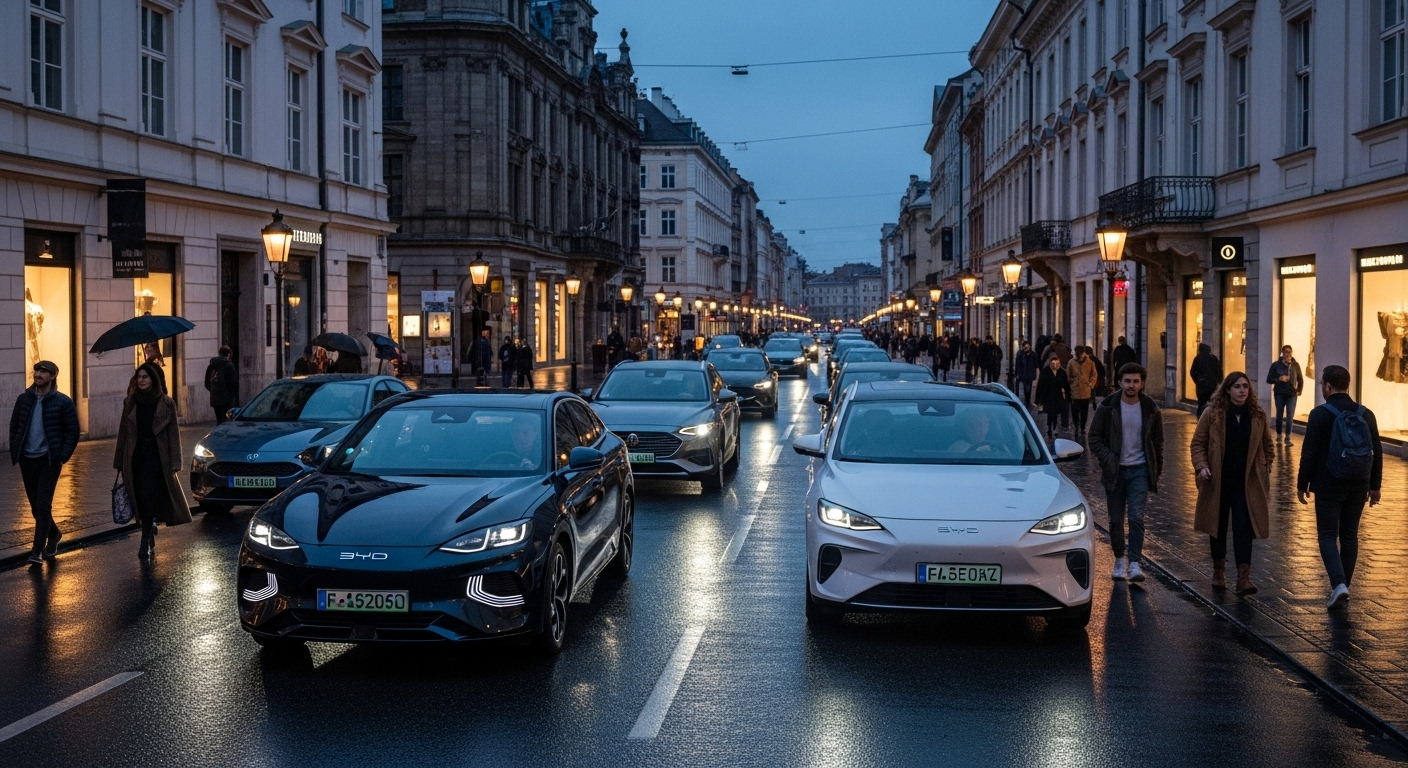
Chinese Plug-In Hybrids Are Quietly Reshaping Europe’s Auto Market
While Brussels pushes hard for full electrification, Chinese carmakers are arriving with a different answer — and European drivers are listening.
Europe’s electric vehicle transition was supposed to follow a clear script: combustion engines out, pure battery electrics in, with the continent’s own automakers leading the charge. But a wave of Chinese plug-in hybrid models is complicating that narrative significantly. These vehicles — offering electric ranges that rival or exceed many full EVs, combined with a petrol engine for longer trips — are finding an audience among European drivers who want cleaner motoring without the anxieties that still surround going fully electric. The implications for European industry, policy, and climate goals are considerable.
What Chinese Automakers Are Actually Offering
The plug-in hybrid electric vehicles (PHEVs) arriving from Chinese brands are not the short-range hybrids that European drivers may remember from a decade ago. Brands including BYD, AITO, and Li Auto are bringing models with electric-only ranges of up to 200 kilometres or more on a single charge — enough to cover the vast majority of daily driving without touching the petrol engine at all. For longer journeys, the combustion engine takes over, eliminating the range anxiety that remains one of the primary barriers to full EV adoption.
The pricing is also competitive. Chinese manufacturers benefit from deeply integrated domestic supply chains for batteries and components, allowing them to bring vehicles to market at price points that European rivals have struggled to match. In several European markets, Chinese PHEVs are now undercutting comparable European and South Korean models by meaningful margins.
Why This Puts Brussels in a Difficult Position
The European Union’s 2035 target — effectively banning the sale of new petrol and diesel cars — is built on the assumption that battery electric vehicles will become the dominant technology. Significant policy and infrastructure investment has been directed toward that outcome. Plug-in hybrids, which still carry a petrol engine and can emit CO₂ when that engine is in use, are not part of the EU’s long-term vision.
The problem is that PHEVs are proving more popular with actual consumers than the policy framework anticipated. Charging infrastructure across much of Europe — particularly in Southern and Eastern Europe — remains patchy. Apartment dwellers without access to home charging face real inconvenience with full EVs. And the higher upfront cost of battery electrics continues to deter buyers who might otherwise make the switch. Chinese PHEVs address each of these concerns directly, which is precisely why they are gaining traction at a moment when European policymakers would prefer consumers to move in a different direction.
Hybrid vs. Full EV: How They Compare
| Factor | Chinese PHEVs | Pure Electric Vehicles |
|---|---|---|
| Daily electric range | Up to 200km+ on electric only | 300–600km typical full range |
| Long-distance travel | Petrol engine provides unlimited range | Requires charging stops, network dependent |
| Charging dependency | Low — can run entirely on petrol if needed | High — charging infrastructure essential |
| Upfront cost | Generally lower than comparable EVs | Higher, though falling |
| Emissions | Zero in electric mode, CO₂ when petrol runs | Zero tailpipe emissions |
| EU 2035 compliance | Not eligible for sale as new vehicles post-2035 | Fully compliant |
| Appeal to hesitant buyers | High — removes range anxiety entirely | Moderate — infrastructure concerns remain |
The Pressure on European Carmakers
For Volkswagen, Stellantis, Renault, and the rest of Europe’s established automotive industry, the Chinese PHEV wave arrives at an already difficult moment. European manufacturers have spent heavily on EV transitions while facing slower-than-expected consumer uptake. Profit margins on electric vehicles remain thinner than on combustion models, and the cost reduction journey has been harder than projected.
Chinese competitors, meanwhile, have been building EV and hybrid expertise for over a decade with substantial state support. Their battery costs are lower, their development cycles are faster, and they are not carrying the legacy cost structures that weigh on European incumbents. The arrival of competitively priced, well-specified Chinese PHEVs in the European market is not just a commercial challenge — it is a structural one.
Several European manufacturers are now revisiting their PHEV strategies, having previously deprioritised hybrids in favour of full electrics. Whether this represents a pragmatic response to market conditions or an unwelcome step backward from climate commitments depends heavily on who you ask.
What the Environmental Debate Actually Looks Like
The environmental case for PHEVs is genuinely contested. In theory, a driver who charges regularly and uses electric power for daily commuting could achieve very low real-world emissions from a PHEV. In practice, studies across Europe have shown that many PHEV owners charge infrequently — particularly those whose vehicles are provided as company cars — meaning the petrol engine runs far more than the official figures suggest.
This gap between tested and real-world PHEV emissions has led to significant scepticism among climate researchers and environmental groups. A PHEV driven primarily on petrol is not meaningfully cleaner than a conventional hybrid. The EU is aware of this and has been tightening the testing and reporting requirements for PHEVs accordingly.
The counterargument is that a well-used PHEV today is considerably cleaner than a combustion vehicle, and that the transition period matters — getting people out of pure petrol cars faster, even if the destination is not yet full electrification, has real climate value. It is an honest debate without a clean answer.
What European Drivers Are Weighing Up
For individual buyers, the calculation is more personal than political. A driver who regularly travels long distances, lives in an area with limited charging infrastructure, or parks on a street without access to a home charger has a genuinely reasonable case for choosing a PHEV over a full EV at this moment in time. The flexibility is real and practical.
For urban drivers with home charging access and predominantly short daily trips, a full EV increasingly makes more financial and environmental sense — lower running costs, simpler maintenance, and no petrol costs at all.
The honest answer is that neither technology is universally right for every driver in every situation, which is precisely why the market is not following the linear path that policy documents projected.
Frequently Asked Questions
Why are Chinese PHEVs specifically disrupting the European market now? Chinese manufacturers have spent years building battery and EV expertise domestically, supported by significant government investment. They are now exporting mature, competitively priced products to Europe at a moment when local manufacturers are still managing their own electrification transitions and consumer uptake of full EVs is slower than expected.
Are plug-in hybrids actually good for the environment? It depends entirely on how they are driven. PHEVs charged regularly and used predominantly in electric mode produce significantly lower emissions than petrol cars. PHEVs rarely charged and driven mostly on petrol offer much more limited environmental benefit. Real-world data across Europe suggests charging behaviour varies considerably between owners.
Will PHEVs be banned in Europe after 2035? Under current EU regulations, new petrol and diesel vehicles — including PHEVs — cannot be sold after 2035. The regulation applies to new vehicle sales, not to vehicles already on the road. There is ongoing political debate about whether these targets will be adjusted, and some exemptions and reviews are already in discussion.
How do Chinese PHEVs compare to European ones in quality? Chinese brands have improved substantially and now offer vehicles that match or exceed European competitors on specifications and technology at comparable or lower price points. Build quality assessments vary by model, and European consumer protection standards apply to all vehicles sold in the EU regardless of origin.
Should I buy a PHEV or a full EV? Consider your daily driving distance, access to home or workplace charging, frequency of long trips, and budget. If you have reliable charging access and mostly drive short distances, a full EV is likely the better long-term choice financially and environmentally. If you regularly drive long distances or lack convenient charging, a PHEV offers genuine practical advantages at this stage of infrastructure development.
How is the EU likely to respond to growing PHEV popularity? The EU faces pressure from multiple directions — domestic automakers seeking more flexibility, consumers favouring hybrids, and climate commitments pulling in the opposite direction. Adjustments to incentive structures and emissions testing methodologies for PHEVs are likely. Whether the 2035 combustion ban is modified remains a significant open political question.