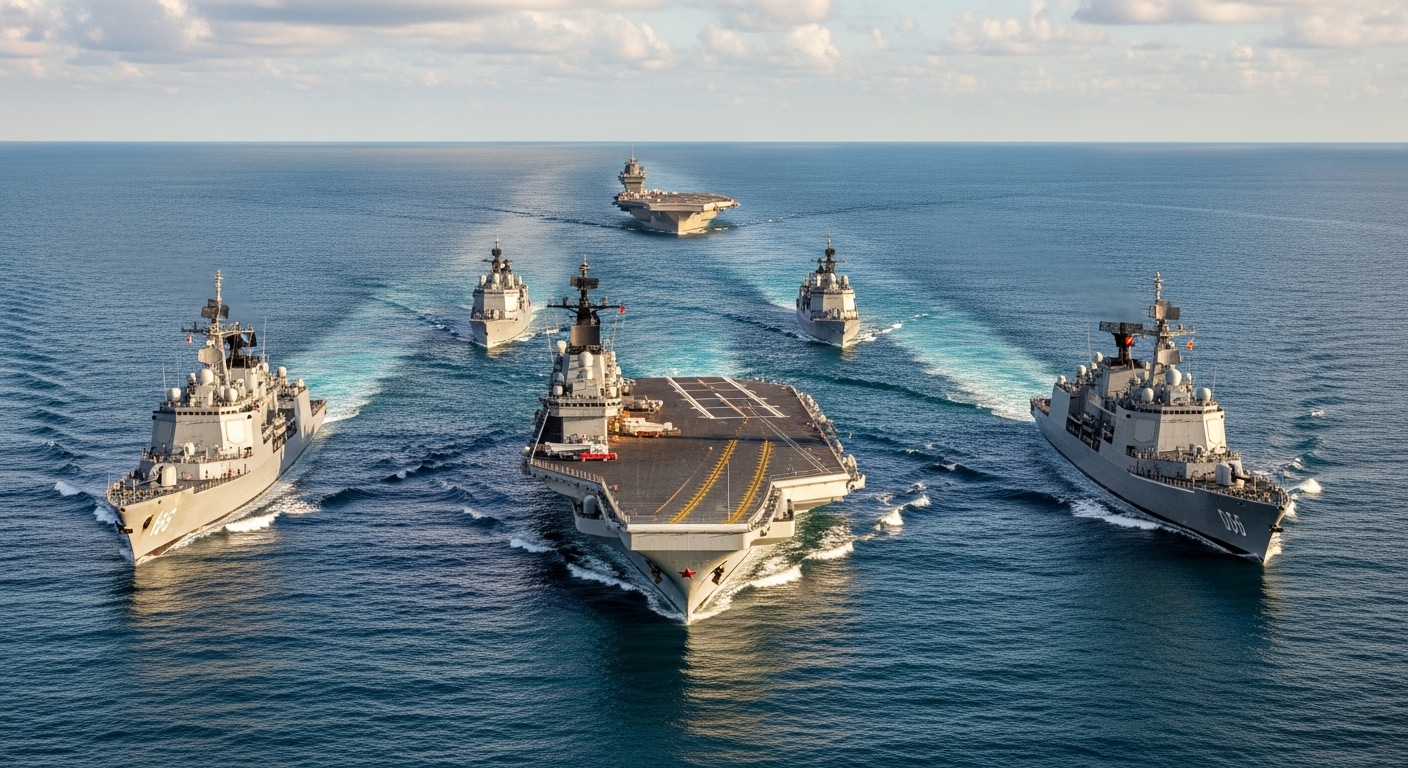
Chinese Fleet Sails Into Contested Waters as US Aircraft Carrier Approaches
The South China Sea has long been one of the most strategically sensitive stretches of ocean on the planet. A fleet of Chinese warships is once again cutting through its waters, their presence signaling a bold assertion of Beijing’s growing regional ambitions. In the distance, a US aircraft carrier has appeared on the horizon, a symbol of American naval power that neither side can ignore.
The stage is set for a tense and consequential standoff between the world’s two most powerful militaries. The world is watching closely, and the outcome of this encounter could shape the balance of power in the Asia-Pacific for years to come.
The Chinese Fleet and Its Movements
The Chinese fleet, led by the aircraft carrier Liaoning, has been making its way through the South China Sea, a region that has been at the center of territorial disputes for decades. China’s sweeping claims over the majority of the waterway, based on what it calls the nine-dash line, have been rejected by an international tribunal. That ruling has done little to change Beijing’s posture.
As the Chinese vessels pressed deeper into the contested area, they were met by a growing US naval presence including the USS Ronald Reagan, a Nimitz-class aircraft carrier conducting exercises in the region. Both sides have been carefully monitoring each other’s movements, engaged in a calculated and deliberate show of capability.
Why the South China Sea Matters So Much
This is not just a military story. The South China Sea carries enormous strategic and economic weight that makes every encounter in its waters significant far beyond the region itself.
Key reasons the South China Sea is so important:
- Approximately one-third of all global maritime trade passes through its waters
- The region is believed to hold significant reserves of oil and natural gas
- It sits at the intersection of critical trade routes linking Asia, the Middle East, and Europe
- Multiple nations including Vietnam, the Philippines, and Malaysia have overlapping territorial claims
- Control of the region carries major implications for military projection across the entire Indo-Pacific
A disruption to shipping through the South China Sea would send shockwaves through the global economy almost immediately. That reality is part of what makes every military movement here so closely watched.
Escalating Tensions Between Washington and Beijing
The current naval standoff is unfolding against a backdrop of deepening rivalry between the United States and China that extends well beyond the South China Sea. Trade disputes, technology competition, and competing visions for regional leadership have all contributed to an atmosphere where miscalculation carries serious risk.
The US maintains a long-standing policy of freedom of navigation in international waters. That policy puts it on a direct collision course with China’s more assertive claims over the South China Sea. Both countries have invested heavily in their naval capabilities in recent years, and neither side is operating from a position of weakness.
The risk of escalation is real. A single misstep by either fleet could trigger a broader confrontation with consequences that would be felt far beyond the region.
Navigating the Diplomatic Minefield
Resolving the South China Sea dispute has never been straightforward. The web of overlapping claims and competing national interests makes simple solutions almost impossible to find.
China insists on its sovereignty over the majority of the sea. Its neighbors including Vietnam, the Philippines, and Malaysia have staked their own claims to various parts of the waterway. The United States, while not a claimant itself, has positioned itself as a guarantor of freedom of navigation and a supporter of its regional allies who feel directly threatened by Chinese expansion.
Finding a resolution will require genuine diplomatic commitment and a willingness to compromise from all sides. The alternative, allowing tensions to continue building without a framework for managing them, carries risks that no responsible government should be comfortable accepting.
Read More: https://wizemind.com.au/
What Experts Are Saying
Those who study the region closely are not minimizing what is happening in the South China Sea right now. The assessments from leading analysts and former military leaders paint a picture of a situation that demands careful handling.
Dr. Lily Yan of the Center for Strategic and International Studies described the Chinese fleet’s movements as a clear assertion of regional ambitions, noting that the encounter tests the resolve of the United States and its allies with implications for the broader balance of power in Asia.
Former NATO Supreme Allied Commander Admiral James Stavridis called the situation delicate and potentially volatile, emphasizing that open communication and a commitment to diplomacy are the essential tools for preventing miscalculation from spiraling into something far more dangerous.
Professor Xiao Wen of Fudan University framed the dispute as a proxy for the broader US-China competition for global influence, arguing that whoever establishes dominance in this contest will hold a significant advantage in shaping the world order for the rest of the century.
The Geopolitical Implications for the Region and the World
The stakes in the South China Sea extend well beyond the waters themselves. The outcome of this standoff could reshape alliances and strategic calculations across the entire Asia-Pacific region.
If China succeeds in asserting dominance here, analysts warn it could embolden Beijing to take a more aggressive stance in other contested areas including the Taiwan Strait and the East China Sea. That would put enormous additional pressure on US alliances and regional stability more broadly.
If the United States successfully challenges China’s claims and maintains its regional presence, other nations in the region may align more closely with Washington, potentially isolating Beijing and limiting its strategic options. Neither outcome is simple, and neither comes without its own set of risks and complications.
The Environmental Cost Nobody Is Talking About Enough
Amid the military and geopolitical focus, the environmental stakes in the South China Sea deserve serious attention. The region is one of the most biodiverse marine ecosystems on the planet.
Ongoing militarization of the area, including the construction of artificial islands and the constant movement of large naval vessels, threatens coral reefs, fisheries, and delicate marine habitats that millions of people across the region depend on for their livelihoods.
A military conflict in the South China Sea would likely cause irreversible environmental damage on top of its human and economic costs. This dimension of the dispute rarely receives the attention it deserves in discussions dominated by military and strategic analysis.
What to Expect in the Days and Weeks Ahead
The situation is unlikely to resolve quickly. Both sides will continue monitoring each other closely and will be prepared to respond to any perceived provocation. At the same time, both Washington and Beijing are aware of how dangerous an uncontrolled escalation would be.
Diplomatic efforts to de-escalate are expected to intensify behind the scenes even as the public posturing continues on the water. Regional powers including Japan, Australia, and ASEAN member states will play important roles in shaping how the situation develops, as will international organizations with a stake in maintaining open sea lanes and peaceful resolution of disputes.
The world has seen tense South China Sea standoffs before and they have not yet led to open conflict. But the military capabilities on both sides are larger than they have ever been, and the political pressures driving each country’s behavior are not easing. Careful, sustained diplomacy is the only realistic path to preventing this from becoming something far more serious.
Q&A: Chinese Fleet, US Carrier, and the South China Sea 2026
1. What is the significance of the South China Sea dispute? The South China Sea carries roughly one-third of global maritime trade and is believed to hold substantial oil and gas reserves. The outcome of the territorial dispute has major implications for regional and global power balances.
2. What are China’s specific claims in the South China Sea? China claims sovereignty over the majority of the South China Sea based on the nine-dash line. This claim has been rejected by an international tribunal but China continues to assert control, including through the construction of artificial islands.
3. Why is the United States involved if it has no territorial claim? The US has a strong strategic interest in maintaining freedom of navigation in international waters and supports regional allies including the Philippines and Vietnam who have competing claims against China.
4. What are the risks of a military conflict in the region? A conflict could disrupt critical global shipping routes, destabilize the regional and global economy, and potentially draw in other powers in a way that escalates far beyond the South China Sea itself.
5. How could the dispute be resolved peacefully? Resolution would require genuine diplomatic commitment from all parties, potentially including a binding code of conduct, joint resource development agreements, and mechanisms for managing tensions without military confrontation.
6. What role can the international community play? Regional and global powers along with international organizations can mediate, encourage dialogue, and uphold international law principles including freedom of navigation.
7. How does this fit into the broader US-China rivalry? The South China Sea is one arena within a much larger competition between the US and China for economic, military, and diplomatic influence across the Asia-Pacific and globally.
8. Which other countries have claims in the South China Sea? Vietnam, the Philippines, Malaysia, Brunei, and Taiwan all have overlapping territorial claims in various parts of the South China Sea alongside China’s broader nine-dash line claim.
9. What is the nine-dash line? It is a boundary line used by China to claim sovereignty over approximately 90 percent of the South China Sea. It was ruled inconsistent with international law by a tribunal in 2016 but China does not recognize that ruling.
10. Has there been military conflict in the South China Sea before? There have been serious incidents including confrontations between naval vessels and aggressive maneuvers near disputed islands, but a full-scale military conflict between major powers has not occurred.
11. What is the USS Ronald Reagan’s role in the region? The USS Ronald Reagan is a Nimitz-class aircraft carrier that has been conducting naval exercises in the South China Sea as part of the US commitment to maintaining a presence in the region.
12. What is the Liaoning? The Liaoning is China’s first aircraft carrier, originally a Soviet-era ship that was refitted and commissioned into the People’s Liberation Army Navy. Its deployment to the South China Sea is a significant signal of Chinese naval ambition.
13. What are the environmental risks of militarization in the region? Ongoing military activity, artificial island construction, and the risk of conflict all threaten the South China Sea’s coral reefs, fisheries, and marine biodiversity that regional populations depend on.
14. How are regional countries like the Philippines and Vietnam responding? Both countries have strengthened defense ties with the United States and other partners while also pursuing diplomatic channels to protect their territorial claims.
15. What would a peaceful long-term solution look like? Analysts generally point to a combination of multilateral negotiations, a legally binding code of conduct, shared resource development arrangements, and consistent application of international maritime law as the foundation for any durable peaceful resolution.