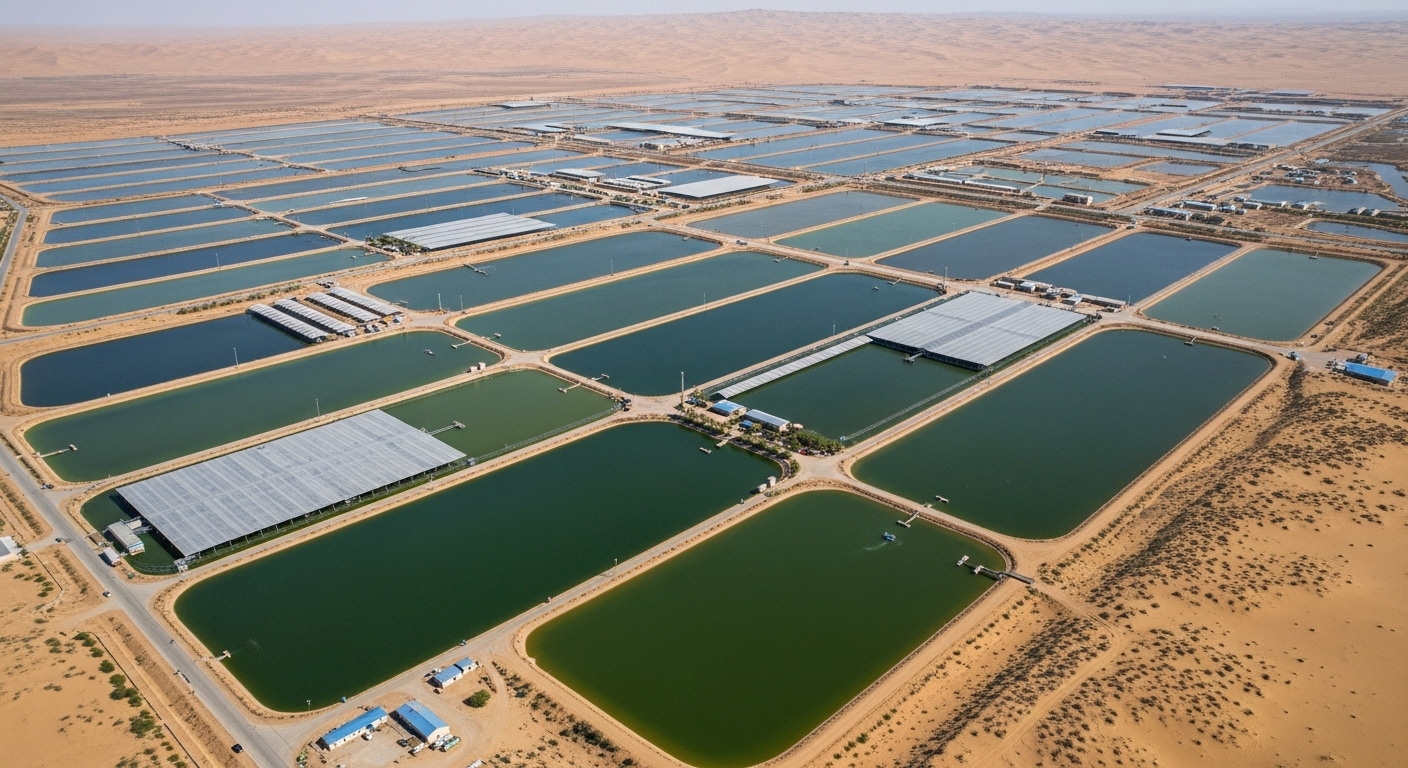
China Turns a Desert Into a Giant Fish and Shrimp Farm
Picture endless sand dunes baking under a relentless sun, stretching as far as the eye can see. In China’s northwestern Xinjiang region, that barren landscape has been transformed into one of the most ambitious aquaculture projects on Earth — a vast, living network of fish and shrimp farms producing food where nothing once grew.
This is not a small pilot programme or an experimental plot. It covers thousands of hectares and is already generating food, jobs, and economic activity at a scale that has drawn attention from governments and agricultural researchers worldwide.
The Problem That Made This Necessary
Xinjiang is one of China’s most arid regions. Freshwater is scarce, the soil is largely unfarmed, and traditional agriculture has never been a realistic option across much of the landscape.
What the region does have in abundance is something most engineers would consider a liability rather than an asset. Deep beneath the desert surface sits a vast reserve of saline groundwater — water too salty for conventional irrigation but, as it turns out, perfect for something else entirely.
Turning Saltwater Into a Food System
The core insight behind the project was deceptively simple. Rather than trying to desalinate the groundwater for conventional farming, the engineers asked a different question — what grows naturally in salty water?
The answer was fish and shrimp. Specialist pumping systems and carefully managed desalination technology were used to bring the saline groundwater to the surface and adjust its conditions to suit different aquatic species. Tilapia, giant river prawns, and a range of other commercially valuable species now thrive in the engineered ponds and channels that stretch across what was previously dead land.
Salinity levels in each pond are monitored and adjusted continuously, ensuring the water chemistry remains within the precise range each species requires. The system is sophisticated enough to support biological diversity while remaining operationally manageable at scale.
What the Farm Actually Looks Like
The physical infrastructure of the project is striking in its own right. Thousands of interconnected ponds and channels now cover land that was featureless desert just years ago. Each section is calibrated for a specific species or growth stage, creating what amounts to a carefully zoned aquatic landscape.
Water flows through the system in managed circuits, moving from intake points through treatment and conditioning stages before reaching the farming ponds and eventually cycling back. Nothing is wasted. The system is designed as a closed loop wherever possible, minimising both water loss and environmental discharge.
Solar panels and wind turbines are integrated throughout the site, providing the energy needed to run pumps, monitoring systems, and processing infrastructure without dependence on grid power. The renewable energy component was built in from the start rather than added as an afterthought.
The Renewable Energy Foundation
Sustainability was not an optional extra for this project — it was a design requirement from the outset. Running pumps, desalination equipment, and water management systems across thousands of hectares demands enormous energy input, and powering that from fossil fuels would have undermined both the environmental credentials and the long-term economics of the operation.
Solar generation is particularly well suited to Xinjiang’s desert climate. The same intense sunlight that makes conventional farming so difficult also makes solar panels exceptionally productive, and the project has taken full advantage of that alignment. Wind resources in the region are also substantial, and the combination of the two provides a reliable energy supply across different weather conditions.
The energy system has also benefited the surrounding communities, providing a more reliable and affordable power source to nearby villages and contributing to the broader electrification infrastructure of a region that has historically been underserved.
The Economic Transformation of a Remote Region
Before the project, Xinjiang’s desert zones offered limited economic opportunity. Employment was scarce, incomes were low, and population drift toward urban centres was ongoing. The aquaculture development has materially changed that picture.
Thousands of jobs have been created across the project’s construction, operation, harvesting, and processing functions. Local residents have been trained in aquaculture management, water systems operation, and food processing — skills that are both well-compensated and transferable to other contexts as the industry grows.
The sense of community ownership around the project has been a significant factor in its operational success. Workers who understand the system they are managing and who have a stake in its productivity tend to operate it more effectively than contracted external labour, and the project’s design has prioritised local involvement accordingly.
What the Ecosystem Did Next
Something unexpected happened as the ponds filled and the aquatic life established itself. The desert around the project began to change. The introduction of open water, aquatic vegetation, and the insects and microorganisms that accompany a living water system attracted wildlife that had not been present in the area for decades.
Migratory birds discovered the ponds on their seasonal routes and began stopping there regularly. Plant species colonised the margins of the water channels, stabilising soil and creating habitat corridors that extended the ecological benefit beyond the farm boundaries themselves.
The project has effectively created a desert oasis — not as a side effect to be managed but as a genuine ecological outcome that the team has worked to support and expand. The interaction between the aquaculture operation and the recovering natural ecosystem has become one of the more scientifically interesting aspects of the project.
The Challenges That Required Solving
A project of this complexity does not succeed without confronting serious difficulties, and the Xinjiang aquaculture development has faced its share. Managing saline groundwater extraction at scale without depleting the aquifer or increasing soil salinity in surrounding areas required careful hydrogeological modelling and ongoing monitoring.
Supply chain logistics presented a separate category of challenge. Getting fresh aquatic produce from a remote desert location to domestic and international markets within the quality and freshness windows that consumers expect required investment in cold chain infrastructure, processing facilities, and transport links that did not previously exist in the region.
Water quality monitoring at the scale this project operates is genuinely demanding. Each pond has different biological conditions, different species requirements, and different vulnerability profiles, and maintaining the health of the entire system requires both sophisticated sensor technology and experienced human judgment working together continuously.
A Blueprint for the World’s Dry Zones
What has been achieved in Xinjiang is already attracting serious attention from countries facing analogous combinations of arid land, saline groundwater, and food security challenges. Large parts of the Middle East, North Africa, Central Asia, and inland Australia share the fundamental conditions that this project has demonstrated can be turned into productive food-producing landscapes.
The model is not directly transferable without adaptation. Different deserts have different groundwater chemistry, different energy resources, and different target species that would thrive in their specific conditions. But the core principles — harness available saline water, use renewable energy to run the system, integrate ecological thinking from the beginning — are applicable far beyond Xinjiang.
Australian agricultural researchers have taken particular interest in the project. Large areas of inland Australia sit above saline groundwater reserves that have long been considered a problem rather than a resource, and the Chinese experience offers a potential template for rethinking what those reserves could produce.
Frequently Asked Questions
What exactly is being farmed in the Xinjiang desert project? The project produces a range of aquatic species suited to managed saline conditions. Tilapia and giant river prawns are among the primary commercial species, alongside other fish and shrimp varieties selected for their adaptability and market value.
How does the project manage water quality at such a large scale? Through a combination of continuous sensor monitoring, managed water flow circuits, and regular adjustment of salinity and chemical conditions in individual ponds. Specialist teams manage each zone of the farm according to the requirements of the species it contains, with data systems providing real-time oversight across the entire operation.
Is the saline groundwater being depleted by this extraction? Aquifer management is one of the project’s primary ongoing concerns. Extraction rates are modelled against recharge estimates, and monitoring wells track groundwater levels continuously. The system is designed to operate within the aquifer’s sustainable yield rather than mining it.
How does the renewable energy component work practically? Solar panels and wind turbines distributed across the site generate electricity used to run pumps, water treatment systems, monitoring equipment, and processing facilities. The renewable generation capacity was sized to match the project’s energy demand, reducing dependence on grid power and lowering operating costs over the long term.
Could this model work in Australia? Potentially yes, particularly in inland regions with saline groundwater. The core technical approach is adaptable to different arid environments, though the specific species selection, water chemistry management, and energy configuration would need to be tailored to Australian conditions. Research interest from Australian agricultural institutions is already active.
What has happened to the local environment around the farm? The introduction of open water and aquatic life has triggered ecological recovery in the surrounding desert. Migratory birds, plant species, and invertebrates have established themselves around the farm margins, creating a broader ecosystem benefit that was not explicitly planned but has been welcomed and supported.
How are the products reaching consumers? Through investment in cold chain logistics, processing infrastructure, and transport links developed alongside the farm itself. Both domestic Chinese markets and export channels are served, with processing facilities on site reducing the time between harvest and distribution.
What is the long-term vision for the project? Continued expansion within Xinjiang and development of the model as an exportable framework for sustainable aquaculture in arid regions globally. The project’s operators and the Chinese government have both expressed interest in sharing the technical and operational knowledge gained with other countries facing similar land and water challenges.
Key Takeaways
- Desert land with no farming history has been converted into a productive aquaculture system covering thousands of hectares in China’s Xinjiang region.
- Saline groundwater — previously considered unusable — is the water source powering the entire fish and shrimp farming operation.
- Solar panels and wind turbines provide the energy needed to run pumps, water systems, and processing infrastructure without grid dependence.
- Thousands of local jobs have been created, transforming the economy of a previously resource-poor and sparsely populated region.
- Unexpected ecological recovery has occurred around the farm, with migratory birds and native plant species returning to the area.
- The model is attracting global interest, particularly from arid nations and regions — including parts of Australia — that sit above saline groundwater reserves.
- Key challenges include aquifer management, supply chain logistics, and continuous water quality monitoring across a complex, large-scale system.
- The project represents a fundamental rethinking of what counts as a productive landscape, with implications for food security planning in a world where freshwater is increasingly scarce.
Read more: https://wizemind.com.au/