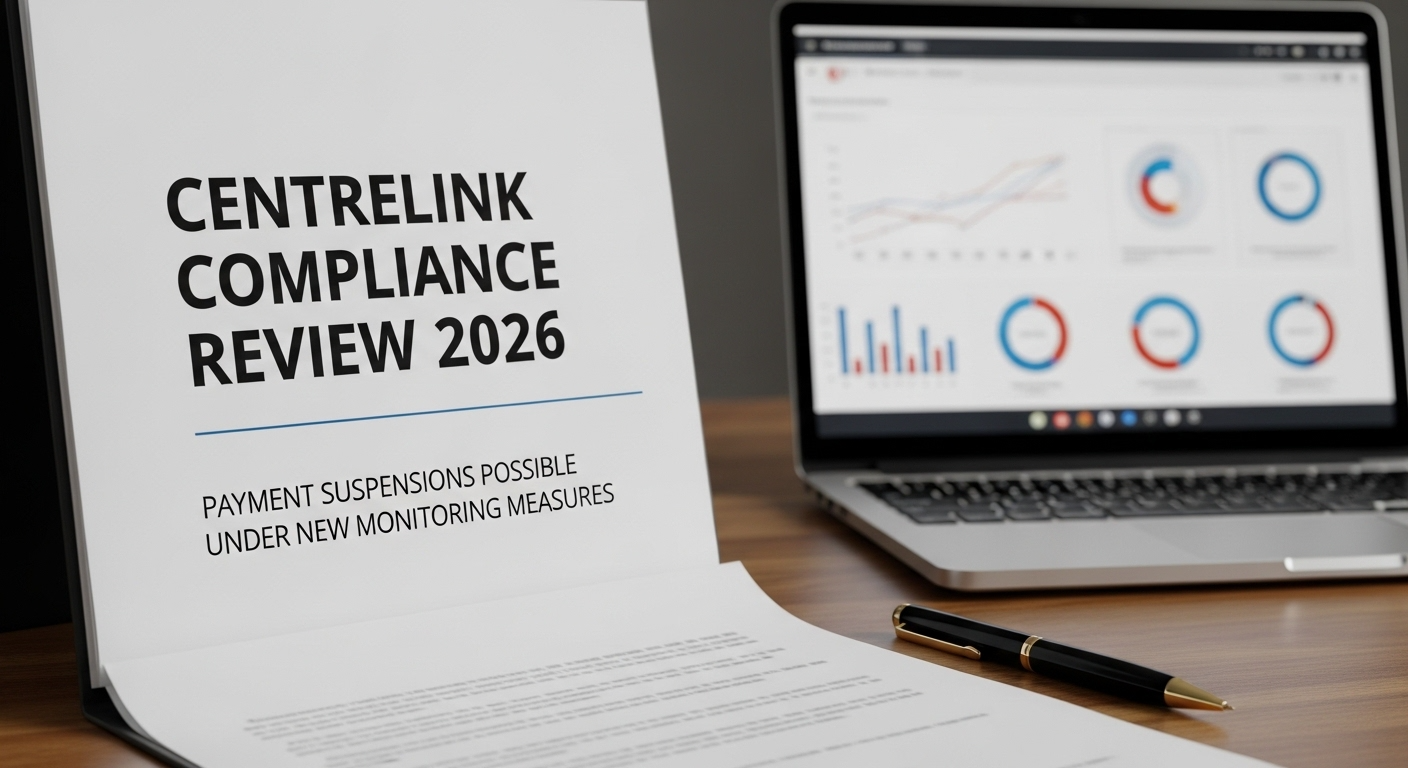
Centrelink Compliance Review 2026 — Payment Suspensions Possible Under New Monitoring Measures
Thousands of Australians receiving government payments are being urged to check their Centrelink accounts immediately as a targeted compliance review gets underway across the welfare system. The review is designed to verify payment accuracy and prevent overpayments, but recipients who do not respond promptly to notifications or whose records contain discrepancies may face temporary payment suspensions that can create serious financial difficulty for households that depend on fortnightly deposits to manage essential expenses.
The scale of this compliance activity is larger than previous rounds, driven by the expanded use of automated data matching between Centrelink and financial institutions that can now identify discrepancies faster and more comprehensively than manual review processes. For recipients who have been assuming their payments will continue without any active engagement on their part, that assumption carries more risk in 2026 than it has in previous years.
What the Compliance Review Is Examining
The current compliance activity is not a random audit. It is a targeted verification campaign focused on the specific areas where payment inaccuracies most commonly occur and where automated data matching is most capable of identifying gaps between declared information and actual financial circumstances.
Income reporting accuracy is one of the primary focus areas. Discrepancies between declared income and data obtained from employers, the Australian Taxation Office, and financial institutions are among the most common triggers for review and potential suspension. Recipients whose income has changed and who have not updated their declarations are particularly exposed.
Asset declarations are being cross-checked against financial institution data, superannuation fund records, and property databases. Recipients who hold assets that are not accurately declared, whether through oversight or the assumption that small amounts do not matter, may find that the automated matching process identifies the discrepancy before they do.
Superannuation balances are under review for pension recipients who may have had balance changes through drawdowns, rollovers, or fund performance that have not been updated in their Centrelink records. Rental details for Rent Assistance recipients are being verified against available tenancy data, and recipients whose rental amounts or living arrangements have changed without notification are at risk.
Bank account information, residency details, and contact information are all subject to verification. A recipient whose contact details are outdated will not receive notifications that are considered delivered the moment they arrive in a myGov inbox, which can create a situation where compliance deadlines pass without the recipient being aware a review is underway.
Why Compliance Activity Is Intensifying in 2026
The increased scale and sophistication of the current compliance review reflects several factors that have converged to make this the most comprehensive verification campaign in recent years. Government officials have been consistent in framing the activity as a fairness measure that protects both taxpayers and legitimate recipients by ensuring payments flow to people who meet eligibility requirements.
The expansion of digital systems and the deepening of data-sharing arrangements between Centrelink, financial institutions, the ATO, and other government agencies has dramatically increased the volume of transactions and account details that can be cross-referenced automatically. Discrepancies that would have required manual investigation to identify are now flagged by automated systems within days of the relevant data becoming available.
The scale of the welfare system, with more than a million Australians receiving Age Pension alone and millions more receiving other forms of income support, means that even small systematic inaccuracies across the payment population represent significant public expenditure. The compliance review is partly a mechanism for recovering overpayments before they compound, and partly a deterrent against the casual inaccuracy in reporting that becomes normalised when recipients assume the system is not actively checking.
Who Faces the Greatest Risk of Suspension
Not every recipient will be flagged during the compliance review, but certain profiles carry substantially higher risk based on the types of discrepancies the automated matching is designed to identify.
Part-pension recipients whose financial circumstances are closer to the means-test thresholds are more sensitive to changes in income or asset values. A relatively small movement in either direction can affect their payment rate, and if that movement has not been reported, the discrepancy between declared and actual circumstances is more likely to trigger a review.
Recipients with fluctuating income from casual employment, seasonal work, or variable investment returns have more complex reporting obligations and more opportunities for inaccuracies to develop between reporting periods. The compliance system is specifically designed to identify patterns where declared income does not match the income data available from other sources.
People who recently changed banks without updating their Centrelink records face a direct suspension risk. If payment processing cannot be completed to the registered account, the payment cannot be delivered, and resolving the account mismatch after a suspension has been triggered is more complicated than preventing it with a timely update.
Recipients of lump sums including inheritances, insurance settlements, asset sales, or superannuation payments that have not been declared as assets or income are among the most commonly identified discrepancies in compliance reviews. The automated matching across financial institution data makes these undeclared lump sums increasingly identifiable.
Recipients who have not responded to previous Centrelink messages are in the highest risk category, because the compliance process is triggered by notification and response. An unread message requesting information is a pending compliance obligation, and the system treats the notification as delivered the moment it arrives in a myGov inbox regardless of whether it has been opened.
Real Consequences for Real Recipients
The compliance review is not an abstract administrative process. Its consequences land in people’s bank accounts and household budgets in ways that create immediate financial stress.
Sandra, 69, from Perth, had her pension paused after missing a digital message requesting updated bank details. “I didn’t realise they needed updated bank details,” she said. Her experience illustrates how a single piece of outdated information, combined with a missed notification, can interrupt a payment that she depends on for daily expenses. The pause was resolved once the information was provided, but the period without the expected deposit created financial difficulty that a timely update would have prevented entirely.
A part-time worker in regional Victoria experienced a temporary payment hold due to reporting confusion around their employment income. “It was just paperwork,” they explained, “but it stopped my payment.” The disruption was administrative rather than based on any genuine ineligibility, which is precisely the frustration that comes with compliance suspensions that affect recipients who are fundamentally entitled to the payment they receive.
The common thread in these experiences is not ineligibility. It is administrative delay or oversight in a system that now moves faster than many recipients realise. The gap between when a notification is sent and when a recipient needs to respond is shorter than it used to be, and the consequences of missing that window are more immediate.
How to Prevent a Payment Suspension
The actions required to protect payment continuity during the compliance review are straightforward and most can be completed through myGov in under thirty minutes. The priority is acting before a notification becomes a deadline that passes without response.
Log into myGov immediately and read every unread message in your Centrelink inbox. Treat each unread message as a potential compliance obligation with a response deadline. A message requesting updated information, document submission, or confirmation of details needs to be acted on promptly rather than left for later.
Review and update your income declarations. Confirm that your most recent income report accurately reflects all income sources including employment earnings, investment returns, overseas pensions, and any lump sums received since your last declaration.
Verify that your asset details are current. Check that savings balances, superannuation values, investment holdings, and property interests are accurately recorded. If significant changes have occurred since your last update, record them now.
Confirm your bank account details are correct and current. If you have changed banks, switched accounts, or updated your account number since your last Centrelink interaction, update that information immediately. A payment that cannot be processed to the correct account will be suspended until the correct details are provided.
Check that your contact information is current. An email address or phone number that is no longer active means you may not receive timely notification of compliance activity even though the notification has been legally delivered to your myGov inbox.
Keep records of every document you submit. If you upload supporting documentation as part of a compliance response, note the date, the content of the document, and the reference number if one is provided. This record protects you if there is any later dispute about whether the required information was provided.
Frequently Asked Questions
What triggers a payment suspension during a compliance review? Suspensions typically occur when required documents are not submitted within the requested timeframe, income reports are overdue, asset details are inconsistent with data obtained through automatic matching, contact information prevents notification delivery, or verification requests are not responded to promptly.
How long does a suspension last? Payments generally resume once the underlying issue is resolved and verified. The duration depends on how quickly the recipient responds and how long document verification takes. Acting promptly after receiving a compliance notification significantly reduces the suspension period and in many cases prevents suspension from occurring at all.
What if I receive a notification I do not understand? Contact Services Australia directly through the official phone line or visit a service centre. Do not ignore a notification because it is confusing. A notification that is not responded to becomes a compliance failure regardless of whether the content was understood, and direct contact with Services Australia is always the right response to any notification that requires clarification.
Does the compliance review mean I am suspected of fraud? No. Compliance reviews are systematic verification processes that apply across the recipient population based on risk factors and data matching outcomes. Being contacted for a compliance review is not an accusation of fraud. It is a request to confirm that the information Services Australia holds is accurate and current.
What should I do if my payment is suspended? Contact Services Australia immediately and ask what information is required to resolve the suspension. Provide the requested documentation as quickly as possible. Do not wait for the situation to resolve itself, as suspensions do not automatically lift without the underlying compliance issue being addressed.