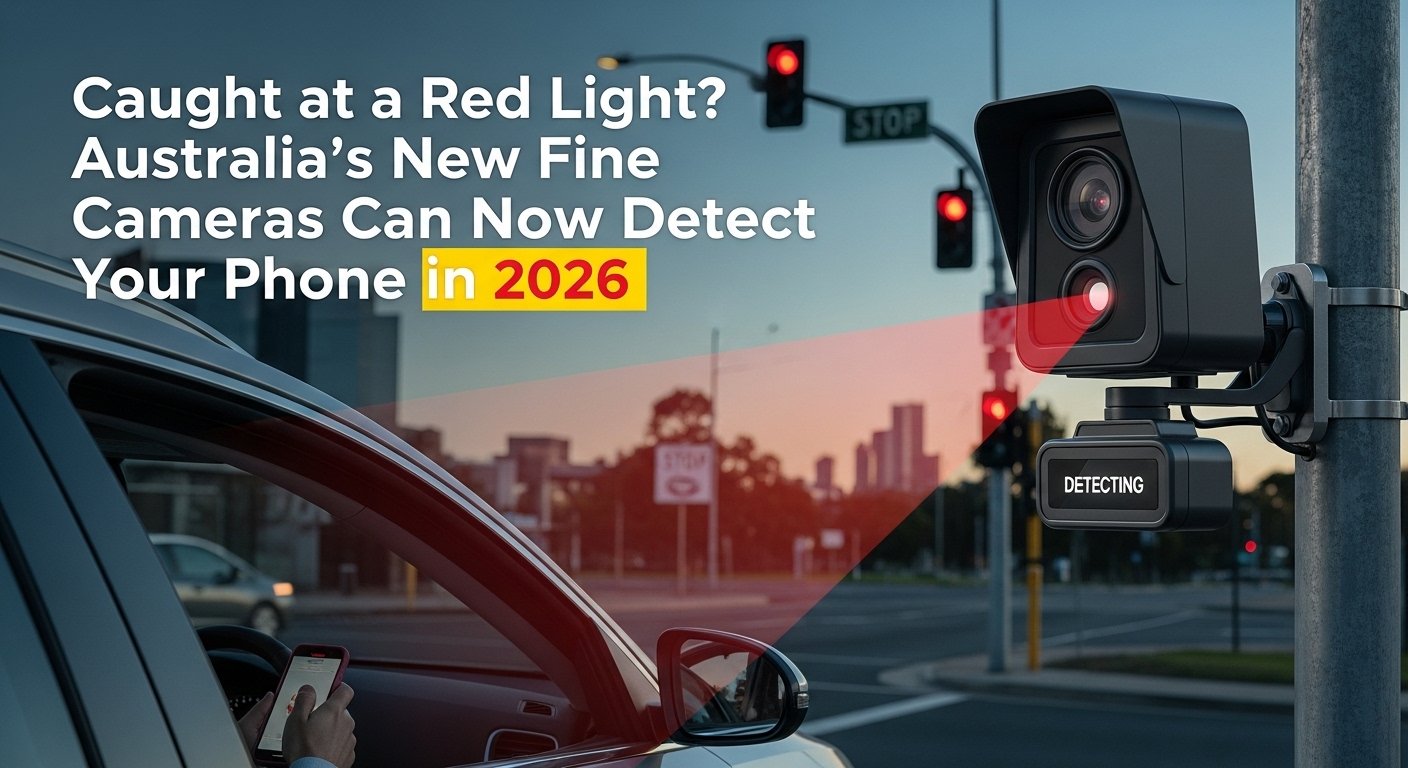
Caught at a Red Light? Australia’s New Fine Cameras Can Now Detect Your Phone in 2026
Title: Phone Out at a Red Light? Australia’s New Detection Cameras Are Watching in 2026 and the Fines Are Serious
When Brisbane delivery driver Jason Miller stopped at a red light last month, he quickly checked a message from his dispatcher. Seconds later, a camera flash lit up the intersection.
“I wasn’t even moving,” he says. “I thought it was legal if you’re stopped.”
Across Australia in 2026, new high-tech road safety cameras are being expanded nationwide and they can detect drivers using mobile phones even while completely stationary at traffic lights. Many motorists still do not realise that being stopped at a red light does not make phone use legal. Not even briefly. Not even for a second.
Here is what is changing, how the cameras actually work, and what penalties drivers face this year.
What Is Changing Across Australia in 2026?
State governments are significantly increasing the rollout of AI-powered mobile phone detection cameras designed to capture illegal phone use at any time a vehicle is in traffic, including when stopped at lights, sitting in congestion, or waiting in a turning lane.
Authorities confirm the technology now detects phones held in hand or resting in laps, operates continuously in all weather conditions around the clock, captures high-resolution images inside vehicle cabins, flags drivers even if the car is stationary but not legally parked, and uses artificial intelligence for initial screening before a qualified human reviewer examines each image before any fine is issued.
In Queensland, enforcement is overseen by the Department of Transport and Main Roads. In New South Wales it is managed by Transport for NSW. Victoria and South Australia are also significantly expanding camera coverage throughout 2026, with more installations confirmed for major intersections and arterial roads.
Is It Actually Illegal to Use Your Phone at a Red Light?
Yes. Completely and unambiguously.
Under Australian road rules, a driver is legally considered to be driving if the vehicle is stationary in traffic but not legally parked. That means phone use is prohibited while waiting at red lights, stopped in congestion, paused in a turning lane, or sitting in a drive-through queue.
The only circumstances in which phone use is generally permitted are when the vehicle is safely and legally parked, when the engine is off in certain states, or when using an approved hands-free system that does not require touching the device. Many drivers have carried a mistaken belief for years that a red light provides some kind of legal loophole. It does not. It never has.
A Real and Very Expensive Lesson
Melbourne nurse Priya Singh was fined earlier this year after briefly checking GPS directions while stopped at a busy intersection during her morning commute. She was not scrolling social media. She was not sending a message. She simply glanced at her navigation for a moment while the car was completely still.
“I thought because the car wasn’t moving, it was fine,” she says. “The fine was over $1,000 and I lost four demerit points.”
Her infringement was issued following AI camera detection and subsequent human review by Victoria Police. The process was swift, the evidence was clear, and the appeal was unsuccessful.
“I’m much more careful now,” she adds. Most drivers are, once the reality of enforcement lands in their letterbox.
How These New Cameras Actually Work
Mobile phone detection cameras are fundamentally different from traditional speed cameras and most drivers do not fully understand how sophisticated they have become.
Each system involves a high-mounted camera angled directly into the vehicle cabin, infrared imaging technology that allows clear visibility inside vehicles at night and in poor light conditions, AI software specifically trained to identify phone shapes, screen illumination, and hand positions consistent with phone use, and a mandatory human review process before any fine is issued. No infringement is sent based on AI detection alone.
Authorities report that detection accuracy exceeds 95 percent after human verification. The combination of infrared imaging, artificial intelligence, and human review means that the system is both highly accurate and legally defensible. Challenging a fine once photographic evidence exists is possible but rarely successful.
What the Penalties Look Like in 2026
Fines vary by state but they have increased significantly in recent years and continue to be reviewed upward as governments treat distracted driving with increasing seriousness.
In New South Wales, fines range from over $400 to $1,200, with higher penalties applying in school zones, and five demerit points are applied. In Queensland, the fine sits at around $1,200 with four demerit points. In Victoria, drivers face fines of around $550 to $600 and four demerit points. In South Australia, the penalty is around $600 or more with three to four demerit points applied.
Repeat offenders across all states face the additional risk of licence suspension, particularly those on provisional licences who carry fewer demerit points before reaching the suspension threshold. Learner and provisional drivers face the strictest rules of all, with many states prohibiting any phone interaction whatsoever regardless of mounting or hands-free use.
Why Governments Are Expanding This Enforcement
The expansion of phone detection cameras is not happening in isolation. It reflects a sustained national road safety priority backed by data that governments can no longer ignore.
Road safety statistics show that driver distraction is linked to approximately 16 percent of serious injury crashes across Australia. Using a phone while driving increases crash risk by up to four times compared to undistracted driving. Younger drivers are disproportionately represented in distraction-related collisions but the problem exists across all age groups and demographics.
A spokesperson from Transport for NSW stated the enforcement rationale directly. Mobile phone detection cameras are saving lives. Stopping at a red light does not remove the danger if traffic suddenly moves and an inattentive driver fails to respond in time.
The Psychology Behind the Red Light Habit
Behavioural experts who study road safety say many drivers genuinely and sincerely underestimate the risk they create during short stops at traffic lights. The brief pause feels safe. The car is still. The road ahead is empty. The temptation to check a notification, glance at a map, or read a message feels harmless in the moment.
Road safety researcher Dr Emma Collins explains the mechanism clearly. When drivers stop at lights they feel temporarily safe, but attention lags when traffic restarts. A delay of even one second in responding to a green light or a pedestrian stepping off the kerb can cause a rear-end collision or something far worse. Studies consistently show that drivers distracted at traffic lights are slower to notice green signals, fail to observe pedestrian crossings clearing, and have significantly delayed responses when the vehicle ahead brakes or moves unexpectedly.
The camera does not care how briefly you glanced at the screen. The fine does not distinguish between a two-second check and a two-minute scroll.
What Is Actually Allowed Under Hands-Free Rules
Not everything involving a phone in a car is prohibited, and understanding what is permitted helps drivers stay legal without inconvenience.
Permitted use generally includes voice-activated navigation and directions, Bluetooth calls completed entirely without touching the device, phones mounted in approved holders with interaction limited to a single touch in some states, and Apple CarPlay or Android Auto integration operated through the vehicle’s built-in screen. The key principle across all permitted uses is that the driver does not need to pick up, hold, or interact physically with the phone itself.
Learner and provisional drivers face considerably stricter rules and in many states are prohibited from any phone interaction whatsoever, including mounted navigation. Always verify the specific rules in your state before assuming permitted use applies to your licence class.
Can You Challenge a Fine If You Receive One?
Yes. Every state has a formal review process and drivers have the right to request a review if they believe an error has occurred.
Possible grounds for a successful challenge include the object detected not being a phone, being legally parked at the time of detection, a passenger holding the phone rather than the driver, or genuine emergency circumstances. However, it must be stated clearly that successful appeals are relatively rare when clear photographic evidence exists. The human review process conducted before fines are issued means that genuine errors are largely filtered out before the infringement notice is sent.
What Drivers Should Do Right Now to Stay Fine-Free
The practical steps every driver should take are straightforward. Set your GPS and navigation before you start driving, not at the first red light you reach. Use voice commands exclusively for any communication or navigation adjustments while in traffic. Place your phone in an approved dashboard mount if you need navigation access. Activate the Do Not Disturb While Driving feature on your phone so notifications do not appear or sound while you are in traffic. And most importantly, treat your phone as completely off-limits unless you are safely and legally parked with the engine off.
Even a brief glance is now a potential fine of hundreds or thousands of dollars and a significant demerit point penalty. The cameras are watching. The technology is accurate. The fines are real.
Are the Cameras Actually Working?
Traffic analysts and road safety agencies consistently say yes. Since the early rollouts of phone detection cameras, thousands of infringements have been issued, behaviour change surveys show measurably reduced observed phone handling at monitored intersections, and road safety agencies report declining distraction-related crashes in several monitored corridors.
Road safety consultant Mark Reynolds sums up the enforcement effect clearly. Enforcement visibility changes habits. Once drivers genuinely believe cameras are operating at traffic lights and that detection is accurate and consequences are real, compliance increases substantially. The goal is not revenue. The goal is behaviour change, and the data suggests it is working.
Frequently Asked Questions
Q1. Is it legal to use my phone while stopped at a red light in Australia? No. Under Australian road rules, a stationary vehicle in traffic is still legally considered to be driving. Phone use at red lights is illegal in every state and territory without exception, regardless of how briefly you glance at the screen.
Q2. Do the cameras operate at night and in bad weather? Yes. The systems use infrared imaging technology that operates continuously around the clock in all weather conditions including rain, fog, and low light. There is no time of day or weather condition that prevents detection.
Q3. Are images reviewed by a human before a fine is issued? Yes. Every image flagged by the AI detection system is reviewed by a qualified human officer before any infringement notice is issued. No fine is sent based on AI detection alone, which is why successful appeals are uncommon once an infringement has been processed.
Q4. What if my phone is in a mounted holder? Limited interaction with a mounted phone is permitted in some states for full licence holders only. Learner and provisional drivers face considerably stricter restrictions and in many states are prohibited from any phone interaction at all. Always check your specific state rules before assuming mounted use is permitted for your licence class.
Q5. Can I dispute a fine if I receive one? Yes. Every state has a formal review process available to drivers who wish to challenge an infringement. Possible grounds include the object not being a phone or a passenger holding the device. However, successful appeals are uncommon when clear photographic evidence exists, as human review filters out most genuine errors before the fine is issued.
Q6. Are fines higher in school zones? Yes. In states such as New South Wales, penalties are significantly higher when phone use offences are detected within school zones. Always be especially cautious near schools regardless of the time of day.
Q7. Does holding the phone in my lap avoid detection? No. The infrared imaging system is specifically designed to detect phones held in laps as well as in hands. Keeping the phone low or out of obvious sight does not prevent the camera from identifying it.
Q8. Do the cameras also detect seatbelt offences? Some of the newer integrated systems being trialled across Australia in 2026 are capable of detecting seatbelt non-compliance simultaneously alongside phone use. The technology is expanding beyond phone detection alone.
Q9. Are overseas visitors and tourists subject to the same fines? Yes. Australian road rules and camera enforcement apply to all drivers on Australian roads regardless of where their licence was issued. International visitors are not exempt and fines can be pursued through relevant channels.
Conclusion
Australia’s 2026 expansion of mobile phone detection cameras represents a clear and permanent shift toward stricter distracted driving enforcement on roads nationwide. The technology is sophisticated, the detection rates are high, and the fines are serious.
Stopping at a red light may feel like a safe and harmless moment to glance at a screen. Under Australian law it is not, and under the watchful lens of AI-powered cameras positioned at intersections across the country, that quick check could cost you over a thousand dollars and several demerit points.
Put the phone down. Set your navigation before you leave. Let the notifications wait. The road ahead matters more than anything on that screen.