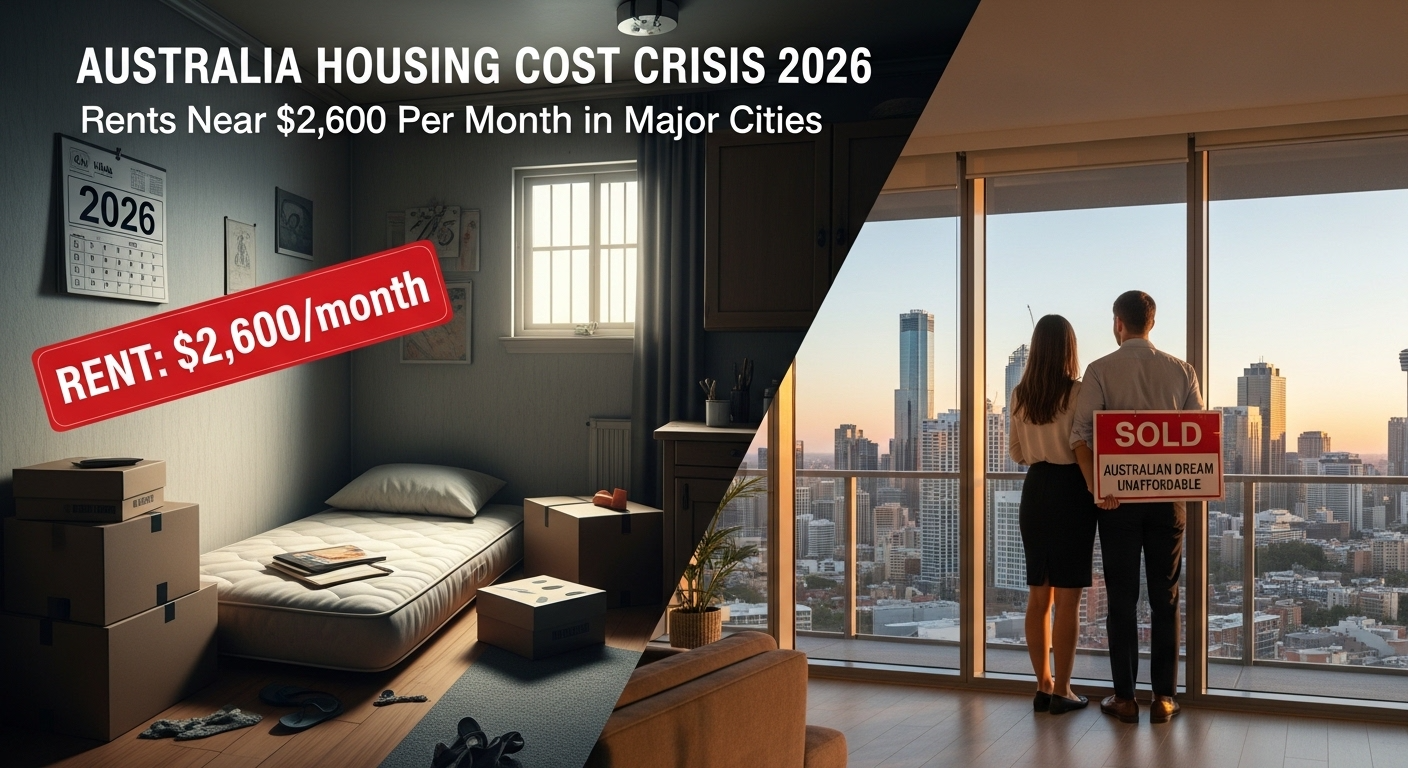
Australia Housing Cost Crisis 2026 — Rents Near $2,600 Per Month in Major Cities
Three years ago, Sarah and Mark thought they had found stability when they signed their lease. The family of four is now packing boxes. Their rent has risen above $2,600 per month, and the mathematics of two full-time incomes no longer produces a workable budget. “We both work full-time,” Sarah says, “but we’re still falling behind.”
Their situation is not unusual. Across Australia’s major cities, stories like theirs have become the defining narrative of household financial life in 2026. Families, young workers, and retirees are being forced to make choices that would have seemed extreme a decade ago. Leave the city where they built their lives. Move into smaller or shared accommodation. Return to multi-generational living arrangements. Or leave the country entirely.
What Is Driving Rent to $2,600 Per Month
The rental crisis of 2026 is not the product of a single cause or a temporary market anomaly. Economists and housing researchers describe it as structural, meaning the conditions producing the crisis are built into how Australia’s housing system operates rather than being cyclical fluctuations that will correct themselves without deliberate intervention.
Housing supply has chronically lagged behind demand in major cities for years. New dwelling construction has consistently failed to match population growth, and the gap between what is needed and what is being built has compounded annually. Each year of undersupply adds to the shortage that the next year’s renters must absorb, and the cumulative effect is the vacancy rates and rental prices that characterise 2026.
Population growth and urbanisation continue to concentrate demand in the same major cities where supply constraints are most acute. Migration, both international and internal, flows toward the economic centres where employment opportunities are densest. Those centres are precisely where land costs are highest, construction is most complex, and new supply takes the longest to reach the market.
Higher interest rates have increased the mortgage costs of investment property owners, and a significant proportion of those increased costs have been passed through to tenants in the form of rent increases. This mechanism connects monetary policy directly to rental affordability in a way that means the same policy settings designed to reduce inflation in other parts of the economy are contributing to higher costs in the rental market.
The long-term rental supply has been reduced by the conversion of some properties to short-stay accommodation and by homeowners exiting the investment market rather than absorbing higher holding costs. Fewer available rental properties competing for a larger pool of renters produces the predictable outcome of higher rents.
| Aspect | Five Years Ago | Today 2026 |
|---|---|---|
| Average monthly rent | Moderate | Around $2,600 in major cities |
| Rent as proportion of income | Around 25 percent | 40 to 45 percent for many households |
| Vacancy rates | Moderate | Critically low |
| Family mobility | Often chosen | Increasingly forced |
| Long-term affordability outlook | Uncertain but achievable | Deeply concerning for many |
When the Numbers Stop Adding Up
Housing experts use 30 percent of household income as the threshold at which rent begins to create financial stress. At $2,600 per month, families need to earn more than $8,600 monthly after tax just to keep housing below that threshold. For households where both adults work full-time at median wages, that threshold is already being exceeded in many major city markets.
Michael, a Melbourne warehouse supervisor, describes the experience of a $480-per-month rent increase at his last lease renewal with a precision that reflects how many Australian renters are living. “We cut holidays, streaming services, everything,” he says. “But there’s nowhere left to cut when rent alone consumes the majority of your income.” His trajectory captures what happens when housing costs absorb an ever-larger share of income. The discretionary spending that cushions life against unexpected costs disappears first, followed eventually by spending on things that did not previously feel discretionary at all.
The 30 to 35 percent stress threshold that housing economists cite as the warning level is being exceeded by a substantial portion of Australian renters. When housing consistently takes 40 to 45 percent of household income, the family budget has no margin for the normal variability of life. A car repair, a medical expense, a period of reduced work hours, any of these becomes a financial crisis rather than an inconvenience.
The Government’s Response Under Pressure
The Australian government has acknowledged the severity of the housing affordability crisis in terms that would have been considered unusually direct in earlier years. Planning reforms, rental assistance adjustments, and housing supply programs have all been cited as active policy responses to a situation that officials are now describing as a national priority.
A senior housing official confirmed the government’s position plainly. “We acknowledge that affordability has rapidly declined. It is now a national priority to increase the supply of housing.” The framing as a supply problem reflects the economic consensus that no amount of demand-side support can resolve a housing crisis whose fundamental driver is an insufficient number of dwellings in the locations where people need to live.
Critics of the government response argue that policy timelines do not match the urgency of the crisis. Planning reforms that accelerate approvals for new housing take years to produce additional supply. Infrastructure investments that enable new development areas operate on decade-long timelines. For the renter who cannot afford their lease renewal in three months, the knowledge that more housing is planned for the mid-2030s provides no immediate relief.
The gap between the population of renters who cannot afford current market rates and the population eligible for social housing creates a middle group for whom no existing policy instrument provides adequate support. They earn too much to qualify for social housing, too little to absorb market rents without severe financial stress, and too much to receive Rent Assistance at levels that meaningfully close the gap.
Where Families Are Going
The combination of unaffordable city rents and limited policy relief is producing visible shifts in where Australians are choosing, or being forced, to live.
Relocation to smaller regional cities and towns has been an accelerating trend, driven in part by the remote work flexibility that persisted after the pandemic and in part by simple financial necessity. Regional rents, while rising, remain below major metropolitan levels in most areas. The trade-off is access to employment, schools, and services that urban concentration produces, and not every household has the flexibility to make that trade.
Multi-generational living arrangements are returning not as a cultural choice but as a financial strategy. Adult children are returning to family homes and families are combining households in ways that reduce the per-person cost of housing at the expense of the space and independence that separate households provide.
International relocation is a more significant factor than in previous years, with social scientists observing that more Australians are exploring employment and housing options in New Zealand, Southeast Asia, and parts of Europe where housing represents a smaller proportion of household income. For skilled workers with location-independent employment, the calculation of whether Australian wages justify Australian housing costs is producing answers that favour leaving.
What Renters Can Do Now
For households currently renting in major cities, the options are constrained, but understanding them clearly is more useful than the paralysis that can follow from feeling there are no options at all.
Know your state’s rules on rent increases. Each state and territory regulates how much notice must be given, how frequently rents can be increased, and in some jurisdictions, whether increases above certain thresholds require justification. The rules vary significantly across jurisdictions, and understanding which apply to your tenancy is the starting point for any response to a proposed increase.
Lease renewals are the most common trigger for significant increases. If your lease is approaching renewal, beginning to assess your options, including negotiating with your current landlord, researching comparable properties, and evaluating relocation possibilities, before the renewal notice arrives rather than after provides more time and more leverage.
Rent Assistance through Centrelink provides partial relief for eligible renters, though it covers only a portion of the gap between current market rents and what lower-income households can afford. Ensuring you are receiving the maximum applicable Rent Assistance and that your current rental costs are accurately recorded with Services Australia is worth confirming regardless of how long you have been receiving the payment.
Early planning is essential because the rental market’s critically low vacancy rates mean that alternatives are difficult to find quickly. Households that begin exploring options months before they are forced to make a decision have considerably more choice than those who start looking after a lease renewal notice has already arrived.
Frequently Asked Questions
Is $2,600 per month now a standard rent figure in Australia? Yes, for family-sized homes in metropolitan areas. The figure varies by city and suburb, but $2,600 represents the typical range for a three or four bedroom property in many major urban markets in 2026.
Will rents come down without intervention? Most housing economists say not without major increases in housing supply. The structural undersupply that drives rental prices is not self-correcting without deliberate policy and construction activity at a scale that has not yet been achieved.
What proportion of income should rent ideally consume? Housing affordability benchmarks generally use 30 percent of gross household income as the threshold above which financial stress begins. Many Australian renters in major cities are currently well above this level, with some households directing 40 to 45 percent of income to housing costs.
Are regional areas a viable alternative? Generally yes for cost, though regional rents have also risen. The trade-off involves employment access, school quality, and the services that urban density provides. The viability of regional relocation depends significantly on employment flexibility and household circumstances.
Who is most severely affected by the current rental crisis? Families with children, single parents who cannot spread housing costs across two incomes, and middle-income earners who sit above social housing eligibility thresholds but cannot comfortably absorb current market rents are the groups facing the most acute pressure.