An ‘Ingenious’ Ukrainian Idea So Good China Patented It For Its Next High-Tech Battle Tank
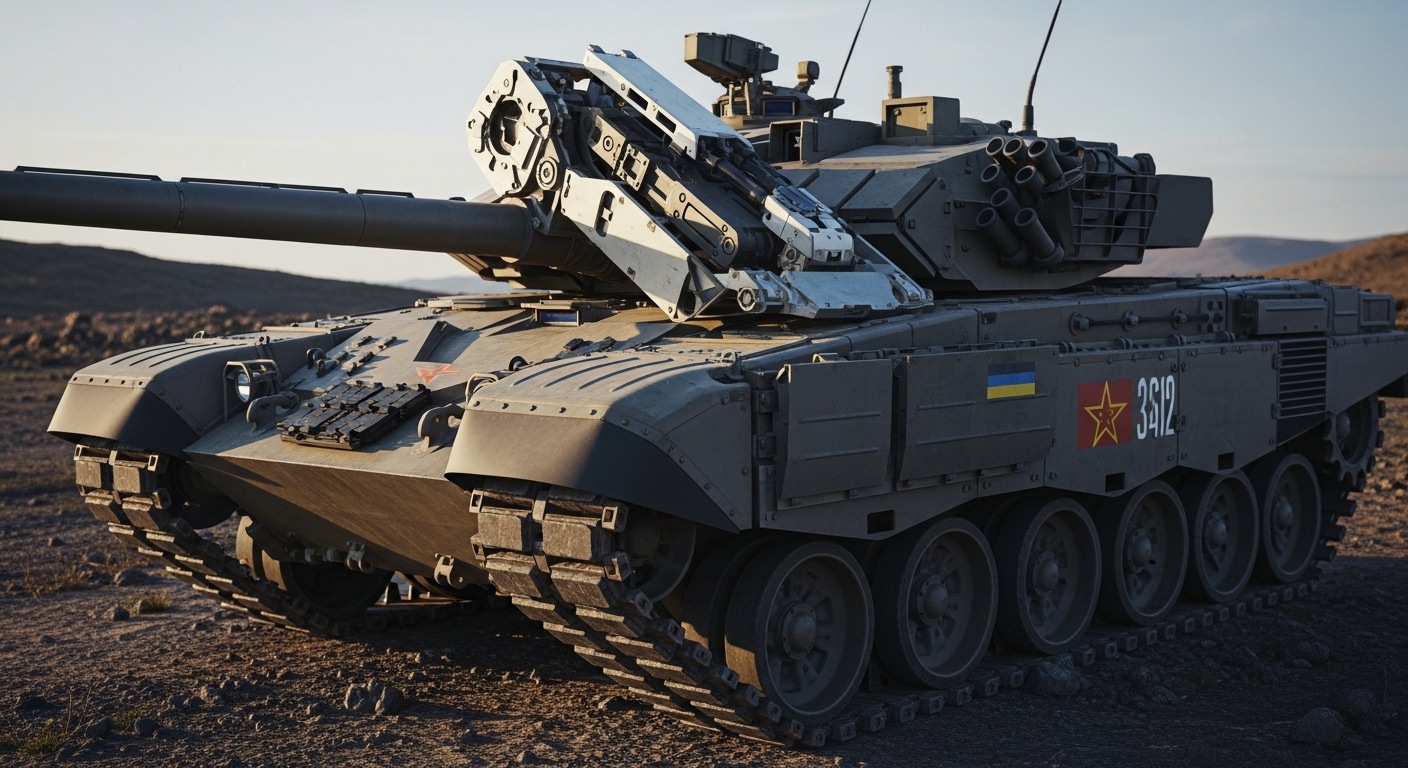
The photo looks almost like a still from a science fiction movie: a low predatory shape in matte paint, its turret bristling with modules that look more like sleek soundbars than armor blocks. It sits in the glare of a factory floor somewhere in China. Around it, engineers are pointing, measuring, photographing. But the strangest thing is not how futuristic it looks. It is that some of the cleverness under its skin can be traced back to a drawing board in Kharkiv, Ukraine, many years and one war ago.
Key Points
- Ukrainian engineers developed a layered design philosophy that treats the tank’s armor, sensors, and protection systems as one unified intelligent shell rather than separate parts
- China’s defense industry studied Ukrainian tank concepts and filed patents describing a modular turret and distributed protection system that carries clear echoes of that original thinking
- The core idea is that a tank should sense threats, react automatically, and protect its crew in the milliseconds before impact rather than relying on passive armor alone
- Modular armor allows damaged sections to be swapped out quickly and upgraded as new threats emerge, extending the vehicle’s useful life without full redesign
- Ukrainian engineers developed this philosophy partly out of resource constraints, designing for flexibility and integration rather than simply adding more weight
- Active protection systems on these tanks can either jam or physically intercept incoming missiles before they strike the vehicle
- The spread of this idea from Ukraine to China is a reminder that engineering concepts in warfare travel not as blueprints but as ways of thinking
The Quiet Journey Of A Loud Idea
The story does not start in a glossy Chinese brochure or on a test range in Inner Mongolia. It starts with the rattle of trams and the bitter wind coming off the steppes, in a Ukrainian design bureau that lived several lives under different flags.
Since Soviet times, Ukrainian engineers at places like the Kharkiv Morozov Machine Building Design Bureau have lived and breathed tanks. They developed the T-64, the T-80UD, and later the sleek angular T-84 Oplot. By the early 2000s they were grappling with a problem that hangs over every tank designer like a storm cloud: how do you keep a fifty-ton steel animal alive in a world filled with weapons designed specifically to kill it?
Modern anti-tank missiles and kinetic projectiles are not the slow lumbering shapes of old war films. They are razor-sharp darts and cunning top-attack warheads that strike from above. Ukrainian engineers began thinking obsessively about the kill chain of an incoming threat: first detection, then tracking, then impact. If you could break the chain at any point, you might save the crew.
They knew about armor. Explosive reactive armor could defeat shaped charges. Thick composite plates could sap the energy of long-rod penetrators. But tanks were already near their practical weight limit. There was no appetite, and no physics, for another ten tons of steel.
So they tried something else. Instead of making the armor thicker, what if the tank itself became an active participant in its own survival? What if it could sense the threat, move, and react almost like a living thing?
The Spark Behind Ukraine’s Ingenious Concept
The Ukrainian answer was not one single device but a layered philosophy. At its heart lay an idea that bordered on biological: distributed organs across the tank’s body, each doing a specialized job, but all wired together into one brain. Sensors became eyes and ears. Armor modules became skin that could change its properties. Software became the nervous system, merging data from sights, laser warning receivers, and radar into a single coherent sense of danger.
On paper the concept was deceptively simple. Use distributed sensors to see the battlefield in all directions. Let the computer rather than the human decide how to react in milliseconds. Make the armor modular so it is easy to swap, upgrade, or tailor to the mission. Tuck the crew deeper inside, surrounded by layers of metal and smart systems.
The most radical part was not a slab of armor or a gun but the way everything was stitched together from turret shape down to electronics. Imagine a turtle shell not glued on as an afterthought but grown as part of the body itself.
One Ukrainian proposal visualized a turret wrapped in faceted modules, each containing its own sensors, armor, and small charges to deflect incoming projectiles. These were not passive bricks. They were part of an active adaptive protection web: a mix of soft-kill jamming and dazzling, and hard-kill physical interception of incoming rounds.
It was this kind of thinking, systemic, integrated, and surprisingly elegant, that caught outside eyes. Some of those eyes, quietly and methodically, belonged to engineers in China.
From Kharkiv To Beijing: How An Idea Travels
China’s rise as a builder of armored vehicles has been swift and intensely focused. Early post-Cold War tanks like the Type 96 and first-generation Type 99 owed a great deal to Russian and Ukrainian designs. Engines, guns, and fire-control systems formed the bones of China’s modern armor school.
But copying eventually becomes a dead end. By the 2010s, Chinese strategists were staring at a new reality: precision weapons, loitering drones, long-range top-attack missiles. The days when you could bolt on more armor and call it progress were over.
Inside China’s defense industry a debate flared. Some argued for an evolutionary path: keep refining the existing Type 99A. Others pushed for something more daring, a new-generation high-tech tank that could survive and dominate a battlefield saturated with smart weapons.
Ukrainian concepts, already tested under real combat conditions and in Ukraine’s own bitter conflicts, looked like a shortcut to the future. Not a blueprint to be copied outright, but a seed. A pattern of thinking.
Chinese engineers did what they do with formidable thoroughness: they studied every public drawing, every export brochure, every image they could find. They examined how Ukrainian tanks laid out their modules, how their active protection systems were positioned, how they balanced armor, weight, and crew safety. Then they folded those insights into their own machine.
China’s Patent And The Shape Of A Future Tank
In the often dry language of patent filings you can sometimes glimpse stories. Buried in Chinese patent databases over recent years are descriptions of a modular armored turret structure and a distributed integrated protection system for a new main battle tank. The documents speak of angular turret faces, detachable armor blocks, sensor clusters embedded between armor segments, and an internal armored capsule for the crew.
To anyone familiar with Ukrainian experiments, the echoes are impossible to miss. This is where the amused and slightly rueful commentary from Ukrainian defense circles comes from. Our idea was so good, they patented it. Not a photocopy, but a clearly related branch on the same design tree.
The patent details outline a turret built in layers. An internal protected core holds the crew, or in some variants mainly ammunition and systems with the crew positioned further down in the hull. Outer panels are composed of modular composite and reactive armor blocks. Sensors including laser warning receivers, radar, and thermal cameras are mounted flush with the armor rather than protruding like vulnerable attachments. Brackets are designed from the start to host active protection launchers.
By weaving sensors and armor into one coordinated unit, the Chinese design echoes Ukraine’s earlier vision: the turret not as a mere gun mount but as a living, sensing, changing shell.
What Makes The Idea Ingenious
Strip away the military acronyms and the cleverness is almost minimalist. Ukrainian engineers understood that the core of modern survivability is not just hardness. It is flexibility and information. You might call it the smart shell principle.
Imagine standing in a quiet field at dawn wrapped in a heavy coat. It will protect you from the cold but not from the unexpected: a thrown stone, a sudden storm, a predator appearing from behind. Now imagine the coat could sense movement behind you, stiffen when struck, and shout a warning. You are still just one person, but your chance of making it home rises dramatically.
On a tank that means letting the vehicle feel the first brush of an enemy laser rangefinder on its skin and automatically pivot armor and gun toward the threat. It means triggering a hard-kill interceptor without needing a human to identify the danger in the split second before impact. It means quickly replacing a damaged armor module without sending the entire vehicle back to a factory. It means upgrading only the outer layer with new sensor suites and better reactive armor while keeping the core chassis in service for decades.
For a country like Ukraine, with limited resources but a deep engineering tradition, this kind of conceptual leap is survival thinking. You design not just a machine but a language of modularity and integration that others can read, adapt, and if they move fast enough, patent.
On The Battlefield Of The Future
Walk mentally onto a battlefield in the 2030s. The air smells of hot dust and ozone. Above, drones hang like slow-moving insects. Somewhere over the horizon, artillery rounds exhale as they arc upward. In a shallow depression a high-tech battle tank idles, its electric systems humming, thermal sights painting the world in gradients of white and black.
From a distant hill an operator launches a top-attack missile. It climbs, curves, and dives, hunting for the warm metal outline below. Decades ago that might have been the end of the story: a bright flash, a chimney of smoke, a burning wreck.
Now something different happens. A sensor cluster on the turret feels the missile’s seeker pinging. Another sensor tucked between armor modules picks up the radar signature of an approaching threat. The systems talk to each other, fusing their data into a single confident picture: incoming, high angle, probable top-attack.
Within milliseconds the turret slews slightly to present the thickest edge of its modular armor to the likely impact point. An active protection unit fires a small interceptor, a streak of light racing upward. At the same time a soft-kill jammer bathes the sky with interfering signals, trying to confuse the missile’s guidance system.
Maybe the missile is destroyed in a mid-air flash. Maybe it survives but strikes at a reduced angle, grazing off a replaceable module instead of punching through to the crew capsule. Either way the crew survives because their vehicle is not just a battered brawler but a wary, sensing animal.
This is the world both Ukraine and China were designing for. The fact that a conceptual strand from one ended up woven into the other says something about how ideas in warfare travel. Not as tidy blueprints, but as ways of thinking.
Unexpected Echoes And Unanswered Questions
There is a certain irony in it all. Ukraine, a country fighting for its own survival against a larger neighbor, helped inspire parts of a future Chinese tank at the very moment when tank warfare itself is under harsher scrutiny than at any time in living memory.
Look at recent conflicts and you see large vehicles destroyed by cheap drones, by jury-rigged munitions dropped from the sky, by missiles costing a fraction of the tank’s price. Skeptics declare the tank obsolete, another dinosaur waiting for the meteor.
But the Ukrainian smart shell idea and its Chinese patent incarnation offer a counter-argument. Tanks are not doomed. Static tanks are doomed. Those that remain only what they were, a mobile gun with thick armor, will be destroyed. Those that evolve into sensor-rich, actively protected, modular platforms still have a future, albeit a narrower and more specialized one.
There are questions that remain open. Can software keep pace with the chaos of real battle? Will complex active protection systems prove robust in the field, or will mud, dust, and shrapnel blind them at the worst moment? How many layers of armor and electronics can you stack before maintenance becomes its own kind of vulnerability?
And there is the moral question that always hovers in the background: what does it mean when an ingenious idea spreads not to make life easier or healthier, but to make conflict more asymmetrical and survival more dependent on engineering than on numbers?
When Ingenuity Crosses Borders
In another world perhaps that Ukrainian idea would be the basis of a collaborative European armored platform or a shared protection standard. Instead it serves as a quiet reminder that even in a fragmented and polarized world, engineering ideas slip through the cracks of geopolitics.
An engineer in Kharkiv, frowning at a screen, asks: how can we give this crew a better chance to make it home? Years later an engineer in Beijing faces a similar question with different constraints, different politics, and different requirements. The answer, in part, rhymes. Embed the senses. Modularize the skin. Let the machine react in the time between heartbeats.
Somewhere along that path, a patent is filed.
In the sterile language of legal claims and technical diagrams you can almost hear the ghost of the original inspiration. Lines of influence are never neat, and defense industries seldom acknowledge their intellectual debts openly. But the silhouette of a new Chinese high-tech battle tank, with its angular module-wrapped turret, carries a whisper of Ukraine nonetheless.
The steel may be forged in Chinese mills. The electronics may be born in Chinese labs. The doctrines that guide its use will be written in Chinese academies. And yet in the way its armor thinks about danger, in the way its skin is meant to be peeled away and renewed, there is a shard of Ukrainian winter, of Kharkiv’s drafting rooms, of designers who tried to teach a tank to feel.
In the end that is what makes the story so strangely compelling. Not that China patented a foreign idea, which is common in the murky world of military technology, but that the idea itself, a quiet and elegant reimagining of what a tank’s body could be, proved strong enough to cross borders, languages, and battlefields.
On some future day when one of these machines rumbles across a training range in northern China, its armor humming with unseen energy, no one there will be thinking about Ukraine. But the concept, ingenious, persistent, and now patented, will be there all the same, wrapped around the crew like an invisible and inherited story.
Frequently Asked Questions
What exactly was the Ukrainian idea that influenced China’s tank patent?
It was less a single gadget and more a design philosophy: integrating modular armor, distributed sensors, and active protection into one coherent smart shell around the tank. Armor blocks, sensors, and interception systems were conceived as a unified and upgradeable layer rather than separate bolted-on parts.
Did China directly copy a specific Ukrainian tank?
Available information suggests influence rather than one-to-one copying. Chinese engineers appear to have studied Ukrainian layouts and protection concepts, then adapted them into their own patented turret and protection system design, blending them with domestic technologies and requirements.
Why is modular armor such a big deal?
Modular armor allows damaged sections to be replaced quickly and makes it easier to upgrade protection over time. Instead of redesigning the whole tank, you can swap in new armor packs or sensor modules as threats evolve, extending the vehicle’s useful life significantly.
How does active protection work on these modern tanks?
Active protection systems detect incoming threats using sensors such as radar and laser warning receivers. Once a threat is tracked, the system can either try to confuse it through soft-kill jamming or physically intercept it with small defensive munitions before it strikes the tank.
Does this mean tanks are safe from modern anti-tank weapons?
No tank is invulnerable. Modern protection systems can significantly improve survival odds against some types of missiles and rockets, but drones, artillery, and advanced top-attack weapons remain very dangerous. The concept is about buying precious seconds and increasing the chance the crew survives, not guaranteeing invincibility.
Read more health and wellness articles at wizemind.com.au