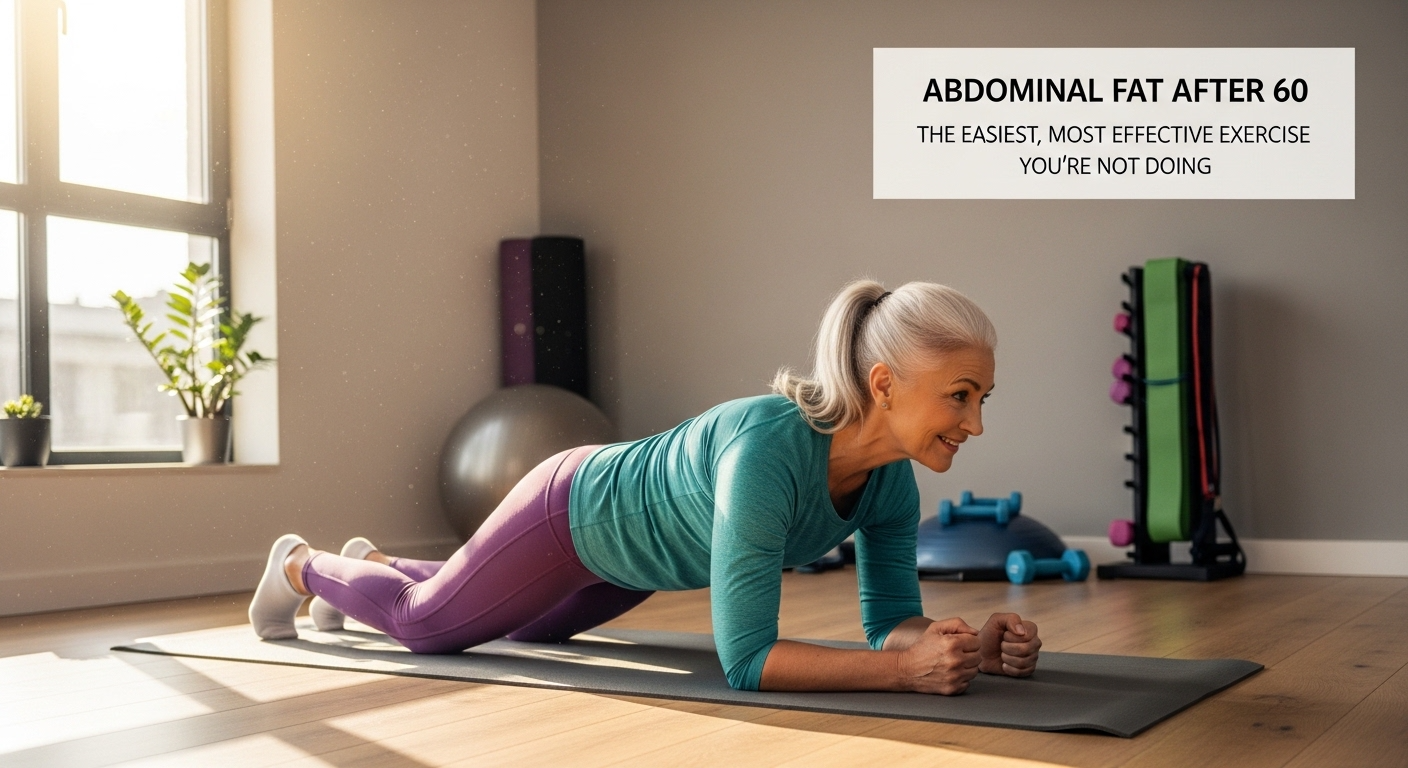
Abdominal Fat After 60: The Easiest, Most Effective Exercise You’re Not Doing
The first thing you notice is the way your shirt pulls. Not dramatically, not enough for anyone else to comment, but enough that you feel it — that soft ring of fullness that seemed to appear somewhere between your 59th and 63rd birthday. You twist in the bathroom mirror, suck in your stomach the way you used to, and nothing happens. The belly stays.
It is not just about vanity. It feels heavier, a kind of tiredness wrapped around your middle. You move a little slower. Stairs feel a bit steeper. And quietly, underneath the annoyance, there is a whisper of worry: Is this just how it is now, after 60?
The Belly That Arrived Without Asking
Abdominal fat after 60 has a way of sneaking up like a slow tide. You do not wake up one morning with a big round belly. It is more subtle than that. A pound here, a pound there. The waistband that once slid on easily now leaves a faint red groove around your skin by evening.
You might blame it on a slowing metabolism, or retirement, or less walking, or a long winter that kept you indoors. Maybe it is medication. Maybe it is stress. Maybe it is just age. Everyone seems to say it with a shrug: that is normal. But deep down, you know this soft, persistent band around your waist feels different from the weight you carried in your hips or thighs in your forties. It feels like something more stubborn, more serious.
Your doctor might have mentioned words like visceral fat or central obesity while tapping on a chart. You nod, pretending to understand, but later at home you grab your stomach in your hands and think — is this what they mean?
The Truth About Abdominal Fat After 60
Here is what is quietly going on beneath that comfortable cotton waistband. As we pass 60, several things happen at once. Hormones shift — estrogen and testosterone decline, encouraging fat to migrate toward the abdomen. Muscle mass naturally decreases unless we work to maintain it, which lowers how many calories we burn at rest. We also tend to move less, often without noticing — fewer work steps, more sitting, more driving.
The result is a kind of perfect storm. More calories being stored, fewer being burned, and a strong tendency for that extra storage to cluster right around your middle. That rounder belly is not just sitting under your skin. Some of that fat weaves deep inside, wrapping around your organs — liver, intestines, pancreas. That is visceral fat.
Visceral fat is metabolically active, which is another way of saying it does not just sit there. It stirs things up. It can increase inflammation, raise blood sugar, nudge your blood pressure higher, and play tricks with your cholesterol. That is why doctors care so much about waistlines, especially after 60.
And yet here is the hopeful part. While visceral fat is sneaky, it is also surprisingly responsive to the right kind of movement. Not endless crunches, not punishing gym sessions, not complicated machines. The easiest, most effective exercise for trimming abdominal fat after 60 is something you already know how to do — and you are probably not doing it enough.
Key Points to Know Before You Start
- Visceral fat wraps around your organs and is more dangerous than surface-level belly fat
- Hormonal changes after 60 push fat storage directly toward the abdomen
- Muscle loss after 60 slows your resting metabolism without you noticing
- Spot reduction with crunches or sit-ups does not work — fat loss is whole-body
- The right kind of daily movement can reverse visceral fat even after 60
- Consistency over weeks and months matters far more than intensity on any single day
- Sleep and food habits quietly work alongside exercise to shape your waistline
The Easiest, Most Effective Exercise You Are Not Doing Enough Of
It is late afternoon. The light is soft, that golden generous light that makes everything look forgiving. You stand at your front door with a pair of shoes in your hand. Not running shoes. Not anything fancy. Just shoes comfortable enough to move in. For a second you debate — stay in, sink into your favorite chair, maybe scroll through your phone — or step outside.
You open the door.
The air meets you like an invitation. The first few steps are small. Your back feels a little stiff, your knees negotiate their terms. But then slowly a rhythm arrives. You are walking. That is it. No stopwatch. No complicated moves. Just walking.
Brisk walking — steady, purposeful walking where your heart beats a bit faster and your breathing deepens, but you can still hold a conversation — is one of the most powerful tools you have to fight abdominal fat after 60. It is simple, accessible, joint-friendly, and far more effective than it gets credit for.
Science consistently shows that regular brisk walking helps reduce visceral deep abdominal fat, improves insulin sensitivity and blood sugar control, protects your heart and blood vessels, preserves muscle mass when paired with light strength work, and lifts mood while lowering stress — which also affects belly fat.
It is not sexy. It does not trend on social media. There is no dramatic before-and-after montage of someone walking down a sidewalk. But walk long enough, often enough, and something begins to shift — first inside your body, then around your waistline.
Why Walking Beats Crunches for Your Belly
We have been sold the idea that to lose belly fat, you must attack your abs directly — crunches, sit-ups, planks until your muscles shake. But abdominal fat does not respond to being targeted like that. Spot reduction is a myth. The body loses fat in patterns determined by hormones, genetics, and overall energy balance, not by which muscle you work hardest.
Walking — especially at a brisk, steady pace — does something more important. It helps you burn energy steadily while calming your nervous system. When you walk regularly, your body taps into stored fat including visceral fat as a fuel source. Your stress hormones like cortisol tend to smooth out, and chronic high cortisol is strongly linked to belly fat. You also build a routine that is sustainable, and sustainability, not intensity, is what changes the shape of your body after 60.
Strength training and core exercises are excellent partners. But for pure, accessible, belly-friendly fat loss after 60, walking is the quiet hero almost everyone underestimates.
How Much, How Fast, and How Often
How much walking does it take to make a real difference in your abdominal fat? A simple, realistic target looks like this:
- Walk 5 to 6 days per week
- Aim for 30 to 45 minutes most days
- Keep the pace brisk enough that you can talk but not sing
- Your heart rate should be slightly elevated and your breathing a little deeper
Think of it this way. Three days of easy 20-minute walks gives you around 60 minutes per week — good for starting out but limited impact on abdominal fat. Five days of brisk 30-minute walks gives you 150 minutes per week — solid improvement in waistline and health markers. Six days of brisk 40-minute walks with a few hills gives you 240 minutes per week — the best results for reducing visceral and abdominal fat over time.
Notice the words over time. Walking is not a crash solution. It is a quiet, repetitive act that works in your favor week after week. Think in seasons, not days.
Finding Your Brisk Pace
You do not need a heart rate monitor to figure out if you are walking briskly enough. Use the talk test. If you can talk but would rather not recite long stories, you are probably in the right zone. If you can sing out loud without effort, you are going too easy. If you are gasping and cannot manage a sentence, that is too intense for a sustainable daily habit.
Your pace will likely change over time. What feels brisk in your first week may feel leisurely a month later. That is a quiet victory — your body adapting, your capacity growing.
Turning Walking Into a Belly-Focused Ritual
One reason walking works so well after 60 is that it naturally weaves into daily life. You do not have to go to the gym. The world becomes your gym — the park path, the neighborhood block, the long hallway at the mall, the quiet loop around your living room if the weather misbehaves.
But there is a difference between an occasional stroll and a ritual that slowly reshapes your waist. The secret is to treat your walks like important appointments with your future self.
Choose a time of day that feels right to your body. Morning, when the world is still half-asleep and the sky is pale with early light. Late afternoon, when the day begins to soften. Evening, when streetlights flicker on. As you walk, invite your senses fully into the experience — feel the shift of weight from heel to toe, notice the air on your skin, listen for layered sounds around you, take in the smells of damp earth or distant blossoms.
This is not just poetic. The more present you are, the more your nervous system settles. Lower stress means calmer cortisol, and calmer cortisol means your body is less inclined to pack extra padding around your belly.
Little Tweaks That Help Target the Middle
While walking itself is the core habit, a few gentle variations can amplify its effect on your midsection:
- Add short hills or inclines once or twice a week to engage your glutes and core more deeply
- Spend one minute every five minutes walking tall with shoulders relaxed and belly lightly supported
- Slightly exaggerate your arm swing for short intervals to wake up the muscles around your waist
- Walk at your normal brisk pace for three minutes, then just a little faster for one minute, and repeat
These are not mandatory. They are seasoning. The main meal is simply showing up and walking.
Pairing Walking With Gentle Strength Work
Your belly benefits enormously when you give a little attention to the muscles beneath it. Not with gym-floor heroics, but with small steady moves you can do at home. Think in terms of support, not sculpting. Two or three times a week, add a 10 to 15 minute mini-session after a walk:
- Seated marches: Sit tall in a chair and slowly lift one knee, then the other, as if walking in place
- Wall push-ups: Stand arm’s length from a wall, place your hands on it, and slowly bend and straighten your arms
- Standing side bends: With hands lightly on your hips, gently lean side to side, feeling the stretch along your waist
- Supported holds: Lying on your back with knees bent, gently tighten your abdominal area, hold for a few seconds, then release
You do not need floor mats, heavy weights, or fancy outfits. Your living room and a stable chair are enough.
Sleep, Food, and the Belly Story
Walking is the easiest, most powerful exercise you are not doing enough of — but it does not live alone. Two quiet companions either reinforce or undo its good work: sleep and food.
When you consistently walk, your body often begins to ask for slightly better fuel. Heavy late-night meals leave you sluggish on your morning loop, while lighter protein-rich dinners help you feel more ready to move. Drinking enough water makes your steps feel smoother.
Sleep is a hidden player in abdominal fat. Poor or short sleep drives up hunger hormones and cranks cortisol higher, both of which encourage weight to stick to your middle. Regular walking often gently improves sleep quality — one more quiet way your daily steps protect your waistline.
Six Months From Now
Imagine this. It is six months from today. Same mirror, same bathroom lighting. You are not 30 again, and you do not want to be. You have earned your years. But something about you looks lighter. Not just your belly — though your waistband digs less, your shirts hang more softly, and that stubborn bulge has softened and eased.
More than that, you move differently. When you step off a curb, your foot lands with more confidence. When you climb a flight of stairs, your breath is there, loyal and steady. Your doctor mentions your blood pressure with a faint note of surprise. Your numbers — blood sugar, cholesterol, waist measurement — tell a quieter, calmer story.
You did not buy a single trendy gadget. You did not sign up for a brutal boot camp. You simply laced up your shoes — on days you wanted to and on days you did not — and walked.
Some days you noticed every cloud and leaf and bird call. Some days you just put one foot in front of the other and thought about dinner. But the accumulated effect of those steps began to rewrite your relationship with your body, especially the part of it you had almost resigned yourself to — the soft ring of age around your middle.
You did not fight your body. You befriended it, one walk at a time.
Frequently Asked Questions
Can I really lose abdominal fat after 60 just by walking?
Yes, especially visceral abdominal fat. Walking alone, done regularly and briskly, can significantly reduce waistline measurements over time. Results are best when walking is paired with reasonable eating habits and basic strength exercises, but walking is a powerful starting point on its own.
How long before I notice changes around my waist?
Many people begin to notice subtle changes — slightly looser waistbands, better energy, easier breathing — within 6 to 8 weeks of consistent walking. More visible changes in abdominal fat often become apparent over 3 to 6 months, especially if you gradually increase duration or frequency.
What if I have joint pain or arthritis?
Walking is generally joint-friendly, but you may need to adjust. Choose softer surfaces like tracks, grassy paths, or treadmills. Start with shorter durations, use supportive shoes, and talk to your healthcare provider if pain is sharp or worsening. In some cases, alternating walking with water-based exercise works well.
Is slow walking still helpful for my belly?
Slow walking is better than no walking. For stronger impact on abdominal fat, aim to progress to a brisk pace where your heart rate increases a little. Build up gradually — start slow, then add short bursts of slightly faster walking as your confidence and comfort grow.
Do I need special equipment or a fitness tracker?
No. Comfortable shoes and safe walking spaces are enough. Fitness trackers and step-counting apps can be motivating, but they are optional. The most important measure is consistency — how often you show up for your walks, not how fancy your tools are.
Should I walk before or after meals?
Both can be beneficial. Some people enjoy walking in the morning before breakfast. Others find a 10 to 20 minute walk after their main meal helps with digestion and blood sugar. Choose the time that fits your life best. What matters most is making it a regular part of your day.
Is it too late to start if I am already over 70?
It is never too late. Studies show that even people starting regular walking in their 70s and beyond can reduce health risks, improve mobility, and gently slim their waistlines. Begin slowly, listen to your body, and discuss your plan with your healthcare provider if needed. Your next decade can feel very different from your last — step by steady step.
Read more health and wellness articles at wizemind.com.au