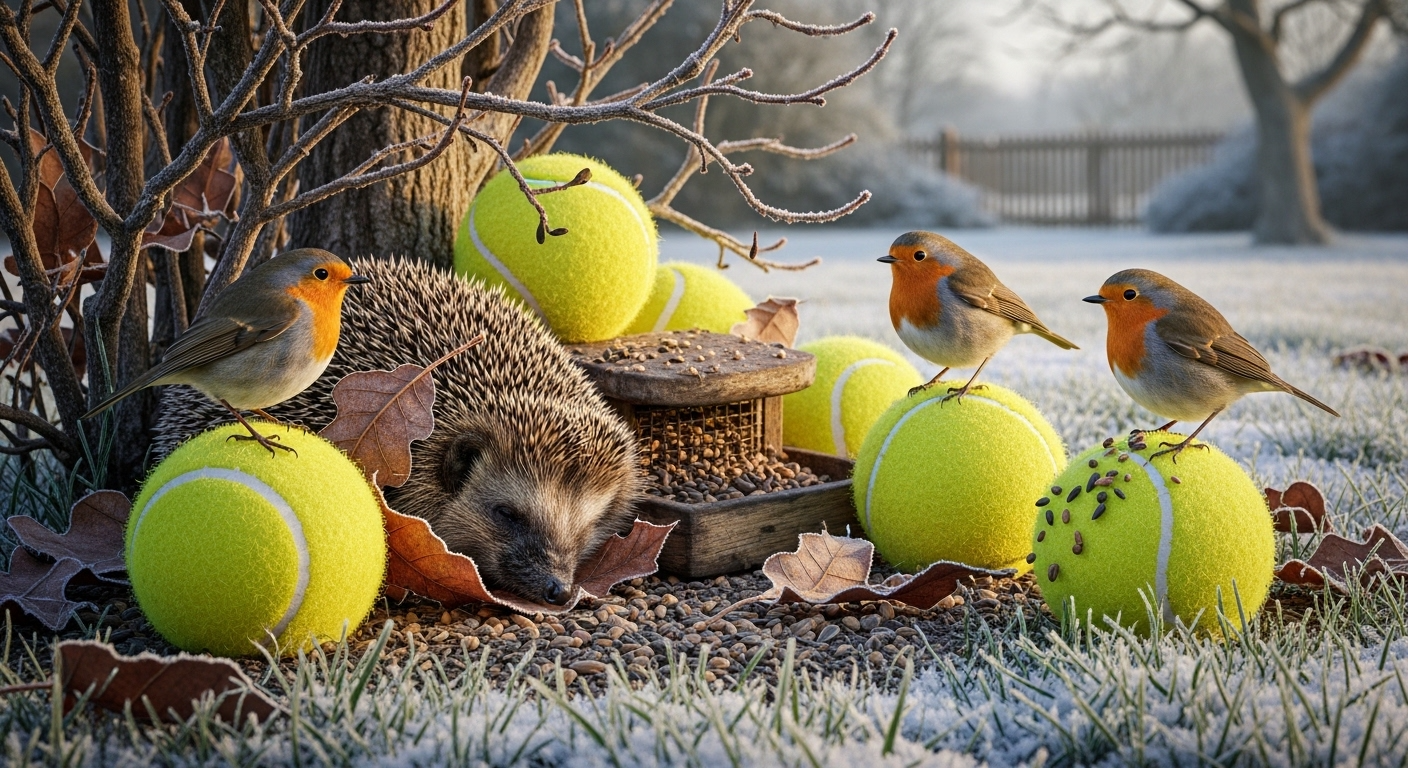
A Small Gesture That Changes Everything: Why Tennis Balls in Your Garden Can Save Birds and Hedgehogs This Winter
The first time I saw a hedgehog up close, it was not in a nature documentary or a wildlife reserve. It was under the harsh white beam of a garden floodlight, half-submerged in the cold shallow water of our back-garden pond. Its tiny paws were scrabbling at the curved plastic lining, claws slipping uselessly, nose barely above the surface. The only sound was the soft and desperate splash each time it tried and failed to pull itself out. I remember the way my breath caught, the way everything else in the world seemed to stop and shrink down to just that one small, spiny body struggling in the dark.
We got it out with an old net and a great deal of panicked whispering between two people who had no idea what they were doing. We wrapped it in a towel and watched its sides shudder with the effort of breathing. It survived. But the feeling that settled in afterward was more complicated than simple relief. There was a sharp and uncomfortable awareness that our tidy, well-loved garden had very nearly become a trap. Not through any cruelty or carelessness. Through the most ordinary kind of human oversight imaginable.
A few days later, a neighbour leaned on the fence and offered a piece of advice that sounded almost absurd. You know, she said, you can stop that happening again with a few tennis balls.
It stayed with me. Tennis balls? Against drowning? Against the slow invisible crisis quietly unfolding in gardens all over the country every winter? It sounded like the opening line of an odd joke. But the more I listened, and the more I read in the weeks that followed, the more that small and silly-sounding idea turned into something unexpectedly serious and genuinely hopeful.
The Quiet Emergency Happening in Winter Gardens
Winter in the garden is easy to stop paying attention to. The colour drains from the borders, the air feels thinner, the lawn turns into a stiff and muted mat of frost-flattened grass. Curtains get drawn earlier. Logs get stacked. The garden becomes a backdrop rather than a place anyone particularly wants to spend time in.
But in that same world, under shrubs and between paving stones and at the edges of ponds, life is still moving. Slower, more fragile, but fiercely persistent. Hedgehogs are searching for safe places to hibernate, weaving through leaf piles and nosing under shed floors and into dense bramble corners. Robins and blackbirds move along frosted borders with careful urgency, probing the hardening soil for whatever is still there. Frogs slip down into the cool, murky depths of ponds and settle into the silt to wait out the cold months. Everything is balanced on a thin line between just enough and not quite.
And it is in this season, exactly when wildlife can least afford any additional hardship, that our gardens quietly become more hazardous. Ponds turn into smooth-sided traps with no exit. Water butts brim after rain and offer nothing to grip. Steep-walled containers and buckets collect water and become invisible dangers for anything small and thirsty. For a hedgehog or a small bird, a few inches of water and a slippery edge can turn a brief visit for a drink into a final mistake.
We tend to imagine dramatic threats when we think about wildlife in trouble. Busy roads, persistent foxes, long hard frosts. But the most common dangers in gardens are small and ordinary. The way a pond is edged. The shape of a step down to the water. The depth of a forgotten bucket sitting under the drainpipe. Tiny design choices made for human convenience that create life or death situations for every other creature sharing the space.
This is where the tennis balls come in, rolling into the story with an almost comic sort of quiet confidence. Because sometimes the answer to a quiet emergency is exactly as small and undramatic as the problem itself.
How a Tennis Ball Actually Saves a Life
Imagine you are a hedgehog on a winter night. Your eyesight is poor. You move through the garden by scent, by sound, by habit. You follow the faint metallic trace of water in the air, the coolness hovering above it. The pond at the bottom of the garden draws you in with the promise of a drink, maybe a stray insect on the surface.
You lean forward to sip, the ground gives slightly, and suddenly you are in the water. The cold hits immediately through your spines. You can swim, for a while. Hedgehogs are capable swimmers under the right circumstances. But you circle the edges and the plastic or stone curves away under your paws, slick and ungrippable. There is nothing to hook your claws into, no root or stone to push against. Panic starts burning through the energy reserves your body spent weeks building up. Winter bodies are lean. There is not much margin to waste.
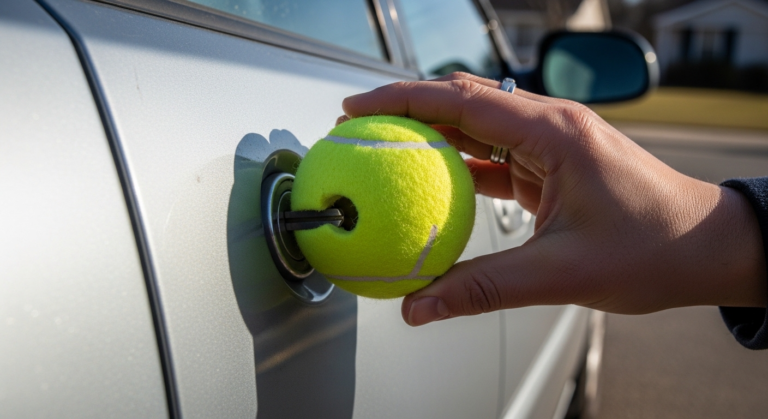
Now change one thing. On the surface of that same pond, three or four tennis balls bob gently in the darkness. As you swim, your paws find something that gives slightly rather than repelling you. Something that floats and stays where it is. You hook your paws over the fuzzy, buoyant surface and rest. It is not a rescue. It is a pause. But that pause is everything. Instead of treading water until exhaustion makes the decision for you, you are floating, conserving what little warmth and energy remains, keeping your nose above the surface until either you find a way out or daylight comes and someone notices you are there.
For birds the situation is very similar. A starling or a blackbird misjudges a landing, comes down too far from the bank, and suddenly has wings that are heavy and cold and useless for flying. A tennis ball becomes a tiny island. A resting place. A platform from which a second attempt becomes possible.
It sounds almost too simple to be true. A handful of ordinary, familiar objects making the difference between an animal that makes it through the winter and one that does not. But wildlife rescue workers and gardeners who have tried it report the same outcome consistently. Fewer drowned hedgehogs. Fewer small birds found still and floating in the morning. Once the water’s surface is no longer a smooth and unbroken plane offering nothing to hold onto, the mathematics of survival quietly shifts.
The Gesture That Changes How You See Your Garden
Dropping tennis balls into garden water is not just a practical trick. It is a change in perspective. A way of looking at the outdoor space around you and recognising that it is shared rather than simply owned. That the design choices made for human convenience ripple outward into other lives in ways that are mostly invisible until something goes wrong.
You could think of it as a form of hospitality. Most people who care about garden wildlife already leave out food. Seed for the finches, fat balls for the bluetits, shallow dishes of mealworms or water for hedgehogs passing through at night. But water is as essential as food and considerably more dangerous when it is poorly designed for the creatures trying to use it.
When you drop a tennis ball into a pond you are sending a message that nobody else will ever read but that matters nonetheless. You are seen. You are considered. Someone thought about you in the cold and the dark and the long hungry nights of winter, and made a small adjustment on your behalf.
That one gesture tends to invite more. Once you have done it, your eyes begin to recalibrate toward risk in a way they did not before. The old metal bucket by the shed, how steep are its sides? The decorative half-barrel planted with water lilies, does it have any way out for something that has fallen in? The water butt, is the lid properly secured or just resting loosely in a way that a curious nose could shift aside on a damp October evening?
What begins with a few tennis balls often grows into a slow and gentle reimagining of the garden as a landscape that works for more than one species. You start noticing the small gap under the gate that could become a hedgehog highway between neighbouring gardens. The tangle of leaves in the corner that looks like untidiness from the kitchen window but might be exactly the kind of shelter a hedgehog needs to make it through to spring. You become, almost without noticing the transition, a guardian as much as a gardener.
Where Tennis Balls Make the Biggest Difference
Not all water in a garden carries the same level of risk, but several common features appear again and again in accounts of winter wildlife casualties. These are the places where a few floating spheres make the most immediate and reliable difference.
Garden ponds are the most obvious and most significant danger zone. Whether formally edged with stone or informally lined with plastic, any pond with steep or slippery sides can become a trap for a hedgehog that comes to drink or a bird that misjudges a landing. Three to six tennis balls spread across the surface give multiple resting points wherever an animal enters the water.
Water troughs and large barrels present a similar problem, particularly in bigger gardens or on the edge of farmland. The depth and smooth interior walls make escape almost impossible for anything that falls in. Two to four tennis balls on the surface can provide the difference between something finding its way out and something that does not.
Decorative containers that hold water, including ceramic bowls, half-barrels planted with aquatic plants, and deep ornamental dishes, are frequently overlooked as danger zones because they seem too small to matter. For a mouse, a small bird, or a young hedgehog, they are not small at all.
Open buckets and tubs left under drainpipes or beside sheds collect rainwater quietly and reliably and are among the most common locations for accidental drowning simply because nobody thinks of them as a hazard.
Important places to check and adapt:
- Garden ponds of any size or style with steep or smooth edges
- Water troughs and large storage barrels without secure lids
- Decorative water containers and ornamental bowls
- Open buckets and tubs collecting rainwater anywhere in the garden
- Any container deep enough that a small animal could not touch the bottom while keeping its nose above the surface
Going Further: Building a Garden That Gently Rescues
Tennis balls are a genuinely valuable first step, but they become considerably more effective when combined with a few other small adaptations. None of these require significant money or specialist knowledge. They require only the willingness to think through the garden from the perspective of something much smaller than yourself.
A floating ball extends the time an animal has before exhaustion wins. An escape ramp actually gets the animal back onto land. Both together are far more effective than either one alone. A simple rough-textured plank angled from the water’s edge down into the pond, or a pile of large stones arranged to create a gradual slope up from the shallow end, gives wet and panicked paws something real to grip. Smooth materials are nearly useless here. Wood, bark, stone, or purpose-built wildlife ramps provide the texture that allows claws to find purchase.
Leaving a little wildness in the garden works alongside these practical measures in a way that is less obvious but equally important. Gardens that are clipped and raked and cleared of every leaf and twig offer hedgehogs very little. The places that draw them in and keep them safe are the slightly untidy ones. A low log pile where beetles and worms shelter beneath the bark. A patch of undisturbed fallen leaves deep enough to hibernate in. A dense shrub or bramble corner that blocks the wind and hides the entrance from above.
These things are connected in a way that makes the whole garden more than the sum of its individual features. A hedgehog drawn in by insects under your log pile will pass your pond on the way to drink. The tennis balls you placed there in October could be what allows it to live long enough to curl up under those same logs when the temperature finally drops far enough.
Winter Seen From Ground Level
We experience winter from a warm and elevated vantage point. From inside warm houses, through double-glazed windows, with central heating ticking quietly in the walls behind us. But imagine the same season from the height of a hedgehog moving through the garden at two in the morning.
The garden is a maze of barriers and opportunities shifting constantly with the weather. Hedges are highways. Untidy borders are feeding grounds. Every puddle is a possible drink and a possible danger. Every shadow is a potential threat to be assessed before passing through it. There is no cupboard to open, no tap to turn on. There is instead a constant and exhausting low-level calculation about what is safe, what is worth the energy, what can be trusted.
On the coldest nights of the year, when frost covers the lawn and breath clouds in the torchlight, a hedgehog’s body is doing something genuinely extraordinary. Metabolism slows to a fraction of its normal rate. Heart rate drops dramatically. The animal slips into a suspended state where every saved calorie is the difference between waking in spring and not waking at all.
To lose significant body heat or energy in a midwinter accident, by falling into cold water and swimming in panic for even a few minutes, is potentially catastrophic. The quiet arithmetic of the season is brutal. Preventing one accident, offering one point of rescue in the dark, can echo through an entire year and sometimes through an entire generation of animals that survive long enough to breed again.
When people talk about saving birds and hedgehogs, it can sound like the kind of language that belongs to conservation organisations and government policies and scientific reports. In reality the most important decisions are made in individual back gardens, at the edge of ordinary ponds, in the question of whether to clear that corner of leaves or leave it be. Small gestures, repeated across thousands of gardens, produce outcomes that matter at a scale that is genuinely measurable.
Making It Part of Your Winter Ritual
The first year you put tennis balls in your pond it might feel slightly eccentric. You will see them from the kitchen window, bright against the grey water, bobbing in the rain or sitting still under a skin of morning frost. You might explain them to visitors with a mixture of mild defensiveness and quiet pride. They are for the hedgehogs, you will say, and watch their expressions shift from confusion toward something warmer.
But the second year it will not feel strange at all. It will simply be something you do when the nights start drawing in. After the tender plants come inside and before the fairy lights go up on the fence. It becomes a seasonal rhythm, a small act of alignment with the quieter and less visible lives that share the same patch of ground.
Maybe one winter morning you will find hedgehog prints in the soft mud near the water’s edge, those small and unmistakable marks, and feel the particular satisfaction of evidence without needing the full story. Maybe you will look out one grey afternoon and see a blackbird balanced on one of the tennis balls with the improbable dignity of something entirely comfortable in a ridiculous situation. Maybe you will never witness any of it directly and that, in many ways, is exactly the point. The close calls that do not happen. The quiet rescues you set in motion without ever needing to be present for them.
In an age when almost every piece of news about wildlife feels heavy, species declining and habitats contracting and seasons shifting in ways that make old knowledge unreliable, there is something deeply grounding about a gesture this local and this immediate. You do not need permission or funding or any particular expertise. You need a garden, a pond, a bucket, or a trough, and a handful of bright fuzzy spheres pulled from a drawer or picked up from a charity shop for almost nothing.
You stand at the edge of the garden in the sharp winter air and you let them fall, one after another, into the still surface of the water. They bob and drift and look, if you are being honest, slightly ridiculous. But somewhere in the fragile and invisible web of winter life in your garden, something has shifted in your favour and in theirs. A margin of safety has been quietly extended. A door that might have closed has been left a little further open.
That is what a few tennis balls do. That is all they need to do.
Read More: For more wildlife guides, garden tips, and nature stories written for Australian readers, visit wizemind.com.au