A New Study in Uganda Shows Chimpanzees Applying Insects to Their Wounds
The forest woke up slowly, like a creature stretching its limbs. Mist clung to the trees in low, ghostly ribbons. Somewhere above, a hornbill called once, twice, three times, then fell silent. Beneath the canopy, where the ground was soft with centuries of fallen leaves, a female chimpanzee named Suzie sat very still, her dark fingers cradling an injured foot.
From a distance, she looked like any other wild chimp tending to a minor wound — prodding it, inspecting it, occasionally licking the exposed skin. But then she did something that made a team of scientists hold their breath, press their binoculars tighter to their faces, and scribble frantically in their notebooks.
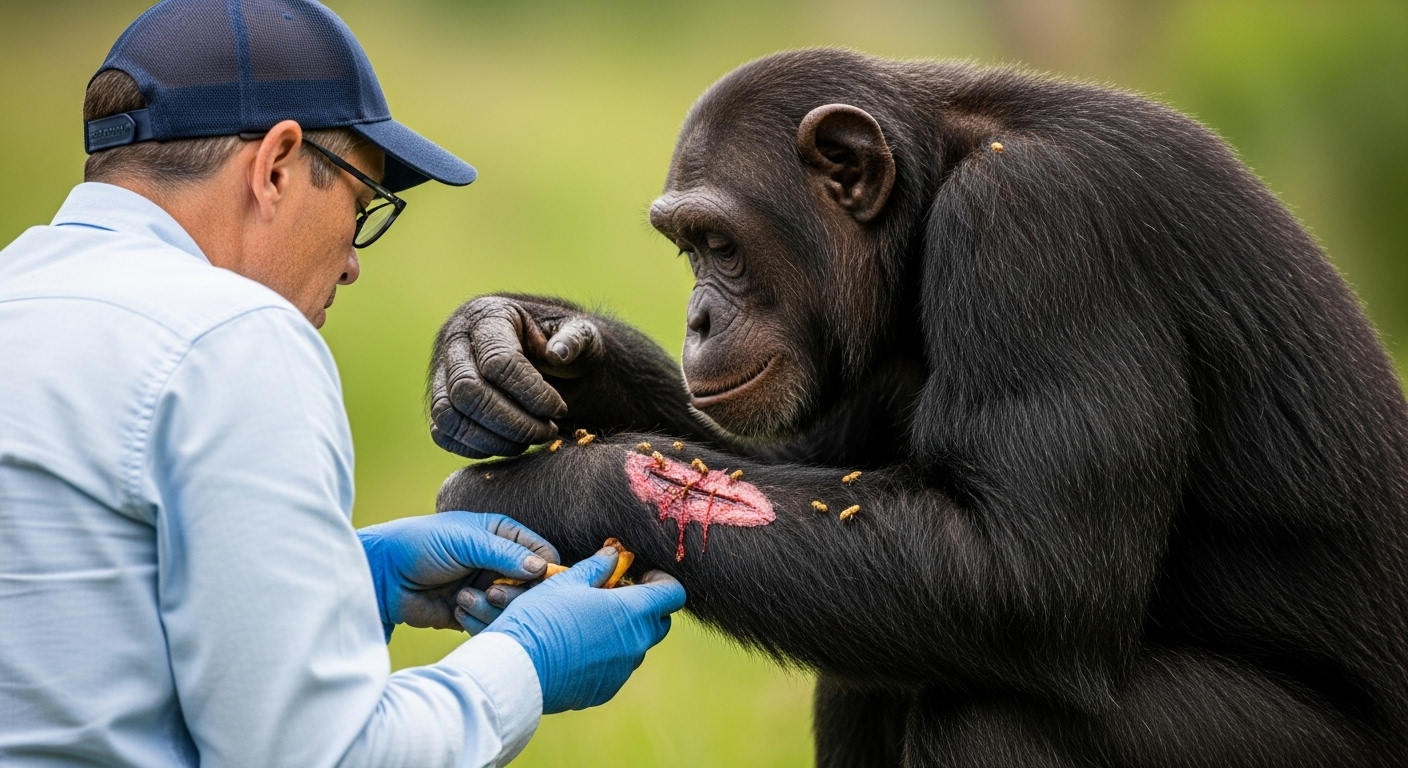
Suzie reached out into the air as if plucking a tiny speck from the invisible. She closed her fingers, brought them to her lips, and delicately pressed the crushed remains of a small insect onto her open wound.
The Forest as a Living Laboratory
The Budongo Forest in northwestern Uganda doesn’t feel like a place designed for scientific breakthroughs. It smells of wet earth and wood rot, of flowers you never see but sense all around you. Sunlight flickers in shards between the overlapping crowns of towering mahogany and ironwood trees. Vines coil around trunks like old stories wrapped tightly around memory.
This is home to the Sonso chimpanzee community, a group that has been observed for decades. Researchers have followed them through births and deaths, alliances and betrayals, quiet afternoons and violent clashes. They’ve watched them crack nuts, fish for termites, use sticks as tools, and tenderly groom each other for hours on end.
But nothing, perhaps, has felt quite as intimate — or as surprising — as watching them treat their own injuries with insects.
A Curious Gesture, Repeated
On the day of Suzie’s insect-wound ritual, the forest was warm and hushed. The research team had already been following the chimps for hours. Then Suzie hurt her foot — no dramatic injury, just a fresh open cut likely from a misstep on a sharp branch.
What happened next snapped the scientists into total focus. Suzie sat down, examined her foot, and began swiping her hand through the air as if trying to catch a fly. When she succeeded, she pinched the insect between her lips. A second later, she placed it directly on the wound, pressing and smearing it across the raw skin.
It would have been easy to dismiss as a strange one-off behaviour. But then it happened again. And again. Over the months that followed, the team documented dozens of similar instances — chimps catching insects and applying them to injuries on themselves or even on another group member.
Some chimps used their fingertips, others used their lips, carefully positioning the insect on the wound and then sweeping it across the exposed area. Often they repeated the action several times, as if making sure the substance was properly applied. It was not random. It was not careless. It looked methodical.
When Animals Become Medicine
Humans have been turning to nature for remedies for as long as we’ve been human. Leaves boiled into tonics, bark reduced to powders, roots chewed to dull pain. We like to think of these practices as exclusively ours — evidence of our special intelligence, our unique relationship with the wild world. But the deeper we look, the more that boundary blurs.
We already know that some animals medicate themselves. Pregnant elephants have been seen eating certain tree leaves that induce labour. Macaws and parrots swallow clay that may help neutralise plant toxins. Chimps in multiple sites across Africa have been observed swallowing rough leaves whole — not chewing them — apparently to flush out intestinal parasites.
But the Sonso chimpanzees are doing something new. They appear to be using insects rather than plants, and applying them externally, directly onto their wounds. It’s more like a salve than a swallowed pill.
What makes this behaviour even more striking is its social dimension. Some chimps did not just treat themselves. They held out an injured limb, or gently opened the fur around another individual’s cut, and carefully applied the insect to that wound. In a world where survival is often framed as every-individual-for-themselves, the sight of a chimp delicately smearing a crushed insect onto another’s bleeding hand is quietly revolutionary.
Is This True Medicine, or Just a Strange Habit?
The cautious voice of science whispers: we don’t fully know yet.
To consider a behaviour as a form of medicine, researchers look for a few key elements. Is the behaviour targeted — are the chimps applying insects specifically and only to injuries? Do they do it in a consistent way, not randomly? And is there any plausible benefit from the insects themselves?
So far, the pattern is striking. The chimps don’t seem to be smearing insects onto their fur just for fun. They are placing them on fresh wounds. They repeat the behaviour in similar ways. They sometimes help others do the same.
Scientists still don’t know which exact species of insect is being used. The forest is thick with flying life, and identifying a crushed, half-seen insect is extremely challenging. But entomologists and biologists are now working to match these mystery insects with known species and test them for antibiotic, antifungal, or other bioactive properties.
Perhaps the chimps have discovered what we haven’t fully recognised yet: that the forest’s pharmacy doesn’t end with roots and leaves. It buzzes, hums, and flutters all around us.
Cooperation in the Canopy
If the use of insects as a kind of medicine is remarkable, the way it’s shared is equally so. Many instances involved one chimp helping another. A mother treated her offspring’s wound. An adult helped a non-related individual. There were no visible rewards or obvious immediate gains.
Picture it: two chimps sitting close, their bodies almost touching, the air between them tense but gentle. One has a fresh gash on the arm, blood still bright against the dark fur. The other catches an insect, holds it carefully, and applies it inch by inch directly onto the edge of the wound. The injured chimp holds still, accepting the treatment.
To share medical care like this suggests a layered kind of mind. There’s the recognition of another’s pain. There’s an understanding — at least on some level — that this peculiar behaviour might help. There’s coordination between two individuals: one who allows, one who acts.
When we watch scenes like these, it is hard not to feel the distance between human and chimpanzee shrink to a sliver. Our hospitals and clinics may look nothing like a Ugandan forest, but the impulse at their core — the urge to alleviate another’s suffering — may be rooted far deeper in our shared evolutionary past than we ever imagined.
Learning, Culture, and the Chimpanzee Mind
How does a chimpanzee learn to do something like this?
One possibility is that a particularly observant individual once noticed that an insect, when crushed and applied, seemed to reduce irritation or help a wound heal. That individual repeated the action. Others watched, as chimps constantly do, paying close attention. Over time, the behaviour spread, becoming a kind of cultural tradition within the group.
Chimpanzees are masters of observational learning. Youngsters shadow their mothers almost incessantly, mimicking actions, experimenting with sticks and stones, watching which fruits to eat and which to avoid. If this insect-medicine practice is cultural, it reveals just how flexible and inventive chimpanzee traditions can be.
It also raises an intriguing question: how many other animal cultures, hidden in forests, oceans, and grasslands, are practising their own forms of medicine right now, completely unnoticed?
What It Means for Us
There’s an almost reflexive human tendency to turn every animal discovery into a mirror. What does this say about our uniqueness? About the mysterious distance between human minds and the minds of other species?
Intelligence is not a single, shining human invention. It’s a tangle of solutions, discoveries, and behaviours that have been emerging for millions of years in many different forms.
We tend to draw a line between using tools and using medicine, as if the latter requires some special insight unavailable to other animals. Yet here, in a forest in Uganda, another species may be nudging its way across that line.
There’s a practical implication too. If insects used by the chimps turn out to contain powerful antimicrobial or anti-inflammatory compounds, they could offer clues for new human medicines. We’ve already found countless drugs in plant and fungal life. Animals, and especially their interactions with each other, may be our next great frontier in drug discovery.
But perhaps the deeper meaning lies less in what chimps can do for us, and more in what they reveal about the living world. Knowledge is not only stored in books and laboratories. It is embedded in behaviour, carried in the bodies and habits of wild creatures.
Sitting With Suzie
Think again of Suzie on that misty morning, sitting under the heavy green of the Budongo canopy.
Her wound is small but vivid. She shifts her weight, winces slightly, and then focuses. A brief flurry of movement as her arm sweeps through the humid air. She catches the insect on the third try. For a second she holds it against her lips, crushing the fragile body with a precision that suggests this is not her first attempt. Then, with a slow deliberate motion, she presses it to her skin.
The forest continues around her: a distant rustle of leaves, the staccato call of a monkey high above, the soft drip of moisture from branch to branch. None of it knows that, just a few metres away, several humans are holding their breath, bearing witness to a tiny act that might change the way we think about animals and medicine.
Suzie doesn’t know she is part of a study. She doesn’t know that her simple gesture will make its way into scientific journals, news reports, and whispered conversations between biologists over late-night coffee. She knows only that her foot hurts, and that she has learned — somewhere, somehow — that a certain buzzing creature might help.
She presses. She releases. She waits.
We watch, and wonder what else the forest has been quietly doing, for centuries, while we were too busy to look.
Frequently Asked Questions
Are the chimpanzees definitely using insects as medicine? Researchers are cautious with their wording, but the behaviour strongly suggests a medicinal use. The insects are applied specifically to open wounds in a deliberate and repeated way, sometimes on others as well as on the self. This matches several criteria scientists use to classify behaviour as potential self-medication, even though the exact biological effects of the insects still need to be tested.
Do we know which insect species the chimps are using? Not yet with certainty. The insects are small, often flying, and difficult to identify when quickly caught and crushed. Ongoing work aims to match field observations and collected specimens to known species and then test them for antimicrobial, anti-inflammatory, or other beneficial properties.
Have similar behaviours been seen in other animals? Yes, though not exactly in this form. Various animals are known to self-medicate — chimpanzees and monkeys eat certain plants to combat parasites, birds incorporate aromatic plants into nests that may repel pests, and elephants select specific leaves that appear to induce labour. However, applying crushed insects directly to external wounds is a particularly unusual and newly documented behaviour.
Could this just be grooming or play rather than medicine? Grooming and play are common in chimps, but this behaviour looks different. It is targeted at open wounds, involves capturing a specific kind of organism, and follows a consistent pattern of catching, mouth-processing, and application. While alternative explanations can’t be entirely ruled out, the pattern fits closely with what scientists consider potential medicinal behaviour.
What does this discovery tell us about chimpanzee intelligence? It suggests that chimpanzee intelligence includes not only tool use and problem solving, but also a capacity for experimentation with biological resources and social transmission of complex behaviours. The fact that chimps sometimes treat others’ wounds hints at an understanding of pain and relief beyond their own bodies, reflecting a rich cognitive life that overlaps with human abilities more than we once imagined.