A Mother Bear and Her Cub Climbing Uphill: The Remarkable Wildlife Moment That Reveals How Bears Raise Their Young
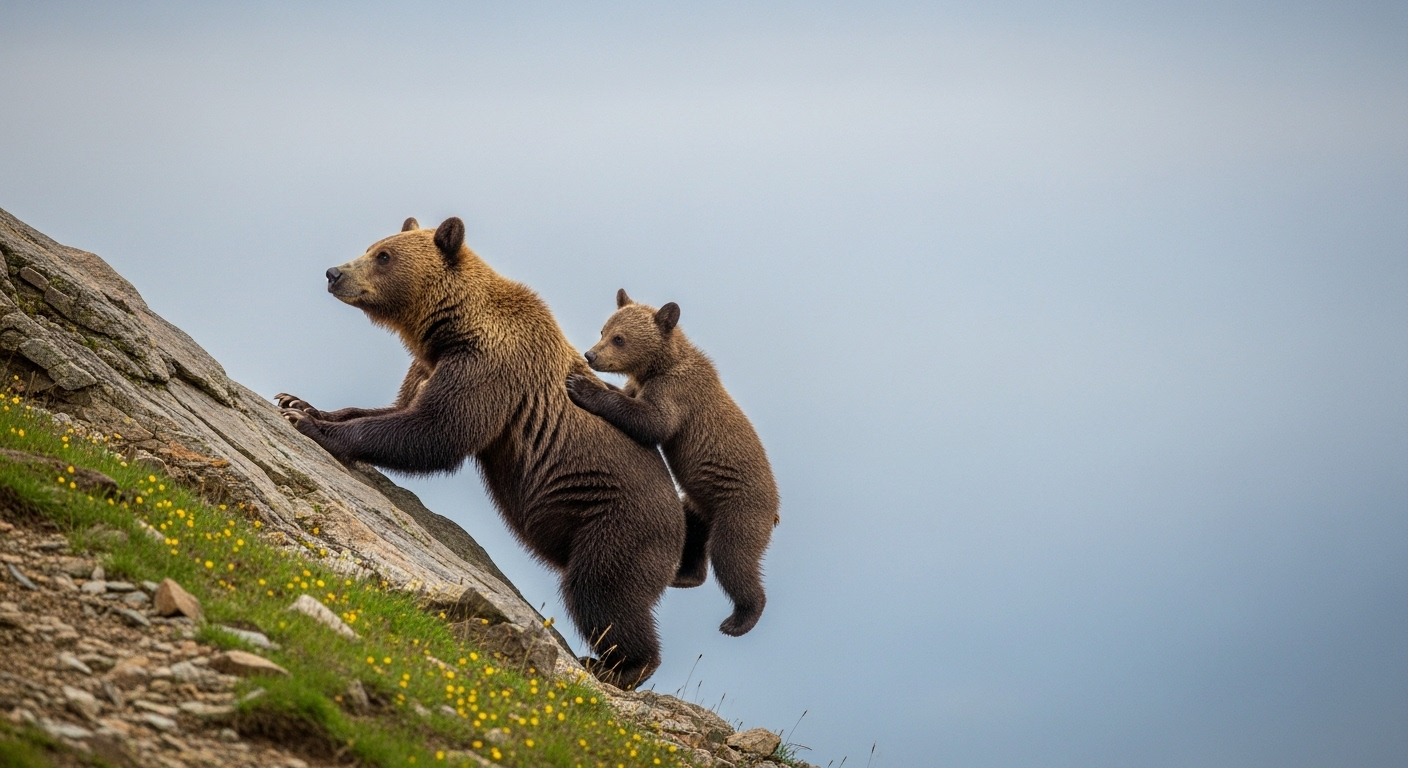
There are moments in nature that need no explanation. A mother bear pausing on a steep hillside, waiting with absolute patience while her small cub scrambles up behind her, paws digging into the dirt, legs working hard, refusing to give up. No words are spoken. No instruction is given. And yet everything essential is being communicated.
Trail cameras positioned deep in wilderness areas have been capturing these moments with increasing clarity in recent years, and what they reveal about the relationship between a mother bear and her cub goes far beyond what most people would expect from a wild animal. It is not just survival. It is teaching. It is patience. It is a bond that shapes everything the young bear will become.
Why the Annual Uphill Climb Matters More Than It Looks
Each year, as winter loosens its grip and the landscape begins to wake up, mother bears lead their cubs away from their denning grounds and up into higher terrain. For the cub, this is not a casual walk. It is one of the most physically demanding experiences of its young life, and it comes at a time when its body is still developing and its strength is nowhere near what it will eventually become.
The steep inclines test everything — leg strength, lung capacity, balance, and most importantly, the cub’s willingness to push through discomfort. There are stumbles. There are moments where the cub stops, clearly exhausted, uncertain whether to continue. And in those moments, the mother does something that wildlife researchers find genuinely striking. She waits. She does not move on. She does not leave the cub behind. She simply waits, and when the cub is ready, they continue together.
This annual climb is not incidental. It is a critical developmental experience that begins building the physical and psychological foundation the cub will need to survive independently in the wild.
What Trail Cameras Are Revealing About Bear Family Behaviour
Until relatively recently, much of what we understood about bear behaviour in the wild was pieced together from brief observations, tracks, and educated inference. Trail cameras changed that. Positioned quietly in bear habitats and left to run without human presence, they capture interactions that would never occur naturally with a researcher nearby.
What the footage shows repeatedly is a level of attentiveness in mother bears that surprises even experienced wildlife biologists. The mother is never truly at rest when her cub is navigating challenging terrain. Her eyes scan constantly — checking the cub’s progress, watching the surrounding environment for threats, reading the landscape ahead for the easiest path forward.
When the cub slips or stumbles, the mother’s response is consistently calm. There is no alarm, no sudden movement. She watches the cub recover, and only if the situation becomes genuinely dangerous does she intervene directly. This approach — letting the cub experience difficulty without rushing to eliminate it — appears to be entirely deliberate, and it mirrors something that developmental researchers in humans recognise as essential for building genuine confidence and capability.
The cub that is allowed to struggle and succeed builds a fundamentally different relationship with challenge than one that is constantly rescued. Trail camera footage makes this visible in a way that no amount of theoretical observation ever could.
How the Cub’s Abilities Change Across the Seasons
The transformation that occurs between early spring and late autumn in a bear cub’s physical development is remarkable to document over time.
In the early weeks after leaving the den, a cub’s movements are tentative and tiring quickly. The muscles are still developing. The coordination is imperfect. Rest breaks are frequent, and the mother calibrates her pace accordingly — never pushing the cub to the point of genuine exhaustion, but never allowing it to simply stop and refuse to continue either.
By summer, something has shifted noticeably. The cub’s stride becomes more confident. It begins to take initiative on terrain it has already encountered, sometimes moving ahead of the mother on familiar ground. The rest stops become shorter and less frequent. There is a visible change in how the cub carries itself — less tentative, more assured.
By autumn, the same cub that struggled up a gentle slope in spring can tackle steep and rocky terrain with an ease that would be difficult to believe if the earlier footage did not exist for comparison. The physical transformation is extraordinary, but the change in the cub’s demeanour is equally significant. It approaches challenges differently — assessing rather than hesitating, moving with purpose rather than uncertainty.
The Role of Nutrition in Fuelling the Climb
None of this physical development happens without the right fuel, and the mother bear’s role in managing her cub’s nutrition during this period is far more sophisticated than simply leading it to food.
In spring, food sources are limited. The landscape is only beginning to produce, and the bears are still drawing significantly on fat reserves built up before winter. The mother must find early season food sources — emerging plant matter, insects, occasional carrion — while carefully monitoring how much energy the cub is expending relative to what it is taking in.
As summer progresses and berry crops begin to ripen, the picture changes substantially. The cub learns to forage by watching the mother — which plants are edible, how to find insects under bark and rocks, how to read the landscape for food. This is not passive observation. The cub is actively imitating and experimenting, and the mother allows it space to do so while keeping it from straying into genuinely dangerous situations.
By autumn, with salmon runs and abundant berry crops available in many habitats, both bears are in full hyperphagia — the intense pre-winter eating period where bears can consume up to 20,000 calories per day. The cub by this point is a competent forager in its own right, though still learning from the mother’s experience and following her lead to the most productive feeding sites.
The Dangers That Shape the Journey
The annual climb is not just physically demanding. It is genuinely dangerous, and the mother’s vigilance reflects that reality.
Predators are a real threat to bear cubs, particularly in their first year. Adult male bears — boars — are known to kill cubs, and the mother’s threat assessment is constant throughout the journey. When she pauses and raises her head, she is reading the air for scent. When she changes direction suddenly, she has detected something that the cub cannot yet read.
The terrain itself presents risks. A cub that loses its footing on a steep slope above a drop can be seriously injured. River crossings during spring runoff carry their own dangers for a small animal that has not yet developed its full swimming strength. Encounters with other wildlife — from territorial deer to occasional predators — require the mother to make rapid decisions about whether to stand ground, move away, or place herself between the threat and her cub.
Watching this unfold on trail camera footage gives a visceral appreciation for how much skill and experience is embedded in a mother bear’s behaviour. It is not instinct alone. It is accumulated knowledge — of this specific landscape, of the threats it contains, of the signs that indicate danger before it becomes visible.
What Bear Behaviour Teaches Us About Conservation
Beyond the individual story of a mother and her cub, these observations carry significant implications for how we understand and protect bear populations in a rapidly changing world.
Climate change is altering the timing of seasonal cycles that bears have adapted to over thousands of years. When berry crops ripen earlier, when snowpack disappears sooner, when salmon runs shift — these are not minor inconveniences. They are disruptions to carefully calibrated natural systems that the bears depend on at specific points in their annual cycle.
If the food sources a mother bear needs to fuel her cub through the early season are no longer available at the right time, the developmental consequences for the cub can be significant. Underweight cubs entering their first winter have dramatically reduced survival rates compared to those that have had access to adequate nutrition throughout the year.
Human encroachment on bear habitat creates a different set of pressures. As wilderness areas fragment, the routes that mother bears use to move between denning grounds and seasonal feeding areas become interrupted by roads, fencing, and development. For a species that relies on learned knowledge of specific landscape routes passed from mother to offspring over multiple generations, losing access to those routes is not a minor inconvenience. It is a rupture in the transmission of knowledge that cannot easily be recovered.
Trail camera networks that document these movements are increasingly valuable tools for conservation planners working to identify which corridors and habitat patches most need protection to maintain viable bear populations.
The Unspoken Language Between a Mother and Her Cub
Perhaps what strikes people most when they watch footage of a mother bear and her cub navigating difficult terrain is how much communication appears to happen without any obvious signal at all.
A pause. A glance. A slight shift in posture. The cub reads these cues with a precision that speaks to months of close attention and an intimate understanding of its mother’s body language. When the mother tenses, the cub stills. When she relaxes and moves forward, the cub follows.
This is not something the cub was born knowing. It is learned — accumulated through thousands of small observations across hundreds of hours of shared experience. The trust embedded in that relationship is complete and mutual. The mother trusts the cub to attempt what she leads it toward. The cub trusts that the mother will not lead it somewhere genuinely beyond its capacity.
It is, when you watch it closely, a remarkably sophisticated relationship. One that took millions of years of evolutionary pressure to produce, and that depends entirely on the preservation of the wild spaces where it can still unfold.
Key Facts
| Climbing season | Spring through autumn |
| Primary purpose | Physical development and survival skills |
| Main threats | Predators, terrain, climate-related food disruption |
| Research tool | Trail cameras in remote wilderness habitats |
| Conservation concern | Habitat fragmentation and climate-shifted food cycles |
Frequently Asked Questions
How long do bear cubs stay with their mothers? Bear cubs typically stay with their mothers for 1.5 to 2.5 years depending on the species and environmental conditions. During this time they learn everything they need to survive independently.
Why do mother bears lead cubs uphill each season? The annual movement from lower denning grounds to higher seasonal feeding areas follows the natural cycle of food availability. It is also a critical physical conditioning experience for the developing cub.
Are bear cubs in danger during the climb? Yes. Steep terrain, predators — including adult male bears — and river crossings all present real risks. The mother’s constant vigilance is a primary factor in the cub’s survival during this period.
What do trail cameras reveal about bear behaviour? They capture natural, unguarded behaviour that would not occur in the presence of humans. Footage shows the nuanced communication and patient teaching methods of mother bears in genuine detail for the first time.
How does climate change affect bear cubs? Shifting food cycles mean that critical nutrition sources are not always available when the bears need them most. Underweight cubs have significantly lower survival rates through their first winter.
What can ordinary people do to support bear conservation? Supporting habitat protection initiatives, respecting wildlife corridors, reducing food attractants in bear country, and advocating for climate action all contribute meaningfully to bear population survival.