Hairstyles After 50: The Classic Cut From the 60s That Every Woman Is Asking For in 2026
She stands in front of the salon mirror for a long moment before saying anything. The stylist waits, scissors in hand, patient. Finally, the woman exhales — not with doubt, but with something closer to relief. “Just do it,” she says. “I am ready.”
Twenty minutes later, the length is gone. What remains is sharp, soft, and completely, unexpectedly her. She tilts her chin. She smiles. And for the first time in years, the woman looking back at her does not feel like someone trying to hold on to something. She feels like someone stepping forward.
That is what this cut does. And in 2026, women over 50 are asking for it everywhere.
Key Points
- The textured pixie-bob inspired by 60s style is one of the biggest hair trends of 2026
- It works especially well for women over 50 because it suits finer, thinner, and changing hair textures
- The cut frames the face, exposes the neck, and creates a lighter, more defined appearance
- It requires minimal styling — most women are out the door in under ten minutes
- Silver and gray hair looks stunning in this cut, with each layer catching light differently
- The style can be personalised for every face shape, curl pattern, and lifestyle
- Choosing this cut is often about more than hair — it marks a new chapter and a fresh sense of self
The Cut That Keeps Coming Back
Fashion has a long memory. Trends disappear for a decade or two, then return slightly changed — the same bones, different skin. In 2026, one of the most talked-about returns in hair is a short, sculpted, effortlessly cool cut that traces its roots directly back to the 1960s.
Think of the women who defined that era — their hair cropped close, their necks long, their faces utterly framed by clean lines and deliberate simplicity. That spirit is back. But it has been updated for today, softened at the edges, loosened from its original rigidity, and made deeply wearable for real women living real mornings.
This is not a costume. It is not nostalgia dressed up as fashion. It is a genuinely flattering, genuinely modern cut that happens to carry the confidence of a decade that never apologised for being bold.
Why Women Over 50 Are Choosing It Now
Walk into any salon this year and you will hear a version of the same conversation. A woman in her fifties or sixties sits down, pulls out her phone, shows a photo, and says something like: I do not want to look younger. I just want to look like myself again.
That distinction matters more than it might seem.
Hair after 50 often tells a story the woman herself did not write. Years of safe lengths kept to please others. Gradual thinning that led to cautious layers. A slow drift toward styles that felt protective rather than expressive. The result is hair that sits quietly on the head without saying anything at all.
This 60s-inspired cut breaks that silence. It is direct. It is considered. And it works with the way hair actually behaves after 50 — finer in texture, sometimes thinner at the crown, often drier and more delicate than it once was. Rather than fighting those changes with heavy product and exhausting maintenance, this cut leans into them. Light layering creates movement. Soft graduation at the nape adds structure without weight. The result feels like the hair finally has permission to breathe.
What the Cut Actually Looks Like
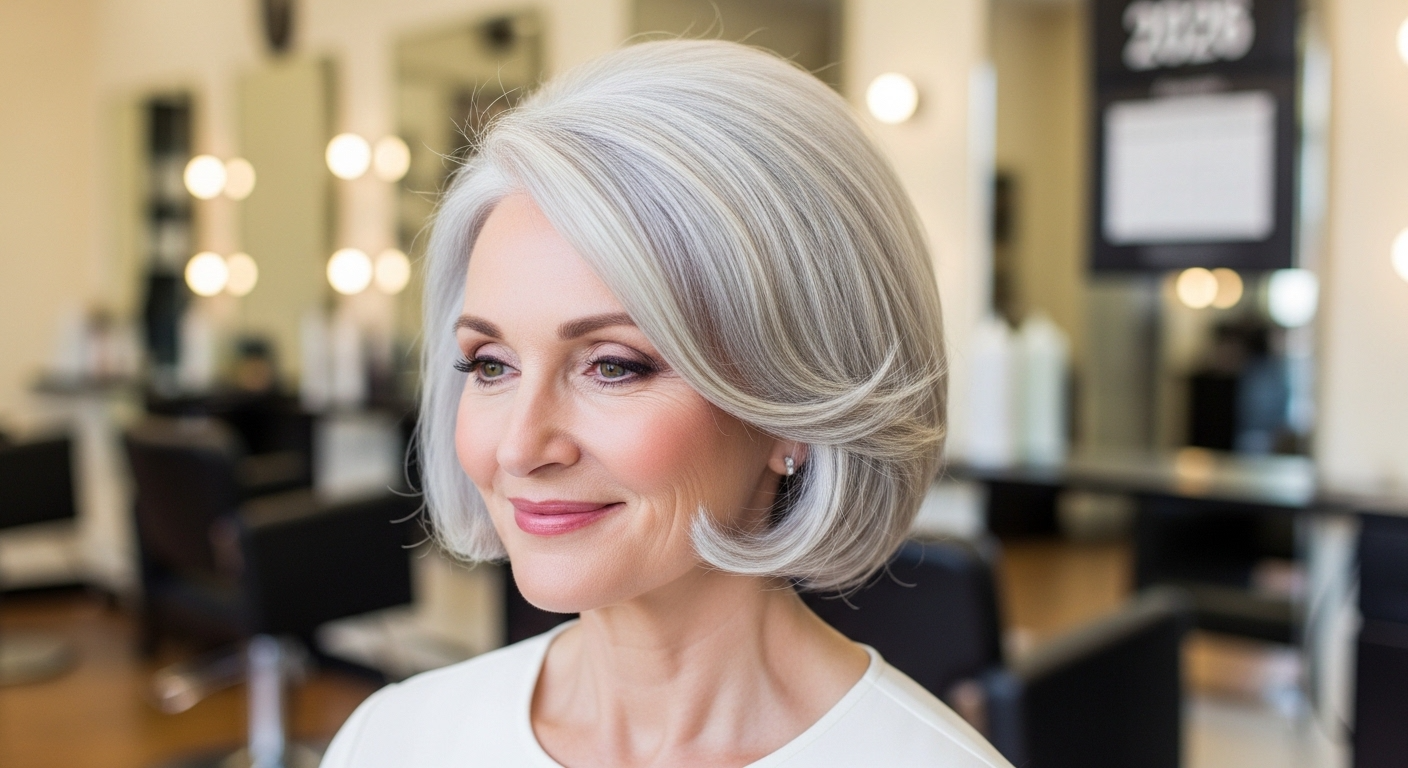
Picture the shape from the side. The nape is neat and tapered — not shaved, not severe, but clean and close. Moving upward, there is a gentle lift at the crown, just enough to keep the silhouette balanced and alive. The sides angle softly forward, with the longest points sitting somewhere between the ear and the jaw depending on the face.
It is shorter at the back and slightly longer at the front. That distinction is what gives it the pixie-bob quality — the precision of a crop combined with the softness of a bob. Nothing about it is harsh. Nothing is overdone.
The fringe is where personality enters the room. Some women choose a soft side-swept fringe that draws attention straight to the eyes. Others opt for something shorter and more daring — a nod to French cinema and 60s attitude. And plenty skip the fringe entirely, letting the front pieces fall naturally in a way that feels effortless rather than constructed.
What makes the 2026 version different from the original is texture. The 60s cut was often smooth, set, and structured. Today’s version is touchable. It moves. It does not look like it took an hour to achieve even when it did.
How It Works for Different Face Shapes
No two women wear this cut in exactly the same way, and a good stylist will always read the face before reaching for the scissors.
Oval faces have the most flexibility and can carry almost any variation — more or less fringe, asymmetric pieces, extra height at the crown. If your face is round, keeping a little extra length at the front to skim the jaw works beautifully, while avoiding too much volume at the sides keeps the balance right.
Square and rectangular faces benefit from soft, feathered ends that curve gently inward rather than cutting straight across. A side-swept fringe can ease angular lines without hiding them. Heart-shaped faces often look stunning with a slightly longer front that draws the eye downward, balanced by a neatly tapered nape.
The key is conversation. Bring photos, but also bring your honest thoughts about your face. The stylist’s job is to translate the inspiration into something that belongs specifically to you.
Working With Your Hair’s Natural Texture
One of the most freeing things about this cut is that it does not demand perfection from your hair. It actually performs better when the hair has some character.
Fine hair gains the illusion of thickness through careful layering that avoids bulk while adding movement. Wavy hair becomes genuinely beautiful in this shape — a small amount of curl cream and a little air drying can produce that lived-in, naturally chic result that used to take an hour to fake. Even curly hair can wear this cut with confidence, as long as the stylist accounts for how much the curl pattern will pull the length upward once dry.
The 2026 approach is not about making all hair look the same. It is about making each person’s hair look like the best version of itself.
The Morning Routine That Changes Everything
Open your bathroom cabinet right now. Count the products. Count the tools. Count the minutes you spend each morning standing in front of a mirror working to achieve something that feels just slightly out of reach.
This cut simplifies all of that in a way that feels almost radical once you experience it.
Out of the shower, blot your hair gently with a towel. Work a small amount of lightweight cream through the mid-lengths. Use your fingers and a blow-dryer to lift the crown slightly if you want volume, or simply let it air-dry for a softer finish. Finish with a light mist of texturizing spray if the day calls for it, or skip it entirely on quieter mornings.
That is the whole routine. Five to eight minutes from wet to ready. The time you save adds up quickly — not in some grand dramatic way, but in dozens of small, quiet moments returned to you each day. A second cup of coffee. A few more pages of your book. A phone call made without rushing.
Silver Hair and the Unexpected Advantage
If you have embraced your gray, or if you are somewhere in the middle of that transition, this cut may be the best thing that has happened to your silver hair in years.
Short, textured hair gives silver and white tones somewhere to live. Each layer catches the light slightly differently — softer at the crown, deeper and cooler near the nape, flecked with warmth around the temples. What can look flat and one-dimensional in longer styles becomes dimensional, almost luminous, when cut this way.
For women still wearing color, the shape is equally forgiving. Soft highlights or lowlights add movement through the layers without creating harsh regrowth lines. And for those in the middle of transitioning from color to natural — this cut is genuinely one of the most graceful ways to do it. The layers blend old and new together in a way that looks intentional rather than in-progress.
What This Cut Is Really About
There comes a point in many women’s lives where the mirror becomes less about comparison and more about recognition. The question shifts from how do I look to the world to does this reflect who I actually am.
The decision to cut your hair dramatically after 50 rarely lives only on the surface. It tends to arrive alongside something else — a milestone crossed, a chapter closed, a quiet internal shift that is looking for an outward expression. A new job or the end of one. Children leaving home. A relationship changed. A health scare survived. Or simply a Tuesday morning where you look in the mirror and decide, firmly and without drama, that it is time.
Before you sit in the chair, think about what you actually want your mornings to feel like. Tell your stylist not just what you want to look like, but what you want to stop thinking about when you leave the house. A good stylist listens for that too.
And when the cut is finished — when the cape comes off and the mirror is handed to you — give yourself a moment with it. Turn your head slowly. Watch how the light moves across the new angles. Let yourself get used to the person looking back.
She has been there a long time. The hair just finally caught up with her.
Frequently Asked Questions
Is this cut suitable for all hair types after 50?
Yes, with thoughtful adjustments. Fine hair benefits from strategic layering that adds movement without removing density. Wavy hair often looks its best in this shape with minimal effort. Curly hair works beautifully when the stylist accounts for curl shrinkage and cuts to the natural shape rather than against it.
Will it make me look older or younger?
Neither, exactly. It tends to make women look more defined and more themselves — the neck is longer, the face is more open, and the overall appearance feels lighter and more deliberate. That often reads as energy rather than age.
How often does it need trimming?
Every five to eight weeks to keep the shape crisp. If you are comfortable with a slightly more relaxed, grown-out version, you can stretch it a little longer between visits.
What do I ask my stylist for?
Ask for a soft textured pixie-bob with graduation at the nape, light layering through the crown and sides, and face-framing pieces at the front. Mention your face shape, how much time you want to spend styling it each morning, and whether you want a fringe. Bring two or three reference photos and use them as a starting point, not a strict template.
Is this a good cut for transitioning to gray?
It is one of the best. The layered texture blends old color and new growth in a way that looks intentional rather than in-between. Silver and white tones genuinely shine in short, textured cuts where each layer can catch the light independently.
Read more health and wellness articles at wizemind.com.au