We Stopped Eating Dinner Together When the Kids Became Teenagers. At 65, I Would Give a Great Deal to Have Those Dinners Back.
It never happened all at once. That is the tricky part, and the part I wish someone had warned me about. Nobody sat down and announced that our family dinners were finished. There was no meeting, no decision, no conversation where we agreed to let that go. It was more like a slow erosion, the kind you do not notice until you step back and look at what has disappeared.
First, one child had sport on Tuesday nights. Then another had a study group that ran late. I was deep in the middle of my career, putting in long hours, telling myself that being a good provider was the same as being a good father. It is not. But that is a lesson I had to learn the harder way.
I am 65 now, and I would give a great deal to have those dinners back. Not for the food. For the version of my family that only existed at that table.
What We Were Actually Losing
That table version of my family was messy and loud and sometimes frustrating. Sarah would talk over Michael. Emma would pick at her vegetables. My wife would give me a look across the table that meant help me out here, and I would be half-distracted thinking about something at work. It was not perfect. But everyone was there. Everyone was present in the same room at the same time, and I did not understand what a rare and precious thing that was until it stopped being true.
Here is what I have come to understand looking back. A family dinner was never really about the food. It was a container for everything else. It was where my kids told me about their day without me having to extract it from them. It was where I found out that Emma was being picked on at school, where Michael first mentioned wanting to learn guitar, where Sarah said something so unexpectedly wise that my wife and I looked at each other in quiet amazement and neither of us said anything because we did not want to break the moment.
Those moments do not happen on demand. You cannot schedule them into a calendar or manufacture them with enough intention. They only emerge when people are together in a relaxed, low-pressure setting with no particular agenda. A dinner table is one of the few places left in modern life where that kind of thing can still unfold naturally, without anyone trying to make it happen.
I grew up in a working-class family, the middle kid of five. We did not have much money, but we always had dinner together. Every single week, no exceptions. My mother would stretch whatever we had into a meal that could feed seven people, and we would crowd around a table that was honestly too small for all of us. I did not appreciate it at the time. Kids rarely do. But that table was the place where our family happened, if that makes sense. It was where we were most ourselves. I did not understand what that meant until I was old enough to have lost something similar.
The Myth of Quality Time
There is a phrase I have heard many times over the years that has always bothered me. Quality time. Parents use it to justify spending less time with their children by reassuring themselves that the time they do spend will be more meaningful. I understand the appeal. It lets you off the hook a little.
But in my experience, that is not how genuine connection actually works. You cannot manufacture a deep conversation with your teenager by blocking out thirty intentional minutes on a Saturday afternoon. Deep conversations happen at random, in the space between ordinary moments. They happen when you are washing dishes together or driving to a sports ground or sitting around the dinner table on a boring Wednesday night when nothing special is going on and nobody is trying to make it memorable.
Being present often matters more than being impressive. And dinner is one of the simplest ways to just be present. You do not have to plan an activity. You do not have to be entertaining or insightful or particularly interesting. You just have to show up and sit down.
Each individual missed dinner does not feel like a big deal in the moment. It is only when you zoom out later and realise you have missed hundreds of them that the weight of it lands properly.
It Was Not Only About the Children
Something I did not expect when I started reflecting on all of this. The family dinner was not just good for my children. It was good for my marriage too, and I underestimated that at the time.
When you eat together as a family, you and your partner are on the same team in the most practical sense. You are navigating the chaos together, sharing glances across the table, dividing the unspoken responsibilities, picking up on things the other one missed. There is an intimacy in that everyday teamwork that is genuinely hard to replicate in other settings.
Once the dinners stopped, my wife and I started living more parallel lives. We were in the same house but not always in the same moment together. We would catch up at the end of the evening, but it felt more like a debrief than a shared experience. Looking back, I think some of the more difficult stretches in our marriage might have been easier if we had kept that daily anchor of sitting down together, even for forty-five minutes.
Many cultures throughout history have treated the shared meal as something close to sacred. Breaking bread together is not just a phrase. It is a ritual that says, without words, you belong here, you matter to me, I am choosing to spend this time with you. That is a meaningful message to send to your partner, your children, and yourself. Delivered daily, it adds up to something substantial over the years. The absence of it, also delivered daily, adds up to something too.
What I Do Differently Now
I cannot go back and reclaim those years of missed dinners with my teenagers. That time is gone and I have made peace with that, or something close to it. But I can do something about today.
Every Sunday morning, my grandchildren come over and I make pancakes. It started as a small weekend routine, nothing deliberate. But over time it has become something more than that. The grandkids expect it now. They fight over who gets to stir the batter. The older ones set the table while the younger ones climb onto their chairs. For that hour or so, everyone is in the same room, talking over each other, making a mess, being a family.
It is not the same as those dinners I lost with my own children. Nothing could be. But it is something real, and I protect it without apology. If anyone suggests doing something else on Sunday morning, the answer is no. The pancakes come first.
I have also become more deliberate about mealtimes with my wife. We have dinner at home without screens at least four nights a week now. It sounds like a modest commitment, and it is. But modest commitments kept consistently over time are how a life together gets built. I learned that too late to be the father I wish I had been, but not too late to be the husband and grandfather I want to be now. That has to be enough, and most days it is.
A Word to the Parents Still in the Middle of It
If your children are young, you have something right now that you probably do not fully recognise. The dinner table is still full. The chairs are still occupied. The noise is still happening around you. I know it can feel chaotic and thankless and like just another chore in a day that is already too long. I felt that too, which is part of why I let it go.
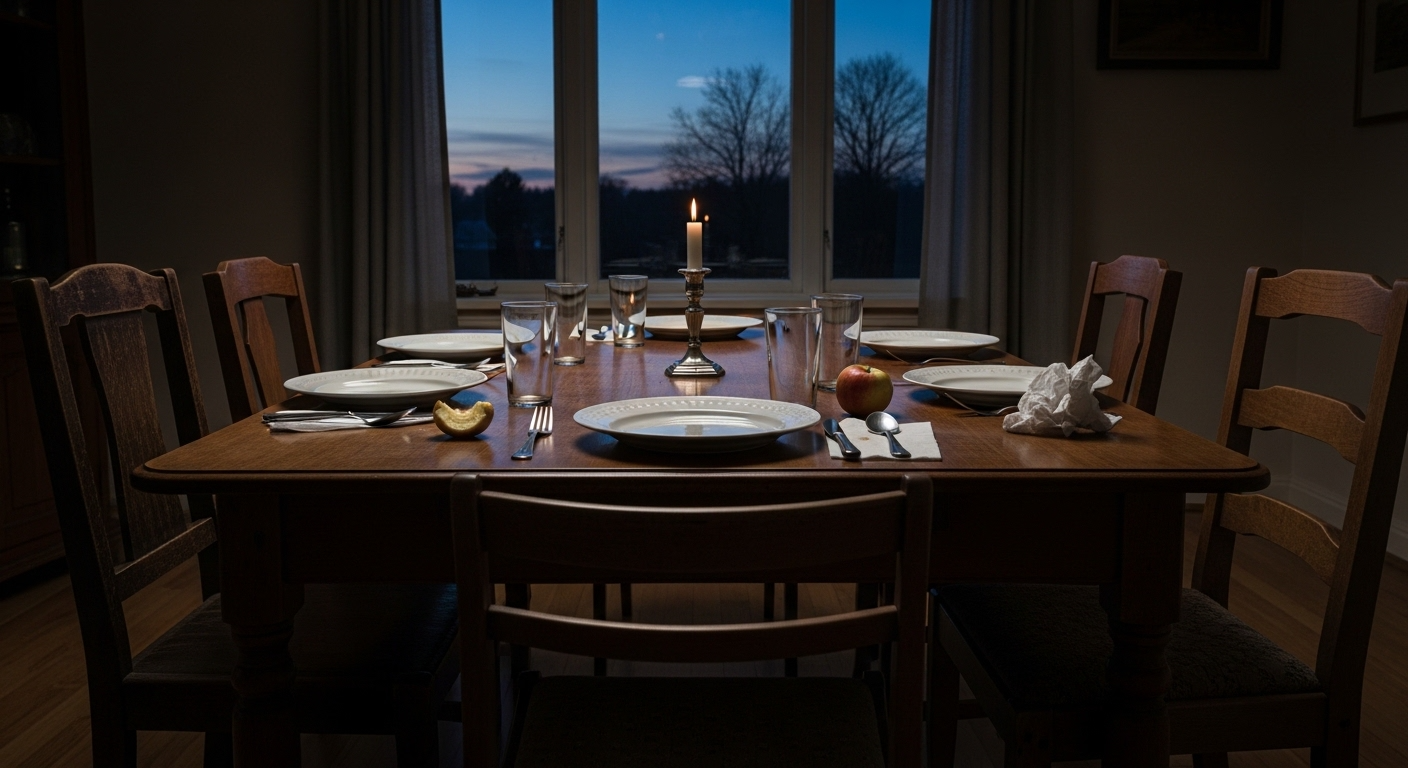
But please hear this. One day those chairs will be empty. One day the house will be quiet in a way it has never been quiet before. And when that day comes, you will not remember what you cooked. You will remember who was there.
You do not have to make it a production. It does not need to be a home-cooked meal from scratch. Pizza works. Cereal works. The food is genuinely beside the point. What matters is that everyone sits down together, at the same time, with nothing else competing for their attention.
Protect that. Even when it is inconvenient. Especially when it is inconvenient.
Because the inconvenience passes and the moment does not come back.
Parting Thoughts
I think about the table from my childhood sometimes. Too small for seven people, always a little crowded, always a little loud. I would give quite a lot to sit there one more time.
You probably have your own version of that table, whether it is from your past or your present. If it is from your present, do not take it for granted. And if it is something you have quietly let slip away, it is not too late to pull the chairs back out and try again. It is never too late for that.
The version of your family that only exists at that table is worth protecting. I know that now in a way I did not know it then. I hope you know it while you still have time to do something about it.
Read More: For more stories about family, life, and the things that matter, written for Australian readers, visit wizemind.com.au