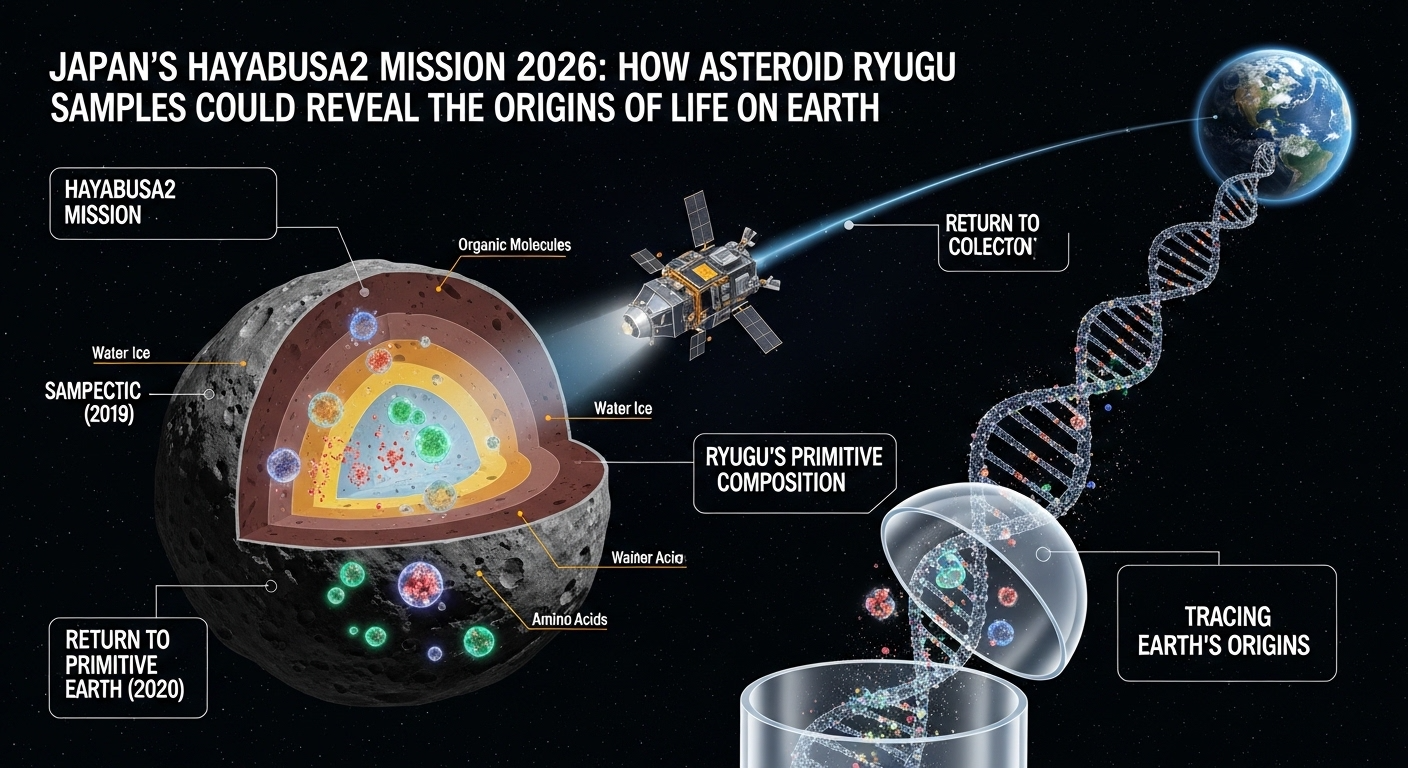
Japan’s Hayabusa2 Mission 2026: How Asteroid Ryugu Samples Could Reveal the Origins of Life on Earth
Somewhere in a Japanese laboratory, scientists are studying a few grams of dark, carbon-rich rock that traveled millions of kilometres to get there. These unassuming pebbles, collected from the surface of an asteroid called Ryugu, may carry answers to one of the oldest questions humanity has ever asked: where did life on Earth actually come from?
The Hayabusa2 mission has delivered something remarkable — and what researchers are finding inside those samples is generating serious excitement across the global scientific community.
What Is the Hayabusa2 Mission?
Hayabusa2 is a Japanese space exploration mission operated by JAXA — the Japan Aerospace Exploration Agency. Over the course of six years, the spacecraft travelled to Ryugu, a near-Earth asteroid approximately 900 meters wide, carefully collected material from its surface, and returned that material safely to Earth.
The mission represents an extraordinary feat of engineering and scientific planning. Navigating to a small, irregularly shaped asteroid, landing on its surface without a traditional touchdown, extracting material without contaminating it, and then delivering that material back across millions of kilometres — every single step presented challenges that had never been fully solved before.
The fact that it worked, and that the samples arrived intact, makes Hayabusa2 one of the most significant space science achievements of recent years.
Why Ryugu? Why an Asteroid?
Ryugu is what scientists classify as a carbonaceous asteroid — a type believed to be among the most primitive objects in the solar system. These asteroids have remained largely unchanged since the solar system formed approximately 4.6 billion years ago. They have not been subjected to the geological processes — volcanism, erosion, plate tectonics — that have continuously altered the surface of Earth and other rocky planets.
In scientific terms, they are time capsules. The material locked inside them preserves a record of the early solar system in a form that simply does not exist anywhere on Earth.
Studying them is as close as we can get to examining the raw ingredients from which the planets — and everything on them — were eventually made.
The Discovery That Changed Everything: Thymine in Space
Among the findings from the Ryugu samples, one stands above the rest in terms of scientific significance: the detection of thymine, one of the four chemical bases that form the building blocks of DNA.
DNA — deoxyribonucleic acid — is the molecule that carries the genetic instructions for all known living organisms. Its four bases (adenine, thymine, guanine, and cytosine) pair together in specific combinations to encode biological information. Without them, life as we understand it cannot exist.
Finding thymine inside a rock that formed in deep space and has never touched Earth raises a profound question: did the raw materials for life arrive here from elsewhere?
Dr. Yuri Motani, a planetary scientist at the University of California, Davis, has described the discovery as a tantalising clue that the building blocks of life may have been more widely distributed across the early solar system than scientists previously assumed. If thymine exists in an asteroid that formed billions of years ago, it may have existed in many such objects — and some of those objects may have collided with early Earth, delivering the chemical ingredients that eventually gave rise to biology.
Asteroids as Delivery Vehicles for Life
The idea that asteroids and comets may have seeded Earth with organic compounds is not new — it is called the panspermia hypothesis in its broader form, and a more specific version focused on chemical delivery rather than living organisms. What makes the Ryugu samples significant is that they provide direct physical evidence supporting this idea in a way that was previously theoretical.
The samples contain not just thymine but a diverse array of organic compounds and inorganic minerals, suggesting that asteroids acted as mixing vessels — gathering, combining, and transporting complex chemistry across the solar system over billions of years.
Dr. Natalie Starkey, a planetary scientist at the Open University in the UK, has described the samples as a window into the early solar system, revealing the complex interplay of processes that shaped how the raw materials for life were distributed. Understanding those processes more precisely could reshape scientific thinking about where life can emerge — and under what conditions.
Keeping the Samples Pure: A Scientific Challenge of Its Own
None of this analysis is straightforward. The quantities involved are almost unimaginably small — just a few grams of material collected from hundreds of millions of kilometres away. Every measurement, every chemical test, and every imaging procedure must extract maximum information from a sample that cannot be replenished.
The greater challenge is contamination. Earth’s surface is saturated with organic compounds — including, of course, all four DNA bases. Any contact between the Ryugu samples and terrestrial material could introduce compounds that did not originate in space, corrupting the data and potentially producing false conclusions.
The Hayabusa2 team addressed this through specialised cleanrooms — sealed, filtered environments where atmospheric particles are reduced to near zero — combined with protective equipment and rigorous decontamination at every stage of handling.
Dr. Toru Nakamura, the lead scientist for the mission, has been clear that maintaining sample integrity is not a secondary concern — it is the foundation on which every conclusion rests. Even a microscopic trace of contamination could compromise findings that the entire mission was designed to produce.
What This Means for the Search for Life Beyond Earth
Perhaps the most consequential implication of the Ryugu findings extends beyond Earth entirely. If the chemical building blocks of life were present in asteroids during the early solar system, and if those asteroids were scattered across many parts of the solar system by gravitational interactions and collisions, then the same delivery process could theoretically have occurred on other worlds.
Mars, in particular, received similar asteroid bombardment during the same period that Earth did. So did the moons of Jupiter and Saturn, some of which are now considered among the most promising locations in the solar system for potential microbial life.
The Ryugu samples do not confirm that life exists elsewhere. But they do strengthen the scientific case that the chemistry necessary for life may be a common feature of the universe rather than an extraordinary accident unique to Earth.
What Comes Next
The analysis of Ryugu samples is still ongoing, and scientists expect it to continue producing new findings for years. Samples have been distributed to research institutions around the world, each applying different analytical techniques to extract different categories of information.
The success of Hayabusa2 has also directly informed planning for future missions. JAXA is already developing Hayabusa2 Extended Mission, targeting a different asteroid. NASA’s OSIRIS-REx mission, which collected samples from the asteroid Bennu, is providing a complementary dataset. Comparing material from multiple asteroids will help scientists distinguish what is unique to Ryugu and what may be universal properties of early solar system chemistry.
Dr. Hiroshi Yano of JAXA has noted that Hayabusa2 demonstrated the technical feasibility of the entire sample-return approach — proving that interplanetary travel, surface sampling, and safe return are all achievable at a level of precision sufficient for scientific purposes. That demonstration opens the door to significantly more ambitious missions in the decades ahead.
FAQs
Q: What is asteroid Ryugu and why was it chosen? A: Ryugu is a 900-metre carbonaceous near-Earth asteroid chosen because its primitive composition preserves early solar system material largely unchanged over billions of years.
Q: What is thymine and why does finding it in space matter? A: Thymine is one of the four chemical bases that make up DNA. Finding it in an asteroid suggests the building blocks of life may have been present in space before life existed on Earth.
Q: How much material did Hayabusa2 collect? A: Just a few grams — an extraordinarily small quantity that required highly specialised analytical techniques to study without exhausting the supply.
Q: Does this prove life exists elsewhere in the universe? A: No — it shows that the chemical precursors to life exist in space, which strengthens the case that life-supporting chemistry may be common, but it does not confirm extraterrestrial life.
Q: How do scientists prevent contamination of the samples? A: Through specialised cleanrooms, protective handling equipment, and rigorous decontamination protocols at every stage of sample processing and analysis.
Q: What missions are continuing this research? A: JAXA’s Hayabusa2 Extended Mission and NASA’s OSIRIS-REx, which collected samples from asteroid Bennu, are both continuing to build on this area of research.
This article is for general informational purposes only and is based on publicly available scientific reporting and space agency communications.