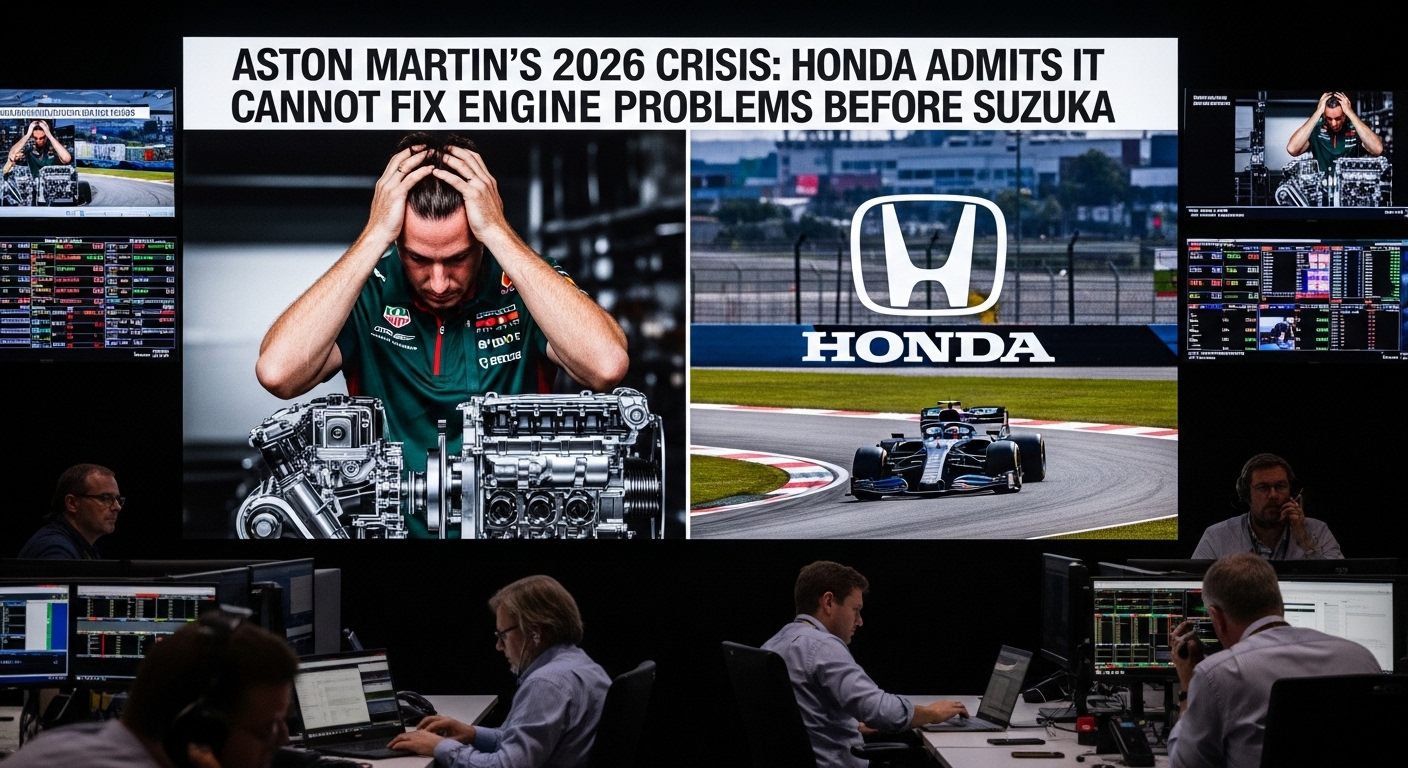
Aston Martin’s 2026 Crisis: Honda Admits It Cannot Fix Engine Problems Before Suzuka
Formula 1 moves at a pace that leaves little room for technical problems to linger. But right now, Aston Martin is dealing with exactly that — a persistent, performance-killing engine issue that Honda has openly admitted cannot be resolved before the Japanese Grand Prix at Suzuka. For a team that entered 2026 with genuine championship ambitions, the timing could hardly be worse.
What Honda Actually Admitted
The admission came as a shock to the paddock. Honda, Aston Martin’s exclusive power unit supplier, confirmed that the vibration and performance issues affecting the AMR26 are too complex to fix within the timeframe available before Suzuka.
This is not a minor setup problem or a tuning adjustment. The issue runs deeper — an engine-related vibration that is disrupting the car’s handling at a fundamental level, making it difficult for Fernando Alonso and Lance Stroll to push the car anywhere near its designed performance envelope.
Honda’s engineers have been working on the problem since it became apparent, but the technical complexity involved means a quick fix is simply not available. The team is heading to one of the most demanding circuits on the calendar with a known, unresolved problem and no clear solution date.
How the Crisis Developed
The problems first surfaced in a serious way at the Australian Grand Prix, where the car’s performance fell significantly short of expectations. The sprint format at the Chinese Grand Prix gave the team almost no time to diagnose and address the issues between sessions, compressing what was already a tight window into something unworkable.
The core of the technical problem lies in the integration between the Honda power unit and the AMR26 chassis. Modern Formula 1 cars are designed as a single integrated system — the engine, gearbox, suspension, and aerodynamic package all tuned to work together within extremely tight tolerances. When the power unit introduces vibrations outside the parameters the chassis was designed around, the effects cascade through every aspect of the car’s behaviour.
Every corner entry, every braking zone, every high-speed section becomes harder to manage when the platform beneath the driver is not stable. It is not simply a matter of the drivers adapting — the issue is physical and mechanical, not a matter of technique.
What This Means for Alonso and Stroll
For Fernando Alonso, now in the later stages of one of motorsport’s most decorated careers, the situation is deeply frustrating. Alonso has spent decades making the most of machinery that is not always at the front of the grid. But even his extraordinary ability to extract performance from a difficult car has limits when the fundamental platform is compromised.
Lance Stroll faces his own pressure. Driving for a team part-owned by his father, Stroll is under consistent scrutiny to deliver results. An unreliable, vibration-affected car makes that task considerably harder and provides an easy external explanation for results that fall below expectations — though that cuts both ways in terms of public perception.
Both drivers face the prospect of arriving at Suzuka — a circuit that demands absolute precision and confidence through its high-speed corners — knowing their car has an unresolved mechanical problem that Honda cannot yet fix.
The Broader Partnership Under Pressure
The Aston Martin and Honda partnership was built on mutual ambition. Honda returned to Formula 1 as an engine supplier with stated goals of reaching the front of the grid. Aston Martin positioned itself as the team that would help deliver that. Both parties have invested significantly in making the collaboration work.
Public admissions of this kind — that a technical problem cannot be fixed in time for an upcoming race — are rare and significant. They signal that the issue is genuinely serious, that internal efforts to contain the situation have not been sufficient, and that the partnership is under real strain.
The question now being asked quietly in the paddock is whether this is a short-term technical problem with a defined solution path, or the beginning of a more fundamental crisis of confidence between the two organisations.
The Scenarios Ahead
Several paths forward are being discussed, each with different implications:
In the short term, the team may be forced to compromise the car’s setup in ways that reduce the vibration at the cost of outright performance — essentially managing the problem rather than solving it, and accepting slower lap times as a consequence.
In the medium term, Honda’s engineers need to identify and implement a genuine fix. Whether that comes as a hardware update, a software change to engine mapping, or a combination of both will determine how quickly the car can return to its potential performance level.
In the longer term, if the issues persist without resolution, questions about the future direction of the partnership become unavoidable. Formula 1 is a results business. Sponsors, investors, and drivers all make decisions based on competitive trajectory — and a team visibly struggling with an unresolved technical partnership problem faces pressure from every direction.
What the Experts Are Saying
Motorsport engineers who have studied the situation point to a structural challenge that goes beyond this specific incident. The increasing complexity of modern Formula 1 power units — with their hybrid energy recovery systems, intricate thermal management requirements, and tight integration demands — makes seamless chassis-engine compatibility harder to achieve and harder to fix when something goes wrong.
The view from experienced F1 journalists covering the team is consistent: Aston Martin cannot afford to let this situation drift. The championship is not won or lost at any single race, but credibility and momentum are fragile things in Formula 1. A team that appears to be managing a crisis rather than solving it loses ground not just on the timing sheets but in the broader battle for talent, sponsorship, and driver confidence.
FAQs
Q: What is the specific technical problem affecting Aston Martin? A: A vibration originating from the Honda power unit that disrupts the car’s handling and prevents drivers from pushing to the car’s performance limits.
Q: Why can’t Honda fix it before Suzuka? A: The complexity of the chassis-engine integration means a proper fix requires more time than the gap between races allows — it is not a simple adjustment.
Q: How does this affect the championship standings? A: Every race where the car is compromised is points lost that cannot be recovered — in a tight championship, that damage compounds quickly.
Q: Could Aston Martin change engine suppliers? A: Not immediately — engine supply agreements in Formula 1 are long-term commitments, and switching mid-season is not a realistic option.
Q: Is Fernando Alonso considering his future at the team? A: No public statements have been made, but drivers of Alonso’s calibre always assess their competitive options — sustained underperformance due to technical issues would inevitably factor into any future decision.
Q: What is Suzuka’s significance in the championship? A: Suzuka is one of Formula 1’s most technically demanding circuits and a Honda home race — performing poorly there carries both sporting and symbolic weight for the partnership.
This article is for general informational purposes only and is based on publicly available Formula 1 reporting and paddock analysis as of March 27, 2026.