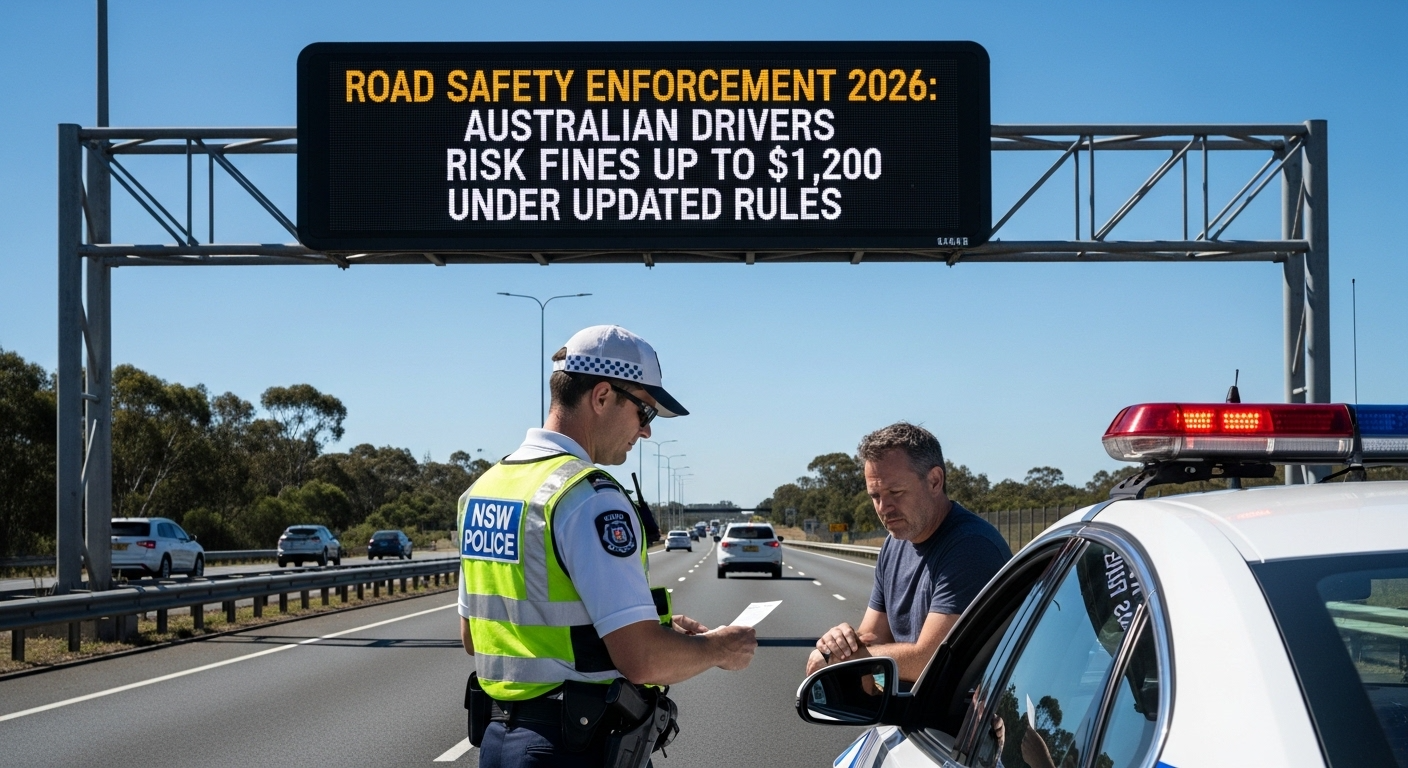
Road Safety Enforcement 2026: Australian Drivers Risk Fines Up to $1,200 Under Updated Rules
A common driving mistake is costing thousands of Australian motorists up to $1,200 in fines every year, and many do not realise they have broken the law until the penalty notice arrives in the mail. The enforcement crackdown is intensifying in 2026, and the technology catching drivers has become far more sophisticated than most people realise.
Illegal mobile phone use while driving is the single most frequent trigger for these fines. The rules are stricter than most drivers assume, and the detection methods have expanded well beyond police officers watching intersections.
What Counts as Illegal Phone Use
Many drivers believe being stopped at traffic lights makes phone use acceptable. It does not. The law applies whether the vehicle is moving or stationary in traffic across most Australian jurisdictions.
The following actions are commonly triggering fines despite drivers believing they fall within acceptable use. Touching or holding a phone at traffic lights, picking up a device to check notifications, using a phone that is not properly mounted, scrolling or selecting music while stopped, and holding a phone during stop-start traffic are all violations under current rules.
Why Fines Have Increased to $1,200
Road safety authorities have deliberately increased penalties to reflect the severity of risk that distracted driving creates. Mobile phone use behind the wheel remains one of the leading causes of accidents in urban areas across Australia.
Recent enforcement changes include expanded use of automated detection cameras, higher penalties for repeat offenders, increased demerit points in several states, and stronger distracted driving campaigns. The combination of higher fines and automated detection has made enforcement far more consistent and unavoidable than in previous years.
How Automated Detection Cameras Work
Many drivers assume fines only come from police officers observing them directly. That assumption is increasingly incorrect. Automated mobile phone detection cameras are now deployed widely across the road network.
These cameras can detect phones held in the driver’s lap, devices briefly raised to eye level, phone use at intersections during stop-start traffic, and actions that are completely invisible to other nearby drivers. Fines are frequently issued days or weeks after the violation, which is why so many drivers are caught off guard when the notice arrives.
Fine and Penalty Comparison by Behaviour
| Behaviour | Fine Range | Demerit Points | Additional Risk |
|---|---|---|---|
| Holding phone while driving | Up to $1,200 | Yes, varies by state | Licence suspension for repeat offenders |
| Touching phone at traffic lights | Up to $1,200 | Yes | Insurance premium increase |
| Unsecured phone use | Up to $1,200 | Yes | Employment risk for professional drivers |
| Learner or P-plate phone use | Stricter thresholds | Higher penalties apply | Zero tolerance in most states |
| Repeat offences | Maximum penalties | Accelerated demerit accumulation | Licence suspension risk |
The financial and licence consequences compound quickly for drivers who receive multiple fines or who are close to their demerit point threshold when a penalty is issued.
Real Experiences From Australian Drivers
Sydney delivery driver Michael was fined over $1,000 for briefly touching his phone while stationary at a red light. He had assumed being stopped made the action permissible. The fine arrived without warning several days after the incident and was captured by a detection camera he had not noticed.
An Adelaide commuter faced a fine that nearly cost her licence after what she describes as a single simple mistake. She had not appreciated how strictly the zero-tolerance rules applied to her situation or that automated cameras would capture the moment with the same consequence as being directly observed by police.
Read More: https://wizemind.com.au/
What the Law Actually Permits
Phone use while driving is not entirely prohibited, but the conditions under which it is permitted are far more restrictive than most drivers appreciate. Across most Australian states and territories, phone use is only lawful if the device is secured in an approved cradle or mount, the driver does not physically touch the phone during use, voice control is utilised where permitted, and the device does not obstruct the driver’s sightlines.
Learner drivers and provisional licence holders face even stricter conditions in most jurisdictions, with zero-tolerance rules applying regardless of whether the phone is mounted or voice-controlled. Professional drivers whose licence is tied to their employment face the additional risk of job loss alongside the financial penalties.
The Demerit Points Consequence
Financial penalties are only part of the risk for drivers caught using phones illegally. Demerit points attached to mobile phone offences can push drivers who are already carrying points toward licence suspension territory with a single violation.
Drivers close to their demerit threshold face a compounded risk when caught in a phone use violation. The fine itself may be manageable, but the demerit points added at the same time can trigger a suspension that disrupts employment, family logistics, and daily independence far more severely than the dollar amount of the fine alone.
Why Authorities Say These Penalties Are Necessary
A road safety spokesperson described the laws as being about saving lives, not raising revenue. Distracted driving from mobile phone use impairs reaction times, reduces situational awareness, and increases both the frequency and severity of accidents in ways that research has shown are comparable to drink driving.
The expansion of automated detection is explicitly designed to make enforcement consistent and unavoidable rather than dependent on police presence at specific locations. The goal is behaviour change at scale, and the combination of high fines, demerit points, and camera coverage is the mechanism for achieving it.
How to Protect Yourself From an Unexpected Fine
The most effective protection is eliminating phone contact entirely before the vehicle moves. Setting navigation, selecting music, and configuring any required apps or notifications before starting the engine removes the temptation and the risk simultaneously.
If phone use becomes genuinely necessary during a journey, pulling over completely to a safe location and stopping the engine before touching the device is the only approach that does not risk a fine. No phone call, message, or notification is worth $1,200 and potential demerit points.
Practical Steps Every Driver Should Take
- Set navigation, music, and any required apps before starting the engine and moving off.
- If your phone needs to be accessible for navigation, place it in an approved and properly secured mount before driving.
- Enable voice control features so audio responses do not require physical phone contact during the journey.
- Switch your phone to Do Not Disturb while driving mode to eliminate the impulse to respond to notifications.
- If an urgent call or message genuinely requires attention, pull over completely to a safe location before touching your device.
Building these habits before they are needed eliminates the circumstances that lead to impulsive phone contact during driving and removes the risk entirely.
Frequently Asked Questions
Can I be fined for touching my phone at a red light when the car is not moving? Yes. The law applies regardless of whether the vehicle is stationary or moving in most Australian states. Being stopped at traffic lights does not create an exception to mobile phone rules and is one of the most commonly misunderstood aspects of the legislation.
How do automated detection cameras actually identify phone use? Artificial intelligence analyses images captured by roadside cameras to identify phones being held or touched by drivers. The technology can detect devices held below the dashboard, briefly raised to eye level, and used at intersections. Detection is automated and does not require a police officer to be present.
How long after the violation does a fine typically arrive? Fines from automated camera detection can arrive days or weeks after the incident. The delayed arrival is one of the reasons so many drivers are surprised by penalty notices, particularly if the original moment of violation was brief and they had not registered it as a potential offence at the time.
What is the maximum fine for mobile phone use while driving? Up to $1,200 depending on the state or territory and the specific circumstances of the offence. Repeat offenders and learner or provisional drivers may face the higher end of the penalty range along with increased demerit points.
Do demerit points apply to phone use fines? Yes, demerit points are applied in addition to the financial penalty in most jurisdictions. The number of points varies by state. Drivers already carrying points from previous offences face licence suspension risk from a single phone use violation.
Is hands-free phone use always legal? Not for all licence categories. Learner drivers and most provisional licence holders face zero-tolerance rules that prohibit even hands-free phone use in many states. Fully licenced drivers can use hands-free provided the phone is properly mounted and not physically touched during the call.
Can professional drivers lose their jobs over a phone fine? Yes. Commercial drivers, truck drivers, and others whose employment depends on holding a valid licence face employment consequences if accumulated demerit points from a phone fine trigger a suspension. The professional stakes of a mobile phone violation extend well beyond the financial penalty for this group.
What happens if I receive multiple phone use fines? Repeat offenders face higher penalties, accelerated demerit point accumulation, and in some states specific repeat offender provisions that can lead to licence suspension more quickly than the standard demerit threshold would suggest. Each subsequent offence within a defined period typically attracts the maximum available penalty.
Can I challenge a fine if I believe the camera detection was incorrect? Yes. Every infringement notice includes a process for requesting a review or lodging a formal challenge. Providing evidence that contradicts the detection, such as phone records showing no activity at the relevant time, is the strongest basis for a successful challenge.
Does phone use while driving affect car insurance? Yes, over time. A conviction for mobile phone use while driving can be considered a traffic offence that affects your insurance premium at renewal. Repeat convictions or licence suspension resulting from accumulated demerit points will have a more significant impact on insurance costs.
Key Points
- Fines of up to $1,200 apply for mobile phone use while driving regardless of whether the vehicle is moving or stationary at traffic lights, across most Australian states and territories.
- Automated detection cameras now catch violations that no police officer would observe, with fines arriving days or weeks after the incident and covering phone contact that lasted only seconds.
- Demerit points compound the financial penalty, and drivers close to their threshold face licence suspension risk from a single phone use violation on top of the dollar amount of the fine.
- Setting up navigation, music, and notifications before moving eliminates the circumstances that lead to impulsive phone contact during driving and removes the risk entirely with minimal inconvenience.
Conclusion
The $1,200 fine for mobile phone use while driving is not a theoretical maximum reserved for egregious behaviour. It is the real-world consequence that thousands of Australian drivers are experiencing after brief, often instinctive phone contact that they did not consider a serious violation at the time.
Automated camera technology has removed the luck element from enforcement. Drivers can no longer rely on not being watched. The cameras are watching continuously, and the technology for identifying phone contact in a moving or stationary vehicle is sophisticated and accurate.
The practical solution is simple even if the habit change takes conscious effort. Prepare everything before the car moves. Mount the phone if it is needed for navigation. Pull over if something urgent genuinely requires attention. The $1,200 fine and the demerit points that come with it are a cost that no phone interaction during a journey is worth.
Read more: https://wizemind.com.au/