The Longest Solar Eclipse of the Century: Date Confirmed and Everything You Need to Know
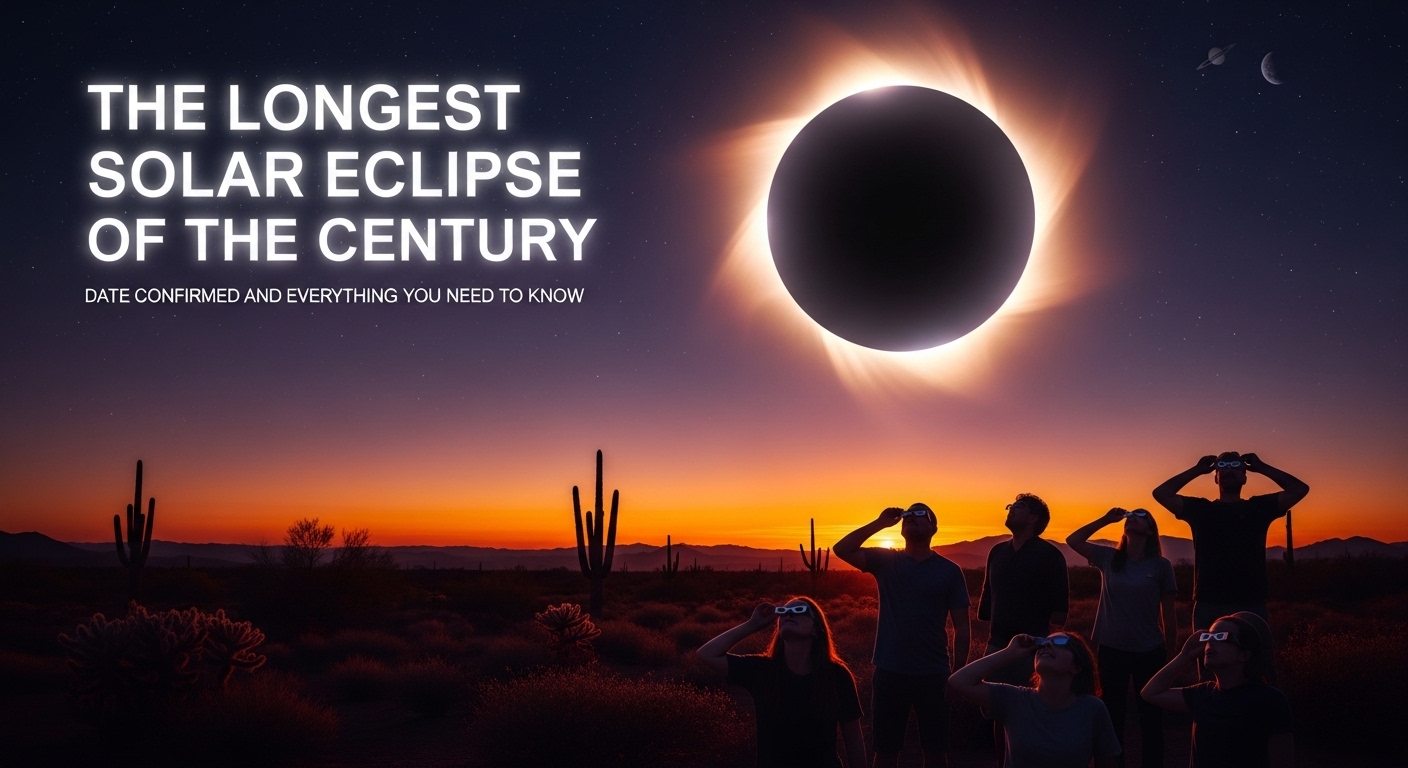
Astronomers around the world have confirmed the date of the longest solar eclipse of the 21st century, and the anticipation building among sky-watchers, scientists, and casual observers alike is entirely justified. This is not an ordinary eclipse. The duration of totality, the period during which the Moon completely blocks the Sun, will be the longest recorded in over a hundred years, making it a genuinely rare event that most people alive today will not see repeated in their lifetime.
For those fortunate enough to be positioned beneath the path of totality when it passes, the experience will be unlike anything else the natural world offers. Day will turn to night. The temperature will drop noticeably. Stars will appear in a midday sky. And around the black disc of the Moon, the Sun’s corona will become visible to the naked eye in all its pale and extraordinary detail.
What Makes This Eclipse Different
Solar eclipses occur somewhere on Earth roughly every eighteen months, so the event itself is not unusual. What makes this particular eclipse exceptional is the combination of the Moon’s position in its orbit and Earth’s position around the Sun at the same moment.
The Moon’s orbit around Earth is not a perfect circle. At certain points it sits closer to us, appearing larger in the sky, and at others it sits further away, appearing smaller. For a total solar eclipse to occur at all, the Moon must appear large enough to completely cover the Sun’s disc. For that totality to be extended rather than brief, the Moon needs to be near the closest point of its orbit, maximising the size of its shadow cast across the Earth’s surface.
When these orbital mechanics align favourably, the shadow moves more slowly across the surface and totality at any given location lasts longer. At the peak of this eclipse, observers along the central line of the path of totality will experience up to six to seven minutes of complete darkness at midday, a duration that is extraordinary by any historical measure.
The Path of Totality
The path of totality is the narrow corridor across the Earth’s surface where the Moon’s shadow falls completely. Outside this corridor, observers will see a partial eclipse, where the Moon covers only a portion of the Sun’s disc. Inside it, they will experience totality.
The path stretches across multiple regions and continents, and its precise track has been mapped by astronomers to an accuracy of metres. For anyone serious about experiencing totality rather than a partial eclipse, positioning matters enormously. A location just a short distance outside the central corridor can be the difference between watching the corona appear and simply observing a dramatic partial covering.
For Australians planning to travel for the eclipse, checking detailed path maps from reputable astronomical sources before booking is essential. The difference between a location inside the path and one just outside it can be invisible on a rough map but decisive in the actual experience.
What You Will Actually See and Feel
People who have witnessed a total solar eclipse consistently describe it as one of the most affecting natural experiences of their lives. Reading about it does not fully prepare you for the sensory reality of it.
In the minutes before totality, the light begins to change in a way that has no everyday equivalent. It dims gradually at first, then more rapidly, taking on a strange metallic quality that makes familiar landscapes look subtly wrong. Shadows sharpen unnaturally. The temperature drops, sometimes by several degrees within minutes, as the Sun’s warming energy is suddenly cut off.
As totality approaches, the remaining sliver of Sun narrows to a thin crescent and then, in the last seconds, light seems to collapse from the horizon in all directions simultaneously. The sky shifts to a deep twilight blue rather than the complete black of night. Planets and bright stars become visible. Birds stop singing. Insects begin their evening chorus, confused by the sudden onset of what their biology tells them is dusk.
And then the corona appears. The Sun’s outer atmosphere, normally invisible behind the overwhelming brightness of the solar disc, extends outward in pale, structured plumes that look nothing like any photograph can capture. It is the most dramatic visual evidence most people will ever see of the fact that we orbit a star.
When totality ends, the light returns with extraordinary speed, and the temperature begins climbing again almost immediately.
The Scientific Opportunity
Beyond the spectacle, this eclipse represents a significant research opportunity. The corona, which becomes visible during totality, is one of the least understood regions of the Sun despite being directly observable during eclipses. Its temperature is paradoxically far higher than the solar surface beneath it, a phenomenon that has not been fully explained, and it is the origin of the solar wind that flows throughout the solar system.
During the extended totality of this eclipse, research teams from multiple countries will deploy instruments designed to study the corona’s structure, temperature variations, and magnetic field configurations with greater precision than most previous eclipses have permitted. The additional minutes of totality compared to more typical eclipses translate directly into more data and more opportunity to capture rare phenomena.
Beyond solar science, researchers will also study Earth’s atmospheric response to the sudden reduction in solar energy, tracking temperature changes, wind pattern shifts, and pressure variations that occur during the shadow passage. Citizen science programmes are also being organised in many countries, allowing interested members of the public to contribute structured observations that complement the work of professional research teams.
Viewing Safely
The rules around eclipse safety are simple but non-negotiable. Looking directly at the Sun without proper protection will cause permanent eye damage, and the partial phases of an eclipse, before and after totality, require the same protection as looking at the full Sun on any normal day.
Certified eclipse glasses with ISO 12312-2 certification are the standard recommended protection for direct viewing during partial phases. Standard sunglasses, no matter how dark, do not provide adequate protection. Camera lenses, telescopes, and binoculars all require specific solar filters attached before the eyepiece, not between the eye and the eyepiece.
The only period when it is safe to look without eclipse glasses is during complete totality, when the Sun’s disc is entirely covered. The moment the first sliver of Sun reappears, protection must go back on immediately.
For those without eclipse glasses, a pinhole projector made from a piece of cardboard with a small hole punched through it projects an image of the Sun onto a surface below and safely shows the eclipse’s progress throughout all phases. Under trees with gaps in the canopy, natural pinhole effects create dozens of crescent-shaped shadows on the ground during the partial phases, which is one of the subtler but most beautiful aspects of the event.
Planning Your Eclipse Experience
Given the rarity and duration of this eclipse, the demand for locations along the path of totality has been intense. Accommodation in prime viewing areas has been filling quickly, and travel packages specifically designed around eclipse viewing have been offered by a growing number of Australian and international tour operators.
For those who cannot travel to the path of totality, the partial eclipse will still be visible across a much wider area and will provide a genuinely striking sky event even without the full experience of totality. Live streams from multiple vantage points along the central path will also be available for those watching from home.
Key preparation steps for eclipse day:
- Confirm whether your viewing location is inside the path of totality or in the partial zone, using detailed astronomical maps
- Source certified ISO-compliant eclipse glasses well in advance, as they tend to sell out as the date approaches
- Check long-range weather forecasts for your chosen location and have a contingency plan if cloud cover is likely
- Arrive at your viewing location early, particularly if you are travelling to a prime site along the path where crowds will be significant
- Set your navigation and travel plans in advance, as roads in eclipse corridor regions can become congested on the day
- Consider bringing a notebook or journal to record your impressions during the event, as many observers find that writing helps them process an experience that is difficult to fully absorb in the moment
After the Shadow Passes
When the Moon’s shadow moves on and the Sun reasserts itself in a normal blue sky, the world returns to its ordinary rhythms with unexpected speed. But something in the people who witnessed it shifts in a way that is harder to describe and longer-lasting than the event itself.
Total solar eclipses have been recorded throughout human history as moments that altered perspective, challenged assumptions, and reminded observers of the scale and mechanics of the solar system they inhabit. The science has changed beyond recognition since those early accounts, but the essential emotional experience appears to have remained consistent across cultures and centuries.
Prepare practically. Protect your eyes. Find a clear horizon if you can. And when the light changes in that particular way that has no equivalent in ordinary life, give yourself permission to simply watch without trying to manage every second of it.
This century will not offer another eclipse quite like this one. That alone makes it worth the planning.
Frequently Asked Questions
When exactly will the eclipse occur? The date has been confirmed by astronomical authorities. Check the current eclipse date through timeanddate.com or your national astronomical society for the precise timing in your time zone.
Will the eclipse be visible from Australia? Visibility depends on the path of totality and partial eclipse zones. Check detailed eclipse maps for your specific location to determine what you will be able to observe.
How long will totality last? At the peak of the path, totality will last up to six to seven minutes, making it the longest of the 21st century. Duration varies along the path.
Is it safe to look at a partial eclipse without glasses? No. Eclipse glasses are required during all partial phases. They can be removed only during complete totality.
Can I photograph the eclipse on my phone? A phone camera pointed at the partial Sun without a solar filter can be damaged by the exposure. During totality, phones can be used freely for the brief window it lasts.
How do I find my nearest viewing location on the totality path? Use the eclipse maps provided by NASA, the International Astronomical Union, or your national astronomical society for precise path information.
Will cloud cover ruin the experience? Heavy cloud obscures the visual spectacle but totality can still be felt through temperature drop and the sudden dimming of the sky. Clear skies are strongly preferable.
Will this eclipse be live-streamed? Yes. Multiple scientific organisations and broadcasters will stream the eclipse from various points along the path of totality.
Read More: For more science, astronomy, and natural world stories written for Australian readers, visit wizemind.com.au